Cricket is one of the easiest darts games to enjoy at home once the scoreboard makes sense. Once you know how to score Cricket darts on a home scoreboard, the game becomes quicker, cleaner and far less likely to turn into a debate after every visit.
The aim is not just to hit big numbers. You are trying to close specific targets, score points only when the rules allow it, and keep both players’ progress visible at a glance.
At a glance
- Standard Cricket uses 20, 19, 18, 17, 16, 15 and the bull.
- Each target needs three marks to be closed by a player or team.
- A single counts as one mark, a double as two marks and a treble as three marks.
- You only score points on a target you have closed if your opponent has not closed it.
- The winner is the player or team that closes every target and is level or ahead on points.
Set up the scoreboard before the first dart
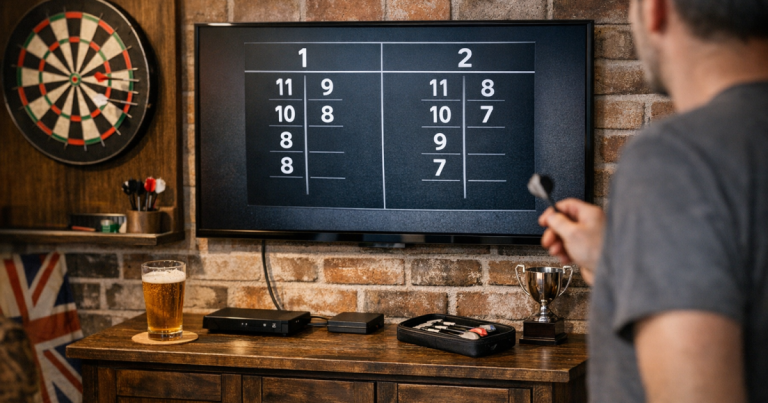
A clear Cricket scoreboard is usually split into three working areas: one column for the first player or team, one centre list of targets, and one column for the second player or team. Write the targets down the middle in this order: 20, 19, 18, 17, 16, 15 and B for bull.
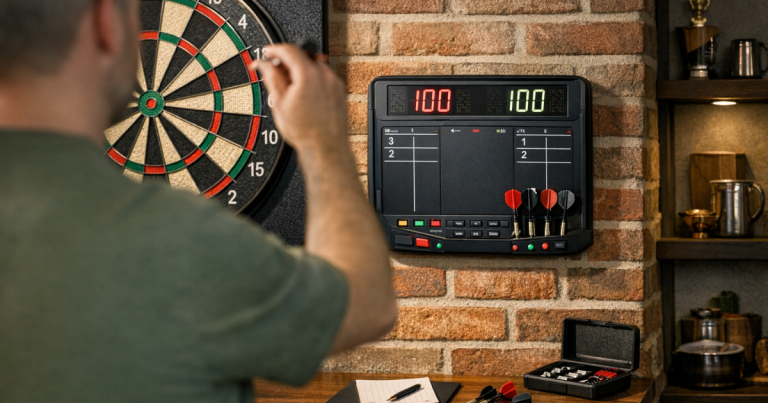
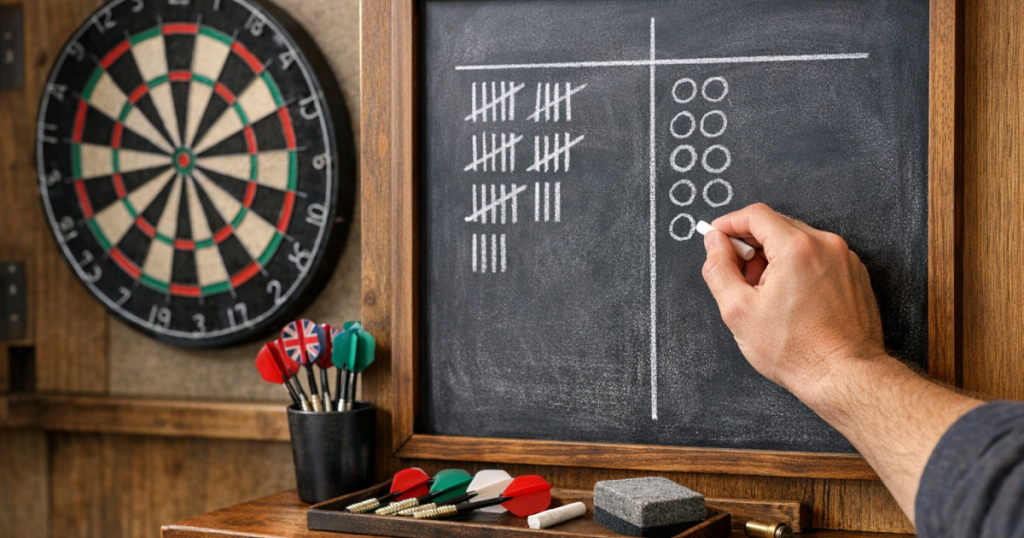
At home, a dry-wipe board, chalkboard or printed score sheet can all work well. The important part is consistency. Leave enough space beside each number for three marks, plus a separate area at the top or bottom for total points. If your board is small, use initials rather than full names so the score does not become cramped halfway through the leg.
Place the scoreboard where the thrower and scorer can see it without standing in the throwing lane. If you play in a rented flat or a shared living room, lighting can matter as much as board size; a clear score is easier to maintain when the dartboard and scoreboard are evenly lit. For low-disruption lighting ideas, see no-drill dartboard lighting for rented homes.
The mark system: slashes, crosses and circles
Cricket scoring is easiest when everyone uses the same symbols. The traditional system is simple:
- First mark: write a slash, usually /
- Second mark: turn it into an X
- Third mark: circle the X, or write a clear close symbol
If you prefer, you can use tally marks or write 1, 2 and 3 instead. That is fine for home play, provided everyone agrees before starting. The point is not to copy a pub scoreboard perfectly; it is to make the state of the leg instantly readable.
Singles, doubles and trebles all affect the mark count. A single 18 gives one mark on 18. A double 18 gives two marks. A treble 18 gives all three marks and closes 18 in one dart. The same principle applies across 20 down to 15.
How points work after a number is closed
The scoring part is where most home Cricket mistakes happen. Closing a number does not automatically give points. Points are only added when one side has closed a target and the other side has not.
For example, if you have closed 20 and your opponent still has only one mark on 20, any further 20s you hit score points. A single 20 scores 20, a double 20 scores 40 and a treble 20 scores 60. If your opponent later closes 20 as well, neither player can score on 20 for the rest of the leg.
Extra marks on the same dart can also score. Suppose you already have two marks on 18 and your opponent has none. If you hit treble 18, the first mark closes 18 for you and the two remaining marks score 36 points. That is because the opponent has not closed 18 yet.
The bull is handled in the same spirit. The outer bull usually counts as one bull mark and 25 points when scoring is open. The inner bull usually counts as two bull marks and 50 points when scoring is open. Agree this before you begin, especially if you are playing with newer players.
A simple turn-by-turn example
Here is a home scoreboard example using two players, Amy and Ben.
Visit one
- Amy hits treble 20, single 19 and misses the third dart.
- On the scoreboard, Amy closes 20 with a circled X and gets one mark on 19.
- No points are added because she has not hit any extra scoring darts on a target Ben has left open.
Visit two
- Ben hits single 20, treble 19 and single 18.
- Ben gets one mark on 20, closes 19, and gets one mark on 18.
- No points are added yet.
Visit three
- Amy hits double 20, single 19 and single 18.
- Because Amy has already closed 20 and Ben has not, the double 20 scores 40 points for Amy.
- Amy’s single 19 gives her a second mark on 19, but no points, because she has not closed it.
- Amy’s single 18 gives her one mark on 18.
After three visits, Amy leads on points because she used a closed number while Ben had left it open. That is the heart of Cricket: closing targets matters, but pressure often comes from scoring on numbers your opponent has not dealt with yet.
Step-by-step method for scoring at home
1. Write the player names and targets
Put one name or team on each side of the scoreboard. List 20 to 15 and bull down the centre. Keep a separate total points area for each side.
2. Mark every dart as it lands
After each visit, update the marks for the targets hit. Do not wait until several turns have passed. Cricket becomes confusing quickly if you try to reconstruct three or four visits from memory.
3. Close targets before adding points
Check whether the player has three marks on that number. If not, add marks only. If the player has already closed the number, or closes it with spare marks remaining, check whether the opponent has closed it too.
4. Add points only if the opponent is still open
If the opponent has not closed that target, add the value of the scoring marks to the player’s points total. If the opponent has closed it, no points are available on that number.
5. Check the win condition
A player wins only when they have closed 20, 19, 18, 17, 16, 15 and bull, and their score is equal to or higher than the opponent’s. If they have closed everything but trail on points, play continues until they overtake or the other player closes out with the lead.
Keeping the scoreboard readable in a home setup
Home darts spaces are often tighter than pub or club setups. The scoreboard might be squeezed beside a cabinet, near a bookcase or across the room from the oche. That makes clarity more important, not less.
- Use one scoring style throughout the leg; do not mix tally marks and traditional symbols.
- Write large enough that the thrower can read the board from the oche.
- Keep totals away from the mark columns so points are not mistaken for target marks.
- Erase fully between legs, especially on dry-wipe boards that leave faint marks.
- Have a spare pen or chalk nearby so the game does not pause unnecessarily.
If your scoreboard sits near sofas, tables or a temporary mat, make sure the scoring position does not pull people across the throw line. The same thinking used to plan a comfortable oche applies here, and planning a darts mat zone around everyday furniture can help you avoid awkward movement around the setup.
Common scoring mistakes to avoid
- Adding points before a target is closed: two marks on 20 are not enough to score.
- Forgetting that both players can close the same target: once both sides have closed 17, 17 is dead for scoring.
- Missing spare marks on a treble: if one mark closes the number and the opponent is still open, the remaining marks can score.
- Confusing bull marks and bull points: agree whether you are using standard outer and inner bull values before the leg starts.
- Ending the game too early: a player must be closed out and level or ahead on points.
Scoring Cricket with pairs or small groups
For pairs, treat each pair as one side of the scoreboard. Both players on a team contribute to the same marks and points total. This keeps the board readable and avoids four separate columns competing for space.
Decide the throwing order before the first visit and keep it consistent. If you already play doubles legs at home, the habits are similar: clear team labels, regular point checks and one person taking responsibility for updating the board. For more on tidy team scoring, use the same principles from scoring doubles matches clearly on a darts scoreboard.
With three or more individual players, Cricket can still work, but the scoreboard becomes busier. A simple home solution is to play in teams, rotate partners between legs, or use a larger board with one clear column per player.
Things readers ask
Do you have to score points in Cricket darts?
No, not always. Some casual players use cut-throat or no-points variations, but standard Cricket includes points when one player has closed a target and the other has not.
Can you win if you close all numbers but have fewer points?
No. You must close every target and be level or ahead on points. If you are behind, you need to score on any open target before the leg can finish.
What does a treble count as in Cricket?
A treble counts as three marks. If it lands on a target where you already have marks, any spare marks after closing can score if your opponent has not closed that target.
How should beginners mark the bull?
Use B on the scoreboard. Mark an outer bull as one bull mark and an inner bull as two bull marks, unless everyone agrees a different house rule before play.
Is a chalkboard or whiteboard easier for Cricket?
Either works. Whiteboards are quick to erase, while chalkboards can be easier to read under some lighting. The clearer option in your room is the better one.
Final thoughts
The easiest way to score Cricket darts at home is to keep the board simple: targets down the middle, one column per side, three clear marks per target and points added only when a closed number is still open for the opponent. Once that rhythm clicks, Cricket becomes a brilliant home game because every visit creates a decision: close, score, or block the other player’s route back into the leg.