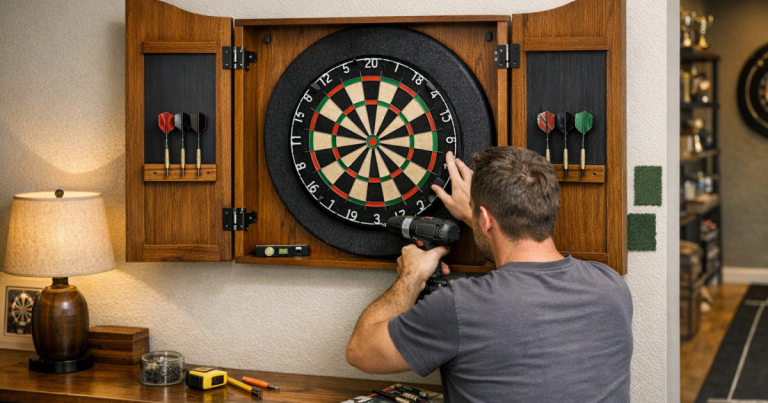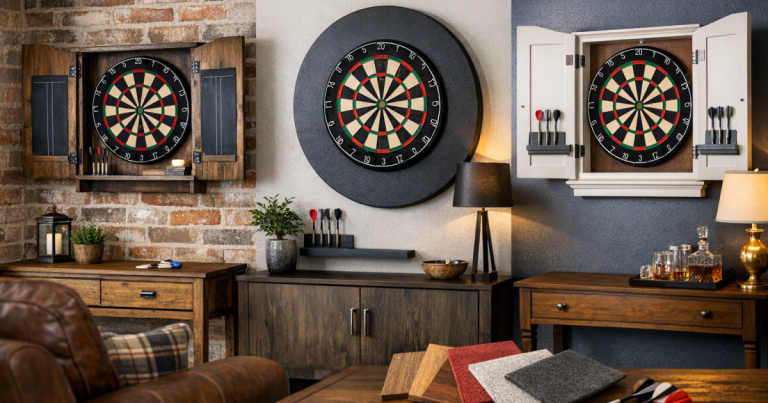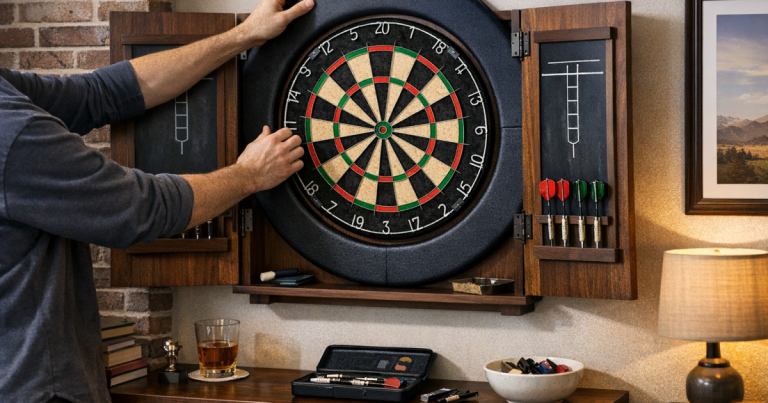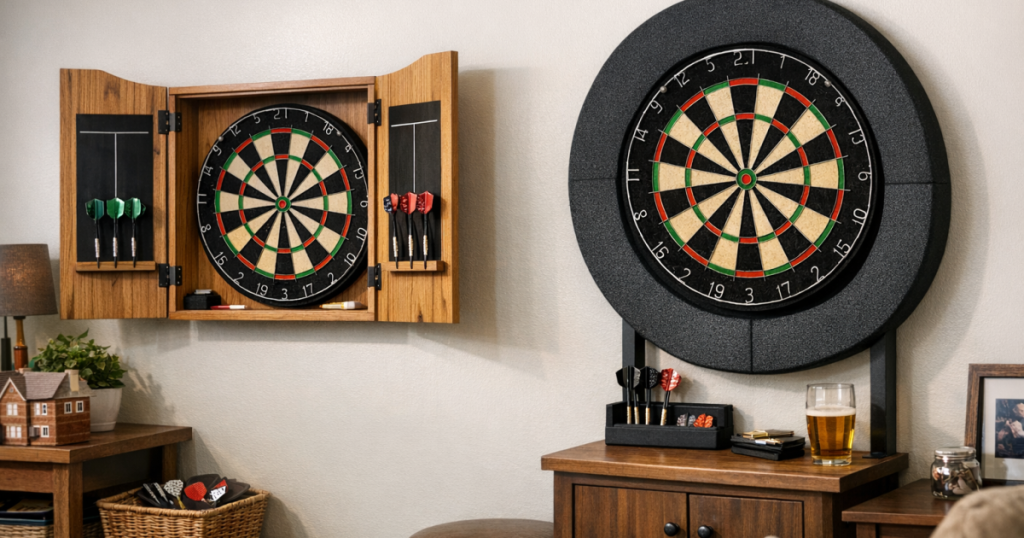
A rented home can still have a tidy, good-looking darts area, but the wall protection has to work harder. The best setup is usually the one that prevents stray marks, keeps the board stable, and leaves the least evidence when you move out. For dartboard cabinets for rented homes, the key question is not just style; it is whether the fixing method, wall type and surrounding protection suit your tenancy.
Drilling into walls, fixing heavy cabinets, or working near hidden cables and pipes should be handled by a qualified tradesperson to comply with UK safety requirements and your tenancy conditions.
What to know first
Cabinets and surrounds solve different problems. A cabinet gives the board a framed look, hides the board when not in use, and usually provides small storage areas for darts and accessories. A surround is mainly a protective ring around the board, designed to catch near misses before they mark the wall. In a rented home, that distinction matters because a cabinet normally needs a more secure wall fixing, while a surround often adds protection without adding much load.
The safest renter-friendly approach is to start with the permission question before the product question. Check your tenancy agreement for rules on drilling, wall fixings, redecorating and making good. Some landlords are relaxed about neat fixings that are filled later; others are not. If you are in shared accommodation, also think about noise, access, and whether the darts area will be in a walkway or communal room.
Wall type is the second big factor. Solid brick or block walls are generally more tolerant of secure fixings than plasterboard partitions, but they still need the right plugs and screws. Plasterboard can be suitable for lighter accessories only when appropriate fixings are used, and it is rarely the place to take chances with a heavy cabinet and repeated dart impact. For a deeper look at fixings by surface, use this dartboard cabinet wall fixing guide before committing to holes.
Cabinet, surround or both?
A cabinet looks smarter than a bare board, especially in a living room, garden room or spare bedroom where the darts setup needs to blend in when guests are round. It can also keep spare flights, stems, chalk and a marker pen in one place. The trade-off is that a cabinet is not a magic wall protector. The doors and frame protect only a limited area, and a badly missed dart can still hit plaster, paintwork or skirting nearby.
A surround is often the more deposit-conscious choice. Foam or rubber-style surrounds sit around the board face and cover the most common miss zone. They are useful for newer players, family games, and any room where wall marks would be difficult to explain at checkout. A surround also makes sense when the board is already mounted securely and you simply need extra protection around it.
Using both can work well when the cabinet opening has enough clearance, but not every cabinet-and-surround combination fits neatly. Measure the board, the inside cabinet width, and the surround depth before assuming they will sit together. Also check whether the cabinet doors can close without pressing against the surround. If the fit is tight, a surround-only setup may be cleaner and easier to remove later.
The renter-friendly hierarchy
For most rented homes, the least risky setup is not always the prettiest one. Think of the options in order of reversibility:
- A free-standing dartboard stand leaves the wall untouched and is often the easiest choice where drilling is not allowed.
- A board on an existing permitted fixing can work if the mount is secure, level and suitable for repeated use.
- A board plus surround gives useful wall protection while keeping the setup fairly simple.
- A cabinet can look excellent, but it usually needs proper fixings and more agreement with the landlord.
- A built-in or heavily customised darts wall is usually better suited to owned homes or outbuildings where alteration is not an issue.
That does not mean renters should avoid cabinets altogether. It means the cabinet has to earn its place. If you are allowed to drill, have a suitable wall, and want the room to look tidy when the board is not being used, a cabinet is a reasonable choice. If you expect to move soon, share the space, or cannot make holes, a stand and surround will normally be easier to live with.
Wall protection beyond the board
Most wall damage happens in a predictable zone around the board, but not all of it is directly beside the doubles. Taller players, bounce-outs and casual throwers can send darts wider or lower than expected. In rented homes, the surrounding area deserves almost as much thought as the board itself.
A wider protective backing panel can help, but it introduces the same fixing questions as a cabinet. Lightweight panels may still need secure mounting, and adhesive strips are not a reliable answer for anything that takes impact. They can also remove paint when pulled away, which defeats the point of avoiding damage.
Freestanding protection is worth considering. A moveable screen, a thick temporary backing board placed safely behind the setup, or a dedicated darts stand with a protective panel can reduce wall contact without permanent fixings. The main thing is stability: anything behind a dartboard must not wobble, lean into the throwing area or create a bounce-back hazard.
If your main concern is near-miss protection rather than storage, it is worth reading this rental-friendly dartboard surround review to see how a surround fits into a temporary home setup.
Stability matters more than a neat finish
A cabinet that looks smart but shifts slightly on every impact will become annoying quickly. It can loosen fixings, make the board rotate, and increase the chance of bounce-outs. The same applies to a stand: if the board trembles after every throw, the setup will feel less satisfying and may become noisier for neighbours or housemates.
Check that the board sits at the correct height, the oche distance is measured from the face of the board, and the cabinet or surround does not interfere with dart entry. A board should feel solid when darts land. If it turns during play, the issue may be the mounting bracket, the cabinet back, uneven wall contact or a worn board mount. This guide to stopping a dartboard spinning on the wall is a useful next step if the setup looks right but will not stay put.
Noise is another rented-home detail that is easy to overlook. A cabinet on a party wall can transfer thuds into the next room or neighbouring property. A surround can slightly soften missed darts, but it will not silence the impact of darts landing in the board. If possible, choose an internal wall away from bedrooms, shared walls and quiet work areas.
Storage and everyday use
One reason cabinets remain popular is that they tidy up the small bits that otherwise scatter around the room. Darts, spare shafts, flights, chalk, a duster and a basic checkout card all need somewhere to live. In a rented home, that storage benefit is strongest when the cabinet replaces extra shelves, hooks or boxes that would otherwise need their own fixings.
However, do not overload a cabinet. Most are designed for light darts accessories, not heavy tools or unrelated household items. Keep the doors closing freely and avoid hanging anything from them. If the room is damp, such as a garage conversion or poorly ventilated utility space, store darts and metal accessories away from condensation rather than leaving everything inside a cold cabinet.
For shared homes, a cabinet also gives the setup a clear on-off feel. Close the doors, put darts away, and the area looks less like a permanent games corner. That can make a difference in living rooms where the same wall has to work for darts, furniture and everyday use.
When a cabinet is worth it in a rental
A cabinet is worth considering when you have permission to fix it properly, the wall is suitable, and the darts area is likely to stay in the same place for the length of the tenancy. It is most useful in rooms where appearance matters: a lounge, dining area, study or garden room used for more than just darts.
A surround is the better first move when the main concern is wall protection, when beginners will be playing, or when you need a setup that can come down with minimal fuss. For many renters, the sweet spot is a secure board, a good surround, a removable oche, and a small storage box or freestanding shelf nearby. It may not look as polished as a cabinet, but it is often easier to justify and easier to reverse.
The most important point is not to rely on hope. Do not assume a cabinet will protect all misses, do not assume adhesive will safely hold weight, and do not assume small holes will be ignored at the end of the tenancy. A renter-friendly darts setup is one that has been thought through before the first dart is thrown.
Common questions
Can I use adhesive strips for a dartboard cabinet?
Adhesive strips are not a sensible fixing for a dartboard cabinet. A cabinet has weight, doors, and repeated impact from play. Use proper fixings where permitted, or choose a free-standing setup instead.
Is a surround enough to protect a rented wall?
A surround protects the most common miss area around the board, but it will not cover every possible stray dart. New players and lively shared-house games may still need wider protection behind or around the board.
Will a cabinet hide damage when I move out?
It might hide marks while it is fitted, but it will not remove your responsibility for damage. Plan for clean removal, filling, touch-up paint and any tenancy requirements before fitting anything permanent.
What is the best setup if drilling is not allowed?
A sturdy dartboard stand with a surround is usually the simplest renter-friendly route. Add a removable oche marker or mat, and keep darts stored separately when not in use.
Can I put a dartboard cabinet on plasterboard?
It depends on the cabinet weight, fixings and wall construction, but plasterboard needs caution. For a rental, get permission first and use appropriate fixings fitted correctly rather than guessing.
Key takeaways
Rented homes do not rule out a proper darts area, but they do reward restraint. A cabinet gives a smart, organised finish when secure fixing is allowed. A surround gives more direct wall protection with fewer complications. For many UK renters, the best answer is a stable board, generous wall protection, and a setup that can be removed cleanly when the tenancy ends.