Getting the correct oche distance right makes your home board feel consistent, fair and much easier to practise on. The key is to measure from the face of the dartboard, not the wall behind it, and to mark the front edge of the throwing line clearly.
You do not need specialist kit for this job. A reliable tape measure, a straight edge, a pencil or low-tack tape, and a few minutes of careful checking will usually give you a better result than guessing from a skirting board or cabinet edge.
At a glance
- For a standard steel-tip dartboard, the throwing distance is 2.37 m from the face of the board to the front of the oche.
- The bullseye should be 1.73 m from the floor before you set the line.
- Measure to the face of the dartboard, not the wall, cabinet back panel or surround.
- The front edge of the tape, mat line or raised oche is the point your foot must not cross.
- If you use a soft-tip electronic board, check the board or league rules, as many soft-tip setups use 2.44 m.
Understand what you are measuring
The official steel-tip home setup is simple once you separate the two measurements. First, the board height sets the bullseye at 1.73 m from the floor. Second, the throwing line sits 2.37 m away from the face of the board. Those two measurements work together; if the board is too high, too low or tilted, the line can feel wrong even if the floor distance is accurate.
The most common mistake is measuring from the wall. A bristle dartboard has depth, and a cabinet or backing board can move the playing surface further into the room. That means a line measured from the wall can leave you throwing slightly too close. It may not look like much, but it can affect rhythm, grouping and confidence when you move between home practice and pub or league boards.
If your floor is uneven, sloped or split between different surfaces, set the board height before you mark the line. For awkward rooms, the method in measuring dartboard height on uneven flooring is worth doing first, because the bull height is the reference point for the whole setup.
What you need before you start
- A metric tape measure long enough to cover at least 3 m.
- A pencil, masking tape, floor-safe tape or a dart mat with a printed line.
- A straight edge, spirit level or square object to help keep the oche line straight.
- A second person if possible, especially when measuring from the dartboard face.
- A small piece of card or a ruler to help project the board face down to the floor.
A rigid tape measure is easier than a soft sewing tape because it stays straighter. If you are working alone, use a small piece of low-tack tape to hold one end temporarily against the board face, then recheck the measurement before marking anything permanent.
Step 1: set the dartboard height first
Before touching the floor line, check the bullseye height. The centre of the bull should be 1.73 m from the floor directly below the board. Measure vertically, not along the wall at an angle, and make sure the board is fully seated in its bracket.
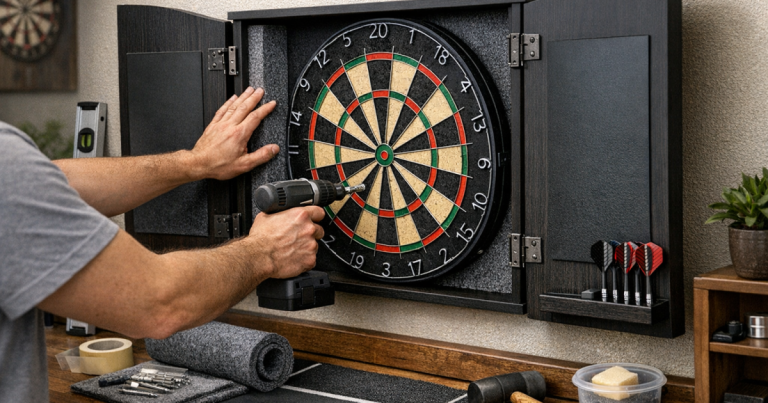
If the board is in a cabinet, check that the cabinet doors, surround or backing panel are not pushing the board forward unevenly. The board should sit flat and stable, with the number 20 at the top. A board that rocks or sits slightly proud on one side can make your distance measurement less reliable.
Step 2: identify the face of the board
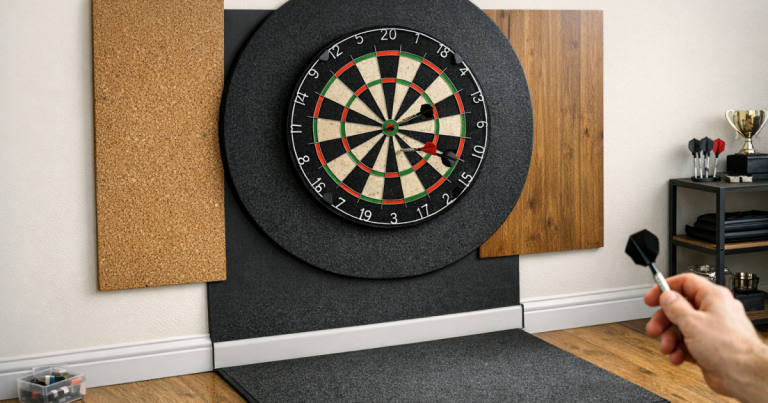
The face is the surface the darts enter, not the outer rim, not the cabinet and not the wall. To find its position on the floor, hold a ruler, book or straight edge vertically against the playing surface and let it point down towards the floor. Mark that floor point lightly with pencil or tape. This gives you a temporary reference point directly below the face of the board.
Do not press hard enough to damage the sisal or move the board. You are only using the straight edge as a visual guide. If a surround makes this awkward, line the straight edge up with the exposed board face at the side rather than the foam edge.
Step 3: measure 2.37 m along the floor
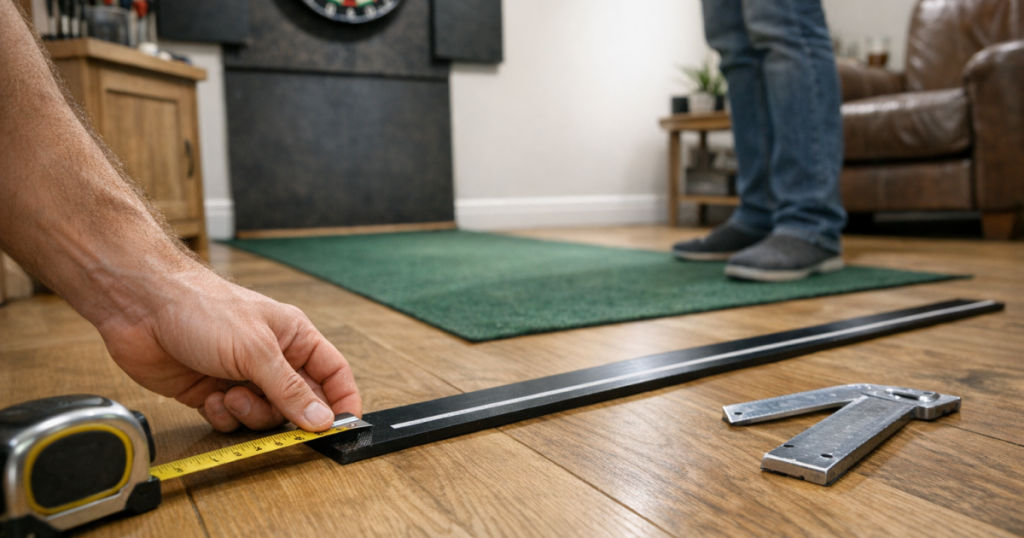
Place the start of your tape measure at the floor point below the board face. Run it straight out into the room and mark 2.37 m. Keep the tape as flat and central as possible, aiming directly away from the bullseye rather than drifting left or right.
If you can, measure twice: once from the centre line of the board and once from either side to check that the line will sit square. The distance should be taken to the front edge of the oche. If you are using a strip of tape, the edge nearest the board is the actual line. If you are using a raised block, the front vertical face of the block is the line.
Step 4: square the line across the throw area
Once you have the 2.37 m mark, draw or tape a straight line across the floor. It does not need to span the full room, but it should be wide enough that players can stand naturally without losing sight of the boundary. Around the width of a standard dart mat is usually enough for home practice.
To square it, measure from the board face to both ends of the proposed line. If one end is closer than the other, adjust it before pressing the tape down properly. This is especially useful in alcoves, garage bays and spare rooms where walls are rarely a perfect guide.
Step 5: check the diagonal measurement
A useful cross-check is the diagonal from the centre of the bullseye to the front edge of the oche. For a standard steel-tip setup, that diagonal is about 2.93 m. This is not a replacement for setting the board height and floor distance properly, but it is a good way to catch a mistake.
Hook or hold the tape at the bullseye, then measure down to the front edge of the line. If the result is noticeably out, recheck the board height, the floor distance and whether you measured from the board face rather than the wall. Small differences can come from tape angle or carpet pile, so use this as a confirmation check rather than a reason to keep moving the line back and forth.
Step 6: choose a line that suits the room
The easiest home oche is a strip of floor-safe tape, but it is not always the most durable. On carpet, tape can lift. On laminate or vinyl, stronger adhesive can leave marks. A dart mat is a cleaner option if you want a repeatable line and some floor protection, provided it stays flat and does not creep forward during play.
A raised oche feels more like a match setup because your front foot has a physical stop. It also makes casual overstepping less likely. The trade-off is that it needs enough floor space to avoid becoming a trip point when the board is not in use. In a shared room, a removable oche or mat is usually more practical than a fixed wooden strip.
Room examples and common adjustments
Living room or spare room
In a normal room, the main challenge is usually keeping the line tidy and removable. Use low-tack tape while testing the position, then switch to a mat or neater tape once you are happy. Check that doors, furniture and walkways do not encourage people to step through the throwing lane while darts are in use.
Garage setup
Garages often give you more length, but floors can slope towards the door and storage can creep into the throwing lane. Mark the board centre line first, then keep the oche square to that rather than to the garage wall. For broader layout planning, the guide to setting up a darts area in a garage covers spacing, wall protection and practical room use.
Cabinet or surround setup
A cabinet does not change the official distance, but it can make people measure from the wrong surface. Always ignore the cabinet back panel when setting the oche. Measure from the dartboard face as it sits in the cabinet. If the board is removed for rotation, re-seat it fully before checking the line again.
Soft-tip board
Soft-tip electronic boards are not always set to the same throwing distance as steel-tip bristle boards. Many soft-tip formats use 2.44 m, but home boards and casual competitions can vary. If you mainly play steel-tip darts, keep your bristle board at 2.37 m. If you are setting up for soft-tip practice, follow the board instructions or the rules of the format you play most.
Final checks before you play
- Stand at the oche and check that your throwing arm has a clear path with no lampshade, shelf or door frame in the way.
- Make sure the line is visible under normal room lighting, not just when you are crouched down measuring it.
- Check that the mat or tape has not moved after a few practice visits to the board.
- Confirm that taller players have enough room behind the line for their stance and follow-through.
- Keep the floor between board and oche clear so darts can be retrieved safely and consistently.
If the setup feels tight even with the measurement correct, the issue is often side clearance, furniture placement or the space behind the thrower rather than the oche itself. The steps to fix a darts setup that feels too cramped can help you decide whether to move the board, adjust storage or change how the room is used.
Helpful questions
Is the oche measured from the wall or the dartboard?
Measure from the face of the dartboard. The wall is only a mounting surface, and measuring from it will usually put the player too close.
What is the correct oche distance for steel-tip darts?
For a standard steel-tip bristle board, set the front edge of the oche 2.37 m from the dartboard face, with the bullseye 1.73 m from the floor.
Can I use a dart mat instead of taping the floor?
Yes, provided the mat lies flat, does not slide and places the throwing line at the right distance from the board face. Recheck it occasionally, as mats can creep on smooth floors.
Does carpet affect the measurement?
Carpet can make tape harder to keep straight and can hide small marks, but the distance is the same. Measure carefully, keep the tape flat and use a visible line or mat.
Should children use a shorter oche distance?
For casual family play you can adapt the distance to keep it fun, but mark the standard line separately if adults want meaningful practice for pub, league or competition-style play.
Main lessons
Set the board height first, measure from the dartboard face, and mark the front edge of the throwing line at 2.37 m for a standard steel-tip setup. Once the line is square, visible and comfortable to stand behind, your home practice will feel much more transferable to other boards.
The best home oche is not always the most permanent one. A neat tape line, a stable mat or a removable raised oche can all work well if the measurement is accurate and the space around it supports a natural throw.