A good garage darts setup starts with the space, not the dartboard. Garages can make brilliant home throwing areas, but the same room may also have a car, bikes, tools, damp corners, uneven flooring and awkward lighting. Sort those details first and the board will feel far better to play on.
Fixed electrical work for lighting, sockets or garage power alterations should be carried out by a qualified electrician to meet UK safety requirements and local building standards. For simple dartboard mounting, always check for hidden cables, pipes and unsuitable wall materials before drilling.
The quick plan
Before you fit anything permanently, work through the garage like a playing lane. You need a safe throwing line, a stable board position, enough headroom, decent light, somewhere for scores, and protection for the surfaces you care about.
- Board height: the centre of the bull should be 1.73 m from the floor for standard steel-tip play.
- Throwing distance: the oche should be 2.37 m from the face of the dartboard, not from the wall behind it.
- Clearance: allow room behind the thrower, beside the lane and above the board so the space does not feel boxed in.
- Protection: cover the wall behind the board and consider floor protection where darts may land.
- Comfort: control glare, draughts, clutter and damp so you actually want to use the area through the year.
Step 1: Choose the best wall, not just the emptiest one
The obvious garage wall is not always the best wall. Stand where the board would go and look back along the throwing lane. You want a straight, uninterrupted run with no door swing, workbench corner, freezer, lawnmower handle or shelving unit intruding into the throw.
In a single garage, the back wall often works well if the car can be moved out during play. In a garage used for storage, a side wall may be better, provided the oche does not sit in a walkway or directly beside stacked tools. Avoid setting the board where someone could enter the garage door into the throwing lane.
Check the ceiling and garage door mechanism before committing. Up-and-over doors, tracks, open rafters, low beams and hanging storage can all make a throwing area feel cramped even when the floor distance looks fine. If headroom is tight, use this ceiling clearance check before installing a dartboard before drilling any holes.
Step 2: Mark the board height properly on a garage floor
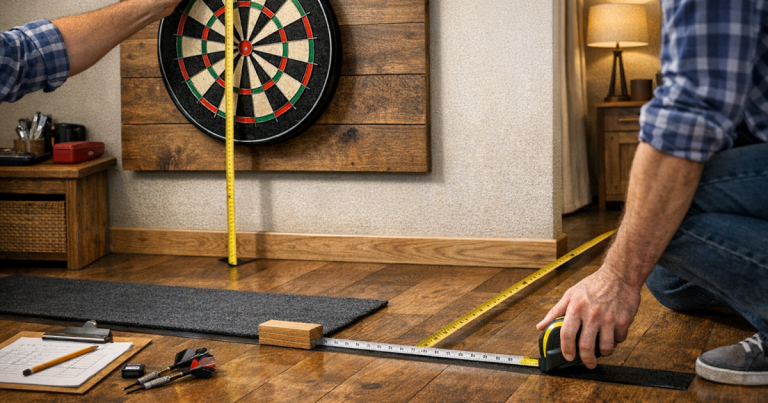
Garage floors are often slightly sloped so water can run towards the door. That is useful for drainage, but it can throw off dartboard height if you measure from the wrong patch of floor. Measure from the floor directly below the face of the dartboard, not from a random point nearby.
Use a tape measure and mark 1.73 m to the bullseye position. If the floor has a visible slope, place the player’s standing area and oche first, then make sure the board height relates to the playing surface you will actually use. A thick rubber mat or raised flooring tile can change the effective height, so fit or account for it before making final marks.
For awkward concrete floors, slopes or patchy garage surfaces, the method in this guide to measuring dartboard height on uneven flooring is worth following before you mount the board.
Step 3: Set the oche and make it repeatable
The oche should be measured from the face of the board to the front edge of the throwing line. If the board sits in a cabinet or on a backboard, do not measure from the wall. That small difference can make the setup feel slightly off, especially if you practise regularly.
For a garage, a removable oche often makes sense. A strip of low-profile timber, a rubber oche mat, or a marked line on a floor mat can work, depending on whether the car or bikes still need access. Tape alone is fine for testing, but it tends to peel on dusty concrete and can become hard to see in low light.
Leave enough room behind the oche for a natural stance and follow-through. If a player has to stand with their heels against a cabinet, door threshold or stacked boxes, the throw will feel cramped even when the official distance is correct.
Step 4: Protect the wall and floor
Garage walls vary: bare brick, blockwork, plasterboard, timber panels and painted masonry all behave differently. A bristle board can be mounted securely on a solid wall, but the area around it still needs protection from stray darts. A wide backboard, surround or cabinet is usually better than relying on a small board bracket and hoping your grouping is good enough.
If the wall is plasterboard, use suitable fixings and think carefully about the load, repeated vibration and missed darts. If it is bare brick or block, a timber backing board can make future adjustments easier and reduce the number of holes in the wall. A quality bristle board such as the Winmau Blade 6 Triple Core still needs sensible backing protection in a garage, especially if beginners or guests will be playing.
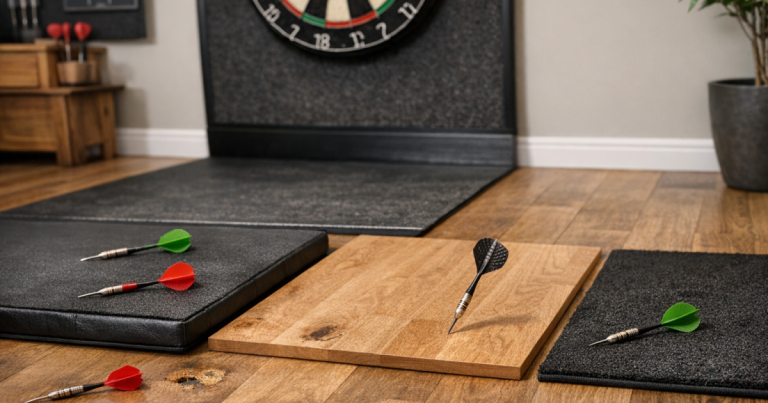
Floor protection matters too. Steel tips can chip concrete, damage tiles and bounce unpredictably from hard surfaces. A rubber dart mat helps mark the oche and softens dropped darts, but check that it sits flat and does not creep underfoot. If the garage gets damp, lift the mat occasionally and let the floor dry underneath.
Step 5: Control light, glare and shadows
Garages often have one ceiling light in the middle of the room, which is rarely ideal for darts. It can cast a shadow from the player, glare off a cabinet door, or leave the lower segments dull. The goal is even light across the board without dazzling the thrower.
Purpose-made dartboard lights and ring-style lights can work well in garages because they keep the light close to the board. A product such as the Target Corona Vision Dartboard Light is a recognisable example of a board-focused lighting approach, but you should still check board fit, surrounding space, cable routing and whether it suits your cabinet or surround before using one.
If you are deciding between ceiling light, spotlights or a board-mounted option, this guide on choosing dartboard lighting that avoids glare and shadows covers the practical differences in more depth.
Step 6: Keep scoring and darts gear close to hand
A darts area works better when everything has a place. Put the scoreboard where it can be seen without stepping into the throwing lane. In a garage, that might be a small whiteboard on the side wall, a cabinet door scoreboard, or a magnetic board fixed to a nearby metal surface if the layout allows it.
Store spare flights, shafts, points, chalk, marker pens and a checkout card away from damp and dust. A simple shelf or wall organiser beside the board keeps the playing area tidy and stops darts being left on workbenches where they can roll, fall or get damaged.
If the garage is used for DIY, gardening or bike maintenance, keep sharp darts separate from general tools. It is a small habit, but it stops points being blunted and keeps the darts area feeling like a proper playing space rather than an afterthought.
Garage layout examples that usually work
Single garage with a car
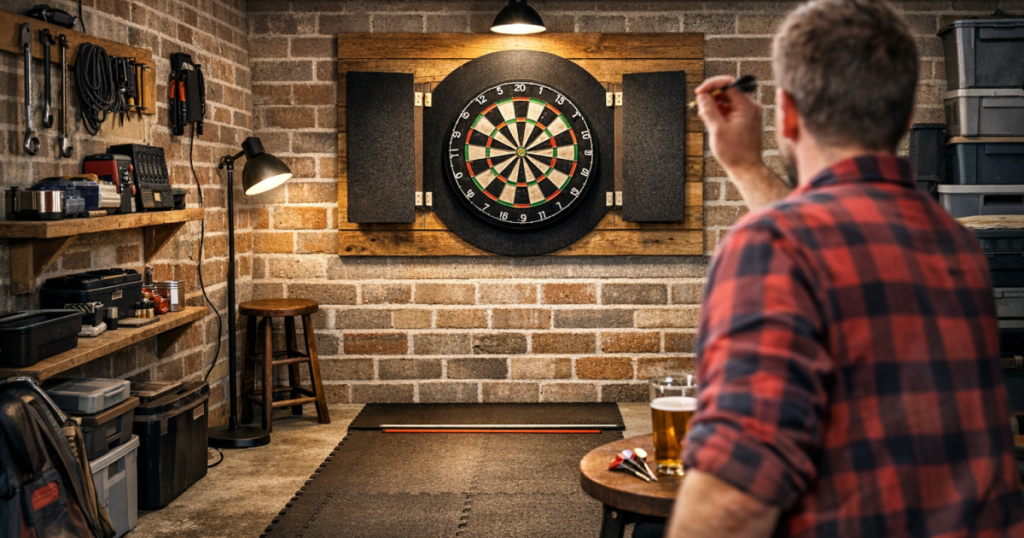
Use a removable oche and avoid permanent floor markings that sit under the tyres. A back wall setup can work well if the car is reversed out for play, but make sure shelves and wall hooks are not in the flight path. Keep the board covered or inside a cabinet if the garage is dusty.
Half-garage workshop
Place the board away from sawdust, paint, solvents and heavy tool storage. The safest throwing lane is usually the one with the least cross-traffic. If the workbench stays in place, check that a player retrieving darts will not brush against sharp tools or hot equipment.
Shared gym and darts space
Do not put the oche where weights, benches or exercise bikes need to move. A rubber floor can be useful, but check the thickness before setting board height. Keep the board protected from impact if gym kit is stored upright nearby.
Final checks before your first proper session
- Measure board height after any mat, tiles or flooring are in place.
- Measure the oche from the board face, not the wall.
- Stand at the oche and make a few slow practice throws without darts to check arm clearance.
- Open and close the garage door to see whether tracks, handles or stored items interfere.
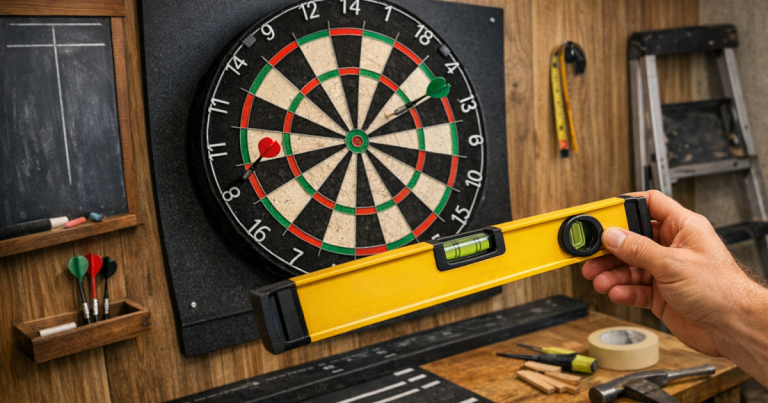
- Check the board is level and does not wobble when darts are pulled out.
- Look at the board from the oche with the lights on and off to spot glare or dark patches.
- Move bikes, tools, bins and storage boxes out of the lane before anyone plays.
- Rotate a bristle board regularly so the most-used segments wear evenly.
Questions people ask
Can you keep a dartboard in a garage all year?
Yes, if the garage stays reasonably dry and the board is not exposed to persistent damp. Avoid mounting a bristle board on a cold, wet wall, and keep it away from leaks, condensation and direct draughts where possible.
Is concrete flooring a problem for darts?
Concrete is playable, but it is hard on dropped or bouncing darts. A flat rubber mat is usually a sensible addition because it marks the oche, improves comfort underfoot and reduces impact on dart points.
How much side space do you need?
There is no single official side-clearance measurement for every home setup, but the thrower should be able to stand naturally without hitting shelving, doors or stored items. If two people cannot pass safely outside the throwing lane, the area is probably too cluttered.
Should a garage dartboard go in a cabinet?
A cabinet can help keep the board tidy, hide it when the garage is used for other jobs, and add some wall protection. It is not essential, but it is useful if the garage is dusty or shared with tools and storage.
Can soft-tip darts be better in a garage?
Soft-tip can suit family play or electronic scoring, but electronic boards still need a dry, suitable location and enough wall protection. Steel-tip on a bristle board feels more traditional and is often simpler for a basic garage area.
The big picture
A garage darts setup works best when it is treated as a small playing zone rather than just a board on a spare wall. Get the height, distance, clearance and lighting right first, then add protection and storage so the space stays easy to use. The result is a garage area that feels deliberate, comfortable and ready for a proper throw whenever you have a spare half hour.