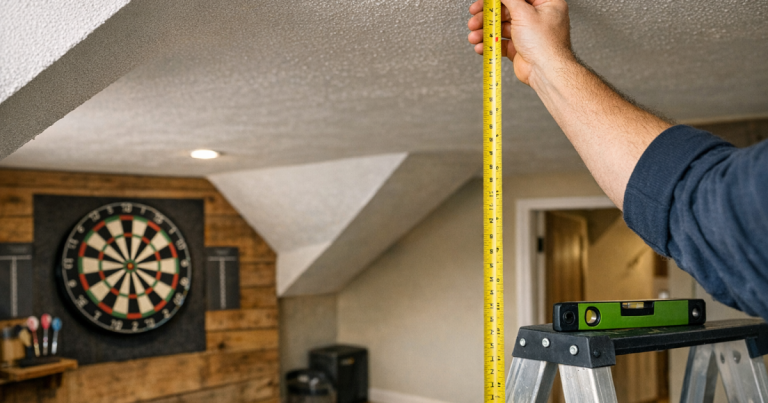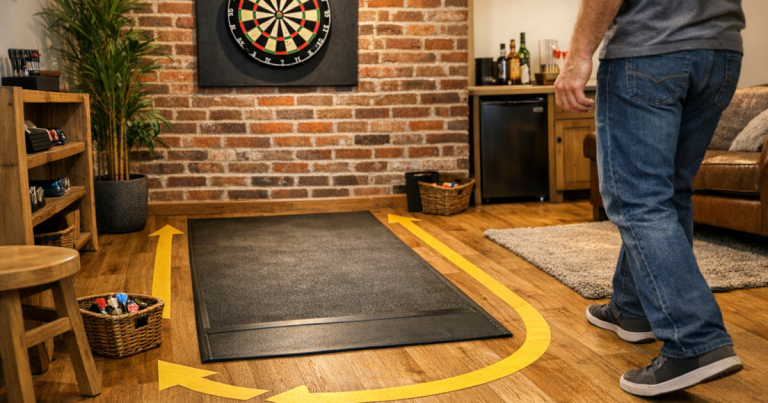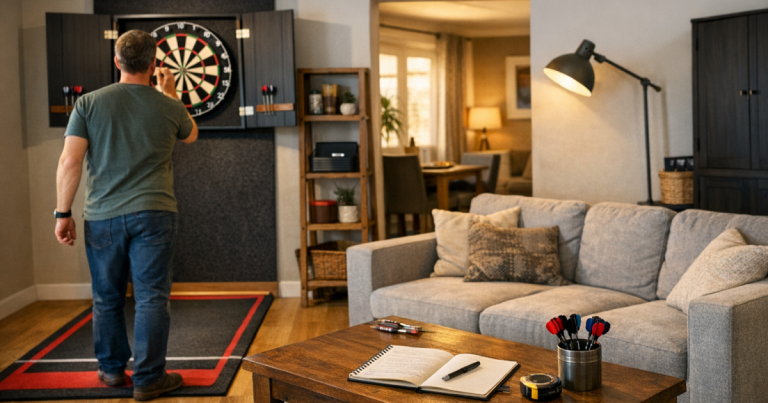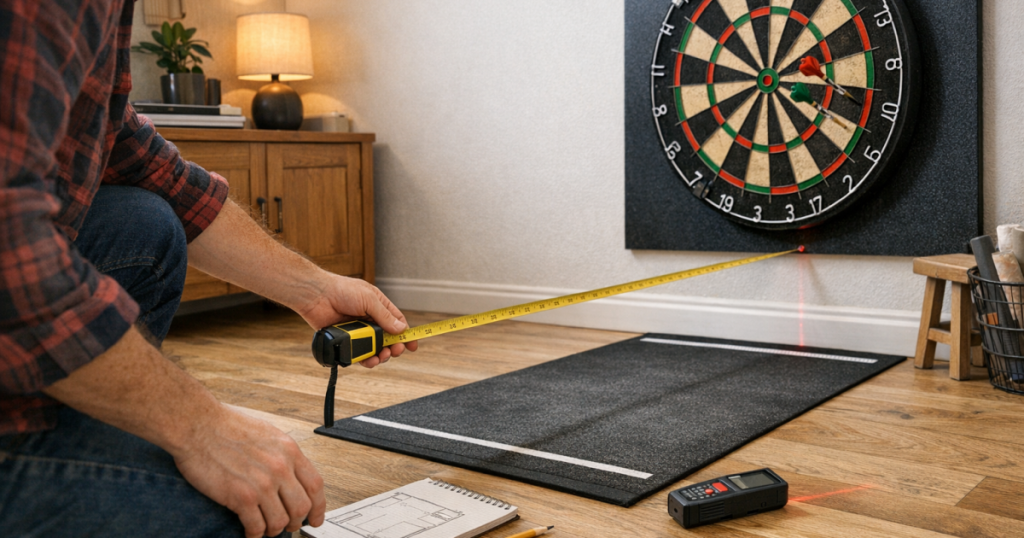
A good spare bedroom dartboard setup starts with the tape measure, not the drill. Before you decide which wall gets the board, check whether the room can hold the throw distance, a safe standing area and a clear walkway once the bed, wardrobe and door swing are accounted for.
The aim is not just to squeeze a board onto a wall. You want a throw that feels natural, a room that still works as a bedroom, and enough clearance that darts, feet and furniture are not constantly fighting for space.
At a glance
- Measure from the face of the dartboard to the oche, not from the wall.
- For a standard steel-tip setup, use 1.73 m to the bullseye and 2.37 m from the board face to the throw line.
- Check at least the full throw lane, not just the wall where the board will hang.
- Allow space behind the oche so the thrower can stand, step back and swap places comfortably.
- Account for beds, wardrobes, drawers, door swings, radiators, sockets and windows before marking anything.
- Leave side clearance so the board is not tucked into a cramped corner.
Start with the fixed dartboard measurements
For a typical steel-tip dartboard at home, the bullseye should be 1.73 m from the finished floor. The throw line, often called the oche, should be 2.37 m from the face of the board to the front edge of the line. That detail matters: if the board is mounted on a backboard, cabinet or thick wall protection, measure from the board face rather than the plaster behind it.
A useful cross-check is the diagonal measurement from the centre of the bullseye to the oche. For a standard steel-tip board, that diagonal is 2.93 m. It is not a replacement for measuring the height and floor distance properly, but it helps confirm that the board and throw line are in the right relationship once everything is marked.
If you are using a different board type, such as an electronic soft-tip board, check the relevant playing distance for that board before you mark the room. Do not assume every board uses the same oche distance.
Map the room before choosing the wall
Sketch the spare bedroom as a simple rectangle first. It does not need to be neat; it just needs to capture the usable space. Measure the room length and width at floor level, then mark anything that cannot easily move: the door, window, radiator, built-in cupboard, chimney breast, sockets, alcoves and sloping ceiling if it is a loft room.
Next, add the furniture in its normal position. Include the bed footprint, bedside table, wardrobe, desk, chest of drawers and any storage boxes that tend to live under windows or along walls. A darts area that only works after clearing half the room every time is unlikely to stay enjoyable.
The simplest test is to draw a straight throw lane from the board wall out into the room. That lane needs to cover the board, the oche and the standing area behind it. If it crosses the bed, clips the door swing or blocks access to a wardrobe, try another wall before committing.
Measure the throw lane from wall to room
Once you have a candidate wall, measure out from it along the floor. Add the depth of the board and any mounting layer before placing the oche. For example, if the board face sits a short distance forward from the wall because of a bracket, surround or back panel, that depth counts towards the measurement. The toe line still needs to be 2.37 m from the board face.
After the oche, allow a practical standing zone behind the line. Around 600 mm to 900 mm is a sensible working allowance in many spare bedrooms because it gives the player room to set their stance, step back and let another player pass. If the room is tight, mark the oche with low-tack tape and physically stand there to see whether the space feels cramped.
Do not forget retrieval space at the board end. You need to walk to the board and remove darts without squeezing around a bed frame or stepping over clutter. If you are planning a mixed-use room, the route from oche to board should stay clear even when the room is being used normally.
Check the width, not just the distance
A room can be long enough but still awkward if the board is too close to a side wall, wardrobe or window reveal. Ideally, the board should feel centred enough that the thrower is not aiming across their body or standing with one shoulder near furniture.
As a practical home check, measure the board wall from side to side and mark the intended bullseye centre. Then look at what sits to the left and right of that centre line. Allow room for the board, a surround or cabinet, and a little breathing space beyond it. A tight corner setup can work, but it is more likely to create bounce-out damage, awkward retrieval and a throw that never feels quite square.
If the spare room has only one realistic wall, think carefully about the flow of the room. The board should not sit where someone will naturally walk across the throw lane to reach a wardrobe or desk. For more layout thinking, the same principles apply as when you plan a darts corner without blocking walkways: the playing zone needs to feel obvious, not like an obstacle course.
Measure height from the finished floor
Measure the bullseye height from the floor surface you will actually stand on. If the spare bedroom has carpet, measure from the top of the carpet, not the floorboards below. If you plan to add a dart mat, remember that a thin mat will not usually make a major difference, but a thick temporary floor covering can affect how level and consistent the stance feels.
Use a tape measure and a pencil mark at 1.73 m, then check the mark with a spirit level or a straight edge if you are transferring it across from another point. In older UK homes, floors and walls are not always perfectly square. Trust the measurement from the standing surface rather than assuming the picture rail, skirting board or wardrobe top is level.
If the room has a sloped ceiling, measure the headroom along the throw line too. Most players do not need huge overhead clearance, but a low slope directly behind the oche can affect taller players, raised follow-throughs or anyone stepping back after a throw.
Account for the bed and furniture properly
The bed is usually the biggest challenge in a spare bedroom darts layout. A single bed pushed along one side may leave a workable throw lane. A double bed centred in the room often makes the setup harder unless the board goes on the end wall and the oche sits beyond the foot of the bed.
Measure furniture with drawers and doors open, not just closed. A wardrobe that looks clear on paper may become a problem when its doors swing into the throw lane. The same goes for under-bed storage, a desk chair, airing racks and guest luggage. If the room is used for visitors, allow space for a person to move around the bed without crossing the oche area while someone is throwing.
A useful test is to mark the board centre, oche and standing zone with masking tape, then live with the room for a day or two before fixing anything. Open drawers, make the bed, walk to the window and try the normal room movements. If the tape keeps getting stepped on or covered, the layout needs adjusting.
Plan wall protection while you measure
Measuring for the board alone is too narrow. You also need to allow for wall protection, especially in a bedroom where plaster, paintwork and furniture are close by. A surround, cabinet or backboard changes the visual footprint of the setup and can slightly affect how far the board face sits forward.
Before you choose the final centre point, measure the width and height of the wall area you are prepared to dedicate to darts. Check nearby switches, sockets, shelves, radiators and picture hooks. If you are leaning towards a surround, it is worth reading how to fit a dartboard surround without wall damage before you finalise the position, because the protection needs to sit cleanly around the board.
For rented rooms or newly decorated bedrooms, avoid assuming you can drill freely or leave marks. A removable backboard or freestanding solution may be more suitable, but you still need to measure the same height, throw distance and clearance.
Check light, glare and shadows at the same time
Spare bedrooms often have a single ceiling pendant, a bedside lamp and daylight from one side. That can create shadows across the board or glare on the number ring, particularly in the evening. Once you have a possible board wall, stand at the oche and look at the wall under the lighting you will actually use.
Check whether your throwing arm casts a shadow over the treble bed. Also check whether a window is behind you, beside the board or directly opposite it. Daylight can be useful, but low winter sun or a bright reflection from glass can make the board harder to read.
If lighting looks marginal, solve it while the layout is still flexible. Moving the board 300 mm to one side may avoid a shadow from a pendant or wardrobe. For a more detailed lighting plan, use the guide to lighting a dartboard without glare or shadows before you fix the board in place.
A simple measuring sequence that works
1. Measure the room shell
Record the full length, width and ceiling height. Mark doors, windows, radiators, sockets, alcoves and any sloping sections. Note which way the door opens and how far it swings into the room.
2. Mark the furniture footprint
Measure the bed, wardrobe, drawers, desk and chair in their normal positions. Include open drawers and wardrobe doors where they affect the throw lane.
3. Choose a candidate board wall
Pick the wall that gives the straightest and least interrupted route from board to oche. Avoid walls where the throw lane crosses the doorway or blocks essential storage.
4. Mark the bullseye height
Measure 1.73 m from the finished floor and mark the bullseye centre. Keep the mark light until you have checked the rest of the layout.
5. Measure the oche from the board face
Allow for the board depth and any backing layer, then mark 2.37 m from the board face to the front of the toe line. Use tape on the floor before adding anything permanent.
6. Test the stance and movement
Stand at the line, throw an imaginary visit, step back, swap places and walk to the board. If the route feels awkward before darts are even involved, adjust the wall or room layout.
Common measuring mistakes in spare bedrooms
- Measuring to the wall instead of the dartboard face, which makes the oche slightly wrong once the board is fitted.
- Forgetting the standing space behind the oche and ending up pressed against a bed or door.
- Choosing the clearest wall visually, even though the throw lane blocks the wardrobe or room entrance.
- Ignoring drawer and door swings when measuring furniture.
- Marking the bullseye height from skirting, carpet grippers or an uneven reference point instead of the finished floor.
- Leaving lighting until last, then discovering the best wall creates heavy shadows.
- Assuming a surround, cabinet or backboard will fit without measuring its full footprint.
Questions people ask
Can a box room work for darts?
Sometimes, but only if it has the full throw distance plus room to stand behind the oche. Many small box rooms are too short once the door, bed and storage are included.
How much space do I need behind the throw line?
Allowing 600 mm to 900 mm behind the oche is a sensible target for a home room. More is better if two players will swap places regularly.
Should the dartboard be centred on the wall?
Not always. It should be centred on the throw lane. If furniture sits to one side, an off-centre board can work better as long as the stance and board access feel natural.
Can I measure the oche before the board is fitted?
You can mark an estimate, but the final oche should be measured from the face of the fitted board. Board depth, brackets and wall protection can change the final distance.
Is a bedroom carpet a problem for the measurements?
No, but measure from the top of the carpet and make sure the oche marker or mat sits flat. Very soft carpet can make a stance feel less consistent.
Why the measuring stage matters
A spare bedroom can make an excellent home darts space, but it needs to remain a usable room. Good measuring helps you avoid the common frustrations: a cramped stance, blocked furniture, poor light, wall damage and an oche that is slightly off from day one.
Take the time to mark everything temporarily before you drill, stick or rearrange. If the throw lane works with the room as it is actually used, the board is far more likely to become part of the home rather than something that has to be moved every time guests arrive.