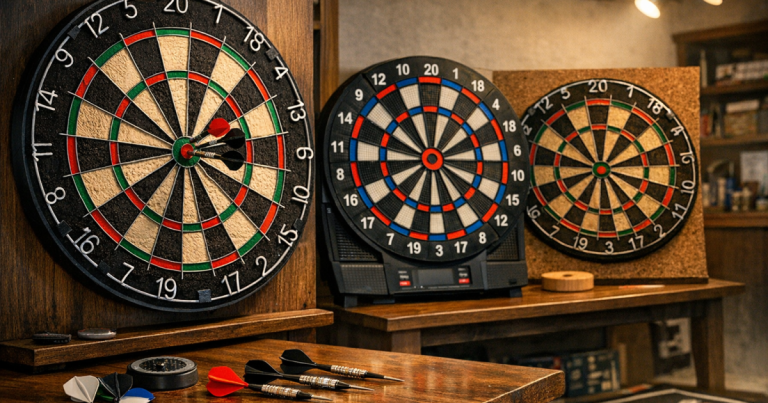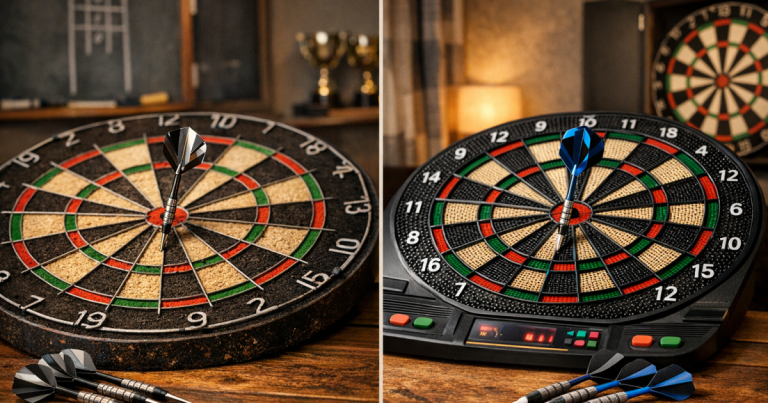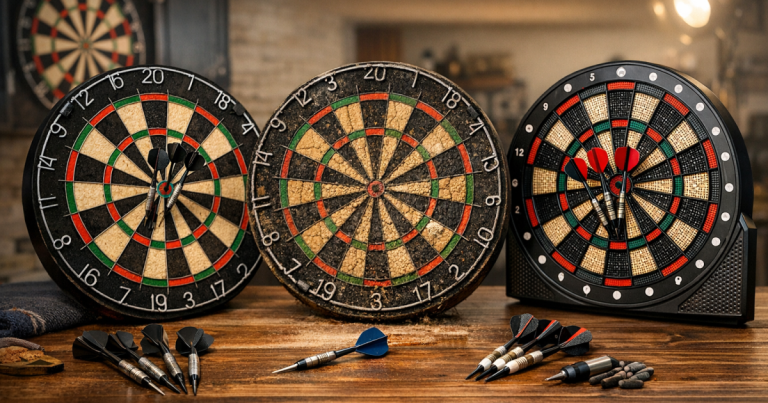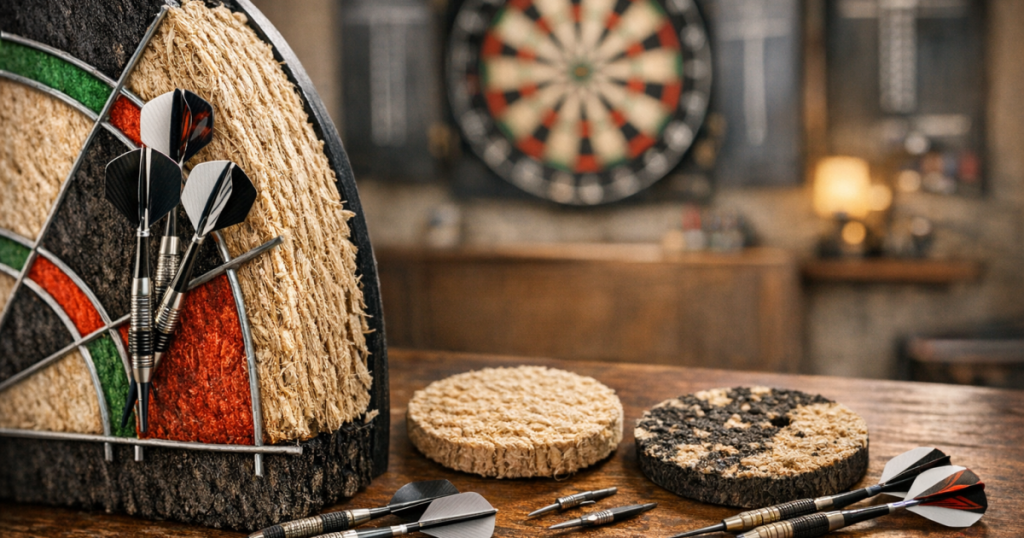
A good board does more than hold a dart. With sisal dartboards, the way the fibres are packed, cut and compressed affects how confidently darts land, how well the surface closes up afterwards and how often a dart hits the floor instead of staying in the treble.
For a home setup, that matters because most players judge a board by two very practical things: does it feel satisfying to throw at, and does it stay playable after weeks of regular practice? The answer is rarely down to one feature. It is a mix of fibre quality, density, wiring, dart points, rotation habits and the way the board is mounted.
In brief
- Density is about how tightly the fibres are compressed, not simply how heavy or hard the board feels.
- Recovery is the board’s ability to close around dart holes after the dart is removed.
- Bounce-outs can come from hard or damaged fibres, thick wiring, blunt points, poor throwing angle or a board that is past its best.
- Maintenance matters: regular rotation usually does more for board life than any single feature claim.
What sisal actually does in a dartboard
The playing face of a bristle board is made from many short fibre bundles compressed together and held under pressure. When a dart enters, it does not drill a permanent hole in the way it would in a soft material. Instead, the point pushes between fibres. When the dart is removed, those fibres can move back towards their original position.
That is why a good board can look fresh for longer than expected, even with regular scoring practice. The board is not magically repairing itself; it is using the structure of the fibre to close up small separations. Once the fibres become cut, crushed, dried out, contaminated or repeatedly battered in the same scoring zones, recovery slows down and visible wear increases.
The “bristle” name can be confusing because modern bristle boards are not made from animal bristles. In everyday darts language, bristle usually means a compressed natural-fibre board designed for steel-tip darts.
Density: why tighter is not always automatically better
Density is often treated as a simple quality marker, but it is more useful to think of it as a balance. If the fibres are too loosely packed, darts may enter easily but the surface can mark quickly and feel less consistent. If the face is extremely firm, some darts may struggle to bed in cleanly, particularly if the points are worn, smooth or hitting at a shallow angle.
Good sisal dartboards aim for a firm, even face that grips the point without feeling dead. You want the dart to enter cleanly, sit securely and come out without pulling clumps of fibre with it. A consistent surface across the twenties, trebles and outer singles is more important than one isolated area feeling impressively hard when pressed with a thumb.
There is also a difference between density and durability. A dense board can still wear badly if the fibres are poorly finished, the segments are uneven, or the board is never rotated. Likewise, a board that feels slightly softer at first can still perform well if it grips consistently and recovers neatly.
Recovery: the quiet feature that keeps a board playable
Recovery is easiest to notice after a focused practice session. Throw repeated visits at treble 20, remove the darts, then look closely at the segment. On a healthy board, the holes should become less obvious once the fibres relax. They may not vanish instantly, but the area should not look shredded after light use.
Several things influence recovery:
- Fibre condition: clean, resilient fibres close better than dry, crushed or contaminated fibres.
- Point condition: damaged points can tear fibres rather than part them cleanly.
- Throw grouping: tight grouping is great for scoring, but it concentrates wear in small areas.
- Rotation: moving high-use numbers around the board spreads impact and extends usable life.
- Environment: avoid damp spaces, direct heat and storage conditions that may affect the board face.
Recovery is also why regular board rotation is so important. The 20 segment takes a beating in most home practice routines. Turning the board so the high-wear zones move to less-used numbers gives the fibres a more even workload. For a step-by-step routine, the board care advice in how to maintain a dartboard and prevent wear is a useful companion to the fibre principles here.
Why bounce-outs happen
A bounce-out is frustrating because it feels random, but there is usually a physical reason. The dart either fails to penetrate the playing surface, hits something that deflects it, or enters at an angle that gives it too little grip.
Board-related causes
- Very firm or tired fibres: a hard impact zone can resist the point instead of accepting it.
- Worn scoring areas: battered segments may lose the clean fibre structure that helps hold the dart.
- Wiring: rounder or thicker wire can deflect more darts than thinner angled wire.
- Raised or damaged areas: uneven surfaces can change the way a point enters the board.
Dart-related causes
- Blunt points: a rounded point may glance off firm fibres or wire more easily.
- Overly polished points: very smooth points can have less bite in some boards.
- Damaged tips: burrs can tear fibres on removal and worsen wear over time.
- Entry angle: darts landing tail-up, tail-down or sideways may not seat as securely.
The wire profile is one reason two boards made from similar-looking fibre can behave differently in practice. A modern blade-style wire system reduces obvious obstruction, while older round-wire layouts may produce more deflections. That does not mean every bounce-out is the board’s fault, but the board’s construction does shape the odds.
Density, recovery and bounce-outs together
These three ideas are connected, but not identical. A dense board may reduce ragged wear, yet still create more rebounds if the face is too unforgiving for your darts. A board with good recovery may look tidy after use, but still suffer bounce-outs if the wiring is bulky. A board with excellent thin wiring can still become unreliable if the high-use areas are neglected.
For home players, the sweet spot is a board that feels even, grips well and ages gradually. You should not have to throw harder just to make darts stick. You also should not see the main scoring zones collapse after a short period of normal practice. If either happens, look at the whole setup before blaming one factor.
Set-up accuracy also plays a role. A board mounted at the wrong height or paired with an inaccurate throw line can change your entry angle and make practice feel inconsistent. If you are refreshing a home oche, check dartboard height and throwing distance before judging the board alone.
Signs a board is performing well
You do not need laboratory equipment to assess a home board. A few practical checks tell you a lot:
- Darts land with a clean sound rather than a hollow thud or sharp slap.
- Grouping marks close up reasonably after the darts are removed.
- The face feels even across different numbers, not hard in one area and loose in another.
- The spider sits flush without obvious lifting or distorted segments.
- Bounce-outs are occasional rather than becoming a normal part of every leg.
If a board starts well and then deteriorates mainly around treble 20, that may simply mean it needs more frequent rotation. If bounce-outs happen all over the board from the start, check your points, mounting, wire profile and whether the board face feels unusually hard.
Where real boards differ
Most home players notice the difference between boards in three areas: the feel of impact, how cleanly the segments recover, and how forgiving the wire system is. Reviews can help here because manufacturer descriptions rarely tell the whole story of day-to-day practice.
For example, a board may be described as premium because of its construction, but still feel firmer than some players prefer. Another may be more affordable and perfectly usable for casual practice, yet show wear sooner under heavy scoring drills. That is why real-use context matters more than a single specification line.
If you want a concrete example of how a known board holds up as a home option, the Winmau Blade 5 Dual Core Dartboard review looks at a recognisable board through a home-oche lens rather than treating it as a display item.
Simple habits that reduce bounce-outs and wear
Small habits can make a noticeable difference, especially if you practise several times a week.
- Rotate the board regularly. Do it before the 20 bed looks tired, not after it is already badly worn.
- Check your points. Replace or dress damaged points so they enter cleanly and do not tear fibres on removal.
- Pull darts out straight. Twisting and levering can disturb the fibre bed more than necessary.
- Avoid damp storage. Sheds, garages and conservatories can be harsh environments if temperature and moisture fluctuate.
- Use a proper oche position. Consistent stance and distance help keep your entry angle repeatable.
Lighting can also affect where darts land, although it does not change the fibre itself. Shadows across the trebles may lead to less consistent grouping and more contact with wires. If the board face is hard to read, upgrading the lighting may help your throw feel more controlled.
Questions people ask
Are harder dartboards always better?
No. A firm, even board is usually desirable, but an overly hard face can increase deflections if darts do not penetrate cleanly. Grip and recovery matter as much as firmness.
Can I fix a dartboard that has stopped recovering?
You can slow further damage by rotating it and checking your dart points, but crushed or badly cut fibres will not fully return to new condition. Once scoring beds are permanently broken down, replacement is usually the realistic answer.
Do bounce-outs mean my board is poor quality?
Not always. Bounce-outs can come from wire contact, blunt points, throwing angle, mounting position or concentrated wear. If they become frequent across the whole board, the board is worth closer inspection.
How often should I rotate a sisal board?
For regular home practice, rotate it whenever the main scoring segment starts showing repeated marks. Heavy players may do this often; casual players can usually do it less frequently.
Should I wet a sisal dartboard to help it recover?
No. Adding water can damage the fibres and affect the board’s structure. Keep the board dry and rely on rotation, sensible storage and clean dart points instead.
What stands out
The best way to understand a dartboard is not to ask whether it is simply hard or soft. Look at how the surface grips, how well the fibres recover, how the wiring deals with near misses, and whether your setup gives the dart a fair chance to enter cleanly.
For a home darts setup, fewer bounce-outs usually come from getting several basics right at the same time: a well-made board, decent point condition, accurate mounting, consistent oche position and regular rotation. When those details work together, the board feels more predictable, lasts longer and makes practice far less irritating.