A temporary oche is useful when you want a proper throw line without drilling, screwing, gluing or leaving tape residue on the floor. It is ideal for rented homes, shared rooms, garages, spare bedrooms and any setup where the darts space has to disappear after a match.
The trick is to choose a marker that suits the floor surface, measure from the board correctly, and make the line obvious enough to use without becoming a trip point.
The short version
- Measure the oche from the face of the dartboard, not the wall.
- For steel-tip darts, the standard throwing distance is 2.37 m from the board face to the front of the oche line.
- Use removable, low-residue marking methods and test them in a hidden corner first.
- Avoid duct tape, packing tape and anything with aggressive adhesive on finished floors.
- Make the line visible, straight and flush with the floor so it does not catch shoes or furniture.
Before you put anything on the floor
Start by confirming that the dartboard itself is in the right place. If the board height or throw distance is wrong, even a neatly marked line will train the wrong stance. The bullseye should sit 1.73 m from the floor, and the oche distance should be measured horizontally from the board face.
If you are still planning the room, check the available depth, side clearance and walking space before marking anything permanent-looking. The room layout matters as much as the line itself, so it is worth reading how to measure oche space before setting up a dartboard if the setup is going into a tight spare room, hallway end or garage bay.
Also clean the area where the marker will sit. Dust, carpet fluff, floor polish and moisture all make temporary markers less reliable. On hard floors, use a dry microfibre cloth. On carpet, vacuum the line area so the marker sits against the pile rather than loose fibres.
Floor-friendly ways to mark the line
Low-tack masking tape for short sessions
Low-tack masking tape can work well for a single evening or weekend, especially on sealed laminate, vinyl or painted garage floors. Use a narrow strip, press it down lightly, and lift it slowly after play rather than yanking it upwards. Do not leave it down for days in direct sunlight or near underfloor heating, as adhesive can soften and become harder to remove.
Removable floor tape for repeated use
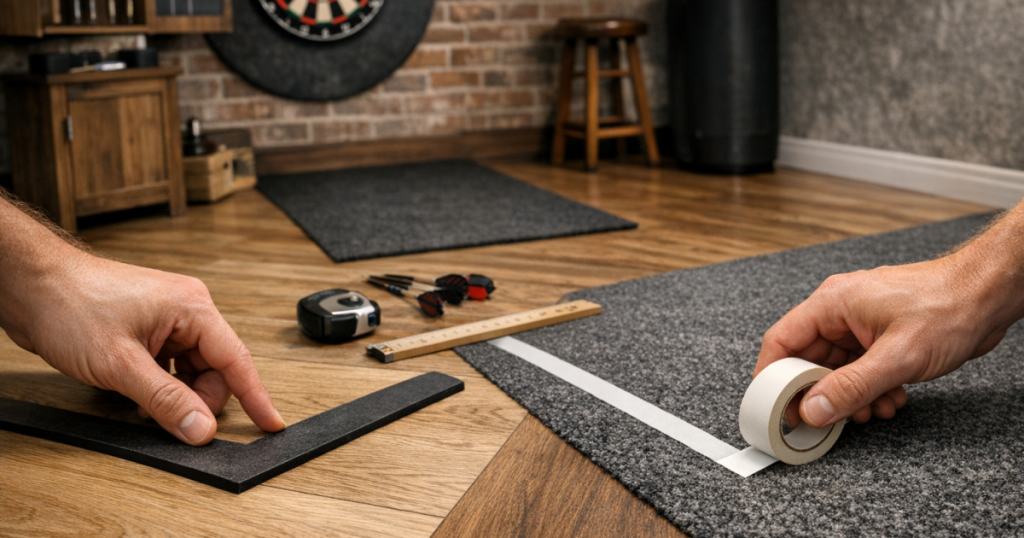
Removable floor marking tape is a better choice if you set up and pack down often. Look for tape described as removable or low-residue rather than heavy-duty. Cut a short strip for the line only; you do not need to tape a large rectangle across the floor.
A loose straight-edge marker
For delicate floors, a loose marker avoids adhesive completely. A thin rubber strip, a flat wooden batten with felt pads, or a purpose-made oche strip can be placed at the throwing distance and lifted afterwards. The important detail is that it must sit flat and not roll underfoot.
Chalk pencil on suitable surfaces
On some matt garage floors or unfinished utility areas, a chalk pencil or tailor’s chalk can make a clear mark that wipes away. Test first, because textured vinyl, pale grout and porous flooring can hold pigment longer than expected.
A darts mat with an oche line
If you want a repeatable line without sticking anything to the floor, a darts mat can be the neatest solution. It protects the standing area, gives a visual throw line and can be rolled away after play. Just make sure it lies flat, does not creep during throwing, and places the oche at the correct distance for your board.
Step-by-step: marking a temporary oche
- Step 1: Confirm the board position. Check that the bullseye is at 1.73 m from the floor. If the board has recently been moved, re-check rather than assuming the bracket is still right.
- Step 2: Measure from the board face. Hook or hold the tape measure at the surface of the dartboard, not the wall or cabinet back. Measure straight out along the floor to 2.37 m for standard steel-tip play.
- Step 3: Mark both ends of the line. Put a tiny temporary reference mark at the left and right side of the intended oche line. This helps you keep the line square rather than slightly angled.
- Step 4: Lay the marker lightly. Place the tape, strip or loose marker across the two reference points. Avoid stretching tape as you apply it because it can lift later or leave a curved line.
- Step 5: Check visibility from standing height. Stand where you throw and make sure the line is easy to see without looking down for too long. A subtle mark is tidy, but it still needs to work during a match.
- Step 6: Test your stance. Step up, throw a few practice darts, and check that your front foot naturally stops behind the line. If you keep overstepping, the marker may be too thin or too low-contrast.
- Step 7: Remove and inspect. After the session, lift the marker and check for residue, lifted fibres or dull patches. If the floor reacts badly, switch to a loose strip or mat.
What to use on different flooring
Carpet
Adhesive tape is rarely ideal on carpet because it can pull fibres, collect fluff and lose grip quickly. A flat strip, a light rubber threshold-style marker, or a darts mat is usually safer. If you do use tape, choose low-tack and remove it the same day.
Laminate and engineered wood
These floors can mark if adhesive is too strong or left in place too long. Avoid anything glossy, thick or industrial. A small low-tack strip may be fine for a short session, but test first in a low-visibility area and lift it slowly along the direction of the board rather than straight upwards.
Vinyl and LVT
Vinyl can be sensitive to adhesive, pressure and heat. Removable tape may work, but do not leave it down under rugs, mats or direct sun. A loose marker is often the least risky option if the floor has a soft or cushioned surface.
Tiles
Tiles are usually forgiving, but grout can stain or collect residue. Keep tape on the tile surface rather than across grout lines where possible. On smooth tiles, make sure the marker is not slippery under shoes.
Garage concrete
Painted or sealed concrete is practical for home darts, but dusty concrete can stop tape sticking cleanly. Sweep and wipe first. If the surface is rough, chalk may be easier than tape, provided it wipes off cleanly.
Avoid these common mistakes
- Measuring from the wall: the dartboard has depth, so this can put the line too far back.
- Using thick raised tape: it can catch the front of a shoe and become annoying or unsafe.
- Leaving tape down permanently: temporary adhesive becomes less temporary over time, especially in warm rooms.
- Choosing a line that blends in: if you cannot see it clearly during a leg, it is not doing its job.
- Ignoring mat movement: if a mat creeps forward, your throwing distance changes without you noticing.
For more on throw-line accuracy and floor movement, the same principles apply to mats as well as tape. The guide to darts mat and oche setup mistakes that affect your throw is worth checking if your stance feels inconsistent even when the distance looks right.
Making the mark match your routine
The right method depends on how often you play. For a one-off night, a short low-tack tape strip may be enough. For weekly home matches, a removable strip or roll-out mat will save time. For a living room setup that has to look normal afterwards, a loose marker kept behind the sofa or beside the board is usually the least intrusive choice.
Think about who uses the room too. If children, pets or guests walk through the area, avoid raised edges and remove the marker after play. If furniture is moved back into place, make sure chair legs or storage boxes are not pressing adhesive into the flooring overnight.
Helpful questions
Can I use masking tape as an oche line?
Yes, for short sessions, but use low-tack masking tape and test it first. Remove it slowly after play and do not leave it on finished flooring for extended periods.
What is the safest no-adhesive option?
A flat loose strip or a roll-out darts mat is usually the safest option for delicate floors. The marker must sit flat and stay in position while you throw.
Should the line be at the front or centre of the marker?
The front edge nearest the dartboard should be the actual oche line. Your foot must stay behind that front edge when throwing.
Why does my measured line still feel wrong?
The board may be set at the wrong height, the distance may have been measured from the wall, or a mat may have shifted. Re-check both height and distance together using the correct dartboard height and oche distance.
Main lessons
A good temporary oche should be accurate, visible and easy to remove. Measure from the board face, choose a floor-safe marker, avoid aggressive adhesives, and check the line after a few throws. If the room changes between sessions, re-measure rather than relying on memory; a minute with a tape measure is better than weeks of practising from the wrong spot.