That faint click at the front of a dart can be maddening, especially when the barrels still feel right in your hand. In most cases, you can fix loose dart points by identifying whether the point has shifted, the barrel nose is dirty, or the press-fit has opened up. The key is to stabilise the point without damaging the barrel or making future repointing harder.
A loose point is not always a sign that your darts are finished. It does, however, deserve attention before it affects grouping, causes odd deflections, or leaves you second-guessing every throw.
The short version
- Stop throwing the dart as soon as you notice movement at the point.
- Check whether the point slides in and out, rotates, clicks, or sits off-centre.
- Clean the point and the barrel nose before attempting any fix.
- Use a dart repointing tool for controlled removal and reseating where possible.
- A tiny amount of suitable retaining compound can help with minor looseness, but it is not a cure for a badly worn barrel bore.
- If the point will not hold securely after cleaning and reseating, replace the point rather than buying a whole new set of darts.
Why dart points work loose
Most standard steel-tip dart points are a press-fit into the front of the barrel. There is no normal screw thread holding them in place. The point is held by friction between the shank of the point and the bore inside the barrel nose, so anything that reduces that tight fit can create movement.
The usual causes are impact, corrosion, dirt, repeated repointing, or a slightly undersized replacement point. Hard misses into brick, tile, concrete floors or metal edges are common culprits in home setups. If your board is close to a hard surface, it is worth reviewing how to choose the safest wall for a dartboard, because poor placement can damage points, flights, shafts and nearby finishes.
Loose points can also appear after storage in damp rooms. Light surface corrosion may not look dramatic, but rust, grime and old adhesive around the barrel nose can interfere with a clean fit. Before reaching for pliers or glue, work out exactly what kind of movement you are dealing with.
How to fix loose dart points cleanly
Start with the least aggressive fix. The aim is to restore a secure fit while keeping the barrel usable for future maintenance. A dart that has been flooded with glue, crushed at the nose, or scarred by pliers can be much harder to service later.
Step 1: confirm the point is actually loose
Hold the barrel firmly and grip the point near the nose with your fingers, not pliers. Try three gentle checks:
- Push-pull movement: does the point slide in or out, even slightly?
- Rotation: does it twist independently of the barrel?
- Side movement: does it rock or click when pushed gently from side to side?
If the point only feels rough or bent but does not move in the barrel, you have a different problem. A bent or burred point can still enter the board badly, but tightening the barrel fit will not fix the shape of the point itself.
Step 2: clean the barrel nose and exposed point
Wipe the exposed part of the point with a clean cloth. If there is oil, wax, dirt or rust staining around the nose, clean it carefully with a small amount of isopropyl alcohol on a cloth or cotton bud. Keep liquid use minimal and dry the area fully before doing anything else.
Avoid sanding the barrel nose unless you know exactly what you are removing. It is easy to mark a tungsten barrel or change the clean edge at the front. For the point itself, very light cleaning is fine, but deep corrosion, flaking or a visibly narrowed shank means the point is unlikely to hold reliably for long.
Step 3: reseat the point with controlled pressure
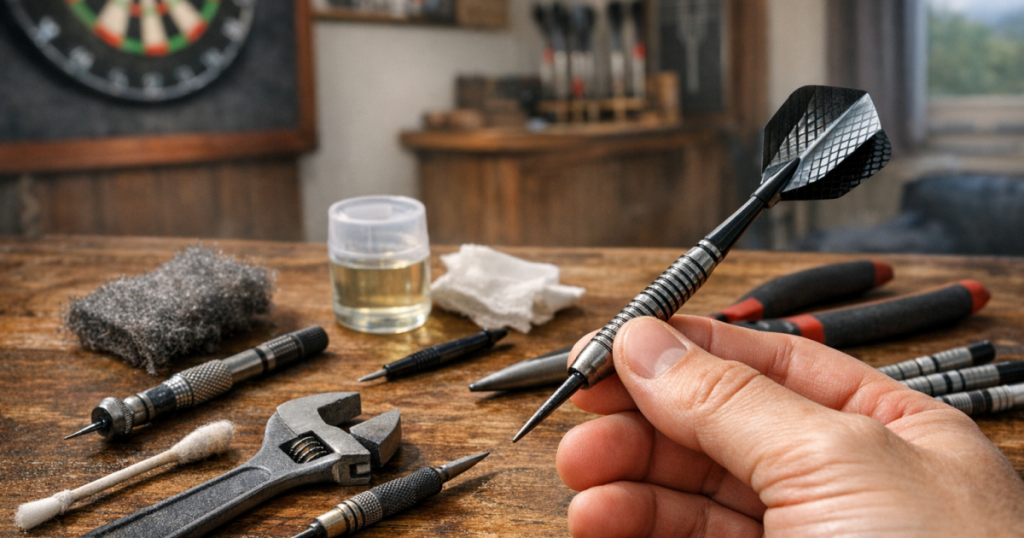
If the point has crept out by a fraction of a millimetre but still grips, reseating may solve it. The cleanest method is to use a proper dart repointing tool, because it applies force in line with the barrel and reduces the chance of bending the point or marking the barrel.
With a repointing tool, secure the barrel as instructed by the tool maker, align the point straight, and press it back into place gradually. Do not force it past its natural seating position. The point should sit squarely, with no visible gap at the barrel nose unless that point design normally leaves one.
If you do not have a repointing tool, do not clamp the point in household pliers and twist aggressively. Pliers can score the point, flatten it unevenly, or encourage it to bend. A rubber grip or cloth can help you test movement by hand, but controlled reseating is much safer than improvised levering.
Step 4: consider a tiny amount of retaining compound
For minor looseness, some players use a small amount of suitable retaining compound on the shank of the point before reseating it. This is a careful repair, not a way to pack out a badly worn barrel. Use only a tiny amount and keep it away from the outside of the barrel, grip cuts and the visible point surface.
The important detail is restraint. Too much compound can squeeze out, look messy, or make later repointing more awkward. Follow the product’s curing instructions rather than throwing straight away. If the compound has not cured properly, the point may shift again and contaminate the board face.
Cyanoacrylate adhesive is sometimes used as a quick fix, but it can be brittle and unforgiving. If you use any adhesive-style product, treat it as a controlled, minimal repair. Do not use it to hide a serious fit problem.
Step 5: test before returning to normal practice
Once the point is reseated and any compound has cured, test it by hand first. Push and twist gently at the point. Then throw a few controlled darts into the board rather than starting with a hard scoring session.
After the first few throws, check the point again. If it has moved, clicked, or left a visible gap, stop. Repeating the same repair without finding the cause usually makes the fit worse.
When a repair is not enough
A loose point does not mean you need to replace your darts, but it may mean the point itself needs replacing. That is a normal maintenance job for steel-tip darts and is far cheaper than retiring a set of barrels you like.
Replace or professionally repoint the dart if you notice any of these signs:
- The point slides out with finger pressure.
- The point rotates freely after cleaning and reseating.
- The barrel nose looks widened, cracked or visibly damaged.
- The point is bent, badly rusted, deeply scratched or uneven.
- The dart has already had several failed adhesive repairs.
- Two or three points in the same set have loosened after repeated hard impacts.
If the barrel bore is worn, a fresh point of the correct type may hold better than the old one. If the barrel itself is damaged, there may be no reliable home fix. The practical decision is whether you are preserving a favourite set or chasing a temporary repair that will keep failing.
Common mistakes that make loose points worse
- Twisting with pliers: this can score the point and increase wobble.
- Hammering the point directly: impact can bend the point or damage the barrel nose.
- Using too much adhesive: excess can seep, cure unevenly and complicate future repointing.
- Ignoring rust: corrosion can stop the point seating cleanly and may spread to other darts in the case.
- Throwing to test a known loose point: this can enlarge the fit problem and damage the board.
The best repairs are boringly neat: clean parts, straight alignment, small movements and a final check before throwing properly again.
Preventing the problem coming back
Loose dart points often come from the way darts are stored and the surfaces they hit when they miss. A snug case helps stop barrels knocking together in a bag or drawer. If your darts rattle about between sessions, making foam inserts for your dart case can be a simple way to protect points, barrels, stems and flights.
Environment matters too. Garages, sheds and utility rooms can be perfectly good darts spaces, but damp air is hard on metal parts. Wipe darts after play, store them dry, and check for early rust before it reaches the point shank. For a fuller prevention routine, see how to stop darts rusting in a damp garage.
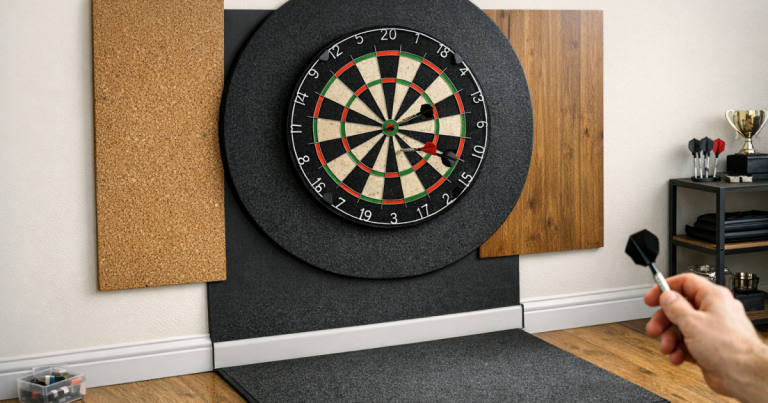
It is also worth looking at your missed-dart zone. A surround, cabinet, soft backing area or better room layout can reduce harsh impacts. If points are repeatedly hitting masonry, radiator edges, tile or bare floor, the repair is only part of the answer.
Straight answers
Can I keep playing with a slightly loose point?
It is better not to. Even slight movement can affect how the dart enters the board, and repeated impacts can make the fit looser. Stop, check it, and repair it before normal practice.
Do I need to replace the whole dart?
Usually, no. In many cases the point can be cleaned, reseated or replaced while keeping the same barrel. Only consider replacing the dart if the barrel nose or internal fit is too damaged to hold a point securely.
Is glue a good permanent fix?
Glue can help with a minor fit issue, but it is not a substitute for a properly seated point. Use the smallest amount possible and avoid relying on adhesive if the point is visibly loose or the barrel bore is worn.
Why did the point loosen after repointing?
The replacement point may not have seated fully, the barrel bore may already be worn, or the point shank may not be the right fit for that barrel. Clean fitting and straight pressure matter more than force.
The big picture
A loose dart point is a maintenance problem, not a reason to abandon a set of barrels you enjoy throwing. Diagnose the movement, clean the parts, reseat the point with controlled pressure, and use retaining compound only for small fit issues. If the repair will not hold, replace the point rather than repeatedly forcing a failing fix.
The wider setup matters as much as the repair. Dry storage, a protected missed-dart area and careful transport all reduce the impacts and corrosion that make points loosen in the first place.