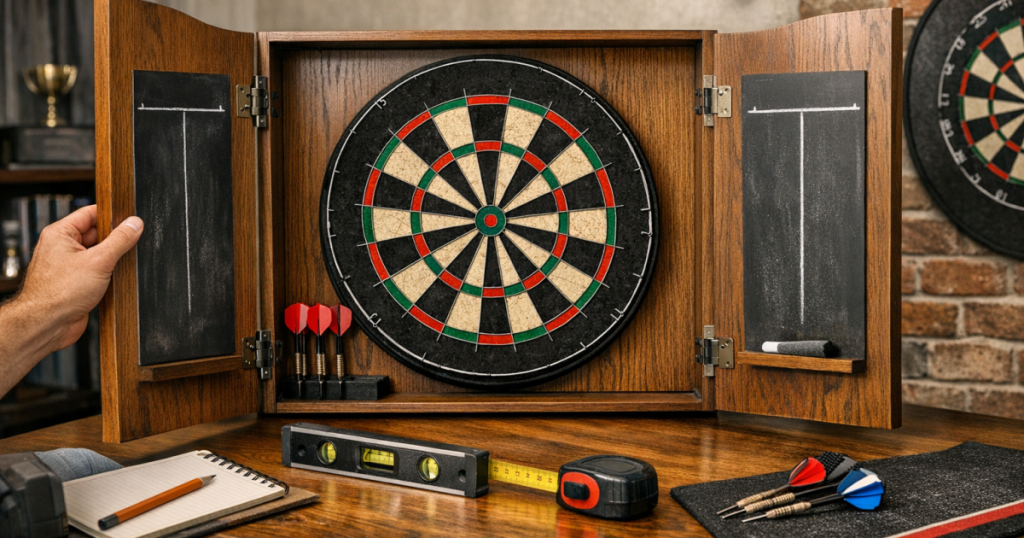
A cabinet can make a home board look tidier, keep darts and chalk close to hand, and give the setup a more finished feel. Before buying a dartboard cabinet, check the board fit, wall space, door clearance, scoring layout and how much protection you actually need. A good choice should work with your room, not just look smart in a product photo.
The main mistake is treating the cabinet as a decorative extra. In a proper home darts setup, it affects access to the board, how you score, where your darts live, and whether the surrounding wall still needs extra protection.
The checks that matter most
- Confirm whether the cabinet is supplied with a board or is cabinet-only.
- Check that it suits a standard steel-tip bristle board, if that is what you use.
- Measure the wall space with both doors fully open.
- Think about stray-dart protection beyond the cabinet edges.
- Check the scoring surfaces, chalk or marker compatibility, and visibility.
- Look at storage for darts, spare flights, stems, chalk and small tools.
- Match the finish to the room, especially if it is in a shared living space.
Start with board compatibility
Some cabinets are sold as complete sets, while others are only the wooden enclosure. That distinction matters because many home players already own a board they like and do not want to downgrade simply to get a tidier wall setup. Read the product listing carefully and check what is actually included in the box.
If you already have a bristle board, confirm that the cabinet is intended for a standard steel-tip board and that the mounting arrangement will not interfere with your existing bracket. Avoid assuming all boards and cabinets are automatically interchangeable. They often are, but it is still worth checking before you buy, particularly with older boards, budget sets or cabinets bundled with their own fixing hardware.
For a deeper overview of where cabinets sit alongside surrounds, backboards and wall protection options, the cabinet and surround basics are worth reading before you commit to a layout.
Measure the full open width, not just the closed cabinet
A closed cabinet can look compact, but the doors need room to swing open without hitting shelves, curtains, pictures, radiators or a nearby corner wall. Measure the available space across the wall and mark the likely open-door width with low-tack tape if you are not sure. This is especially useful in spare bedrooms, garages and narrow utility rooms where the board may share space with furniture or storage.
Also check that the doors will not block the throwing line view. A cabinet tucked into an alcove may technically fit, but if one door sits at an odd angle or throws a shadow across the board, it can become irritating very quickly. Leave enough breathing space around the cabinet so you can stand back, check the score and retrieve darts without feeling boxed in.
Decide whether a cabinet gives enough wall protection
A cabinet protects the area immediately around the board when the doors are closed, but it is not the same as a full surround when play is underway. With the doors open, the side panels may catch some wide throws, yet the wall above, below and beyond the doors can still take hits from bounce-outs or beginner misses.
If the setup is for experienced throwers in a controlled practice space, a cabinet alone may be enough. If it is for family use, casual visitors or a freshly painted wall, consider whether a separate surround, backboard or larger protective panel makes more sense. The decision is less about pride and more about who will actually be throwing.
- Cabinet only: neat appearance, built-in scoring, modest side protection.
- Surround only: better all-round board-edge protection, less storage and no doors.
- Cabinet plus extra backing: tidier storage with wider protection, but needs more wall space.
Check the scoring setup before you fall for the finish
Many cabinets include scoring panels inside the doors, commonly chalkboard-style or wipe-clean surfaces. Before buying, look at how you prefer to score. If you use chalk, check whether the supplied surface is suitable and whether there is a chalk rail or storage spot. If you prefer dry-wipe markers, check that the surface is intended for that use and that replacement pens will be easy to store nearby.
For practice routines, a simple score area may be fine. For legs, checkouts and structured sessions, you may want enough space for names, running scores and a checkout column. If you like a more organised scoring layout, use the inside of the doors well rather than treating them as decorative panels.
Storage is part of the same decision. A cabinet that looks excellent but has nowhere convenient for spare flights, stems or a sharpener can still leave you hunting through drawers mid-session. If you enjoy a tidy setup, our guide to fitting accessory hooks inside a cabinet gives you a simple way to improve organisation without overcomplicating the space.
Look at construction and finish honestly
Cabinets vary from lightweight starter options to heavier, more furniture-like designs. You do not need the most expensive model, but you do want doors that hang straight, hinges that feel secure, and a finish that will tolerate regular opening and closing. Product photos can hide a lot, so read buyer feedback for comments about door alignment, damaged corners, flimsy backs and difficult assembly.
Finish matters more than many players expect. A black or dark wood-effect cabinet can suit a games room, while a plainer wood finish may blend better in a dining room, hallway or spare bedroom. If the board is in a shared space, choose something the household can live with when darts are not being played.
Named examples such as the Winmau Professional Dartboard Cabinet, Target Darts Arc Cabinet and Unicorn Striker Dartboard Cabinet show the kind of real-world options you might compare, but do not buy on brand name alone. Check the current listing for included parts, finish, board compatibility, scoring surfaces and fixing requirements before ordering.
Think about lighting before you fix anything to the wall
A cabinet changes the way light reaches the board. The open doors can create side shadows, and a ceiling light behind the thrower can still cast the familiar head-and-shoulder shadow across the treble bed. Before drilling holes, stand where you will throw from and check how the light behaves at different times of day.
If you plan to add a ring light or dedicated board light later, check whether it will fit comfortably with the cabinet doors open. Some lighting systems sit close to the board, while others need more clearance around the outside. The best time to plan this is before the cabinet goes up, not after you have already centred everything on the wall.
For a cleaner practice setup, the guide to adding dartboard lighting without glare or shadows will help you avoid the most common placement mistakes.
Check the mounting position and throwing area together
The cabinet is only one part of the setup. You still need the correct board height and a clear throwing distance, plus enough room for a mat or marked oche. Before buying, confirm that the cabinet can sit at the right height without clashing with dado rails, shelves, sockets, pipework or sloping ceilings.
Door depth also matters. If the cabinet projects from the wall, it can feel more intrusive in a narrow room. That may not affect the throw itself, but it can affect how comfortable the space feels when people walk past. In a small UK spare room, a slightly slimmer design may be more practical than a chunkier cabinet that looks better online.
Budget for the whole setup, not just the cabinet
It is sensible to set a budget in £ for the full wall area rather than spending everything on the cabinet alone. You may still need a decent bristle board, better fixings, a surround, a mat, lighting, chalk, markers or small storage extras. A cheaper cabinet with a better board can be a stronger setup than an expensive cabinet paired with a poor playing surface.
Also consider whether you are buying for looks, function or both. A cabinet in a living area has to earn its place visually. A garage or practice room cabinet can be judged more heavily on durability, storage and easy scoring.
Common questions
Do dartboard cabinets fit all bristle boards?
Not always. Many are designed for standard steel-tip bristle boards, but you should still check the product listing, mounting method and whether a board is included.
Is a cabinet better than a surround?
It depends on the problem you are solving. A cabinet adds doors, scoring and storage; a surround usually gives better protection around the board during play.
Can I use a cabinet in a small bedroom?
Yes, provided the doors can open fully and the throwing area remains clear. Measure the open width and the room layout before ordering.
Should I buy a cabinet set with a board included?
It can be convenient for a first setup, but check the quality of the included board. If you already own a good bristle board, cabinet-only may be the better route.
Will a cabinet stop all wall damage?
No. It helps tidy the setup and may catch some stray darts, but wide misses can still hit the surrounding wall unless you add wider protection.
The big picture
The best cabinet is the one that fits your board, your wall and your throwing routine without creating new annoyances. Measure carefully, check what is included, think about protection during real play, and plan scoring, storage and lighting before the cabinet is fixed in place. Get those basics right and the cabinet becomes a useful part of the setup rather than just a smart-looking box around the board.