A few missed darts are part of home practice, but repeated wall marks soon make a darts area look tired. That is where cork dartboard backboards and foam surrounds come in: both protect the wall, but they do it with different levels of coverage, permanence and visual impact.
The better choice depends on your room, how often you play, and whether you want a neat fitted look or a wider protective zone. For many home setups, foam is the easier solution. For garages, shared games rooms and beginner-heavy boards, cork can make more sense because it can cover a larger area around the board.
The short version
Choose a cork backboard if you want broad wall protection, a more customised shape, or a surface that can blend into a larger darts feature wall. Choose a foam surround if you want something quick, removable and made specifically to sit around a standard dartboard.
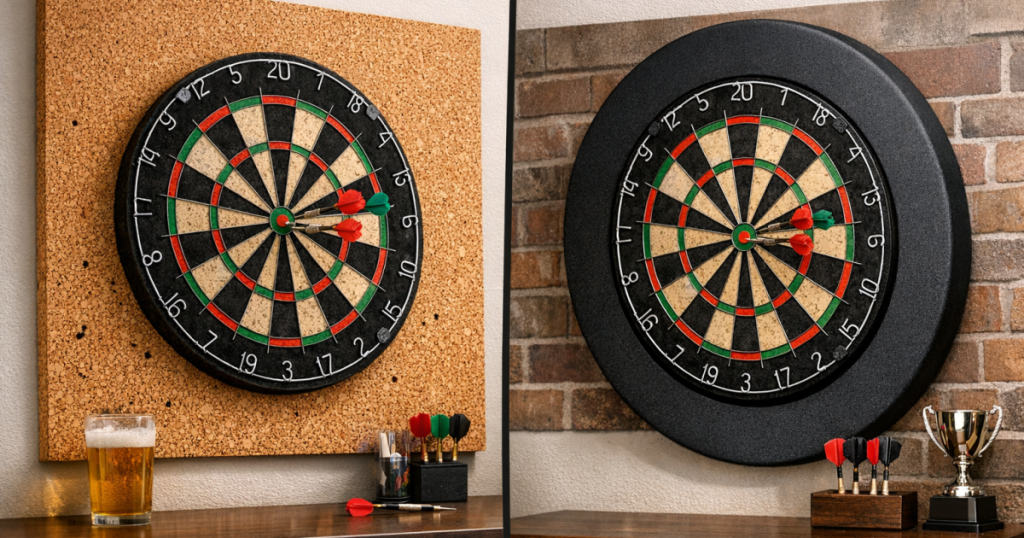
Neither option is automatically better. A foam ring protects the immediate missed-dart zone around the board, which is where most near misses land. A cork panel can protect much more of the wall, but it needs careful positioning, secure fixing and enough thickness to stop darts reaching the wall behind.
- Best for quick setup: foam surround.
- Best for wider protection: cork backboard.
- Best for rented homes: usually foam, provided it fits securely and does not need permanent fixing.
- Best for a garage or games room: cork, foam, or a combination of both depending on wall size and humidity.
- Best for a tidy minimal look: a close-fitting foam surround or a neatly cut framed cork panel.
How each option protects the wall
Foam surrounds
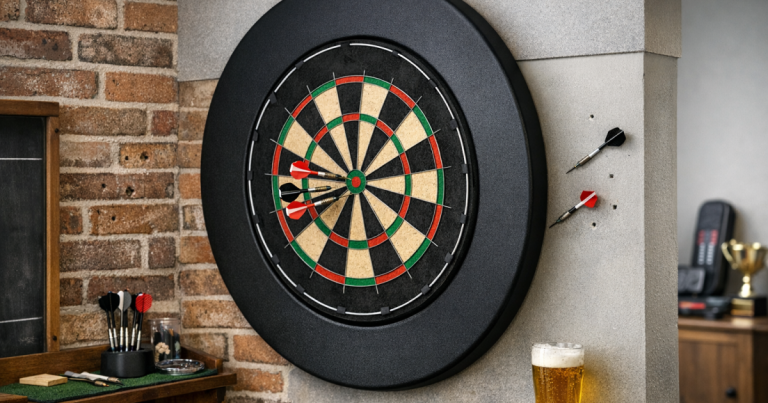
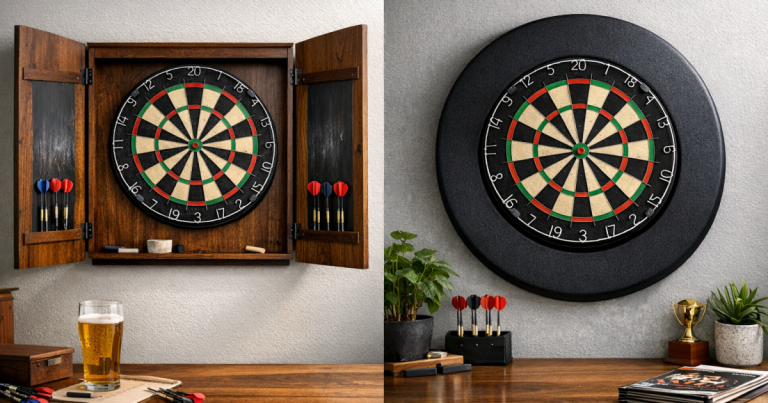
A foam surround is usually a ring or multi-piece guard that sits around the dartboard. It is designed to catch darts that narrowly miss the scoring area. Because it is shaped for the board, it can look tidy with very little measuring. You normally remove the board, place the surround behind or around it according to the design, then refit the board.
The strength of foam is convenience. It is lightweight, quick to take down and does not usually change the footprint of the darts area very much. That makes it ideal in living rooms, spare rooms and shared spaces where you want wall protection without building a dedicated feature wall.
The limitation is coverage. A foam surround protects the zone close to the board, not the whole wall. If beginners, children under supervision, or casual guests are throwing, the missed darts may travel further out than a standard surround covers. In that case, you may still get marks beyond the edge.
Cork panels and backboards
Cork works differently. Instead of hugging the board, it creates a larger sacrificial surface behind it. You can use a single board, multiple tiles, or a framed panel. This gives you more freedom over width, height and style, but it also means you need to plan the setup rather than simply fitting a pre-shaped guard.
Cork dartboard backboards are particularly useful when the wall is vulnerable, freshly decorated, uneven, or part of a garage setup where a practical finish matters more than a slim living-room look. They can also suit a wider darts station with a scoreboard, oche marker and accessory storage nearby.
The main caution is thickness and wall contact. Thin cork tiles may stop scuffs but may not reliably stop a dart point from reaching the wall behind, especially with heavier darts or a firm throw. A backboard should be thick enough, dense enough and mounted flat enough to catch misses without flexing or leaving gaps.
Where cork is genuinely better
Cork earns its place when you need more than a narrow halo of protection. If your dartboard is used by mixed-ability players, or if the board sits in a garage, utility area or family games room, wider coverage can save a lot of repainting.
- Beginner sessions: a larger cork area gives more forgiveness for low, wide or nervous throws.
- Shared rooms: a panel can define the darts area visually and stop random wall marks spreading across the room.
- Garage walls: cork can cover rougher surfaces and make the board area feel more finished.
- Scoreboard zones: if you keep chalk, dry-wipe scoring or accessories near the board, a wider panel can make the setup feel organised.
- Custom layouts: cork can be cut or arranged to suit alcoves, awkward walls and boards mounted on backing timber.
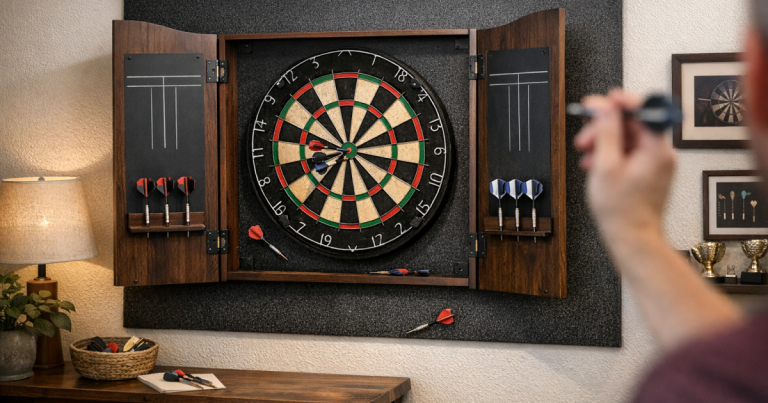
Cork is also useful when you want the dartboard to sit within a broader wall feature. For example, a rectangular cork area behind the board can be framed with timber trim and painted walls around it. That can look more deliberate than a small ring floating on a large blank wall.
Before committing to a larger backboard, check that the wall itself is suitable for a dartboard position. Height, surrounding space, nearby furniture and throw line clearance matter just as much as wall covering. If the room layout is still being decided, start with choosing the right wall for your dartboard before cutting or fixing any panels.
Where foam still has the edge
Foam surrounds are popular for good reason. They solve the most common wall-protection problem with minimal effort: darts missing by a few centimetres. For a competent home player practising regularly, that may be all the coverage needed.
Foam also suits rooms where appearance and reversibility matter. A well-fitting surround keeps the board area compact, and many designs can be removed without leaving a large backing panel behind. That is helpful if the dartboard is in a lounge, dining space or spare bedroom rather than a dedicated darts room.
- Fast fitting: less measuring, cutting and layout work than a cork panel.
- Low visual bulk: the surround follows the board shape rather than covering a rectangle of wall.
- Easy replacement: individual surrounds are simple to swap when worn.
- Good for confident throwers: most close misses land within the ring.
- Cleaner temporary setup: useful when the darts area is not permanent.
If you are leaning towards foam but want a clearer idea of fit and wall coverage, the fitted surround review is a useful next read because it shows the type of protection a surround is designed to provide.
Step-by-step: decide which one suits your setup
1. Mark the realistic missed-dart zone
Stand at the throw line and look at where missed darts actually land during normal play. Do not plan only for your best throws. Think about guests, warm-up darts, bounce-outs and tired practice sessions.
If nearly every miss lands close to the board, foam is likely enough. If darts often land well outside a surround-sized area, cork gives you a safer margin.
2. Measure the wall, not just the board
A standard dartboard does not need much visual space, but safe and practical wall protection does. Measure the area available to the left, right, above and below the board. Check switches, sockets, shelves, pictures and doorways. A backboard that looks good in isolation may be awkward if it crowds nearby furniture or clips a light switch.
3. Check the surface you are fixing to
Foam surrounds rely on the board and wall area being reasonably flat. Cork panels need a more deliberate fixing method, especially if they are large. Plasterboard, masonry and timber backing all behave differently, so use fixings suited to the wall type and check for hidden cables or pipework before drilling.
4. Think about throw strength and dart type
Steel-tip darts can drive into soft materials with more force than expected. Heavier darts and direct hits near the same spot will wear protection more quickly. Foam is made for this purpose, while cork depends heavily on density and thickness. Very thin decorative cork is not the same as a protective darts backboard.
5. Decide whether the darts area is permanent
A permanent garage or games-room setup can justify a framed cork board, painted trim and a larger protective layout. A board in a multi-use room may be better with a removable foam surround and a clean throw line solution.
If you are planning the whole area, protection should work alongside lighting rather than after it. A backboard that casts shadows or reflects light can make doubles harder to see, so pair the wall choice with glare-free dartboard lighting before finalising the layout.
Examples that make the decision easier
The spare-room practice board
For a solo player using a spare bedroom, foam is usually the neater option. The missed-dart pattern is likely to be tight, and the room may still need to look like a normal living space when the board is not in use. A surround protects the obvious risk area without making the setup feel overbuilt.
The family games room
A cork backboard becomes more attractive when lots of different people use the board. New throwers do not always miss neatly. A wider panel behind the board reduces worry and makes the darts corner feel intentional rather than improvised.
The garage setup
Garages often suit cork because the wall may already be marked, rough or functional. A bigger protective board can cover imperfections and provide a clear darts zone. The main checks are damp, wall flatness and secure fixing. Cork should not sit against a surface that regularly gets damp, as that can shorten its life and spoil the finish.
The rented home
Foam is usually easier to justify in a rented property because it avoids a large fixed panel. That said, every setup still needs a properly mounted dartboard, and any fixing should comply with the tenancy agreement. If wall marks are a major concern, a freestanding dartboard stand may be more suitable than either cork or foam fixed to the wall.
Common mistakes to avoid
- Using thin craft cork as impact protection: it may look right, but it may not stop dart points reaching the wall.
- Making the backboard too small: if it is barely larger than the board, it loses the main advantage over foam.
- Ignoring the bottom area: low misses and bounce-outs can mark below the board, not just to the sides.
- Leaving gaps behind cork: flexing panels can feel poor and may reduce protection.
- Forgetting lighting: a dark or shadowed board is frustrating, however well protected the wall is.
- Overbuilding a temporary setup: a heavy framed panel may be unnecessary if you only play occasionally.
Key questions answered
Will cork stop dart points completely?
It can, but only if the cork is thick and dense enough for darts use and is backed properly. Thin cork tiles are often intended for noticeboards or decoration rather than repeated dart impact. If you use cork, treat thickness, density and backing as practical checks rather than assumptions.
Do foam surrounds damage darts?
A good foam surround is designed to catch missed darts without presenting a hard surface. As with any wall protection, wear will build up over time in frequently hit areas. If darts begin to fall out easily or the material crumbles, it is time to replace or rethink the protection.
Can you use cork and foam together?
Yes. A foam surround over a larger cork backboard can give a tidy board edge and wider protection beyond it. This is a sensible approach for busy home setups, though it can look bulkier than either option alone. Keep the board face flush and stable so the added layers do not affect how the board sits.
Which looks better?
Foam usually looks cleaner in compact rooms because it follows the dartboard shape. Cork can look better when it is designed as a feature: straight edges, balanced proportions, a frame, and enough surrounding space. Poorly cut cork tiles can look messier than a simple surround.
The big picture
Foam surrounds are the straightforward answer for most neat home dartboard setups. They are compact, purpose-made and easy to live with. Cork dartboard backboards are better when you need wider coverage, a custom wall area or a more robust visual boundary for a busy darts space.
The best choice is not about which material sounds tougher. It is about the missed-dart pattern, the wall surface, the room use and how permanent the setup needs to be. If you are protecting a small, tidy practice board, foam will usually do the job. If you are building a proper darts corner for mixed players, cork deserves serious consideration.
Whichever route you choose, plan the whole setup together: board height, wall choice, lighting, throw line and nearby furniture. Wall protection works best when it is part of the layout, not an afterthought added once the first holes appear.