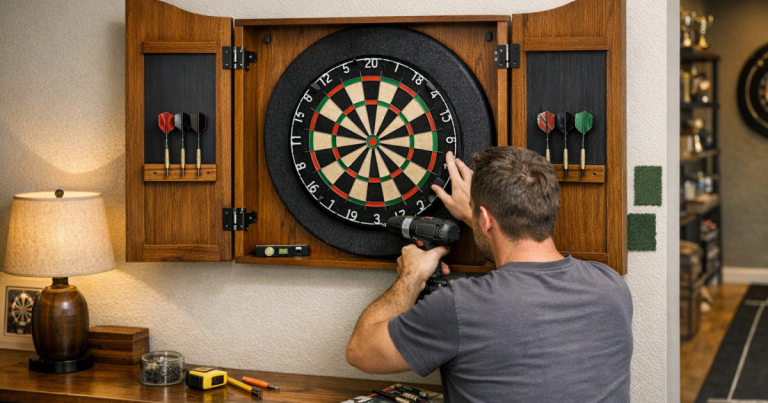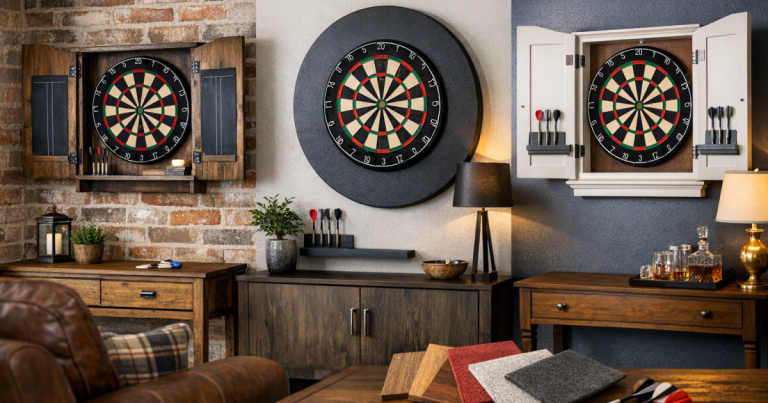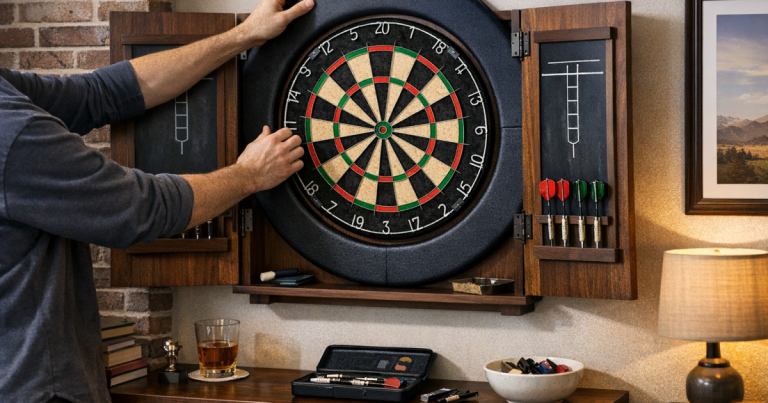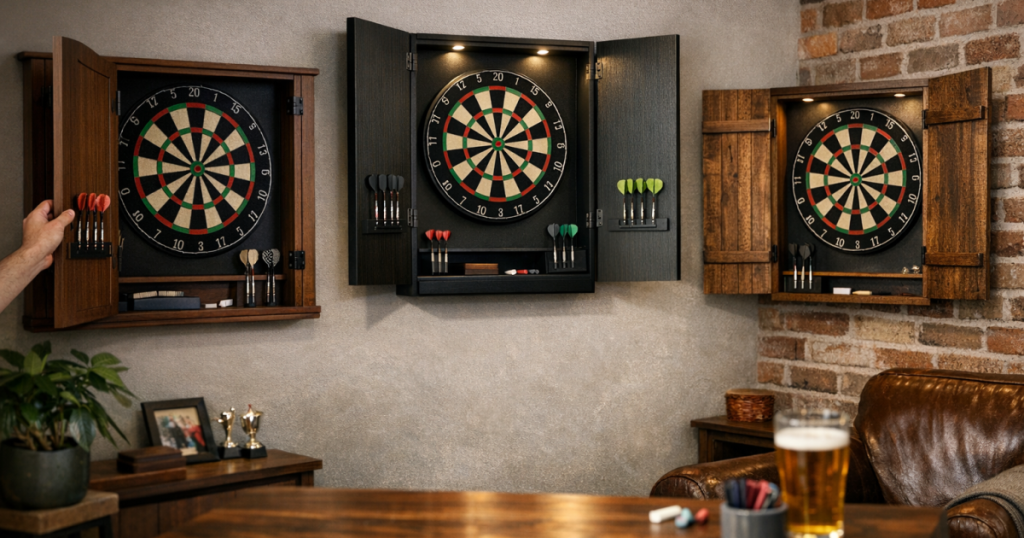
A dartboard cabinet can make a home board look deliberate rather than temporary, but it also changes how the board sits, how much wall is protected and where your darts live. The best fit is the one that works with your room, not just your board.
Before choosing a style, look at the wall, the furniture around the throwing lane, the way people move through the room and whether you want the setup to disappear when the doors are shut. Small details decide whether the cabinet feels smart or awkward.
What to know first
- Start with the room layout, not the finish. A cabinet that looks great online can feel bulky if the doors clash with shelves, curtains or a nearby corner.
- Check how the board, number ring and any surround sit inside or around the frame before committing.
- Think about storage as part of the setup: spare flights, shafts, chalk, markers and a small checkout card all need somewhere sensible to live.
- Door swing matters. Open cabinet doors can affect lighting, block a scoreboard or make a narrow room feel more cramped.
- Wall protection is useful, but a cabinet is not always a full substitute for a surround or backboard if your group includes newer players.
Start with the room, not the cabinet
A dartboard cabinet is partly furniture and partly playing equipment, so it has to suit both the look of the room and the way people throw. In a dedicated games room, you might be happy with a darker, more traditional cabinet that stays open most of the time. In a living room, dining area or home office, a cleaner finish with doors that close neatly may matter more.
Stand where the board will go and look at what sits either side of it. Radiators, bookcases, curtain poles, alcoves and wall-mounted televisions can all limit how wide the doors can open. Also check the space below the board. A cabinet can make the board area look tidy, but it will not fix a cramped throw line, an awkward sofa position or a walkway that people constantly cross.
If your setup is in rented accommodation, the decision is slightly different. You may prefer a lighter-looking arrangement, fewer wall marks and a layout that can be removed cleanly later. For that kind of planning, the advice on planning a darts setup in a rented home is a useful companion before you drill, hang or rearrange anything.
Match the cabinet to your board and playing style
Most home players using a standard bristle board want the cabinet to frame the board without hiding any part of the scoring area. If you already own a board such as the Winmau Blade 6 Triple Core, check the cabinet is intended for a standard bristle dartboard and that there is enough clearance around the outer number ring. Do not assume every cabinet, surround and lighting accessory will sit together neatly just because each one fits a dartboard on its own.
Think about how often the board will be rotated, too. A cabinet should not make routine board rotation a chore. If you need to remove awkward clips, shift a light or squeeze your fingers behind the frame every time, maintenance is more likely to be ignored. A good room-friendly setup lets you rotate the board, clear dust and tidy accessories without dismantling half the wall.
Cabinets can also change the feel of the throw. A deep frame may make the board appear more recessed, while a very shallow frame can leave less visual separation between the board and the surrounding wall. Neither is automatically better; the right choice is the one that keeps the board easy to read and comfortable to focus on from the oche.
Decide how much wall protection you really need
A cabinet gives some protection to the wall immediately around the board, especially when the doors are open. That can be enough for careful adult players with a consistent throw. It may be less forgiving for beginners, children, parties or casual games where stray darts are more common.
If your wall already has marks, or the board is going near fresh paint, wallpaper or plasterboard, think about whether a surround or wider backboard is more suitable. The cabinet may look tidier, but its protection is usually concentrated close to the board. A surround covers a different area and can be easier to remove, replace or clean depending on the material.
The main practical check is whether the cabinet and surround can work together without crowding the doubles. If you want the extra protection of a ring around the board, read the guide to fitting a dartboard surround without blocking doubles before you treat the cabinet as the only wall-protection decision.
Storage should be useful, not just decorative
One of the biggest reasons to choose a cabinet is to stop darts kit spreading across shelves, mantelpieces and drawers. The most useful storage is simple: somewhere for two or three sets of darts, a place for spare flights and shafts, and a scoring area or holder that is visible when the doors are open.
Look at your actual habits. If you swap stems often, keep different flight shapes to hand or play with guests, shallow token storage may not be enough. If you use one set of darts and rarely change anything, oversized storage can be unnecessary clutter. Cabinet storage works best when it supports the way you play rather than trying to hold every accessory you own.
Flights are easy to crush if they are pushed into a narrow ledge or left loose behind a door. Spare shafts, points tools and chalk also need to be held securely so they do not rattle or fall when the doors open. For a more organised approach, the dartboard cabinet storage and organisation guide goes deeper into what to keep near the board and what is better stored elsewhere.
Think about scoring before the cabinet goes up
Traditional cabinets often include score panels on the inside of the doors. That is convenient, but it only works if everyone can see the scores without stepping into the throwing lane. In a narrow room, a door-mounted scoreboard may face the wrong angle for spectators or the player waiting next.
If you prefer chalk scoring, check that the panel surface is practical to clean and that chalk dust will not drop directly onto soft furnishings. If you use a whiteboard marker, confirm the surface is intended for that use rather than assuming any glossy panel will wipe clean nicely. Where the cabinet has no built-in scoring area, leave space nearby for a separate scoreboard that can be read from the oche and the seating area.
Also consider left-handed and right-handed players. A scoring panel on one door may be perfect for one side of the room and awkward on the other. The best arrangement is the one that keeps the scoring routine natural without making players walk across the throw line after every visit.
Door swing, depth and furniture clashes
Cabinet doors are easy to overlook until the board is on the wall. Open the imaginary doors in your head before choosing the size and position. Will they hit a light switch, picture frame, curtain, shelf or speaker? Will one door be trapped against an alcove wall? Can someone still pass behind the thrower when the doors are open?
Depth matters as well. A deeper cabinet may feel more substantial and can help hide the board when closed, but it may project too far in a hallway or multi-use room. A slimmer cabinet can look neater, though it may offer less storage or less clearance around accessories. In smaller British homes, where a darts setup often shares space with everyday furniture, a few centimetres of projection can make a noticeable difference.
If the cabinet is going above a sideboard, desk or radiator cover, check sightlines from the oche rather than simply centring it over the furniture. The board height and throw line still come first. A cabinet that is visually centred on the room but awkward for play will annoy you every session.
Lighting can make or spoil the setup
A cabinet can cast shadows if the room lighting is behind the thrower or above the board at the wrong angle. Open doors may also block side light. Before settling on a cabinet style, think about how the board will be lit when the doors are open, because that is when the setup actually has to perform.
Ring lights and cabinet frames do not always play nicely together. If you plan to use a dedicated light such as the Target Corona Vision, check the manufacturer’s fitting guidance for both the light and the cabinet. Pay attention to whether the light needs space around the board, whether the doors can still open fully and whether cables can be routed neatly without being pinched.
Room lighting is not only about brightness. Colour, glare and shadow all affect how easy the treble bed is to read. If you are building the whole area from scratch, the guide to dartboard lighting brightness, colour temperature and placement will help you plan the light before the cabinet fixes the board area in place.
Choose a finish that belongs in the room
Cabinets tend to sit in one of three visual camps: traditional wood-effect, plain dark finishes and cleaner modern designs. Traditional styles can suit pubs, games rooms and rooms with darker furniture. Black or grey finishes often work well with modern boards and minimal rooms. Lighter finishes can soften the look, although they may show marks more readily in busy spaces.
Try to match the cabinet to existing furniture rather than the dartboard alone. If the room has oak shelving, black metal furniture or painted fitted units, use those cues. A cabinet that feels connected to the room is less likely to look like a random sports accessory fixed to the wall.
Door fronts matter when the setup is closed. If guests or family see the cabinet more often closed than open, the outside appearance may matter more than the internal graphics. Avoid overly loud designs in shared rooms unless that is genuinely the look you want every day.
Small checks before you commit
- Measure the wall space with the cabinet doors open, not just closed.
- Confirm the board, mounting bracket and number ring will sit correctly inside the frame.
- Check whether your chosen surround, light or scoreboard will clash with the cabinet.
- Make sure the throwing lane remains clear once nearby furniture is back in place.
- Look for storage that suits your real kit: darts, spare flights, shafts, chalk or markers.
- Consider how easy it will be to rotate the board and clean around the cabinet.
- Pick a finish you can live with when the doors are closed, not just one that looks good during play.
Things readers ask
Is a cabinet enough to protect the wall?
It can be enough for accurate players, but it will not protect as wide an area as a surround or backboard. If beginners or guests use the board, extra wall protection is usually more forgiving.
Can I use a cabinet with a dartboard surround?
Sometimes, but it depends on the cabinet shape, door clearance and surround thickness. Check that the surround does not push into the scoring area or stop the doors opening properly.
Should the scoreboard be inside the cabinet?
It is convenient, but not always ideal. If the inside of the door faces away from players or spectators, a separate scoreboard in a clearer position may work better.
Are cabinets suitable for small rooms?
Yes, provided the doors can open without hitting furniture and the cabinet does not project into a walkway. In tight rooms, a slimmer cabinet or a surround-only setup may feel less intrusive.
Do I need special lighting with a cabinet?
Not always, but you do need even light across the board. Check for shadows from open doors and make sure any ring light or wall light has enough clearance.
Final thoughts
The right cabinet should make your darts area look tidier, protect the most vulnerable wall space and keep everyday accessories close without making the room harder to use. Treat it as part of the full setup rather than a decorative box around the board.
Start with the wall, the door swing, the lighting and the way people move through the room. Once those basics work, style becomes the enjoyable part: choosing a finish that suits your space and makes the board feel properly at home.