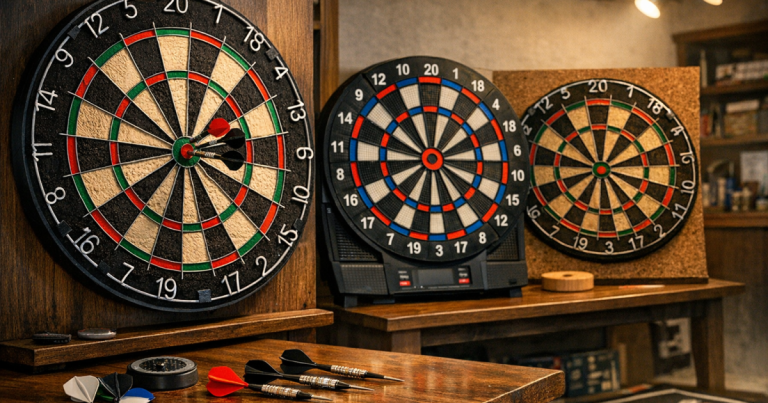
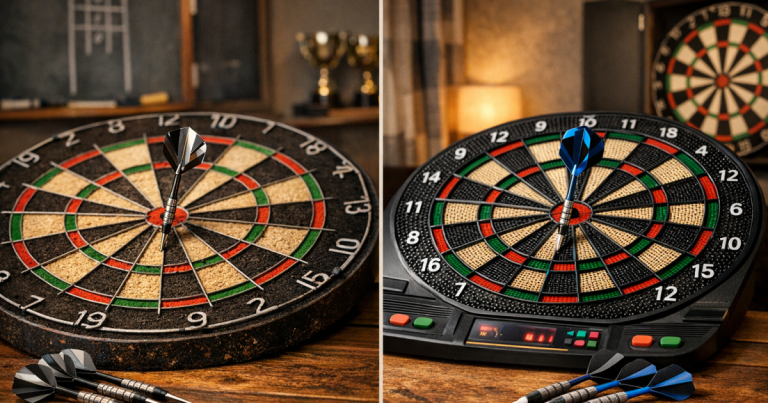
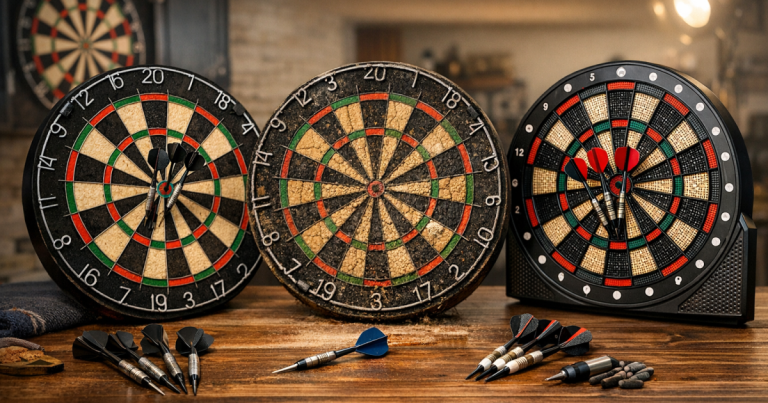
For anyone throwing several nights a week, staple-free dartboards can feel like a small detail until a dart hits metal and drops to the floor. The question is not whether the design is newer or neater, but whether it makes enough difference on a real home oche to justify caring about it.
The short answer: regular steel-tip players usually benefit from a staple-free design, but it is not a magic fix for every bounce-out. The wire profile, sisal quality, board rotation, dart points and the way the board is mounted all affect how the board plays over time.
What to know first
- A staple-free board removes the small metal staples that used to hold the scoring spider in place on many bristle boards.
- It can reduce obvious dart-on-metal deflections, particularly around trebles, doubles and the bull area.
- It does not remove the spider entirely, so a dart can still hit a divider and bounce or deflect.
- The benefit is most noticeable for players who practise often, group tightly, or play lots of scoring games on worn high-traffic segments.
- A poor-quality or badly maintained board can still feel disappointing even if the wiring is staple-free.
The easiest way to think about staple-free construction is as a reduction in obstruction, not a guarantee of perfect dart retention. If two boards are similar in price, build quality and condition, the cleaner wire system is usually the sensible choice. If the choice is between a cheap staple-free board and a better-made bristle board with stronger recovery, the better overall board may still be the more satisfying buy.
Look closely at the wording when comparing boards. Some descriptions focus on being “staple-free”, while others mention bladed wiring, thinner dividers or embedded spider designs. Those details are not always identical, so it helps to check photos of the board face as well as the product claims. A lower-profile spider generally gives the dart more room to enter the sisal cleanly.
For a shared family board, the upgrade is nice but not urgent. For a player trying to build consistent practice habits, it becomes more useful because fewer avoidable interruptions keep sessions flowing. That is the real value: not dramatic improvement overnight, but a board that gets in the way less often.
What the wire system actually changes
Traditional bristle boards used a raised round-wire spider, with staples fixing that metal framework into the playing surface. When a dart hit a staple, it had very little chance of staying in the board. It either dropped out, glanced into a different segment, or damaged the point of a tight grouping.
Modern staple-free dartboards usually use a cleaner embedded or bladed divider system, depending on the board. The idea is simple: reduce the amount of hard metal presented to the dart and give the point a better chance of sliding into the sisal rather than striking an obstruction square-on.
That matters most in the areas regular players attack repeatedly. Treble 20, treble 19, treble 18, doubles around finishing practice and the bull all see heavy traffic. If you throw enough darts, even a small reduction in exposed metal becomes noticeable because you are giving the dart fewer reasons to fall out.
Why regular players notice the difference more
An occasional player might not throw enough volume to care. If the board is used for a few legs at the weekend, a basic bristle board can still be perfectly enjoyable. For regular players, the maths changes. Three practice sessions a week can mean hundreds of darts into the same scoring zones, so tiny annoyances become repeated patterns.
The biggest everyday benefit is rhythm. A bounce-out interrupts scoring, forces a reset, and can make practice feel less tidy than it should. If you are working on 60s, 100-plus scoring, doubles routines or around-the-board drills, fewer obvious metal hits help you trust the board and focus on the throw.
There is also a fairness angle for home matches. A dart that falls out because it hits a staple feels different from a loose throw that fails to stick. The cleaner the board face, the less debate there is about whether the board or the player caused the problem.
Where staple-free design is not the whole story
It is easy to over-credit the wire system. Bounce-outs do not only come from staples. They can happen because the sisal has hardened, compressed or failed to recover cleanly; because the board has not been rotated; because the dart point is blunt, hooked or dirty; or because the board is mounted with movement behind it.
Sisal behaviour is especially important. A dense, well-made bristle board should hold darts securely while still closing up after the dart is removed. If the fibres are too tired or compacted, a cleaner spider will not rescue the board. For a deeper look at that side of performance, the guide to how sisal density affects recovery and bounce-outs is worth reading alongside any discussion of wiring.
Mounting also matters. If the board rocks slightly on impact, the energy of the dart is not absorbed cleanly. That can make bounce-outs feel worse, even on a board with a neat spider. A stable wall bracket, a flat backing surface and a board that sits flush will all help.
What a regular home player should expect
A good staple-free bristle board should feel cleaner around the scoring segments. You may still hear or see the occasional dart clip a divider, but the frustrating dead-stop impact against a staple should be less common. Over time, that can make practice sessions feel smoother and reduce the number of darts lying on the floor after a good throw.
Do not expect your averages to jump simply because the board has no staples. The gain is more about removing one source of interruption. If your darts are landing flat, your points are worn, or the board is past its best, those issues will still show up.
One practical way to judge the value is to think about your current frustrations. If most of your lost darts are hitting raised metal, the upgrade is likely to be meaningful. If your darts are falling from soft, chewed-up treble beds, a fresher board with better recovery may matter more than the staple-free label by itself.
Real-world examples without getting lost in labels
Many current bristle boards aimed at serious home use now avoid the old stapled construction. That includes well-known modern boards such as the Winmau Blade 6 Triple Core review, where the wider board build, wiring and playing feel all matter together rather than in isolation.
You will also see boards such as the Target Aspar Dartboard and Unicorn Eclipse Ultra Dartboard discussed by players looking for a cleaner wire layout. With any named board, check the current product details rather than assuming every version uses the same construction, because ranges and descriptions can change.
The useful comparison is not simply “staples versus no staples”. It is better to ask: does the board combine a low-obstruction spider, reliable sisal recovery, secure mounting and sensible longevity for the amount you play? That is the combination regular players actually feel.
When it is probably worth it
- You practise several times a week: Higher dart volume makes small reductions in wire hits more noticeable.
- You play scoring drills: Repeated visits to treble 20 and treble 19 expose weaknesses in the spider and sisal quickly.
- You care about match rhythm: Fewer avoidable drop-outs makes home games feel cleaner and less stop-start.
- Your current board has a raised, busy spider: Moving to a neater face is likely to feel like a genuine upgrade.
- You already maintain your setup: A staple-free board rewards regular rotation and sensible care more than a neglected one does.
When it may not be the priority
If you only play casually, the difference may be pleasant rather than essential. A basic bristle board in good condition can still be fine for relaxed home darts, especially if it is mounted securely and rotated before the main scoring areas become badly worn.
It may also be the wrong focus if your setup has other obvious problems. Poor lighting, glare, a loose board, an unstable mat or a cramped throwing area can affect enjoyment more than the spider design. A cleaner board face helps most when the rest of the oche is already reasonably sorted.
Maintenance is the other big factor. Rotate the board regularly, avoid soaking or spraying the surface, remove darts carefully, and keep aggressive or damaged points under control. The site’s dartboard maintenance routine covers the habits that help any bristle board last longer and play more consistently.
Things readers ask
Do staple-free boards stop bounce-outs completely?
No. They reduce one common cause of bounce-outs, but darts can still hit the wire, land badly, strike another dart, or fail to grip tired sisal.
Are they only useful for better players?
No, but better or more regular players tend to notice the benefit sooner because they group darts tighter and throw more volume into the same segments.
Is a staple-free board always better than a stapled board?
Not automatically. A well-made, well-maintained board with good sisal can outperform a poor board that simply uses the staple-free label.
Will it make much difference for soft-tip darts?
This discussion mainly applies to steel-tip bristle boards. Soft-tip setups use different boards and segment materials, so the same staple-free argument does not transfer directly.
How often should regular players rotate the board?
Rotate it whenever the most-used scoring areas start to look noticeably compressed or marked. Frequent players usually need to rotate more often than occasional weekend players.
Key takeaways
For regular steel-tip players, a staple-free board is usually worth having because it reduces a real and annoying source of deflections. It will not turn a poor throw into a good one, and it will not fix worn sisal, loose mounting or neglected maintenance, but it does make the playing surface cleaner and more forgiving around high-value targets.
The best way to think about it is as part of the whole home oche. Choose a good bristle board, mount it securely, keep it rotated, and make sure the surrounding setup supports consistent throwing. In that context, staple-free construction is not just a marketing phrase; it is a practical improvement regular players are likely to appreciate.