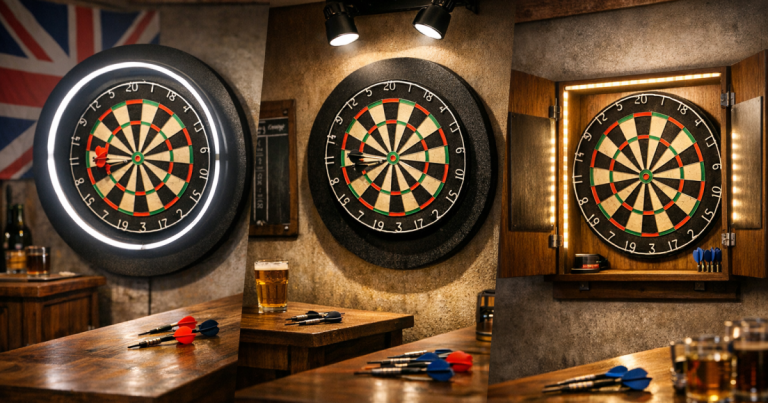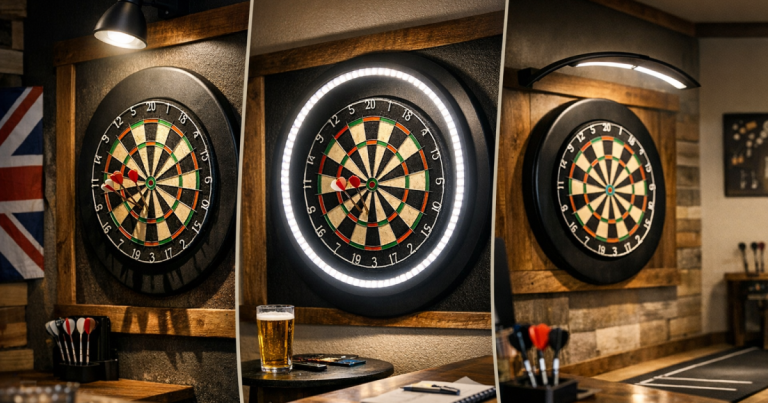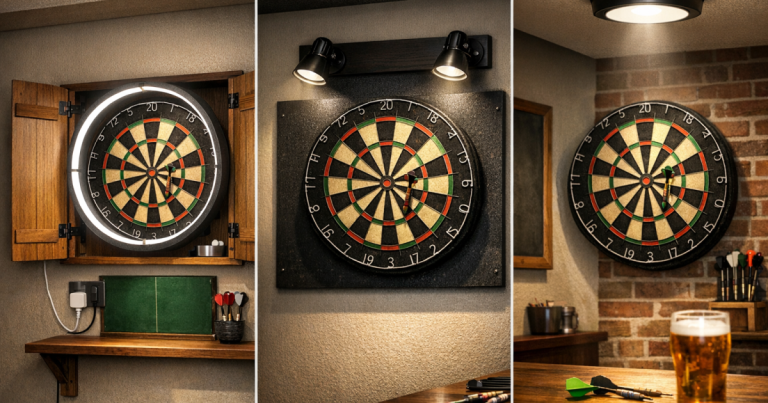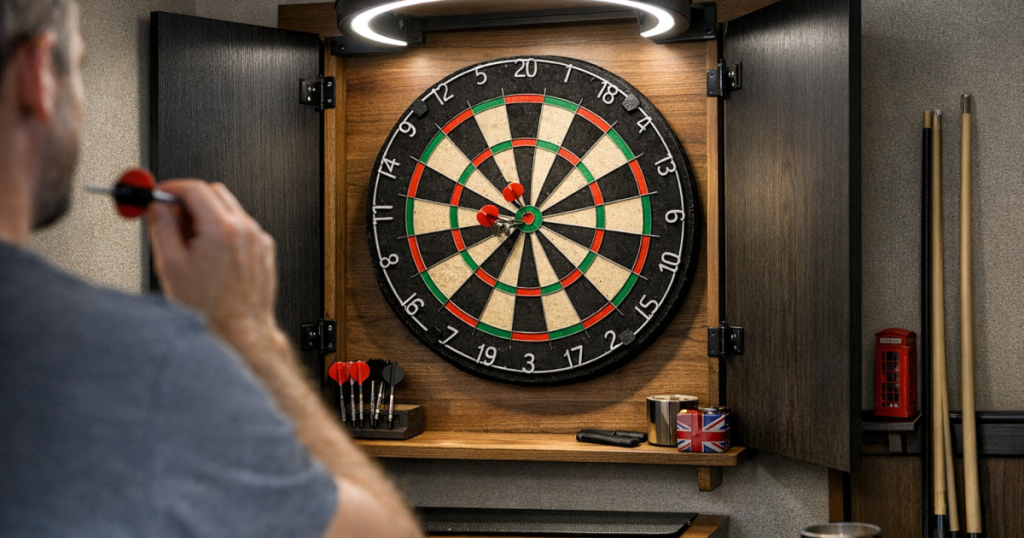
Small rooms make dartboard glare and side shadows more obvious: the thrower stands close to walls, ceiling fittings sit off-centre, and cabinet doors can interrupt the light path. Good shadow-free dartboard lighting is less about brightness alone and more about where the light comes from, how evenly it wraps the board, and whether your setup leaves the treble bed clear to see.
Hard-wired light fittings, new sockets and electrical connections should be carried out by a qualified electrician to comply with UK electrical safety requirements and relevant standards.
At a glance
- A light directly above or behind the thrower often creates a hand or dart shadow across the board.
- Full surround-style lighting gives the most even coverage because light reaches the board from several angles.
- In small UK rooms, depth matters: check how far any light, cabinet or surround projects from the wall.
- Glare can be as distracting as darkness, particularly on shiny number rings and fresh sisal.
- The cleanest setup is usually one that lights the board only, not the whole wall or room.
The aim is not to flood a spare bedroom, garage corner or box room with harsh light. A darts board needs even, controlled illumination across the scoring area, with as little interruption as possible from the player, darts, cabinet, shelves or ceiling shade.
Why small rooms make dartboard shadows worse
In a larger games room, there is usually more freedom to place the board away from corners, ceiling pendants and tall furniture. In a compact room, the board is often fitted wherever the 2.37 m throw line can be achieved, which may put it close to a side wall, wardrobe, door frame or low ceiling light.
That makes shadows more likely for three reasons. First, the thrower may stand close enough to block a central ceiling light. Secondly, the dart’s flight path can pass through the strongest part of the light beam. Thirdly, anything around the board, including a cabinet frame or deep surround, can throw a thin shadow onto the outer singles and doubles.
This is why board position and lighting should be planned together. If you are still deciding where the board belongs, the room layout advice in choosing a dartboard for a small room is a useful next step before fixing anything permanently.
What “shadow-free” really means on a dartboard
No home setup is perfectly shadowless in every possible condition, but a well-lit board should avoid hard, distracting shadows over the treble 20, bull, doubles and main scoring beds. A faint soft shadow at the edge of a dart is usually harmless; a strong line across the treble bed is not.
The difference comes from the size and spread of the light source. A small spotlight creates a narrow, directional beam, so objects cast sharper shadows. A wider light source, or several lights working together, softens those shadows because the board is lit from more than one angle. That is the main reason ring-style systems have become common in home darts setups: they place light around the board rather than relying on one ceiling point.
Brightness still matters, but it should be comfortable brightness. If the board is dazzling from the oche, or if the number ring catches the light so strongly that it pulls your eye away from the target, the setup is not doing its job. Even coverage beats maximum intensity.
Common lighting layouts and how they behave
Ceiling light only
A standard pendant or central ceiling fitting is the most common starting point in UK homes, but it is rarely ideal on its own. If it sits between the thrower and board, the player’s arm can cast a moving shadow. If it sits behind the thrower, the body can block light. If it sits to one side, the board may look bright on one half and dull on the other.
Ceiling lighting can still help the room feel comfortable, but it should not be the only source if you want consistent scoring visibility. Treat it as background room light rather than the main dartboard light.
Single spotlights
A wall or ceiling-mounted spotlight can work when carefully aimed, but it is easy to create glare or a hard dart shadow. In small rooms, spotlights can also feel visually intense because the beam is concentrated on a small area. If you use one, the key is to avoid pointing it straight at eye level from the throwing position.
Two or more angled spots can reduce shadows compared with one, but they need careful positioning. If one side is much stronger than the other, the board will still feel uneven.
Ring and surround-style lighting
Ring-style systems place light around the dartboard, either as a complete circle or as a shaped frame around the board. This gives the most reliable shadow control because the dartboard is lit from multiple directions at once. For many small rooms, it is also neat: the lighting sits close to the board rather than needing extra wall brackets or ceiling adjustments.
The important check is physical fit. Some lighting systems sit proud of the wall, and some need clearance around a cabinet, surround or number ring. Before committing to a layout, check how the light will interact with your existing protection. Our guide to dartboard surround size and fit explains the wall-protection side of that decision.
Cabinet lighting
Cabinets can look tidy in living rooms and shared spaces, but they introduce their own lighting issue. Doors, frames and score panels may block light from the sides, and small cabinet-mounted lamps can create a bright top section with a dull lower half. This does not make cabinets a poor choice; it simply means the lighting needs to be checked with the doors open, from the actual oche position.
If the cabinet is already fitted, stand at the throw line and look for shadows around double 3, double 11 and the lower singles. These areas often reveal uneven lighting before the central scoring zones do.
Positioning details that make the biggest difference
Start from the board centre rather than the light fitting. A standard steel-tip board is usually mounted with the bull at 1.73 m from the floor, and the light should be arranged to illuminate that centre point evenly. If the light is visually centred on the cabinet or wall space rather than the board face, it can still miss the target area.
Next, check the view from the oche, not just from close up. Small rooms encourage people to judge the board from arm’s length while setting up, but darts are thrown from further back. Stand at the proper throw line, raise your throwing arm naturally and look for movement across the board. If your hand creates a shadow during a practice throw, the main light source is probably in the wrong place or too narrow.
Side walls matter too. A board tucked into a corner can have one side lit less effectively, even with decent equipment. Pale walls may bounce some light back; dark walls and heavy curtains absorb it. That does not mean every darts corner needs redecorating, but it does explain why two rooms can behave differently with the same lighting.
Glare, colour and comfort
Glare is often mistaken for good lighting because the board looks bright in a photo. In play, glare makes it harder to focus. The number ring, wiring and fresh board surface can reflect light at awkward angles, especially if the light source is low, narrow or pointing directly back towards the thrower.
A comfortable darts light should make segment boundaries easy to read without making the white and light-coloured areas feel harsh. Very warm room lighting can make the board look cosy but slightly muddy; very cool lighting can feel clinical in a small domestic room. The best balance is the one that lets you read the board quickly and repeatedly without eye strain.
It is also worth considering the rest of the room. If the dartboard is dramatically brighter than everything around it, your eyes have to keep adapting when you retrieve darts, score or talk to other players. Soft background lighting can help, provided it does not introduce new shadows across the board.
How to test your setup before changing anything
You can learn a lot before drilling, moving fittings or replacing accessories. Use the board as you normally would, then test the lighting from the positions where problems actually appear.
- Stand on the throw line and raise your throwing arm slowly. Watch for a moving shadow across the treble 20 and bull.
- Place three darts in the board at different heights. Check whether their shadows cross important scoring areas.
- Open cabinet doors fully, then half-close them slightly to see whether they interrupt the light path.
- Look at the board from a seated scoring position if you use one. The scorer needs clear visibility too.
- Test in evening conditions, not just daylight, because many UK spare rooms rely heavily on artificial light after work.
If a quick test shows the top of the board is bright but the bottom is dull, the light is probably too high or too directional. If one side of the board is consistently darker, the issue is usually angle or obstruction. If the board is bright but uncomfortable, glare control is the priority.
Where ring lights, spots and cabinets fit in the bigger setup
Lighting is only one part of a good home darts corner. The board, surround, oche, mat and wall position all affect how natural the setup feels. A neat light can still feel awkward if the throw line is cramped, the mat creeps, or the board is squeezed too close to furniture.
For a deeper look at the different lighting forms and where they fit, the separate guide to dartboard lighting options for UK homes covers rings, spots and cabinet-friendly approaches in more detail. Use that alongside your room measurements rather than judging by product photos alone.
The most successful small-room setups tend to share the same pattern: the board is centred, the protection fits cleanly, the light is close enough to control shadows, and the thrower’s body does not sit between the main light and the board. None of that requires a huge room, but it does require checking the whole line from wall to oche.
Key takeaways
A reliable shadow-free dartboard lighting setup starts with even coverage, not brute brightness. In a small UK room, the strongest results usually come from bringing the light closer to the board, spreading it around the scoring area, and avoiding any arrangement where the thrower, cabinet or surround blocks the beam.
Before changing the room, test the board from the actual throw line in evening conditions. Look for hard shadows, glare on the number ring and darker outer doubles. Once you know which problem you have, the solution becomes much clearer: soften the light, change the angle, improve board-centred coverage or rethink the way surrounding accessories sit around the board.
Get those basics right and even a compact spare room, garage wall or shared living space can feel far more consistent for practice and casual matches.