When space is tight, choosing a dartboard for a small room is less about finding a miniature target and more about getting the whole setup right. The board, throw line, lighting, wall protection, noise and door swing all matter in a typical UK spare room, garage corner or box room.
A standard-size board is still usually the right answer if you want proper practice. The trick is knowing where you can compromise, where you should not, and which type of board makes the room easier to live with.
The big picture
For most home players, a compact setup should prioritise three things: a regulation playing area, safe clearance around the board, and a setup that does not make the room annoying for everyone else in the house.
- Do not shrink the target if you want useful practice. A smaller novelty board changes the game and makes your doubles and trebles practice less transferable.
- Measure from the board face, not the wall. The official throwing distance for steel-tip darts is measured from the face of the dartboard to the oche.
- Allow for the player’s stance. A room that technically fits the distance can still feel cramped if a bed, desk or wardrobe blocks your throwing position.
- Protect the wall early. Small rooms tend to have less margin for stray darts, so a surround or backing area is more useful than it looks.
- Think about noise. A bristle board on a thin internal wall can be more noticeable in the next room than you expect.
Start with the room, not the board
The first job is to check whether the room can support a proper throwing line. For a steel-tip setup, the bull should sit 1.73 m from the floor, and the oche should be 2.37 m from the face of the board. That face-to-oche detail matters because a cabinet, backing board or thick mounting system can push the board forward.
In a small UK room, the challenge is rarely just the distance. It is the usable area at the throw line. You need enough space to stand squarely, lean naturally and retrieve darts without stepping around furniture every visit. A narrow spare bedroom might have the length but not the width; a garage might have the width but need better lighting and floor marking.
If you are still working out the line, measurements and practical clearances, the detailed home darts oche setup guide is the best next step before you commit to a board position.
Why a standard bristle board often still makes sense
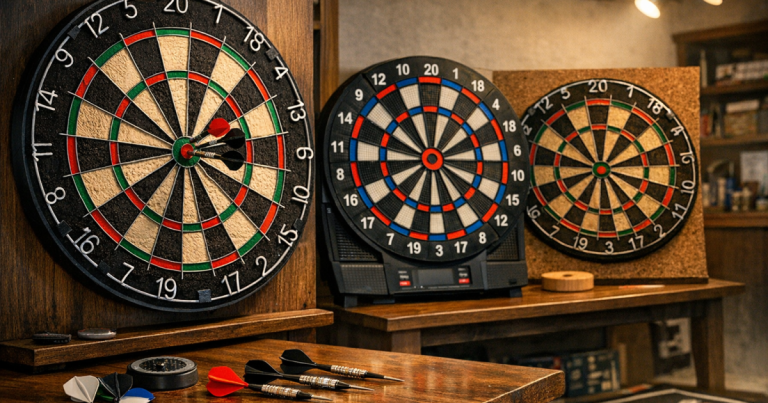
A regulation bristle dartboard is usually the best fit for anyone practising steel-tip darts seriously, even in a compact room. The playing surface, segment layout and wire geometry are what you will meet in league-style play, pub darts and most home practice routines. In other words, the board itself should not be where you save space.
Good bristle boards are also simple. They do not need power, speakers, apps or extra clearance for control panels. Once mounted correctly, they are easy to rotate, easy to pair with a surround, and straightforward to maintain. That simplicity is helpful in a room that may already be doing double duty as an office, guest room or storage space.
Recognisable examples include the Target Aspar Dartboard and the Nodor SupaMatch 3 Dartboard. Treat these as reference points for the kind of full-size steel-tip board worth considering, rather than as proof that any one model automatically suits your room. Check the mounting depth, compatibility with your surround or cabinet, and whether the board includes the fixing kit you need.
When an electronic board is the easier small-room choice
Electronic dartboards can make sense where soft-tip darts are more practical. They are often used by families, beginners and players who want automatic scoring. In a small room, softer tips may also feel less intimidating around painted walls, laminate flooring or shared spaces.
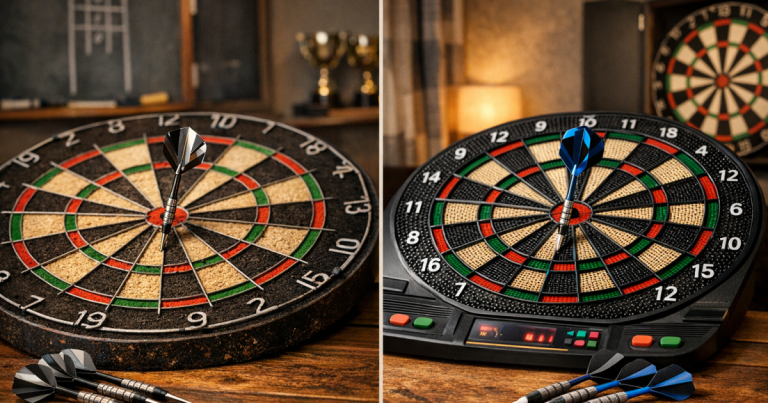
The trade-off is that electronic boards are not a direct replacement for steel-tip practice. The feel, segment response and playing rhythm differ. Some also need mains power or batteries, have sound effects, and may require more wall space for displays or controls. Before choosing one, check the recommended throwing distance for that specific board, because soft-tip setups are commonly played from a different distance from steel-tip darts.
A model such as the GranBoard 132 Electronic Dartboard shows why electronic boards appeal in tighter spaces: scoring is built around the board experience, and soft-tip play can be more relaxed in a multi-use room. Still, confirm the exact installation requirements, power arrangement and compatible darts before building your room around it.
If you are unsure which format suits your household and practice style, the guide to bristle versus electronic dartboards explains the differences in more depth.
Wall protection matters more when the room is small
In a generous games room, missed darts have somewhere to go. In a box room or narrow office, they are more likely to meet plaster, skirting, a door frame or furniture. That makes protection part of the board choice rather than an afterthought.
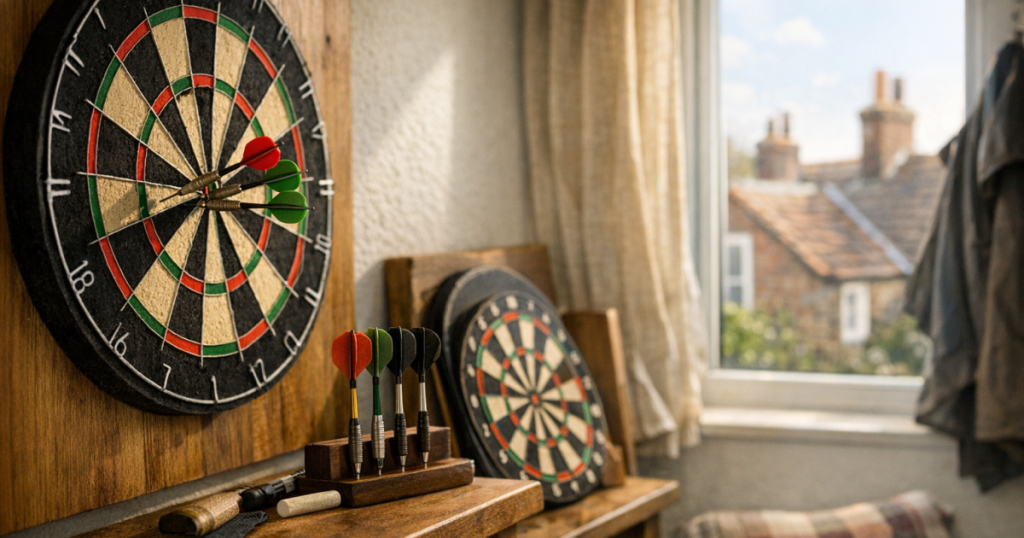
A simple foam surround is often the neatest solution because it hugs the board closely and adds protection without a bulky footprint. A cabinet can look tidier and gives you somewhere to keep darts, chalk or a checkout card, but open doors need side clearance. In a small room, that extra width can clash with shelves, wardrobes or light switches.
Backing boards are another route, particularly in garages or utility spaces where appearance is less important. A sheet of suitable backing material can protect a larger area, but it must be fixed securely and positioned so it does not push the board face forward without you rechecking the oche distance.
Lighting can make or break a tight setup
Small rooms often have one ceiling pendant, a desk lamp or a strip light in the wrong place. That can create shadows across the trebles or put glare in your eyes at the throw line. Good lighting does not just make the board look better; it makes scoring and grouping more consistent.
Dedicated dartboard lighting rings are popular because they light the board evenly from close range. In a compact UK room, they can also be tidier than relying on a floor lamp or clip-on light. The main things to check are how the light attaches, whether it works with your surround or cabinet, and whether it adds depth that affects the board face position.
For more detail on placement, shadows and room-specific fixes, use the dartboard lighting setup guide for UK homes alongside your room measurements.
Noise, neighbours and shared walls
Darts noise is not just the sound of impact. It can travel through the board, bracket, wall and floor. In a terrace, semi-detached house or flat, a board mounted on a shared internal wall may be more disruptive than one mounted on a solid external wall or garage wall.
If noise is a concern, consider where the board sits before spending money on upgrades. A heavier backing board, suitable isolation behind the mount, or a different wall can reduce the problem, but no setup is completely silent. Electronic boards can also make noise from segment impact and built-in sounds, so do not assume soft-tip automatically means quiet.
The floor matters too. A dart mat can define the oche and protect flooring, but check that it does not bunch up near the throw line or create a trip point in a narrow room. If the room doubles as an office, a roll-up mat may be more practical than a permanent raised oche.
What to avoid in a cramped UK room
The most common mistake is buying the board first and trying to make the room fit afterwards. That leads to awkward throw lines, doors opening into the playing area, or a board mounted in a place where lighting and retrieval are poor.
- Avoid novelty-size boards for proper practice. They are fine for casual fun, but they do not help much with regulation doubles, trebles or checkout routines.
- Avoid mounting above radiators. Heat and awkward stance positions make this a poor long-term setup.
- Avoid placing the oche in a doorway. Even if the distance works, it is inconvenient and can be unsafe when other people enter the room.
- Avoid relying on ceiling light alone. Shadows are more obvious in small rooms because you often stand close to the main light source.
- Avoid oversized storage solutions. A cabinet may look smart, but a slim surround can be better if the wall width is limited.
Matching the board to how the room is actually used
A spare bedroom used once a month can take a more permanent setup than a home office used daily. If the board will stay up all the time, appearance, storage and wall protection matter more. If it needs to disappear between sessions, keep the setup simple: a standard board, removable surround, roll-out mat and clearly marked oche can work well.
For a garage, think about temperature, damp and lighting. A bristle board should be kept in a reasonably dry environment and rotated regularly to spread wear. For a living space, think about how the setup looks when not in use. A cabinet or tidy surround may keep the room feeling less like a dedicated games area.
For family use, soft-tip may be more approachable, but supervision and sensible positioning still matter. The board should not be on a route through the room, near a TV, or above furniture that encourages people to stand in the wrong place while someone is throwing.
Key questions answered
Can you use a normal dartboard in a small room?
Yes, if the room allows the correct throwing distance and enough clear space around the oche. A full-size board is usually better than a smaller board because your practice remains realistic.
Is a cabinet too bulky for a small room?
Not always, but measure the width with the doors open. In tight spaces, a surround can be more practical because it protects the wall without needing door clearance.
Should a beginner choose electronic or bristle?
Choose bristle if the aim is traditional steel-tip practice. Choose electronic if automatic scoring, soft-tip play or a more casual household setup matters more. The room layout and who will use it should guide the decision.
How much side clearance do you need?
There is no single perfect number for every room, but you should have enough clear wall and standing space that missed darts do not immediately hit furniture, switches, door frames or windows. Wider protection is sensible for beginners.
Final thoughts
The right board for a compact UK room is usually the one that lets you keep the important parts of darts intact: correct height, correct throw, clear stance, visible segments and safe retrieval. Do not over-focus on the board diameter. Focus on the full playing area.
If you have enough length for a proper oche, a standard bristle board with a slim surround is the most straightforward route for steel-tip practice. If the room is shared, family-focused or better suited to soft-tip play, an electronic board can be a sensible alternative. Either way, measure carefully, protect the wall, sort the lighting, and choose a setup you will actually enjoy using week after week.