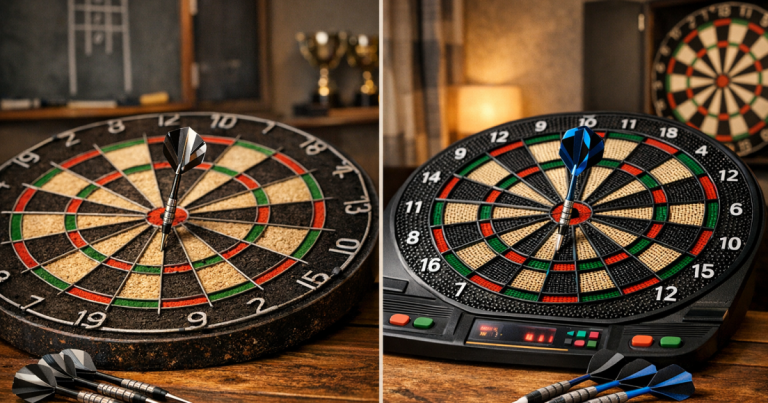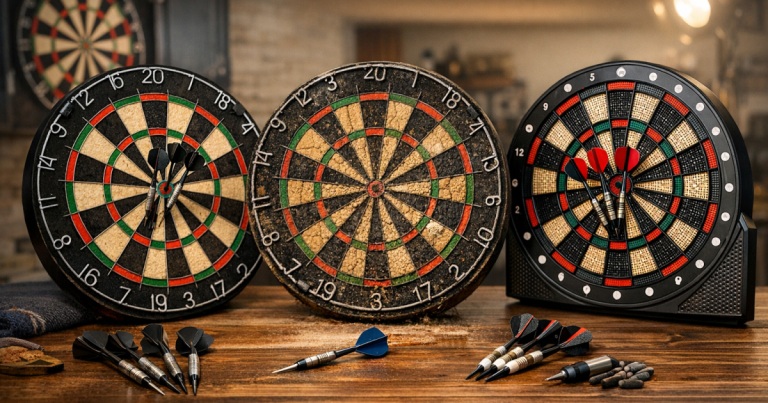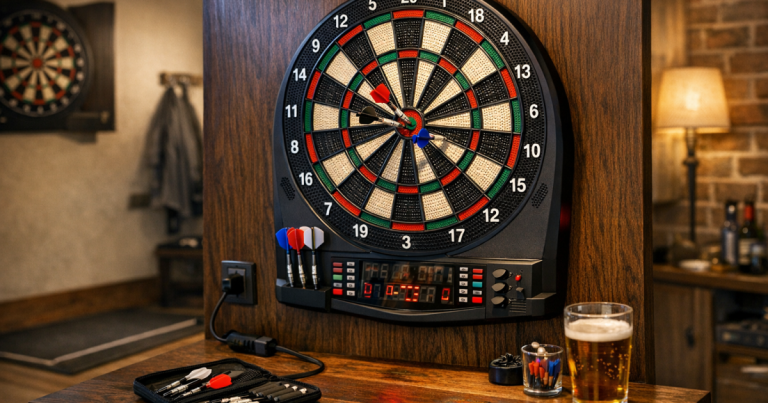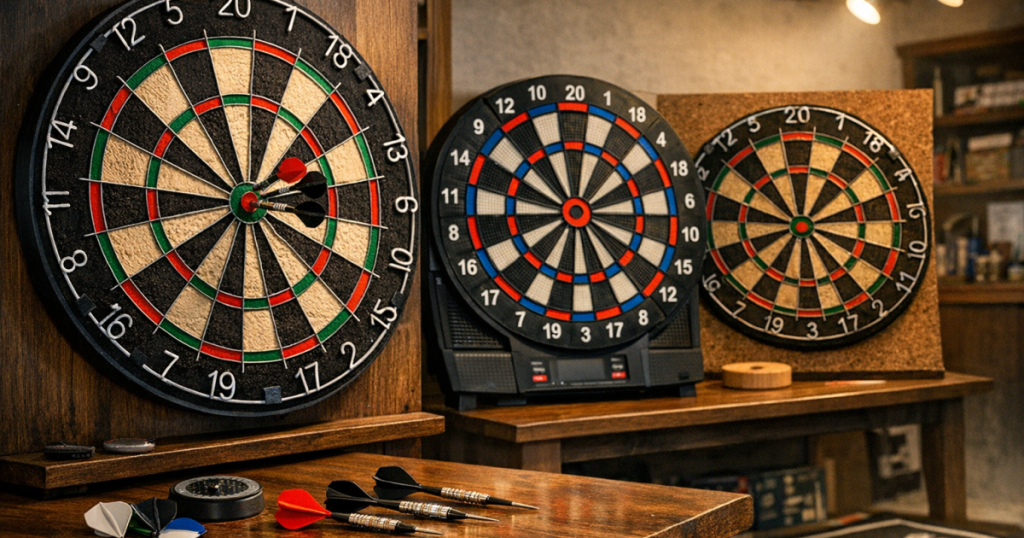
A match-quality setup at home starts with understanding what tournament dartboards are actually designed to do: give consistent scoring areas, fair bounce-out behaviour and a familiar throwing experience from one venue to the next. For most home players, the goal is not to recreate a stage setup perfectly, but to use the same core standards so practice feels transferable when you play league nights, pub matches or local competitions.
The short version
A proper match board is a regulation-size steel-tip board with clear segment geometry, dense sisal construction, thin dividing wires and a rotatable number ring. It should be mounted at the correct height, paired with the correct oche distance and kept in a space with safe wall and floor protection. If you are building a serious home setup, the board is only one part of the equation; lighting, mounting, room depth and maintenance all affect how close the experience feels to match play.
The best home choice for regular practice is usually a quality bristle board rather than a novelty board, paper-wound board or very cheap entry-level option. You do not need to chase every premium feature, but the board should hold darts cleanly, recover well after use and avoid bulky wires that cause unnecessary deflections.
What makes a board tournament standard?
In steel-tip darts, a standard match board follows familiar dimensions: the bull is centred at 1.73 metres from the floor, and the throwing distance is 2.37 metres from the face of the board to the oche. The board itself uses the recognised numbered clock layout, with double and treble rings, an outer bull and an inner bull. For a home setup, these measurements matter more than the brand name printed on the board.
If you are setting up from scratch, get the playing geometry right before worrying about cabinets, mats or accessories. A well-made board mounted at the wrong height will not help your practice rhythm. For a step-by-step measurement check, use the guide to setting the correct dartboard height and oche distance before marking the wall permanently.
Competition organisers may use specific approved boards or supplier agreements, but the practical home takeaway is simpler: choose a proper bristle steel-tip dartboard with regulation proportions and a clean playing surface. A premium board such as the Winmau Blade 6 Triple Core is an example of the sort of high-end bristle construction many serious home players consider, although suitability still depends on your room, budget and playing frequency.
Core features that affect real play
Sisal density and self-healing
Most serious steel-tip boards are made from compressed sisal fibres. When a dart enters the board, the fibres part rather than tearing in the way softer or lower-grade surfaces might. Over time, a better board tends to show slower visible wear, provided it is rotated regularly and not left with one heavily punished treble section taking all the work.
Density matters because a board that is too soft can feel dead and wear quickly, while a board that is too hard may increase bounce-outs or make darts sit awkwardly. You cannot judge this perfectly from photos, so look for credible user feedback on dart retention, wear pattern and consistency across the board rather than marketing language alone.
Wire profile and bounce-outs
The dividers between scoring segments have a big effect on how forgiving the board feels. Traditional round wires can deflect darts more often. Modern thin wiring and staple-free designs reduce the amount of metal exposed to incoming darts, giving more usable scoring area and fewer frustrating rebounds.
This does not mean every bounce-out is the board’s fault. Dart point condition, throw angle, loose mounting and worn sisal all play a part. However, if you practise doubles and trebles regularly, a thinner wire profile is one of the most noticeable upgrades from a basic board.
Number ring and rotation
A rotatable number ring is essential for extending board life. The 20 segment takes heavy punishment in most practice routines, so rotating the board spreads wear around the sisal. The number ring should be easy to remove and refit without bending or loosening. If the ring rattles, sits unevenly or catches darts, it becomes irritating very quickly.
Home suitability: when a match board makes sense
Tournament dartboards make the most sense at home when you play regularly, practise structured routines or want your setup to feel similar to pub, club or league conditions. They are less necessary if the board is mainly for occasional party use, children’s games or a mixed-use room where soft-tip darts would be more appropriate.
For most adult steel-tip players, a proper bristle board is a sensible long-term choice because it supports consistent practice and uses the same throwing format as many UK pub and league environments. If you are deciding between board types for a shared space, the guide to steel-tip and soft-tip dartboards explains the practical trade-offs around wall protection, scoring style and room use.
Room suitability is just as important as board quality. You need enough clear throwing space, a safe area behind and around the board, and a floor surface that can cope with dropped darts. A darts mat can help define the oche and protect flooring, but it should sit flat and not create a trip point.
Examples of setups that work well
A compact spare-room setup can still feel match-ready if the essentials are right: a regulation bristle board, a fixed oche mark, a simple surround and even lighting. You do not need a large games room, but you do need enough uninterrupted throwing length and ceiling clearance for a natural arm action.
A garage or outbuilding setup gives more flexibility, although damp and temperature changes can affect equipment. Keep the board away from direct moisture, avoid leaving darts embedded between sessions and rotate the board regularly. If the room is cold or slightly echoey, a cabinet or backing panel can also make the setup feel more finished.
A living-room board is usually about compromise. A cabinet may hide the board when not in use, while a surround protects the wall from stray darts. The board can still be regulation, but noise, wall marks and floor protection often become the deciding factors. In a shared family room, soft-tip may be more suitable than steel-tip depending on who plays and how often.
Checks before fitting one at home
- Measure from the board face, not the wall: the oche distance should be taken from the playing face, which matters if the board sits proud on a bracket or inside a cabinet.
- Confirm the bull height: the centre of the bull should be 1.73 metres from the floor for standard steel-tip play.
- Check clear space around the thrower: leave enough room for stance, follow-through and movement behind the oche.
- Plan wall protection: a surround, cabinet or backing panel reduces damage from missed doubles and loose practice darts.
- Think about lighting before drilling: shadows across the treble bed make scoring and grouping harder than they need to be.
- Use a stable fixing: the board should not twist, wobble or rattle when darts land.
- Choose accessories that reinforce consistency: a fixed oche, visible scoreboard and spare flights help practice feel less makeshift.
Lighting is often underestimated. A strong board with poor light can feel worse than a modest board lit properly, because shadows hide segment edges and make the bed harder to read. For home rooms, the aim is even illumination across the whole face without glare in the thrower’s eyes. The guide to the best lighting for a dartboard covers the main options and placement considerations.
Maintenance that keeps the board playing properly
Rotate the board frequently, especially if you practise 20s, 19s and doubles in long sessions. Move the number ring and turn the board so worn areas shift away from the most used targets. How often you rotate depends on use, but regular light rotation is better than waiting until the treble 20 is visibly tired.
Do not soak or spray the playing surface. Modern bristle boards are not improved by water, and moisture can distort fibres or shorten board life. Keep the board dry, remove darts after play and avoid direct heat sources. If your darts start bouncing out more often than usual, check the points, the mounting and the board surface before blaming one cause.
It is also worth keeping the surrounding setup tidy. Loose mats, clutter near the oche and poor sightlines all chip away at practice quality. A home setup does not need to look like a televised stage, but it should let you repeat the same throw without adjusting your stance or worrying about what is behind you.
Common mistakes to avoid
- Buying purely by appearance: a smart cabinet cannot compensate for a poor board surface or thick wires.
- Ignoring the oche: a temporary mark that moves between sessions makes practice less reliable.
- Mounting too close to a corner: cramped wall space affects stance, recovery and comfort.
- Skipping wall protection: even accurate players miss doubles, especially during warm-ups and finishing practice.
- Leaving the number ring fixed: this wears out high-use segments faster than necessary.
Helpful questions
Are tournament-style boards only for serious players?
No. Casual players can use one too, and the main benefit is consistency. If you practise at regulation height and distance, your throw transfers more naturally to pubs, clubs and league boards.
Can I use soft-tip darts on a bristle match board?
Soft-tip darts are made for electronic or soft-tip boards, not standard bristle steel-tip boards. For a bristle board, use suitable steel-tip darts and check that the points are in good condition.
How long should a good home dartboard last?
It depends on playing frequency, rotation, dart points and room conditions. Regular rotation, dry storage and sensible wall protection will usually extend useful board life noticeably.
Do I need a cabinet for a tournament-style board?
No, but a cabinet can protect the wall, reduce visual clutter and provide somewhere for scoreboards or accessories. A surround is often simpler if you want a clean practice setup.
Is a more expensive board always better for home practice?
Not always. Better materials and thinner wires can help, but correct height, oche distance, lighting and maintenance often make a bigger difference than moving from a good board to a premium one.
In brief
A tournament-style dartboard is about reliable standards rather than showpiece looks. For home players, the biggest wins come from a proper bristle board, accurate measurements, stable mounting, good lighting and regular rotation. Get those details right and your home practice will feel sharper, fairer and much closer to the conditions you are likely to meet in competitive play.