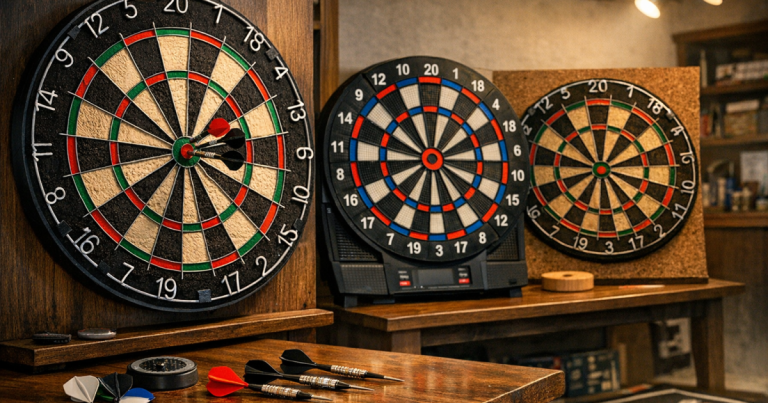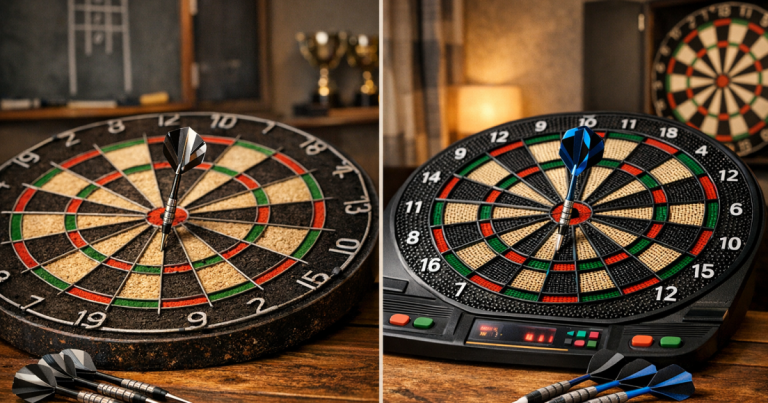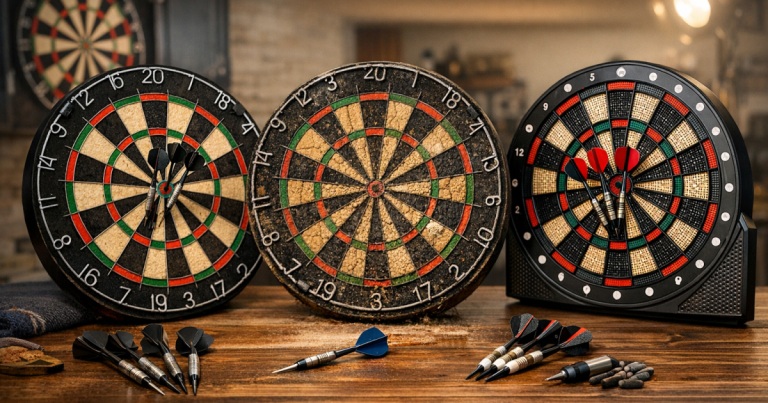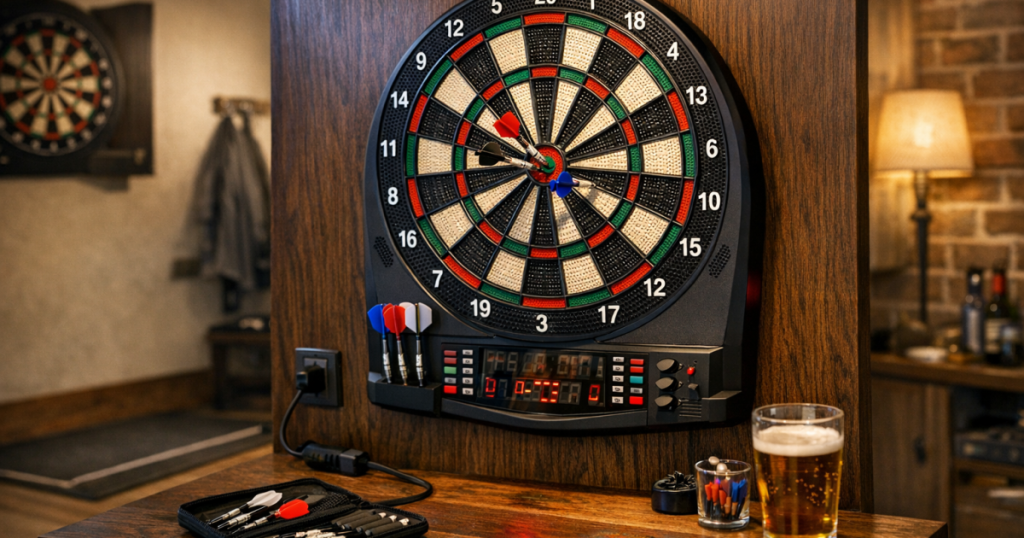
A home board that counts every dart for you sounds simple, but electronic dartboards vary a lot in how they score, what darts they accept and how much space they need. Some are friendly soft-tip boards for family games; others link to an app or display more match data. The important bit is matching the board to the room, the players and the type of darts you actually want to throw.
Main points
- Most auto-scoring home boards use soft-tip darts and a segmented plastic playing surface.
- The throw line is commonly set at 2.44 m for soft-tip play, but always check the board’s own instructions and game format.
- Scoring convenience is the main benefit, but bounce-outs, missed darts and correction controls still matter.
- Power access, cable routing, lighting and wall protection are just as important as the board itself.
- Steel-tip players should check carefully whether they want a true bristle board, a soft-tip board, or a sensor-assisted alternative.
How the scoring actually works
Traditional bristle boards rely on the players to add up scores, either mentally, on a chalkboard or through a scoring app. Electronic dartboards do the counting through sensors behind the target face. When a soft-tip dart lands in a scoring hole, the segment registers the hit and the board updates the score.
That makes casual games faster, especially when several people are playing, because the board can handle totals, turn order and common game formats. It also reduces arguments over arithmetic, which is useful in a shared living room or games room where not everyone knows checkout maths.
Electronic dartboards are not completely hands-off, though. A dart can bounce out, land between holes, hit the surround, or fail to register cleanly if the board is worn or the dart tip is damaged. A decent board should make it easy to correct a score, count a missed dart, or move to the next player without digging through awkward menus.
Soft-tip, steel-tip and the important difference
The biggest decision is not the screen or sound effects; it is the type of dart the board is designed to take. Most home electronic boards are soft-tip boards. They use plastic-tipped darts, usually with lighter barrels than a typical steel-tip setup, and the board face is made up of moulded scoring holes.
Soft-tip boards are friendlier for mixed households because the darts are less aggressive on walls, doors and floors than steel tips. They are still darts, so they need sensible space and adult supervision around younger players, but they tend to suit family games, party nights and casual leagues at home.
Steel-tip auto-scoring is a different category. Some systems aim to track scores on or around a bristle board, while smart boards such as the Unicorn Smartboard are designed around a more traditional throwing feel. These are worth treating separately from soft-tip electronic boards because the playing surface, dart choice and setup expectations are different.
If you are moving from a standard bristle board, revisit the board layout and scoring areas before assuming everything feels the same. The names are familiar, but the playing surface can feel very different under the dart. For a refresher on the basic scoring zones, see how a dartboard is laid out.
Game modes and score controls that matter
Electronic boards often promote long lists of built-in games. That sounds impressive, but most home players repeatedly use a smaller set: 501, 301, cricket-style games, around the clock and simple count-up formats. The useful question is not how many game names are printed on the box, but whether the board makes your regular games easy to start, correct and finish.
- Player count: check how many players or teams the board can manage without manual workarounds.
- 501 settings: look for control over double-in, double-out, master-out and bust rules if you play more seriously.
- Cricket scoring: make sure the display is clear enough to show marks, closed numbers and scores without confusion.
- Handicap options: useful when adults, children and stronger players share the same board.
- Score correction: missed darts and bounce-outs are normal, so correction buttons should be quick to use mid-leg.
- Volume control: voice prompts and sound effects can be fun at first, but a mute or volume option is handy in UK homes with shared walls or evening play.
If you want phone or tablet scoring instead of relying only on the board’s own display, app-based scoring can work well for both electronic and traditional setups. The key is making sure the device is visible, protected from stray darts and easy to operate between visits. There is a separate walkthrough on setting up a dart scoring app for home matches if you prefer that route.
Setup space: height, throw line and the room around it
For soft-tip play, the oche distance is commonly 2.44 m from the face of the board to the throw line. The bullseye height is commonly set at 1.73 m from the floor. That said, electronic boards can differ by rule set, region and manufacturer, so use the instructions supplied with your board as the final reference.
Measure from the board face, not the wall behind it. This matters because cabinets, spacers, mounting plates and thick backboards can push the playing surface forward. A small error is not the end of the world for casual play, but if you are trying to practise consistently, it is worth getting the measurements right from the start.
Leave room behind the throw line for the player’s stance and follow-through. In a spare bedroom or garage, the limiting factor is often not the wall with the board on it; it is the furniture, door swing, radiator or storage boxes behind the player. A mat with a raised or marked oche can make the setup repeatable without permanently marking the floor.
Power, cables and placement
Many electronic boards need either mains power through an adaptor or batteries, depending on the model. Do not assume the power lead will reach a convenient socket once the board is mounted at playing height. Plan the socket position before drilling holes or committing to a cabinet location.
Loose leads are one of the easiest ways to make a neat darts area feel untidy. A visible power cable can also distract the eye when it runs close to the board. Use simple cable clips, trunking or a route down the side of a cabinet rather than letting the cable hang straight from the centre. For a cleaner layout, use the ideas in tidying scorer cables around a dartboard.
If you are using a tablet, phone stand or external scorer nearby, keep it outside the likely miss zone. Soft-tip darts are kinder than steel tips, but repeated impacts can still scuff a case, knock a device over or mark a wall.
Lighting still matters with an auto-scoring board
Because an electronic board handles the maths, it is easy to overlook lighting. Poor light still affects aim, makes the segment colours harder to read and can cause shadows across the lower half of the board. That is particularly noticeable in garages, sheds and multi-use rooms where the ceiling light is behind the thrower.
A good lighting setup should illuminate the whole target face evenly without dazzling the player. Ring lights, cabinet-mounted lights and ceiling spots can all work, but the right answer depends on the board depth, mounting position and whether the area folds away after play. For more detail, see choosing lighting for bristle and electronic boards.
What the extra features are really for
Some features sound like luxuries until you use the board regularly. A large, readable display helps when players are standing back from the board. Dedicated buttons for missed darts and player changes save time. Doors or built-in dart holders keep the setup tidy in a shared room. A sleep mode can be useful if the board is left mounted in a living area.
Connected boards, such as the Gran Board 3s, appeal to players who want online-style play, app scoring or more detailed match records. Before treating connected features as essential, check what works with your phone or tablet, what the app experience is like, and whether the features you care about require any ongoing account or service. Availability and app support can change, so verify current details rather than relying on old product listings.
For a simpler family board, the best feature may be the one nobody talks about: clear controls. If guests need a manual every time they start 301, the board will not get used as often as it should.
Common compromises
Electronic scoring brings convenience, but it changes the feel of the game. Soft-tip darts do not land like steel tips in sisal. The impact sound is different, the board face is firmer, and the pattern of bounce-outs can be different from a bristle board. None of that is necessarily a problem, but it matters if your main goal is to practise for pub or league steel-tip darts.
Noise is another real-world factor. Plastic segments, voice prompts and cabinet resonance can be more noticeable than expected in a flat, terrace or room next to a bedroom. A solid mounting surface helps, and volume control is worth checking before you buy or install.
Durability depends on use, dart weight, tip condition and how accurately the board is hit. Replace damaged soft tips promptly because bent or burred tips can cause poor registration and unnecessary wear. Keep spare tips, shafts and flights nearby so a casual match does not stop because one dart is unusable.
Common questions
Can I use steel-tip darts on a soft-tip electronic board?
No. A soft-tip electronic board is designed for plastic tips, and steel tips can damage the playing surface and sensors. Use the dart type specified by the manufacturer.
Do electronic boards score 501 properly?
Most do, but the detail varies. Check whether the board supports the rules you use, such as double-out, bust scoring and player rotation.
Is an electronic board suitable for serious practice?
It can be useful for scoring speed, routines and casual match play. If you compete on bristle boards with steel-tip darts, keep practising on that format too.
How much wall protection do I need?
Soft-tip darts reduce damage risk but do not remove it. A surround, cabinet or backboard is sensible if the board is in a decorated room or near furniture.
Should I choose batteries or mains power?
Mains power is convenient for a fixed setup, while batteries can suit occasional use or a foldaway area. Check the model’s power options before mounting it.
What to remember
An electronic board is not just a normal dartboard with a calculator attached. It changes the darts, the feel of the throw, the setup around the board and the way people interact during a match. For family games and relaxed home sessions, that convenience can be excellent. For steel-tip practice, it is worth being clear about the differences before making it your main board.
Get the basics right first: correct height, suitable throw distance, tidy power routing, even lighting and enough room around the oche. Once those are sorted, the useful features are the ones that make your regular games easier to play, not the longest list of modes on the box.