A dart case works best when every barrel, shaft, flight and point has a proper place. Adding foam inserts for dart case storage is one of the simplest ways to stop parts rattling around, protect spare flights, and make your setup feel tidier without replacing the case. The key is to measure patiently, cut shallowly, and build the insert around the darts and accessories you actually carry.
The short version
Start by emptying the case, measuring the internal space, and laying out your darts and accessories before cutting anything. Use foam that compresses lightly without crushing flights or gripping barrels too tightly. Cut the main insert first, then add shallow recesses for barrels, shafts, flights, points and small tools.
- Measure the inside of the case in millimetres, including usable depth.
- Plan the layout with the case open, not from memory.
- Keep sharp points away from delicate flights and spare stems.
- Cut a little smaller than your traced outline, then widen gradually.
- Test the fit with the case closed before calling the job finished.
How a good foam insert should work
The aim is not to jam everything in as tightly as possible. A useful insert holds items securely enough that they do not move in transit, while still letting you remove them without tugging, bending flights or scraping coatings from barrels.
For most home players, the insert needs to cope with a few common items: one set of assembled darts, spare shafts, spare flights, a point protector, a checkout card, a small point tool or flight punch, and perhaps a set of spare rings. If your case also travels to league nights, leave a little open space for last-minute extras rather than filling every centimetre.
Foam works particularly well in hard and semi-rigid cases because it stops the contents sliding across the base. In a soft wallet-style case, it can still help, but it needs to stay thin and flexible enough for the case to close properly.
Gather the right bits before you start
You do not need a workshop. A tidy table, good light and a few basic tools are enough. Choose a surface you do not mind working on, or put down a cutting mat so you do not mark a desk or dining table.
- Sheet foam, preferably firm enough to hold its shape but easy to cut cleanly.
- A ruler or tape measure marked in millimetres.
- A sharp craft knife or snap-off blade.
- A cutting mat or thick scrap card underneath the foam.
- A fine marker, chalk pencil or soft pencil for marking outlines.
- Your actual darts, flights, shafts and accessories for test fitting.
Use a sharp blade and controlled cuts rather than forcing a blunt knife through the foam. Keep fingers clear of the cutting line and cut away from your hand. Small, repeated passes are neater and safer than trying to cut through the full depth in one go.
Step 1: Empty the case and measure the usable space
Remove everything from the case, including loose packaging, old flight sleeves and any removable trays. Wipe out dust and grit before measuring, as small debris can scratch barrels or sit under the foam.
Measure the internal length, width and depth in millimetres. Do not assume the outer case size is useful; hinges, seams, elastic bands and rounded corners often reduce the real space. If the case lid has pockets or elastic loops, close the case gently and check how much vertical clearance remains.
For a snug insert, cut the foam a fraction smaller than the internal base. Around 1 to 2 millimetres of clearance on each side is usually enough to avoid bunching at the corners, although soft cases may need a little more.
Step 2: Plan the layout around your throwing routine
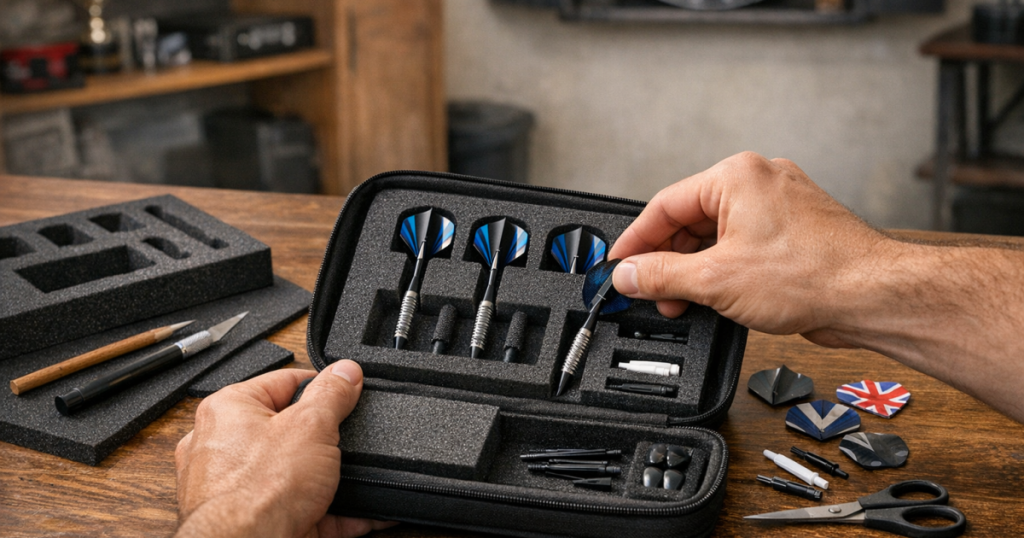
Place the uncut foam in the case and arrange your gear on top. Put the items you use most often where your hand naturally reaches first. For many players, that means assembled darts in the centre, spare flights to one side, and small tools or rings at the end.
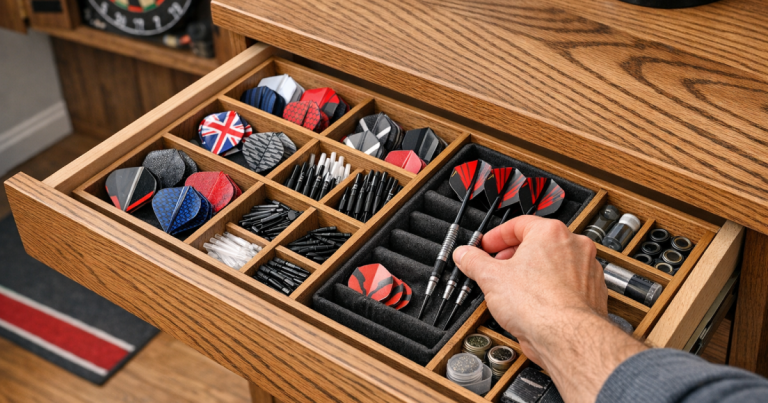
If you store several types of accessories at home, it is worth keeping the case for match-ready kit rather than turning it into a general drawer. Larger collections are easier to manage separately; our guide to using drawer dividers for darts accessories is useful if your spare flights, stems and points have started spreading across the room.
Leave enough space between recesses so the foam does not tear. Thin walls of foam look tidy at first, but they weaken quickly once you start removing and replacing darts. A few millimetres of separation between cut-outs makes the insert last longer.
Step 3: Cut the main insert to fit the case
Mark the outer size of the insert on the foam, then cut it slightly oversized on the first pass. Test it in the case, trim the edges gradually, and keep checking until it sits flat without curling.
Rounded cases need a little extra patience. Press the foam gently into the corner, mark the curve, remove the foam, and trim small sections at a time. Avoid crushing the foam into place because it can distort the layout and make your later cut-outs uneven.
If the case is deep, consider using two thinner foam layers rather than one thick piece. The lower layer can act as support, while the top layer contains the shaped recesses. This approach is easier to adjust and can look neater when you want shallow pockets for flights and deeper pockets for barrels.
Step 4: Mark the darts and accessories
Put each item on the insert and trace around it lightly. For assembled darts, decide whether you want to store them complete or broken down. Fully assembled darts are convenient, but they take up more length and can put pressure on flights if the case is shallow.
For barrels, mark a slightly tapered or straight channel rather than an exact outline of every groove. The foam only needs to cradle the barrel, not copy the machining. For shafts, use a narrow channel or a shared slot. For flights, use a shallow pocket that supports the edges without flattening the shape.
Flights are usually the first accessories to look untidy if they are squeezed. If you carry premium or patterned flights, give them enough room to sit flat. For an example of why small flight upgrades are worth protecting, see our Red Dragon dart flights review.
Step 5: Cut shallow recesses, then deepen them slowly
Begin each recess with a light outline cut. Once the outline is clean, remove the foam in thin layers. The easiest method is to make several shallow cuts inside the marked area, then lift small pieces out gradually.
Do not cut straight through unless you deliberately want a full-depth slot. A blind recess, where the foam remains underneath the item, gives better support and stops points or small tools touching the case base.
For steel-tip darts, keep the point end protected. A deeper point channel or a small separate point protector helps prevent sharp tips from digging into the foam. For soft-tip darts, the same principle applies, but the priority is usually keeping replacement tips together and preventing them from spilling into other pockets.
Step 6: Test the fit with the case closed
Once all the recesses are cut, load the case as you normally would and close it gently. Do not force the zip, clasp or lid. If the case resists, open it and look for the item sitting proud of the foam.
A good test is to close the case, hold it normally, and turn it carefully from side to side. You should not hear barrels rolling around or loose shafts sliding across the base. If something rattles, deepen or tighten that specific recess rather than adding random foam pieces everywhere.
Pay attention to lid pressure. Flights can look fine when the case is open, then get crushed when the lid shuts. If the lid contains pockets, elastic or a scoreboard card, remove one layer of foam or relocate the flights to a shallower area.
Step 7: Keep the insert clean and replaceable
Foam attracts dust, chalk marks and tiny fragments from points and shafts. Brush it out occasionally and remove grit before it works into barrel grooves. If you play around a mat or fixed oche, it is worth keeping that area clean too; our darts mat care and oche maintenance guide covers the wider playing space.
Avoid gluing the foam in place unless the case design makes it necessary. A removable insert is easier to shake out, repair or replace when your darts setup changes. If you do use adhesive, apply it sparingly to the base only and let it dry fully before putting darts back in.
Layout examples that work well
Compact home case
Use one main recess for three assembled darts, a narrow slot for spare shafts, and a shallow rectangular pocket for flights. This keeps the case quick to open and close for practice sessions at home.
League-night case
Break the darts down into barrels, shafts and flights. Add a small pocket for replacement points or rings, and leave a free corner for a chalk holder, checkout card or other match-night item. The layout should favour reliability over maximum capacity.
Accessory-heavy case
Use a two-layer insert. The bottom layer supports the whole case, while the top layer has separate pockets for flights, shafts and tools. This makes it easier to remove small pieces without digging into deep foam.
Common mistakes to avoid
- Cutting the recesses too large on the first attempt, which lets items rattle.
- Storing flights under pressure, which can bend or crease them.
- Leaving sharp points exposed against soft accessories.
- Making foam walls too thin between pockets.
- Forgetting to check the closed-case clearance before using the case outside the house.
Common questions
What thickness of foam should I use?
Use foam shallow enough for the case to close without pressure, but deep enough to cradle the items. Measure the internal depth first, then allow clearance for lid pockets, elastic straps and flights.
Should I store darts assembled or taken apart?
Assembled darts are quicker for home practice, but they need more length and height. Broken-down darts are usually neater for travel and make it easier to protect flights separately.
Can I use packaging foam from deliveries?
You can, provided it is clean, firm and not crumbly. Avoid foam that sheds particles, smells strongly, or compresses so much that it stops holding the darts securely.
How do I stop the foam lifting out with the darts?
Make the outer insert fit the case snugly and avoid recesses that grip barrels too tightly. If needed, use a very small amount of base adhesive, but keep the insert removable where possible.
Is foam better than elastic loops?
Foam is better for separating mixed accessories and reducing rattling. Elastic loops are quicker for holding a fixed set of darts. Many tidy cases use both, with foam for spares and loops for the main set.
Why it matters
A neat set of foam inserts for dart case storage makes the small parts of your setup easier to trust. Your darts are quicker to pack, flights stay in better shape, and spares are easier to find when a shaft cracks or a point needs attention. Take the time to measure and test the insert properly, and even an ordinary case can feel much more organised.