A darts setup feels better when the throw line, board and room all agree with each other. The correct dartboard height and oche distance gives you a fair practice area at home, whether you are putting a bristle board in the spare room, garage or a corner of the living room.
The key is not just knowing the numbers. You also need to measure from the right points, allow for board thickness, keep the oche square to the board and re-check the setup once the surround, cabinet or mat is in place.
The measurements to use
For a standard steel-tip setup, the centre of the bullseye should be 1.73 m from the finished floor. The oche should be 2.37 m from the face of the dartboard, not from the wall behind it.
- Steel-tip dartboard height: 1.73 m from the floor to the centre of the bullseye.
- Steel-tip oche distance: 2.37 m from the board face to the front edge of the oche.
- Diagonal check for steel-tip: about 2.93 m from the bullseye to the front of the oche.
- Soft-tip oche distance: commonly 2.44 m from the board face, though league and board rules can vary.
- Wheelchair darts height: commonly 1.37 m to the bullseye, with the same throwing distance used for the format being played.
Measure from the surface you actually stand on. If you throw from a mat, raised flooring or thick carpet, take the bullseye height from that surface rather than from bare floorboards underneath.
Before you mark anything, check the space
Pick the wall and standing position before you start drilling, sticking or taping. The board needs enough clear throwing room, a stable fixing point and a floor area where the oche can stay in the same place between sessions.
Ceiling clearance matters more than many home players expect, especially in loft rooms, converted garages and under-stairs spaces. If the room feels tight overhead, use this guide to checking ceiling height before installing a dartboard before committing to the layout.
Also check what sits beside the throw. Doors, radiators, bookcases and sofas can all make a technically correct setup feel cramped. You do not need a pub-sized darts lane, but you do need a comfortable stance and enough room to retrieve darts safely without squeezing around furniture.
Step 1: mark the bullseye height
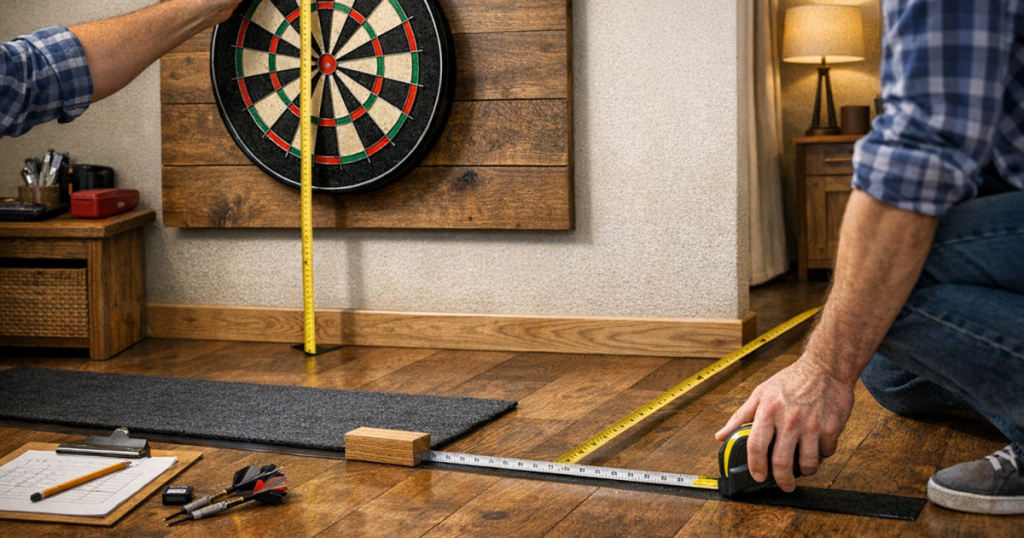
Start with the wall, not the oche. Measure 1.73 m up from the finished floor and make a small pencil mark where the bullseye centre should sit. Use a tape measure held vertically and keep it straight rather than angled away from the wall.
If the floor is uneven, take the measurement from the exact standing surface directly below the board. In older UK homes, skirting boards, sloped floors and thick carpet can make the first mark look slightly odd, so measure twice before fitting the bracket or hanging system.
Once the board is on the wall, the bullseye itself should line up with your mark. Do not rely on the top of the board, the cabinet frame or the surround as the reference point. Different boards and accessories can sit differently, but the bullseye height is the important measurement.
Step 2: measure the oche from the board face
The most common mistake is measuring 2.37 m from the wall. That puts the throw line too far back because a dartboard has depth. Always measure from the front face of the board, directly below the bullseye, to the front edge of the oche.
A neat way to do this is to hang a plumb line, string or tape measure from the bullseye down to the floor. Mark the point on the floor directly below the board face, then measure 2.37 m out into the room. That floor mark is where the front edge of the steel-tip oche should sit.
If you use a raised oche, the toe line is the front vertical face of the block. If you use tape, a vinyl line or a mat marking, the front edge of that line is the limit. Your foot can be behind it or touching it, but it should not cross over it during the throw.
Step 3: keep the oche square
Distance is only half the job. The oche also needs to be square to the board, otherwise the left side and right side of the line are not equally far from the target.
After marking the centre point, use a spirit level, straight edge or carefully measured line to set the oche at a right angle to the centre line of the board. For a simple home setup, mark the centre of the oche directly in line with the bullseye, then make sure both ends of the line sit evenly across the throwing area.
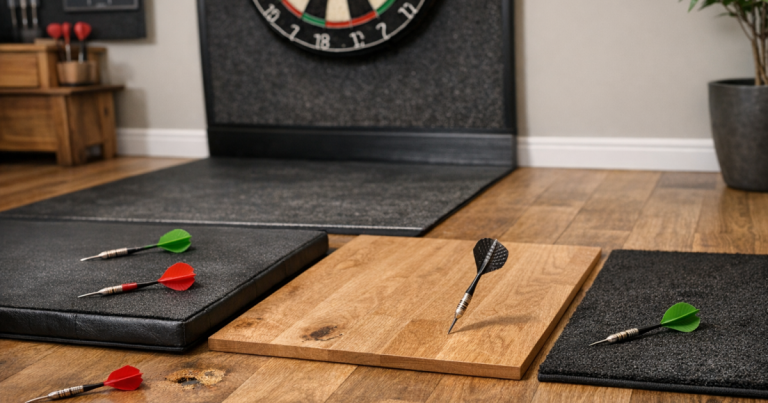
If you are using a darts mat, let it settle flat before relying on its printed line. Some mats shift slightly on smooth flooring, so it is worth checking the position again after a few sessions. A small piece of low-tack tape at the corners can help you see whether the mat has moved.
Step 4: use the diagonal check
The diagonal measurement is a useful second check because it confirms the board height and throw distance together. For a standard steel-tip setup, measure from the centre of the bullseye to the front edge of the oche. The distance should be about 2.93 m.
This is especially helpful if the wall is uneven, the board sits in a cabinet, or you are not completely sure where the face of the board falls in relation to the wall. If the diagonal measurement is right but the horizontal measurement looks wrong, re-check that you are measuring to the board face and not the rear wall.
For soft-tip boards, the diagonal will differ because the throwing distance is commonly longer. If you are setting up an electronic or soft-tip area, confirm the format you plan to play. The broader choice between a steel-tip or soft-tip dartboard affects more than the darts themselves; it can change the room layout too.
Common measuring mistakes at home
Most awkward home setups come from one of a few small errors. They are easy to fix if you spot them early.
- Measuring from the wall instead of the dartboard face, which makes the oche too far back.
- Measuring bullseye height before adding a thick mat or raised floor surface.
- Using the bottom or top of the board as a reference instead of the centre of the bull.
- Letting the oche line sit at an angle to the board.
- Assuming a cabinet or surround does not affect the visible alignment of the board.
- Marking the room once and never checking it again after the board settles or the mat moves.
Adapting the setup to your room
If the board is inside a cabinet
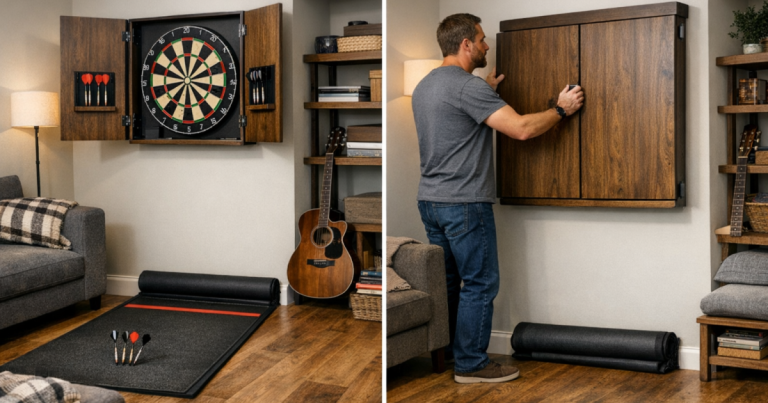
Fit the cabinet securely first, then hang the board and check the bullseye height. Do not set the oche from the cabinet doors or the back panel. The measurement still comes from the playing face of the board.
If the board has a surround
A surround protects the wall, but it should not change the measurements. Make sure it is seated evenly around the board so it does not push the board out of line or make the setup look off-centre.
If you throw from carpet
Carpet can make tape marks less reliable and can let lightweight mats creep forward. Use a visible oche marker that stays in place, then re-measure occasionally. If the carpet has a thick pile, press the tape measure down consistently when checking height.
If different people use the board
For casual family games, one standard setup is usually simplest. For wheelchair play or specific league practice, mark a separate throw line or board height only if you can do so clearly and safely without creating confusion.
When the setup still looks wrong
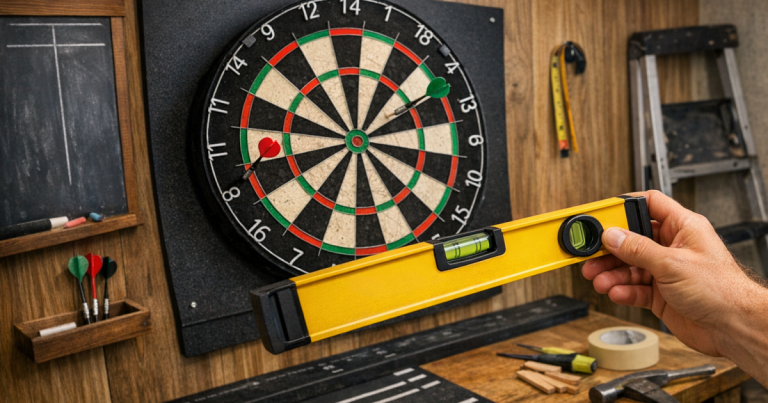
Even with the right numbers, a board can look strange if the 20 segment is not exactly at the top, the cabinet is not level, or the wall and floor are not visually square. Use a small spirit level on the cabinet or backing surface, then rotate the board so the 20 is centred at the top.
If you keep adjusting but something still feels out of line, the issue may be visual rather than measured. This breakdown of why a dartboard looks crooked is useful for separating real alignment problems from wonky walls, uneven floors and optical tricks.
The big picture
Once dartboard height and oche distance are set properly, the whole home setup becomes easier to trust. You can practise with the same stance each time, compare scores more fairly and avoid relearning your throw because the line has drifted forward or the board has been hung slightly low.
The best routine is simple: measure the bullseye from the finished floor, measure the oche from the board face, check the diagonal, then test the setup by standing naturally at the line. If anything feels cramped, solve the room layout before you make the marks permanent.
FAQ
Do I measure the oche from the wall or the dartboard?
Measure from the face of the dartboard. Measuring from the wall is a common error because it ignores the thickness of the board and makes the throwing line too far back.
What is the correct dartboard height for steel-tip darts?
The centre of the bullseye should be 1.73 m from the floor or from the surface you stand on when throwing.
Can I use tape instead of a raised oche?
Yes. A tape line is fine for home play as long as the front edge is clearly marked, straight and kept at the correct distance from the board face.
Does a darts mat change the measurement?
It can. If you stand on the mat, measure the bullseye height from the top of that mat and make sure the printed oche line has not shifted out of position.
Is soft-tip darts measured the same way?
The bullseye height is commonly the same, but the throw distance is often 2.44 m. Check the rules for your board, league or format before marking a permanent oche.