Your throw can feel off even when the board is technically level, because a dartboard looks crooked for several different reasons: the number ring has shifted, the cabinet is uneven, the wall is out, or the room is visually pulling your eye. The fix is usually simple, but it helps to check the board, surround, lighting and throwing line in the right order rather than adjusting everything at once.
Start with the quick visual checks, then confirm the mounting height and centre line before you loosen any screws or rehang the board.
Any drilling where hidden wiring, pipework, or uncertain wall construction is involved should be carried out by a qualified tradesperson to comply with UK safety requirements and safe installation practice.
At a glance
- If the 20 is not at the top, rotate the number ring or board before touching the wall bracket.
- If the board is level but still appears slanted, check the cabinet, surround, lighting and nearby shelves.
- If darts land consistently to one side, check your oche alignment as well as the board itself.
- If the wall is uneven, use the board centre and throwing line as your reference points, not the skirting board.
- If the board moves when darts hit, tighten the bracket and stabilisers before judging the alignment.
First, check whether the board is actually rotated
The easiest fault to miss is a shifted number ring. On a bristle board, the metal number ring can be rotated for wear management, and it can also be knocked slightly out of position. If the 20 segment is not perfectly at the top, the board will look wrong even if the bracket is square.
Stand directly in front of the board and look at the 20, bullseye and 3 as a vertical reference. The centre of the 20 should sit above the bull, with the 3 directly below. If that line feels twisted, rotate the number ring or the board face until the segments sit correctly. Do not use the printed logo as your main reference, as logos can vary in position and your eye may give too much weight to the branding.
Use the bullseye as the true centre
Once the top number is in the right place, work from the bullseye. The board can look skewed if the cabinet doors, surround edge or wall decoration is slightly off, but the bull is what matters for play.
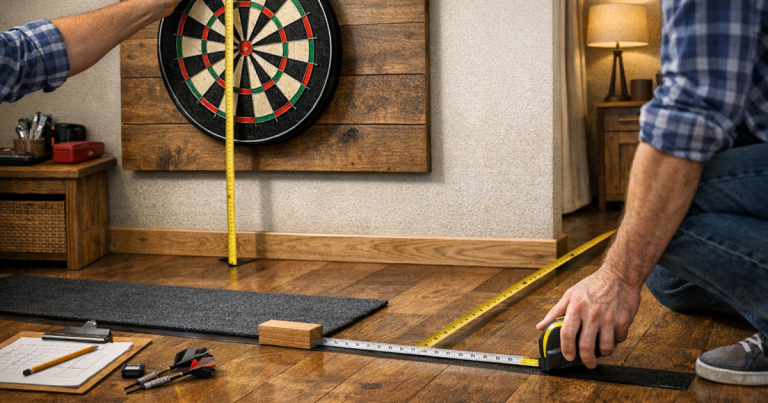
Measure from the floor to the centre of the bullseye and confirm your setup height. For a standard steel-tip setup, the bull should be 1.73 m from the floor. If you use a mat or raised floor protection, measure from the playing surface, not the bare floor beneath it.
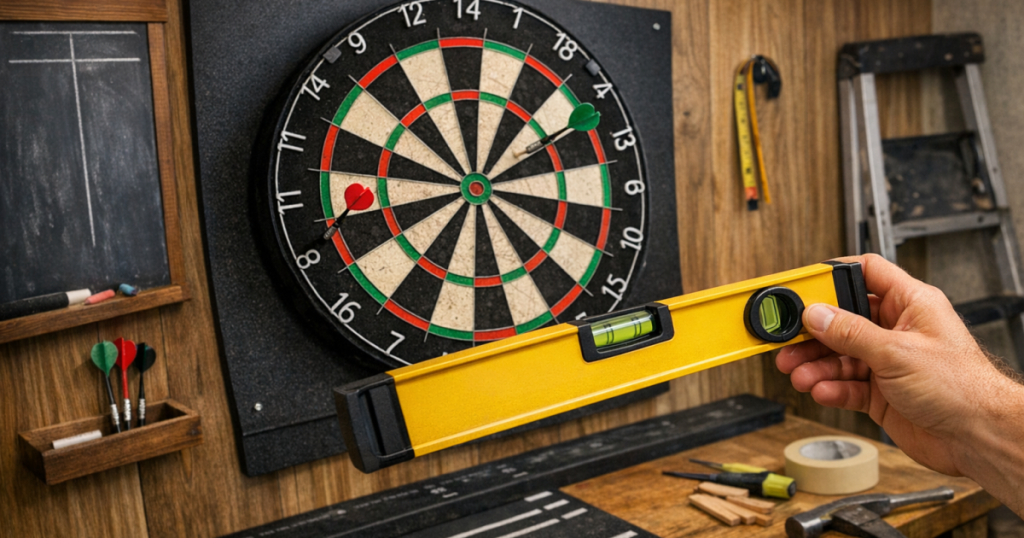
Next, mark or imagine a straight vertical line through the bull. A small spirit level can help, but do not rely only on the outer edge of the board, because some surrounds and cabinets sit a little unevenly. If the bull is central and the scoring segments are correctly rotated, the playing area may be right even if the surrounding furniture is misleading your eye.
Check the cabinet, surround and wall edges
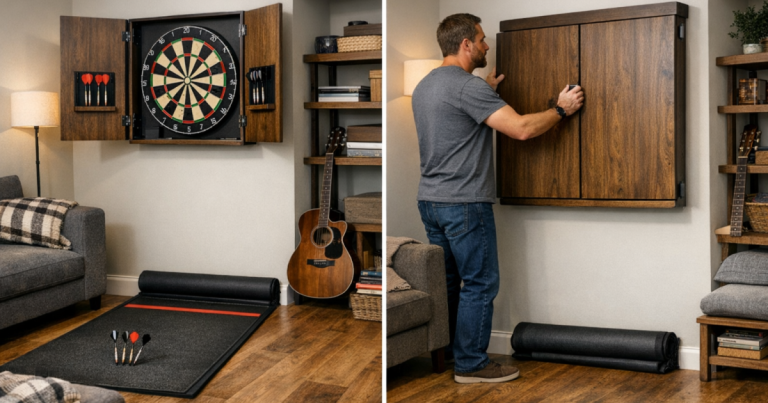
A dartboard mounted inside a cabinet can look crooked when the cabinet is the part that is out of level. Doors can settle unevenly, hinges can loosen, and a cabinet fixed to an imperfect wall may lean very slightly. The result is a board that looks tilted even when the board itself is fine.
Open both cabinet doors and judge the board without the door edges framing it. If it suddenly looks straighter, the issue is probably the cabinet or the way your eye is reading the frame. Tighten loose hinge screws, check the cabinet body with a spirit level, and make sure the board bracket is centred within the cabinet opening.
Surrounds can create the same effect. A foam or rubber surround that has not been pushed fully home can leave a wider gap on one side. Remove the surround, check the board on its own, then refit the surround evenly. If you are planning a cleaner wall layout, a properly aligned surround and cabinet can make the whole area look calmer; the guide on building a tidy dartboard wall with cabinets and surrounds is a useful next step.
Look for room features that trick your eye
Many home darts setups are squeezed into spare rooms, garages, garden rooms and alcoves. Those spaces often have visual lines that are not perfectly square: sloping ceilings, uneven skirting boards, picture rails, exposed brick, shelving, radiator pipes or door frames. If you align the board to one of those features, the throw line may end up wrong.
Use the board centre and oche line as the main geometry of the setup. The bullseye should sit on a straight line with the centre of your throwing position. A nearby shelf can be slightly off without affecting your game, but a board that is not centred to the oche can make practice feel awkward.
Step back to your normal throwing spot and look at the bull, not the outer ring. If the bull sits directly ahead, the setup is more likely to be playable even if the surrounding wall is visually busy. For rooms where people pass behind or beside the thrower, it is also worth checking the wider layout using the advice on planning safe walkways around your dartboard.
Make sure the board is sitting flat on the wall
A board can look twisted if it is leaning forward, wobbling on the bracket, or touching the wall more on one side than the other. This is common when the rear mounting screw is not seated properly in the bracket, the wall is uneven, or the stabilisers on the back of the board are not adjusted evenly.
Lift the board off the bracket and check the rear screw. It should be secure, central and proud enough to sit into the bracket slot properly. If it is too loose, the board may rock; if it is too tight or badly positioned, it may not sit fully into the hanger.
When refitting the board, press it gently into place and check that it does not wobble. If your board has adjustable rear feet or stabilisers, set them so the board rests evenly against the wall. Avoid over-tightening anything into plasterboard or weak fixings, as that can make the bracket less reliable rather than more stable.
Check shadows and lighting before remounting
Uneven lighting can make a straight board appear slanted. A strong light from one side throws shadows across the wire, and the darker side can look lower or further back. This is especially noticeable in rooms with ceiling spotlights, desk lamps, or a window to one side of the board.
Turn on the lights you normally use for throwing and stand at the oche. Look for heavy shadows across the 20, 5 and 1 areas. If one side of the treble ring looks darker, the board may feel crooked even when it is not. Try a temporary lamp position, then reassess before making holes in the wall.
For a more permanent setup, even lighting around the scoring area makes alignment easier to judge and improves practice comfort. If shadows are part of the problem, the dartboard lighting installation guide covers plug-in, wall and ceiling options for home rooms.
Check the oche line, not just the wall
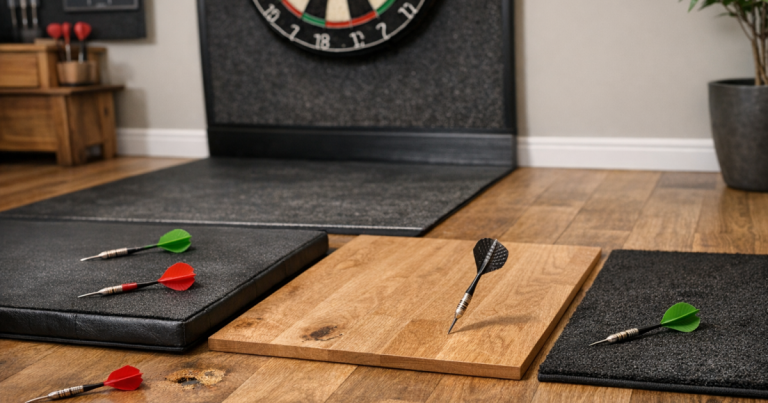
Sometimes the board is straight and the throwing line is the part that is wrong. If a mat has crept sideways, a tape line was applied at a slight angle, or a raised oche is not centred on the bull, every throw can feel as though the board is leaning away from you.
Measure from the face of the board to the oche at the correct throwing distance, then check that the centre of the oche lines up with the bull. A simple way is to hang a weighted string from the bull area or use a laser line if you already have one, then mark the floor centre point. The throwing line should be square to that centre point rather than square to a nearby wall or rug.
If you use a removable mat, check it before every session. Mats can shift a few centimetres during cleaning or when people walk over them, and that is enough to make the board feel off-centre.
A sensible order for fixing it
Work through the issue in this order so you do not create a new problem while chasing a visual one:
- Stand at the oche and check whether the 20, bull and 3 form a straight vertical line.
- Rotate the number ring or board face if the scoring segments are out of position.
- Remove or ignore the surround and cabinet edges while judging the board.
- Confirm the bull height from the playing surface.
- Check the rear screw, wall bracket and stabilisers for wobble or lean.
- Confirm the oche is centred on the bull, not just parallel with a wall.
- Assess lighting and shadows from your normal throwing position.
- Only remount the bracket if the board centre, height or stability is genuinely wrong.
This order matters because many crooked-looking boards are not actually mounted badly. If you start by moving the bracket, you may turn a visual issue into a real alignment issue.
When remounting is the right fix
Remounting is worth doing when the board centre is too high, too low, off to one side, or the bracket is no longer secure. It is also sensible if the fixings have loosened in the wall or the board cannot sit flat even after you adjust the rear screw and stabilisers.
Before moving the bracket, mark the current bull position with low-tack tape, then measure the correct height and centre line again. Use fixings suited to the wall type, and avoid reusing damaged holes that no longer grip properly. If the wall surface is crumbly or hollow, the board may never feel solid until the fixing point is improved.
After remounting, throw a few darts before deciding whether it looks perfect. A board viewed from close up can still seem slightly odd because of the room around it, but what matters is whether the bull, segments and oche line feel consistent during play.
Questions people ask
Why does my board look straight close up but crooked from the oche?
Your eye is probably reading the wider room, not just the board. Door frames, shelves, skirting boards and shadows can all create a false tilt when viewed from throwing distance.
Should the dartboard be level with the cabinet?
The board should be aligned to the bull, scoring segments and oche. A cabinet should ideally be level too, but do not twist a correctly mounted board just to match a slightly uneven cabinet door.
Can a loose number ring make the board look wrong?
Yes. If the ring has shifted, the 20 may no longer sit exactly at the top. Straighten the ring before adjusting the bracket or moving the board.
Does an uneven floor affect how the board looks?
It can. In garages, older homes and garden rooms, floors may slope slightly. Measure the bull height from the actual playing surface and align the oche to the bull rather than relying on room edges.
How often should I recheck alignment?
Check it whenever you rotate the board, move a mat, refit a surround, or notice unusual wobble. A quick visual check before practice is usually enough once the setup is stable.
Final thoughts
A crooked-looking dartboard is usually caused by rotation, framing, lighting or oche alignment rather than a serious mounting fault. Work from the centre of the bull outwards, ignore misleading room lines, and only move the wall bracket once you have ruled out the simple causes. The result is a board that looks right, feels right, and gives you a more consistent reference point every time you step up to throw.