A darts mat does more than mark where to stand: it protects the floor, makes the throw feel repeatable, and helps keep the room looking intentional rather than improvised. The fixed vs removable darts mat decision usually comes down to how permanent your board area is, who shares the room, and how much tolerance you have for tidying away after a session.
For a spare room, garage or dedicated games corner, a more permanent oche can feel brilliant. In a living room, hallway or multipurpose space, a mat you can roll away may keep darts enjoyable rather than turning it into a household negotiation.
The short version
- A fixed setup suits a dedicated darts area where the board, throw line and floor protection can stay in place between sessions.
- A removable setup suits shared rooms, rentals, compact homes and anyone who needs the floor clear after playing.
- The oche matters as much as the mat: a raised or fixed oche gives a consistent foot position, while a printed line is easier to live with.
- Floor type changes the answer. Carpet, laminate, vinyl, tiles and concrete all behave differently under a mat.
- Accuracy depends on measuring from the board face to the front of the oche, not guessing from the wall or cabinet.
What counts as a fixed darts mat and oche setup?
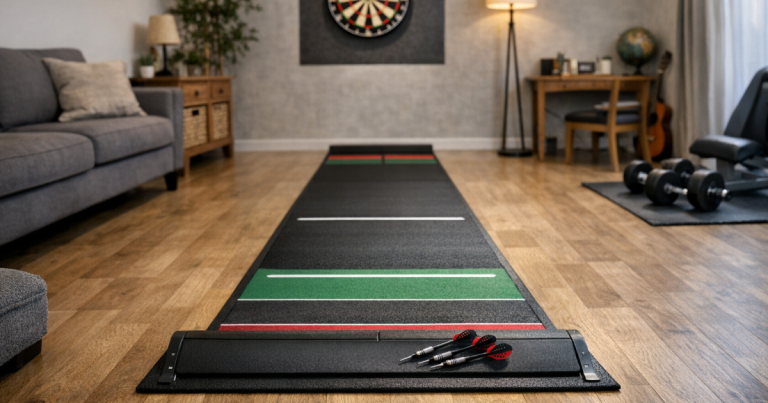
A fixed setup is one where the playing area remains laid out and ready. That might mean a heavy mat left on the floor, a fixed throw line, a raised oche strip, or a complete dartboard wall where the mat, surround, cabinet and scoring area all have a permanent place.
The biggest advantage is consistency. If your feet meet the same oche every time, the setup feels more like a proper board area than a temporary corner of the room. You spend less time unrolling, aligning and checking the mat, and more time throwing.
Fixed setups work particularly well in garages, converted sheds, spare rooms and home bars. They also suit players who practise regularly, because a stable oche removes one small source of variation. When people talk about fixed vs removable darts mat setups, this is usually the point that decides it: convenience while playing versus convenience when the room is not being used for darts.
The trade-off is that a fixed mat or oche takes up visual and physical space. It can interrupt how a room is used, gather dust at the edges, or become awkward if furniture needs to move. A raised oche can also be a trip point if it sits in a walkway, so it needs a sensible position, not just an accurate one.
What counts as a removable setup?
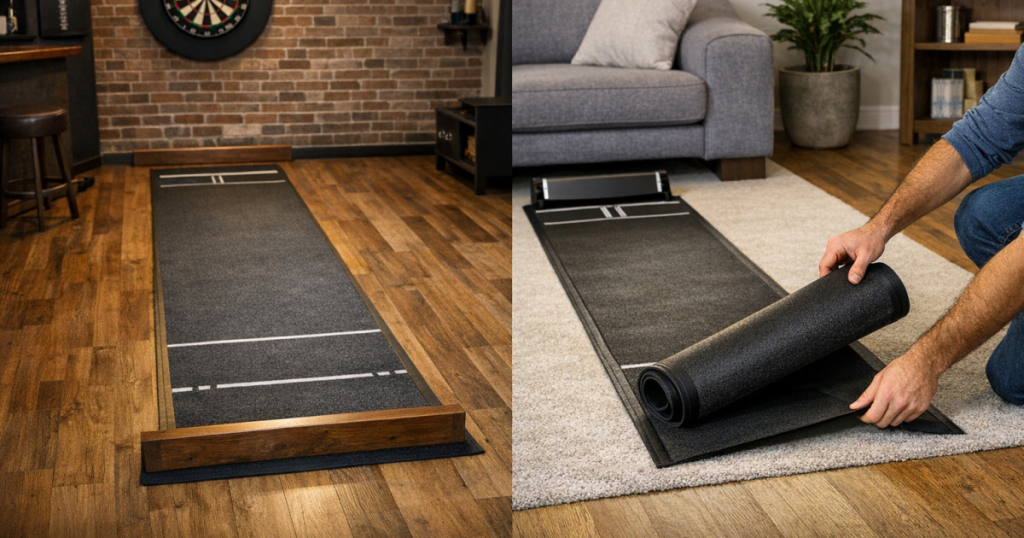
A removable setup is built around parts that come out for a session and go away afterwards. This often means a roll-out darts mat with a printed oche line, a moveable oche block, or a simple floor marker used with a mat. The board may still be permanently mounted, but the floor area returns to normal when you finish.
This approach is ideal when darts shares space with everyday life. A living room, dining room, office, conservatory or rented flat may not suit a permanent mat across the floor. A removable option also gives you flexibility if you sometimes need to shift furniture or change the throw lane.
The weak point is setup discipline. If the mat is not rolled out square to the board, the oche line can be accurate in distance but wrong in alignment. If it moves during play, your stance changes without you noticing. That is why removable setups need a simple routine: unroll, align, check the throw line, and make sure the mat sits flat before the first leg.
For rooms that need to change use quickly, the advice in portable darts mat and oche setups is a useful next step, especially if your board area has to disappear between games.
The oche is the detail that changes the feel
The mat protects the floor and defines the lane, but the oche controls where you stand. A printed line is low-profile and easy to store, but it does not give the same physical feedback as a raised edge. A raised oche gives your leading foot something to meet, which can help repeatability, but it is less discreet and needs a room where it will not be in the way.
For standard steel-tip darts, the throw distance is 2.37 m from the face of the board to the front edge of the oche. That small phrase matters: measure from the board face, not from the wall, not from the cabinet door, and not from the backboard. If your dartboard sits proud of the wall, measuring from the wall will leave the oche in the wrong place.
Before settling on a fixed or removable arrangement, mark the correct distance temporarily and play a few sessions. Notice whether your foot naturally creeps over a printed line, whether the mat shifts, and whether the oche position clashes with doors, sofas, coffee tables or walking routes.
Room-by-room examples
Dedicated spare room or garage
A fixed setup usually makes sense here. The room is already committed to hobbies or storage, and a permanent throw lane is less likely to annoy anyone. A heavier mat can stay flat, and a raised oche can be left in position. If the space has hard flooring, the mat also helps soften noise and reduce visible damage from bounce-outs.
Shared living room
A removable mat is usually easier to justify. It lets you protect the floor when playing without leaving a long mat across the main sitting area. The key is storage: if the mat is awkward to reach, you will either stop using it or leave it out permanently. For room layout ideas, planning a darts setup in a shared living room covers the practical compromises around furniture, sightlines and shared use.
Rented home
Removable normally wins because it avoids marks, adhesive residue and permanent fixings. A roll-out mat, door-safe storage spot and non-permanent oche marker are easier to reverse when you move. Check the mat backing against your flooring, because some rubberised materials can mark certain floor finishes if left in place for long periods.
Home bar or games corner
This is where the choice can go either way. If the area is clearly set aside for darts, a fixed oche helps create a proper playing feel. If the same space is used for parties, exercise kit or storage, a removable mat may be more practical, with a subtle wall-mounted scoring area and a mat stored nearby.
Floor protection: fixed does not automatically mean safer
Both styles can protect floors well, but only if the mat actually covers the likely bounce-out zone. Darts do not only land neatly below the board. They can kick forward, glance sideways, or drop near the skirting after hitting a wire, another dart or the surround.
A fixed mat left in place gives continuous protection, which is useful if several people play or if casual throws happen without much setup. A removable mat can protect just as well during play, but only if it is always used and placed correctly. If someone has a quick throw without rolling it out, the floor is unprotected.
Floor type matters too. Laminate and engineered wood can show point marks. Vinyl can dent. Carpet can hide small marks but may make a mat less stable. Tiles are hard and easy to clean, but bounce-outs can be unforgiving on dart points. For a fuller look at under-board protection, see the guide to protecting floors beneath a dartboard.
Checks before you commit
- Measure the throw line properly: set the front of the oche 2.37 m from the board face for standard steel-tip play, then check the mat has not shifted during use.
- Check the full standing area: make sure there is enough room for your stance, follow-through and retrieval path without stepping around furniture.
- Test mat movement: throw a few legs and watch whether the mat creeps, curls at the end, or lifts at the corners.
- Think about storage: removable only works well if the mat has an obvious home close to the board.
- Watch door swings and walkways: a fixed raised oche should not sit where people naturally walk through the room.
- Protect the wall area too: floor protection helps with bounce-outs, but it does not replace a surround, cabinet or backboard around the dartboard.
- Consider noise: hard floors, hollow walls and echoey garages can make darts sound sharper, so a mat may help the room feel less harsh.
Examples of mat and oche styles you may see
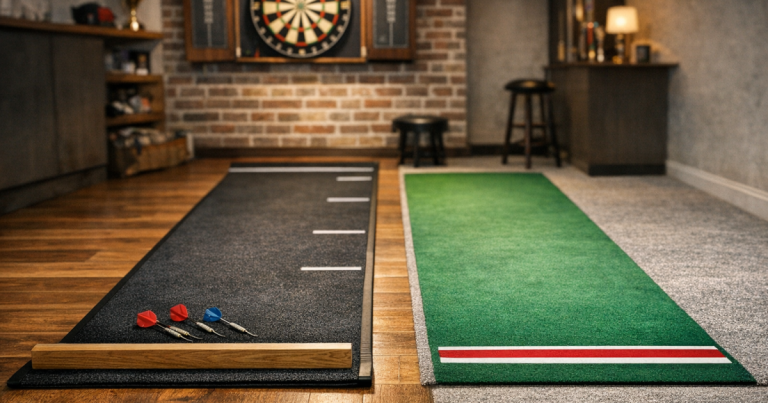
Roll-out rubber mats are popular because they are simple, wipeable and easy to store, though the weight and backing vary by model. Carpet-style darts mats can feel softer underfoot and more room-friendly, but they still need checking for flatness and accurate oche markings.
Named products such as the Winmau Xtreme Dart Mat and Unicorn Professional Dart Mat are examples of the kind of recognised darts mats players often compare when planning a home setup. Rather than assuming any mat is automatically right, check the printed distances, backing material, storage size, edge behaviour and whether it suits your floor surface.
Oche options range from a printed line to a moveable oche block or a permanent raised strip. A printed line is the easiest to live with. A moveable block gives a physical stop without making the room permanently awkward. A fixed raised oche gives the most consistent feel, but it only makes sense where the throw lane is dedicated and unlikely to obstruct normal use.
Maintenance and day-to-day use
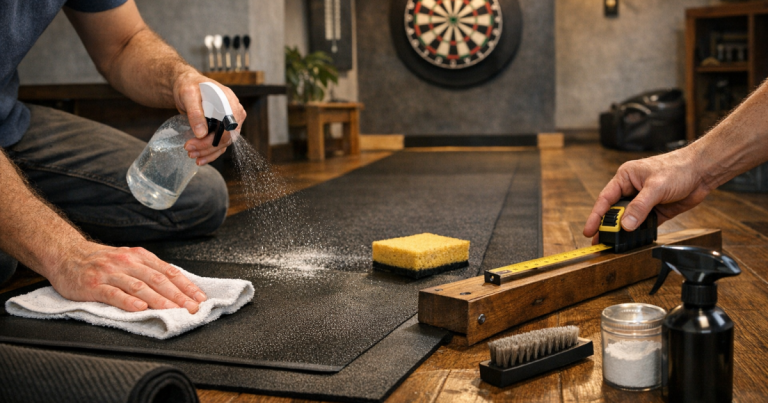
Fixed mats need occasional lifting, cleaning underneath and checking for edge curling. Dust and grit trapped below a mat can scratch hard flooring over time, especially where people pivot or stand repeatedly. If the mat has a backing that grips the floor, lift it now and then rather than assuming it can stay untouched indefinitely.
Removable mats need a different routine. Roll them loosely enough that they lie flat next time, store them away from damp areas, and avoid crushing them under heavier items. When you bring the mat out, align it to the board before anyone starts throwing. A quick check takes seconds and prevents a whole session being played from a poor line.
For either style, the best setup is the one you will actually use. A theoretically perfect fixed oche is not helpful if it annoys everyone else in the house. A neat removable mat is not helpful if it lives in a cupboard so awkward that nobody bothers with it.
Common questions
Is a raised oche better than a printed line?
A raised oche gives clearer foot feedback and can make practice feel more consistent. A printed line is easier in shared rooms because it does not create a permanent obstruction.
Can I leave a removable darts mat down all the time?
You can, but check the flooring regularly. Some mat backings may leave marks, trap grit or flatten carpet pile if left in one place for long periods.
Should the mat start at the wall or the board?
The important measurement is from the face of the dartboard to the front edge of the oche. The wall position can be misleading because boards, cabinets and backboards add depth.
What if my room is slightly too short?
Do not shorten the throw distance and call it close enough if you want consistent practice. Reposition the board, choose another wall, or use a room where the full throw lane is available.
Do I need a darts mat if I already have carpet?
Carpet softens bounce-outs, but it does not give you an accurate oche or protect against every mark. A mat still helps define the throw line and keeps the setup repeatable.
In brief
Choose a fixed setup when the darts area is genuinely dedicated, the oche will not obstruct everyday movement, and you want the most consistent practice feel. Choose a removable setup when the room has to stay flexible, the property is rented, or the board shares space with normal household life.
The best home setup is not the most permanent one by default. It is the one that gives you an accurate throw line, sensible floor protection and a room that still works when the darts are packed away.