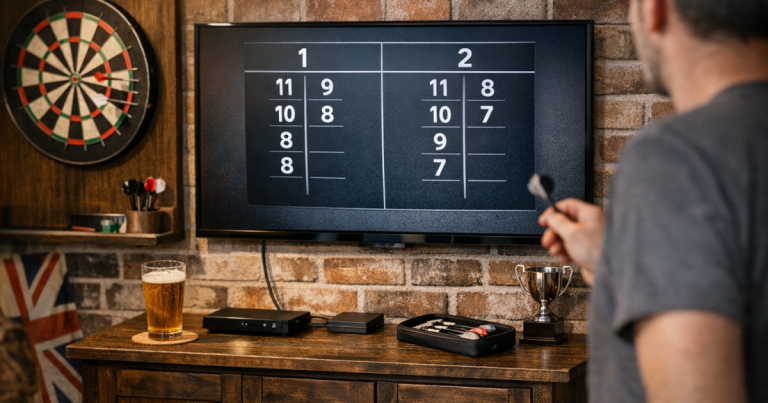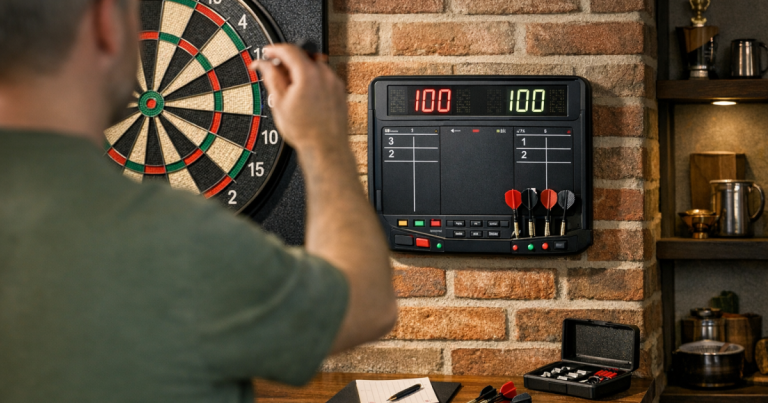
A 501 leg is simple once the scoreboard becomes part of your throwing rhythm rather than a pause between visits. Once you know the rhythm, it is straightforward to score 501 on a darts scoreboard without slowing the game down. The aim is to count down from 501 to exactly zero, with the final dart landing in a double or the inner bull.
For home play, the best scoring system is the one everyone at the oche can read quickly: clear names, clear remaining scores and no guesswork about busts. Whether you use chalk, a whiteboard or a dedicated darts scoreboard, the same process applies.
The short version
Start each player on 501. After each visit of up to three darts, add the darts scored in that visit, subtract that total from the player’s remaining score, and write the new remaining score on the board. To win the leg, the player must reach exactly zero with a double or the inner bull.
- Each player starts on 501.
- A visit means up to three darts.
- Only darts that count are added to the visit total.
- The visit total is subtracted from the player’s remaining score.
- The leg must finish on a double, including the inner bull.
- If a player goes below zero, leaves 1, or reaches zero without a double, the visit is bust and the score goes back to what it was before that visit.
Set up the scoreboard before the first dart
Write each player’s name at the top of a separate column. Under each name, write 501 as the starting score. Leave enough space down the column for each new remaining score, because a neat board is far easier to follow when the leg gets tense.
For casual home games, it helps to agree one scorer for the leg. That person calls the visit total, checks the subtraction, then writes the new score. The player should leave the darts in the board until the score has been called and accepted, because pulled darts are harder to verify afterwards.
If you are also tracking match structure, keep legs and sets separate from the running score. A leg is the individual race from 501 to zero; a set is a group of legs. For a fuller breakdown of match notation, see how to track sets and legs on a darts scoreboard.
Know what each part of the board is worth
Scoring 501 accurately depends on reading the board correctly. The single areas score the number shown on the outside ring. The thin outer ring is double that number. The thin inner ring is treble that number. The outer bull is 25, while the inner bull is 50 and counts as a double for finishing.
Common shorthand is useful on a scoreboard or when calling scores. T20 means treble 20, D16 means double 16, and S5 means single 5. If someone calls “treble twenty, single twenty, single five”, the visit total is 60 + 20 + 5, which is 85.
If you want a refresher on the scoring areas themselves, the guide to dartboard segments, bullseye and the number ring explains the layout in more detail.
Score each visit in the same order every time
The cleanest method is to use the same three-part routine for every turn: read the darts, total the visit, then subtract from the remaining score. Do not try to do all three at once, especially when someone has hit a mixed visit such as treble, single and double.
Step 1: read the darts
Look at each dart that counts. A dart normally counts only if it remains in the board until the score is called, though casual groups should agree their house rule before starting. Bounce-outs and darts that fall out before being called are usually not scored in steel-tip play.
Step 2: add the visit total
Add the three darts together. For example, T20, T20 and S20 is 140. S20, S5 and T19 is 82. D18, S18 and S4 is 58. Calling the total aloud gives the thrower a chance to spot an obvious mistake before anything is written down.
Step 3: subtract from the remaining score
Take the visit total away from the number already on the scoreboard. If the player is on 501 and scores 85, write 416 below their starting score. On their next visit, if they score 60, subtract 60 from 416 and write 356.
A worked example from 501 downwards
Here is a simple home-game example showing how a column might develop over the first few visits.
- Starting score: 501
- Visit 1: T20, S20, S5 = 85. New remaining score: 416.
- Visit 2: S20, S20, S20 = 60. New remaining score: 356.
- Visit 3: T20, T20, S20 = 140. New remaining score: 216.
- Visit 4: T20, S20, S16 = 96. New remaining score: 120.
- Visit 5: T20, S20, D20 = 120. The player reaches zero with a double, so the leg is won.
That final visit works because the last dart was D20. If the same player had hit T20, S20 and S40, that would not be possible because there is no single 40 segment. If they hit T20, S20 and S20 from 120, they would leave 20, not win the leg.
How the double-out rule affects the scoreboard
The double-out rule is the part that catches most new scorers. You can reduce the score during the leg with singles, doubles, trebles and bulls, but the winning dart must be a double or the inner bull. The scoreboard should show the remaining number until a legal finish is hit.
For example, if a player has 40 left, D20 wins the leg. If they hit S20 with the first dart, they now have 20 left and can still finish on D10. If they hit S20 and then S20, they have reached zero without a double, so the visit is bust and their score returns to 40.
The same applies when a player leaves 1. If someone is on 18 and hits S17, they have 1 left. Because 1 cannot be finished with a double, the visit is bust and the score goes back to 18. This is why leaving even numbers matters so much near the end of a leg.
What to write when someone busts
When a player busts, do not write the failed remaining score. The score returns to the number they had at the start of that visit. You can either leave the previous number as the latest visible score or rewrite it on the next line so everyone can see that a turn has passed.
For example, if a player starts a visit on 32 and hits S16, they have 16 left. If the next dart hits S16, they have reached zero without a double. That visit is bust, and their score remains 32 for their next turn. If you are scoring on a whiteboard, writing “32” again on the next line is often clearer than leaving a blank space.
Useful checkout examples for home scorers
You do not need to memorise every checkout to score correctly, but a few common finishes make the board easier to manage. These examples also help newer players understand why the scorer may say “you require 32” or “that leaves tops”.
- 40 remaining: D20 wins. This is often called tops.
- 32 remaining: D16 wins. Many players like this because missed singles can still leave an even finish.
- 24 remaining: D12 wins.
- 50 remaining: inner bull wins because it counts as a double.
- 78 remaining: T18 leaves 24, then D12 wins.
- 100 remaining: T20 leaves 40, then D20 wins.
At home, the scorer does not need to coach the player unless your group is happy with that. The scorer’s main job is to keep the numbers correct and visible.
Keep the setup comfortable for scoring
A scoreboard should be easy to see from the throw line without being so close to the board that it distracts the player. Place it where the scorer can write safely and the players can check the remaining score between visits.
Your throw line also matters because consistent position keeps the game fair and avoids confusion around whose turn it is. If you are refining a home setup, the advice on choosing a darts mat and oche setup for your floor is a useful next step.
Common mistakes when you score 501
Most scoring disputes come from a small handful of avoidable habits. Slow down slightly at these points and the leg will feel much smoother.
- Subtracting from the wrong line: always use the latest visible remaining score, not the starting score or the visit total above it.
- Forgetting the double-out rule: reaching zero is not enough unless the final dart is a double or inner bull.
- Counting a bounce-out: agree before play whether a dart must remain in the board to count.
- Removing darts too early: leave darts in place until the score has been called and accepted.
- Writing visit totals instead of remaining scores: either method can work, but remaining scores are clearer for most 501 games.
- Losing track of busts: after a bust, return to the score at the start of that visit.
Things readers ask
Do you subtract each dart or the whole visit?
Most scorers add the whole visit first, then subtract the total from the player’s remaining score. This keeps the board tidy and reduces arithmetic errors.
Can you finish 501 on the bullseye?
Yes, but only on the inner bull, which scores 50 and counts as a double. The outer bull scores 25 and does not count as a double finish.
What happens if the score goes below zero?
The visit is bust. The player’s score returns to whatever it was at the start of that visit, and any remaining darts in that visit are not used.
Should a home scoreboard show remaining score or points scored?
Remaining score is usually clearer for 501 because players can see what they need to leave or finish. Some scorers also note the visit total in smaller writing, but it is not essential.
What is the easiest way to avoid mistakes?
Use a consistent routine: read the darts, call the visit total, subtract from the current score, and write the new remaining score clearly before the next player throws.
What to remember
To score 501 well, keep the board simple: start at 501, subtract each visit, and only end the leg on a double or inner bull. The scorer does not need to rush; clear calls and neat writing are more valuable than speed.
Once everyone understands busts, doubles and remaining scores, a 501 leg becomes much easier to follow. That leaves the players free to focus on rhythm, finishing routes and enjoying the game rather than arguing over the maths.