When the mat shifts, the toe line is unclear or the floor feels uneven, your throw starts changing before the dart leaves your hand. A dependable darts mat and oche area gives you a repeatable stance, protects the floor and makes a home setup feel much closer to a proper match space.
The aim is not to overbuild it. The aim is to create a stable, correctly measured, comfortable throwing zone that works in the room you actually have, whether that is a spare bedroom, garage, hallway end or garden room.
Main points
- Measure from the face of the dartboard, not from the wall, when setting the oche distance.
- Use a mat that lies flat, grips the floor well and gives enough standing space for your normal stance.
- Make the throwing line visible, fixed and repeatable, whether it is printed, taped or raised.
- Check the floor surface underneath the mat, as carpet, laminate, tiles and concrete all behave differently.
- Keep the area clear around your feet so your stance does not drift to avoid furniture, skirting or clutter.
Start with the board position, then work back
A reliable mat starts with a reliable board position. For a standard steel-tip setup, the bullseye should be 1.73 m from the floor, and the throwing distance should be 2.37 m from the face of the board to the front edge of the oche line. That last detail matters: if your board sits in a cabinet, on a thick bracket or proud of the wall, measuring from the wall can leave the line slightly wrong.
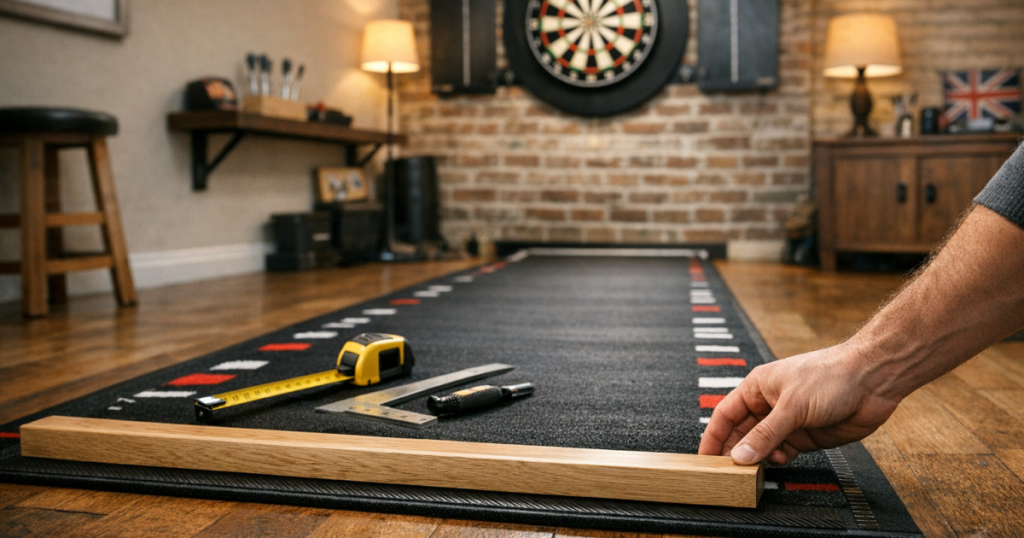
Use a tape measure and mark the centre line before worrying about the mat itself. The throw should run square to the board, not diagonally across the room because the furniture is in the way. If you are working in a tight room, it is worth checking the full throwing lane, standing zone and retrieval route before fixing anything. For a fuller room-planning check, see our guide to how to measure oche space before setting up a dartboard.
What makes a mat reliable?
A darts mat is reliable when it stays where you put it, gives the same foot reference every time and does not create a trip point. Thickness, weight, underside grip and edge behaviour all matter more than how smart it looks on day one.
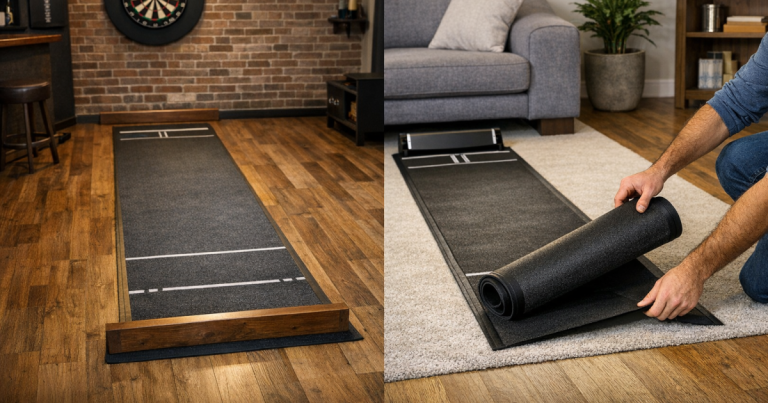
Rubber mats are common because they tend to sit firmly and offer useful floor protection. Carpet-faced mats can feel warmer underfoot and less harsh in a living space, but they need to lie flat and resist curling. Lightweight roll-up mats are convenient in shared rooms, though they can be more prone to movement if the floor underneath is smooth. Printed oche lines are handy, but they should still be checked against your own board position rather than trusted blindly.
Named mats such as the Winmau Xtreme Dart Mat and Target Darts World Champions Dart Mat are familiar examples of roll-out home darts mats, but the principle is the same with any brand: confirm the distance, check how it grips your floor and make sure the standing area suits your stance.
Choose the right oche style for the room
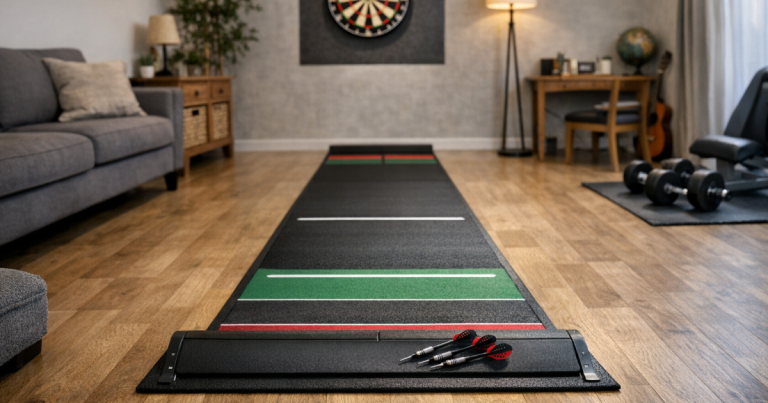
The oche is more than a line. It is the fixed reference point your body learns, so it needs to be clear and consistent. A printed line on a mat is the simplest solution, but it can be less satisfying if the mat moves or if the print does not align exactly with your board. A raised oche gives a positive toe stop, which many players prefer because you can feel the front edge without looking down.
A raised bar is better suited to a permanent or semi-permanent area where people are not walking through regularly. In a family room or narrow garage route, a raised strip can become an annoyance if it is always in the way. A flat taped line, removable floor marker or low-profile oche can be more sensible when the space has to return to normal after a session. If you need a non-permanent approach, our guide to marking a temporary oche without damaging flooring covers low-impact methods.
Match the mat to the floor underneath
Flooring changes how the whole setup behaves. On laminate or vinyl, a light mat may slide unless it has a grippy underside or a suitable non-slip layer beneath it. On thick carpet, a mat may feel stable but can sit unevenly, especially if the pile compresses differently under each foot. On concrete garage floors, the mat may grip well but feel cold or hard during longer practice sessions.
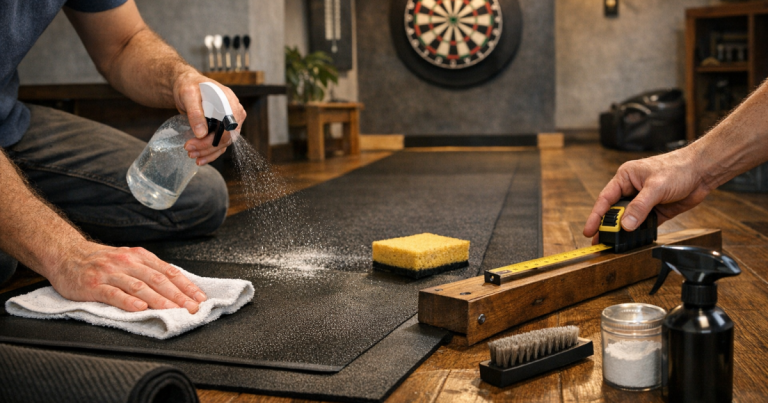
Before settling on the final position, roll the mat out for a few days if possible. Some mats need time to relax after being stored rolled up. If the corners curl, avoid taping them aggressively straight away; first try laying the mat flat under gentle weight. The goal is a flat edge that does not catch your foot as you step in and out of the throw.
If the mat creeps forward during practice, check whether you are pushing off with your rear foot, dragging your front shoe or standing partly off the edge. Sometimes the mat is not the only problem; the stance and available space are contributing to movement.
Give your feet enough usable space
Many home players focus on the throwing distance but forget lateral space. You need room to stand naturally, not just room for a toe line. A narrow standing zone can push you into an awkward angle, especially if you stand to one side of the centre line or use a wider stance.
Keep shoes, dart cases, stools and storage boxes away from the oche area. Even small obstructions can train you into a compromised position. If the mat sits close to a skirting board, radiator or cabinet, make sure your trailing foot has room. Good reliability is partly physical and partly behavioural: the setup should encourage the same stance without making you think about it.
Build in wall and floor protection together
A mat protects the floor from dropped darts, but it will not solve every damage risk. Missed darts, bounce-outs and enthusiastic retrievals can still mark the wall, skirting or nearby furniture. The most dependable home areas treat the board, surround, lighting and oche as one small playing zone rather than separate accessories.
A dartboard surround, cabinet or backing panel can help protect the wall around the board, while the mat covers the main drop zone underfoot. If the setup is in a decorated room, think about how darts are retrieved as well as thrown. Players often damage paintwork by leaning in, catching points on the wall or placing darts down on nearby shelves without thinking.
Keep the throwing line honest
Once the board and mat are positioned, test the line from several angles. Stand at the oche, look at the board and check that your body feels square. Then measure again. It is surprisingly easy for a mat to look straight while being a few centimetres off-centre.
If you use a raised oche, place the front edge exactly on the legal throwing line, not behind it. If you use tape, mark the front edge clearly so there is no confusion about whether your toe should sit on, behind or just touching the strip. For friendly home games, the important thing is not tournament formality; it is that every player uses the same reference point.
Common reliability problems and what they usually mean
- The mat moves after a few visits to the board: the underside may not suit the floor, or the mat may be too light for the surface.
- The oche feels different each session: the mat is probably being rolled out in a slightly different position, so add discreet alignment marks.
- Your front foot keeps missing the line: the oche may be too subtle, too close to a pattern on the mat or poorly lit.
- The mat curls at the edges: it may need more time to flatten, better storage or replacing if it has developed a permanent bend.
- Your stance feels cramped: the room layout may be forcing your feet to avoid furniture or walls, even if the official distance is correct.
Lighting and visibility affect the oche too
Lighting is usually discussed around the board, but the oche needs to be visible as well. A clear board with a gloomy floor line still creates uncertainty. Shadows from ceiling lights, cabinets or your own body can make a printed line harder to see, particularly on darker mats.
Try a few throws at the time of day you normally play. A garage or garden room can feel very different on a winter evening compared with a bright afternoon. The ideal setup lets you see the board clearly without losing the oche line under your feet.
Make it easy to reset accurately
If the space is shared, reliability depends on how easily the mat returns to its correct position. Add small, discreet reference marks at the rear corners, or use the edge of a skirting board, rug, cabinet or floor joint as a repeatable guide. Avoid relying on memory alone.
Store a roll-up mat loosely rather than crushing it into a tight bend. Keep the oche bar, tape or marker with the mat so parts do not go missing between sessions. If you use a dry-wipe scoreboard or accessories nearby, keep them off the floor and away from the standing zone so the mat does not become a storage area.
Test the setup before calling it finished
Throw a short practice session from your normal stance, then invite another player to try it. Watch whether they naturally find the line, whether they step around anything and whether the mat shifts after retrieval. A reliable area should work without a set of verbal instructions.
After a week, measure again. Mats settle, tape can lift and rooms get rearranged. Small checks prevent small errors becoming part of your practice routine. Once the darts mat and oche area is stable, most of your attention can go back where it belongs: rhythm, grouping and finishing.
Things readers ask
Can I use a normal rug instead of a darts mat?
You can, but it is rarely as consistent. A rug may slide, bunch or lack a clear throwing line. If you use one, measure the oche separately and make sure the front edge cannot move during play.
Should the oche be raised or flat?
A raised oche gives the clearest toe reference, which many players like for practice. A flat marker is better in shared rooms, rented homes or walk-through spaces where a raised strip would get in the way.
How often should I remeasure the oche?
Remeasure whenever you move the board, change the surround or reposition the mat. For roll-away setups, a quick check every few sessions keeps the distance honest.
What should I do if my mat keeps sliding on laminate?
Check that the underside is clean, then try a suitable non-slip layer designed for smooth floors. Also check your stance, as pushing hard through the rear foot can move lighter mats.
Does a mat protect the floor from all dart damage?
No. It helps with dropped darts and bounce-outs near the board, but it cannot cover every angle. Keep the surrounding floor clear and combine it with sensible wall protection around the dartboard.
Key takeaways
A reliable home throwing area comes from accurate measurement, stable flooring, a clear oche and enough space to stand naturally. Do those basics well and the setup starts to disappear in the best possible way: you stop adjusting your feet and start concentrating on the visit.
For more setup checks, read our notes on darts mat and oche setup mistakes that affect your throw.