A solid darts mat setup can make your throw feel repeatable, protect the floor and give the room a proper match-night feel. When it is slightly wrong, though, it can nudge your feet out of line, shorten the throw, create a trip point or make the board feel less comfortable to aim at. Most problems come from small details: where the oche sits, whether the mat creeps, how level the floor is and whether the player has enough space to stand naturally.
In brief
The most common mat and oche mistakes are measuring from the wrong point, placing the mat slightly off-centre, using a surface that slips, allowing the raised oche to move, and setting up too close to furniture or walls. Each one can affect your balance, shoulder alignment and release point. You do not need a tournament-style room to fix them, but you do need a consistent reference point and a mat that stays where it is put.
Before adjusting your stance or blaming the darts, confirm the board and throw line are correct. The standard steel-tip setup is 1.73 m from the floor to the bullseye and 2.37 m from the face of the board to the oche. If you want the full measuring method, use our guide on setting dartboard height and oche distance correctly.
Measuring from the wall instead of the board face
This is the classic home setup error. The throw distance is measured from the face of the dartboard, not from the wall, cabinet back, surround, or mounting plate. If you measure from the wall behind the board, your oche can end up too far away or, more commonly, slightly too close depending on the board and bracket depth.
A few centimetres may not sound dramatic, but darts is a repeatable-motion game. If you practise for weeks from a short throw, a properly measured oche elsewhere can feel strangely long. Your arm may start reaching, your follow-through can flatten, and grouping may drift low.
What to do instead
- Measure from the front surface of the dartboard, not the wall.
- Use a tape measure that stays straight and taut across the floor.
- Check the diagonal measurement if floor access is awkward, but use a reliable reference rather than guessing.
- Recheck after changing board, cabinet, backing panel or surround depth.
Putting the oche line off-centre
A mat can be the correct distance from the board and still be wrong if it is not aligned with the centre of the bullseye. This happens a lot in alcoves, garages, spare rooms and narrow utility spaces where the mat is positioned to avoid a skirting board, radiator, sofa leg or door swing.
If the line is offset, your body compensates. Right-handed players may find themselves leaning across the throw line, opening the shoulders too much, or standing with the front foot angled awkwardly. Left-handed players can have the same problem in reverse. Over time, the setup teaches a throw that only works in that slightly skewed space.
A simple alignment check
Stand at the oche and imagine a straight line from the bullseye to the middle of the throw line. Your usual standing point does not have to be exactly in the centre, because many players stand slightly left or right by preference. The mat itself, however, should be square to the board so that your preferred stance is a choice, not a workaround.
- Mark the centre point below the board before laying the mat.
- Align the printed oche line or raised oche square to that centre point.
- Check both ends of the mat, not just the oche edge.
- Look from the board end back towards the mat to spot skew more easily.
Letting the mat creep during play
A mat that moves by a few millimetres every visit is annoying; a mat that shifts by several centimetres over an evening changes the whole match. Creeping is common on laminate, vinyl, polished concrete and some short-pile carpets. It can also happen when players step on and off from the side rather than walking straight up to the oche.
The problem is not just distance. When the mat moves, the raised oche or printed line can end up diagonal. Players then reset their feet subconsciously, which makes throw rhythm inconsistent. In doubles or casual home games, different players may unknowingly be throwing from slightly different positions.
For a deeper step-by-step fix, see our advice on positioning a dart mat so it stays put.
Signs the mat is moving
- The back edge is no longer parallel with floorboards, tiles or a wall line.
- The mat bunches slightly near the toe line.
- Players keep looking down before throwing because the line no longer feels trustworthy.
- The oche distance measures differently at the start and end of a session.
Using a raised oche that is not secure
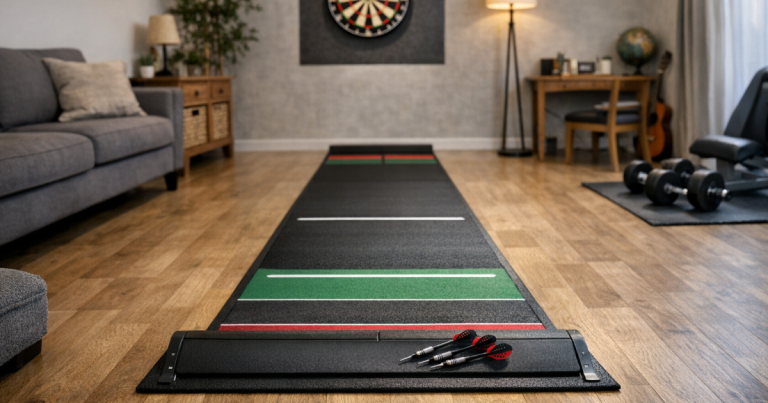
A raised oche gives a clearer physical stop than a printed line, which many home players prefer. The mistake is treating it as a loose accessory rather than part of the setup. If the raised edge lifts, rocks, slides or catches a shoe, it becomes a distraction and a safety issue.
Some mats have an integrated raised oche. Others use a separate bar or attachable strip. Either can work well, but it needs to sit flat and remain square. If you constantly tap it back into place with your foot, it is already affecting your throw.
Why it changes your release
Players often press the front foot lightly into the oche as a reference. If that reference moves, the front knee, hip and shoulder position change with it. A wobbly oche can also make players stand slightly back from the line, shortening their normal stride into the throw and making the action feel cramped.
- Check that the oche edge is straight before each longer session.
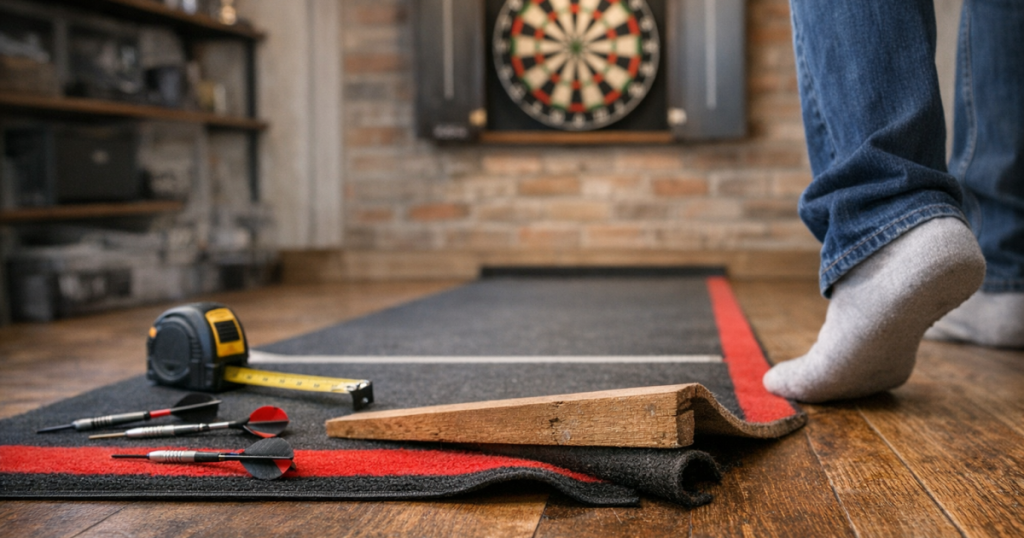
- Make sure the join between mat and oche is not curling upwards.
- Avoid temporary fixes that create a ridge or trip point.
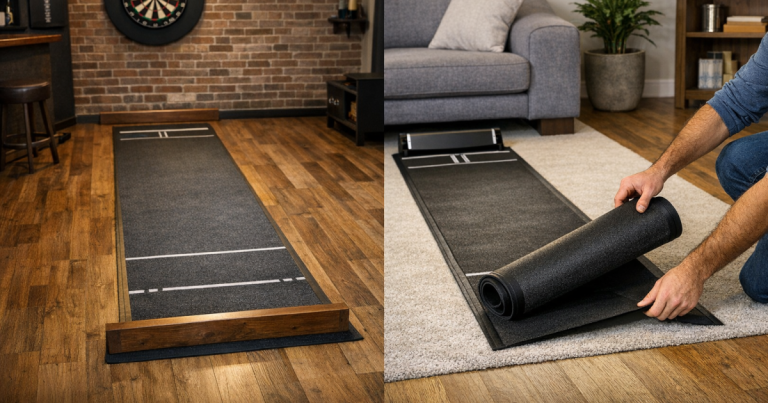
- If the oche is removable, store it flat so it does not warp or twist.
Ignoring the floor underneath
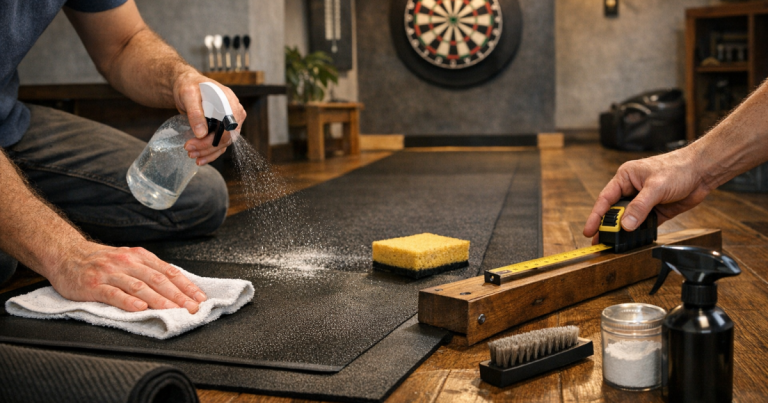
The same mat can behave differently from room to room. A heavy rubber mat may sit confidently on one floor and creep on another. A thinner roll-out mat may feel fine on carpet but slide on smooth laminate. Uneven flooring can also create a subtle slope under the lead foot, which affects balance more than many players realise.
In UK homes, darts spaces are often squeezed into multipurpose rooms: a dining area, garage conversion, spare bedroom, hallway end or garden room. That means you may be dealing with rugs, thresholds, underfloor heating, draughts, skirting boards and furniture legs rather than a clean sports-floor surface.
Floor checks worth doing
- Walk across the mat slowly and feel for rocking, rippling or sliding.
- Check whether the front foot lands partly on a seam, rug edge or floor transition.
- Look for curled mat corners after storage or cleaning.
- Make sure the floor is dry before play, especially in garages or garden rooms.
- Keep the throwing area clear of loose cables, bags, stools and spare darts cases.
Grip and trip hazards matter as much as throw consistency. Our separate guide to darts mat safety, grip and floor protection covers the practical checks in more detail.
Choosing comfort over a repeatable stance
It is tempting to place the mat where the room looks neatest, but the best-looking position is not always the best throwing position. If the oche is too close to a wall, cabinet, sofa or shelving unit, the player may shorten their stance or bring the elbow in. Tall players may also feel restricted if there is furniture immediately behind or beside the throwing area.
Give yourself enough room to stand naturally, retrieve darts safely and let other players wait without crowding the thrower. The mat should define the throwing lane, not become a narrow strip squeezed into whatever floor space is left.
Common room-layout traps
- The mat is straight, but the player has to stand with one foot against furniture.
- The oche is positioned so close to a door that people cross behind the thrower.
- The mat stops short of the normal standing area, leaving the back foot on a different surface.
- A cabinet door, scoreboard or light fitting makes the player stand off-centre.
- The room looks tidy, but the throwing lane does not feel relaxed.
Overlooking how different players stand
A home setup often has to work for more than one person. One player may stand square, another side-on, another with the lead foot angled across the line. If the mat is narrow, slippy or surrounded by clutter, only one stance may feel comfortable.
This does not mean the room has to suit every possible style. It does mean the oche should be clear enough that players can choose their normal foot position without stepping off the mat, catching the edge or standing partly on a different surface.
Watch a few turns rather than judging from one throw. If everyone keeps shuffling before release, the setup may be asking players to adapt too much. A good mat and oche arrangement should disappear into the background once play starts.
A quick home check before your next match
Use this short sequence when a setup feels slightly off but you cannot immediately see why. It takes only a few minutes and is more useful than repeatedly adjusting your throw to compensate.
- Confirm the bullseye height and throw distance with a tape measure.
- Check that the oche line is square to the centre of the board.
- Stand at your usual spot and see whether both feet are fully supported.
- Throw a normal visit, then check whether the mat has shifted.
- Look for curled edges, loose oche sections or anything your shoe could catch.
- Make sure the route to retrieve darts is clear and not crossing stored items or cables.
- Ask another regular player whether the position feels natural, not just technically correct.
If the measurements are correct but your throw still feels cramped, look at the room rather than the mat. Side clearance, lighting position, board surround depth and waiting-player space can all affect how confidently you stand at the line.
FAQ
Can a mat really affect scoring?
Yes. The mat does not change the dart, but it can change your stance, balance and distance. If your foot position varies every visit, your release point is likely to vary too.
Is a raised oche better than a printed line?
A raised oche gives a clearer physical reference, but only if it is stable and square. A printed line on a secure mat is better than a raised edge that moves or catches your foot.
How often should I remeasure the oche?
Remeasure after moving the board, changing the cabinet or surround, cleaning under the mat, or storing the mat rolled up. For a busy home setup, a quick check every few weeks is sensible.
What if my room is too small for a full mat?
Keep the official throw distance correct and prioritise a clear, stable foot position. A shorter mat can still work if the oche is accurate and the standing area is safe.
Should the whole throwing area be covered?
Ideally, both feet should be on a consistent surface when you throw. If one foot is on the mat and the other is on bare floor or carpet, your balance can feel different from visit to visit.
Final thoughts
Most mat and oche mistakes are not dramatic. They are small enough to miss, but big enough to affect confidence at the line. Start with the fixed points: board height, distance from the board face and centre alignment. Then look at the moving parts: mat grip, oche stability, floor surface and player space.
When the setup is right, you should not be thinking about it during a leg. Your feet find the same place, the oche feels reliable, and the throw lane feels clear. That consistency is what turns a home darts corner from a casual board on the wall into a proper practice space.