A good light makes darts easier to score, more comfortable to play and far less frustrating in a dim room. But dartboard lighting safety is just as important as brightness: a light that runs too hot, has trailing cables or sits loosely above the board can turn a neat home setup into an avoidable hazard.
Mains electrical wiring, fused spurs, new sockets and any hard-wired lighting connections should be carried out by a qualified electrician to support compliance with UK electrical safety requirements and relevant standards.
For most home players, the safest route is a well-made plug-in dartboard light, fitted exactly as the manufacturer describes, with cables kept away from feet, darts, heat sources and moving parts. The aim is simple: clear visibility without creating new risks around the oche, the wall or the board surround.
The short version
Safe dartboard lighting comes down to three practical checks: heat, cables and fixing. If the light stays cool enough in use, the lead is routed neatly, and the fitting cannot move or drop during play, you are most of the way there.
- Use lighting designed for use around a dartboard, cabinet or wall-mounted sports setup, rather than improvising with unstable lamps.
- Keep fittings, power supplies and cables clear of the scoring area and away from where darts may land.
- Do not overload extension leads or tuck power supplies into enclosed spaces where heat can build up.
- Check fixings periodically, especially if the board is mounted on plasterboard, a cabinet or a shared wall.
- Stop using any light immediately if it flickers, smells hot, has damaged insulation or feels insecure.
Heat: what matters around a dartboard
Modern dartboard lights are usually much cooler than old-style bulbs, but heat still deserves attention. The issue is rarely dramatic overheating during normal use; it is more often poor airflow, a covered power supply, a fitting pressed against fabric, or a lamp left running in a cramped cabinet.
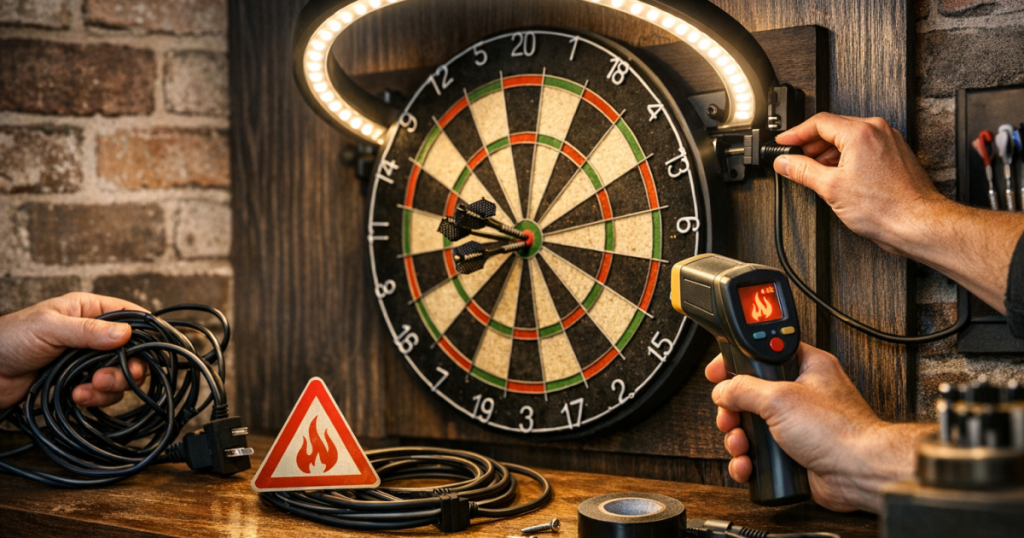
Check the light after it has been on for a typical playing session. It should not feel uncomfortably hot to touch on exposed outer surfaces, and there should be no warm smell, discolouration or buzzing from the fitting or plug. If the manufacturer gives clearance instructions, follow those rather than guessing.
Be careful with improvised setups. A desk lamp clipped to a shelf, a work light balanced on furniture or a strip light fixed with weak adhesive may seem fine for one evening, but darts setups are repetitive environments. Players move, lean, retrieve darts and sometimes brush against nearby furniture. Anything that can be knocked, covered or pulled by its cable is a poor fit for regular play.
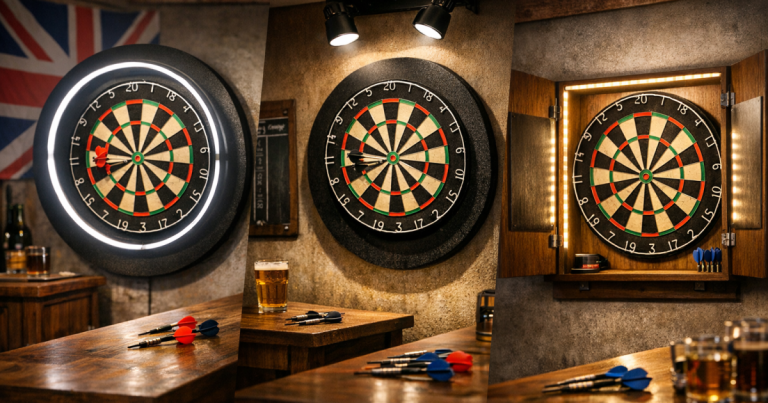
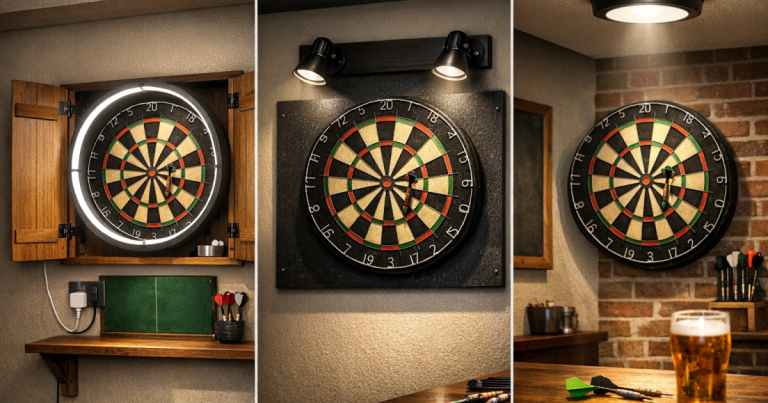
Cabinets need an extra heat check because doors, backing panels and enclosed spaces can reduce airflow. If you are planning a cabinet-based layout, the trade-offs are worth thinking through before buying or fitting anything. The guide to dartboard cabinets with integrated lighting covers the practical compromises around space, access and visibility.
Cables: route them as part of the throw area, not an afterthought
A cable that looks harmless beside the board can become a nuisance once people start playing. The oche area needs to stay clear, and the route from the light to the socket should avoid both foot traffic and the path used when collecting darts.
The neatest setups usually place the socket to one side of the board area, not directly below the bullseye. From there, the cable can run vertically or along an edge, secured with suitable clips or trunking. Avoid loose diagonal runs across the wall, dangling loops behind a cabinet door, or leads that cross the floor behind the oche.
Extension leads are common in UK spare rooms, garages and converted corners, but they need sensible limits. Use a lead in good condition, keep it uncoiled during use if the manufacturer instructs this, and avoid daisy-chaining extensions. A small dartboard light may not draw much power, but the risk often comes from the overall arrangement: heaters, chargers, lamps and other room equipment all sharing one overloaded lead.
If the cable must run down to skirting level, make it visible, tight to the wall and away from standing positions. Do not hide damaged or strained cable behind a surround, acoustic panel or mat. If a plug, cable or inline power supply looks worn, cracked or crushed, replace the product or have the issue assessed before using it again.
Secure fitting: why small movement matters
Dartboard lights are often fitted above, around or close to a bristle board. That means they may be near a cabinet, surround, backboard or wall panel. A loose fitting does not have to fall completely to be a problem; even a small sag can create shadows, distract players or leave a cable under strain.
Before fitting a light, identify what is actually taking the load. Solid masonry, timber backing and properly installed cabinet fixings behave differently from plasterboard alone. Use the fixings supplied by the manufacturer only when they are suitable for your wall or cabinet material. If they are not suitable, choose appropriate alternatives rather than forcing the supplied screws into a weak surface.
After fitting, give the light a controlled stability check. It should not wobble when the cabinet door is opened, when the surround is adjusted, or when someone retrieves darts from the board. Cables should not be acting as support, and the light should not rely on the dartboard itself unless the product is specifically designed to do so.
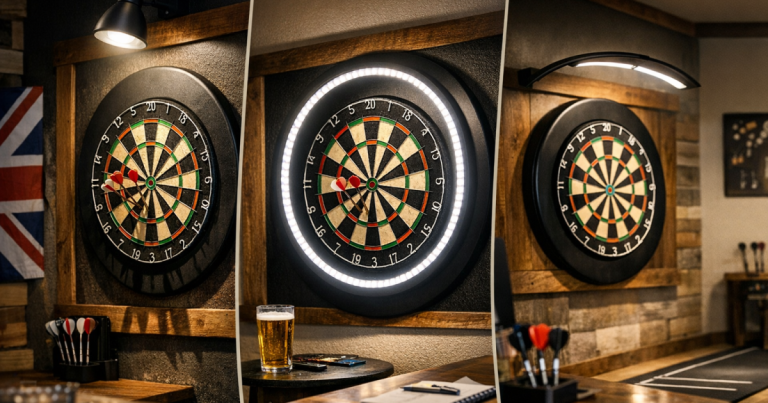
Lighting position also affects secure fitting because some mounting points are naturally more exposed than others. A light that sticks far out from the wall may be easier to knock in a narrow hallway or garage bay. A compact light may be safer in a tight space, provided it still gives even coverage. For positioning and shadow control, read the separate guide on planning lighting without shadows over your dartboard.
Common home setup risks
The light is fitted, but the plug is awkward
If the plug is behind furniture or trapped behind a cabinet, players may leave the light switched on because it is inconvenient to reach. That increases unnecessary heat and wear. Keep the switch or plug accessible, or use a safe, properly rated switched socket arrangement fitted by a qualified electrician where fixed wiring is involved.
The cable hangs behind the board
A dangling cable behind a dartboard can rub, snag or become pinched when the board is rotated. Keep cable routes outside the moving area of the board and away from the metal number ring. If the board is in a cabinet, open and close the doors fully after fitting to check nothing catches.
The light is attached to a weak surface
Some surrounds, thin decorative panels and soft wall coverings are not designed to carry accessories. If a light must be mounted to a backing panel, make sure the panel itself is securely fixed and suitable for the load. Adhesive-only fixing should be treated cautiously unless the product is specifically designed for that surface and weight.
The room has multiple trip hazards
Lighting is only one part of the floor plan. A cable crossing behind the oche, a curled mat edge and a loose extension lead can combine into a bigger problem than any single item. Keep the throwing lane clean and predictable, especially when guests or children are around.
A simple safety check before a longer session
Before league-style practice, a family tournament or an evening with friends, take two minutes to inspect the setup. It is easier to fix a loose clip or move a cable before people start throwing.
- Look at the fitting: check that screws, brackets, clamps and clips are still firm and aligned.
- Check the cable path: make sure it is not crossing the oche, hanging near the board or trapped by furniture.
- Feel for unusual heat: after the light has been on, check that the fitting, plug and power supply are not excessively warm.
- Watch for flicker: intermittent light can indicate a poor connection, failing component or strained cable.
- Clear the playing area: move bags, spare darts, stools and trailing leads away from the throw line.
- Switch off after play: do not leave the light running unattended once the session is over.
If you are also refining visibility, glare and board coverage, the broader dartboard lighting guide explains how to balance brightness with comfort and practical setup standards.
Where lighting meets children, pets and shared spaces
Many home boards are not in dedicated darts rooms. They are in dining rooms, garages, spare bedrooms, sheds or multi-use family spaces. That makes cable control and secure fitting more important because the area may be used when darts are not being played.
Children and pets can pull dangling cables, knock freestanding lamps or investigate switches. Keep leads high or tight to the wall where possible, and avoid leaving portable lighting near the board after play. If you pack darts away between sessions, include the lighting cable in the same reset routine: switch off, unplug where appropriate, and leave the floor clear.
Shared rooms also need lighting that does not interfere with normal movement. A low-hanging fitting in a narrow walkway, a power brick left on the floor or a cable taped across a doorway is not a long-term solution. If the board is temporary, consider a setup that can be removed cleanly rather than one that relies on improvised cable runs every time.
What not to do
Some shortcuts look tidy at first but create avoidable problems over time. Avoid these common mistakes:
- Do not wrap cables tightly around brackets, cabinet hinges or the dartboard number ring.
- Do not cover power supplies with clothing, acoustic panels, curtains or foam surrounds.
- Do not run a light from a damaged extension lead or a socket that feels loose or unreliable.
- Do not mount a light where missed darts can easily strike the fitting or cable.
- Do not rely on temporary tape for a permanent overhead fitting.
- Do not ignore movement just because the light has not fallen; wobble is a warning sign.
Common questions
Can a dartboard light get hot enough to damage the board?
Under normal use, a suitable modern dartboard light should not damage a bristle board. Problems are more likely when the product is faulty, poorly ventilated, left on for long periods, or fitted too close against materials contrary to the manufacturer’s instructions.
Is it safe to use an extension lead for dartboard lighting?
It can be, provided the extension lead is in good condition, properly rated, not overloaded and not creating a trip hazard. Avoid daisy-chaining extension leads or running cables across the playing area.
Should the cable run behind the dartboard?
Usually no. A cable behind the board can be pinched, rubbed or caught when the board is rotated. A side route, clipped neatly to the wall or cabinet edge, is generally cleaner and safer.
How often should I check the fitting?
Check it after fitting, again after the first few sessions, and then periodically as part of normal room maintenance. Recheck sooner if the board, cabinet, surround or wall panel has been moved.
Can I fit lighting inside a dartboard cabinet?
Yes, if the light is suitable for the cabinet layout and has enough clearance and ventilation. Make sure doors, cables and fixings do not clash when the cabinet is opened and closed.
Main lessons
A safe lighting setup should feel boring in the best possible way: no hot smells, no dangling leads, no wobble, no awkward plugs and no shadows that make you lean in to score. Once heat, cable routing and secure fitting are sorted, the light can do its real job quietly in the background.
Treat the dartboard area as a complete playing space rather than a board with accessories added around it. Plan where people stand, how they collect darts, where the cable runs and how the light is supported. That approach gives you better visibility, fewer distractions and a home setup that is easier to enjoy session after session.