A slightly wonky board is one of those small home darts problems that becomes annoying very quickly. A crooked dartboard can make the treble bed look off, make the 20 segment feel strange, and turn a tidy setup into something that never looks quite right.
The good news is that most cases are easy to fix. You usually need to check three things: the board’s rotation on its centre screw, the wall bracket or cabinet mount behind it, and whether anything around the board is pushing it out of position.
In brief
- Start by checking whether the number 20 is truly vertical, not just close enough by eye.
- If the board has rotated, loosen and re-seat it on the wall bracket before touching the wall fixings.
- If the whole board leans, check the bracket, centre screw, cabinet back panel and wall plugs.
- If the board looks straight but plays oddly, re-check the official height and throwing distance using a tape measure.
- Do not rely on the outer cabinet edges, picture rails or skirting boards as your only reference point; many rooms are not perfectly square.
Work out what kind of crooked you are dealing with
Before adjusting anything, identify the problem properly. A dartboard can look wrong for several different reasons, and each one has a different fix.
The first type is rotation. This is where the board itself has turned slightly in the bracket, so the 20 segment is no longer directly at the top. The board may still sit flat against the wall, but the scoring segments look slanted.
The second type is tilt. This is where one side of the board sits higher or lower than the other because the mounting bracket, cabinet or wall fixing is not level. The number ring might look straight relative to the board, but the whole board appears to lean.
The third type is uneven projection. This happens when one side of the dartboard sits proud of the wall, often because the centre screw is not seated properly, the rear pads are uneven, the cabinet back panel is bowed, or a surround is pressing against the board.
It is worth separating these faults before reaching for a screwdriver. If you adjust the wall bracket when the board has simply rotated on the centre screw, you can create a bigger alignment problem than the one you started with.
Step 1: Check the 20 segment with a proper reference
Stand directly in front of the board at the oche line and look at the number 20. The centre of the 20 segment should run vertically down through the bull. If it is leaning left or right, the board has rotated.
A small spirit level can help, but do not place it across the number ring and assume that tells the full story. Number rings are removable and can sit slightly unevenly. A better check is to use the wire that runs through the 20 segment and compare it with a vertical reference.
If you have a plumb line, hang it from just above the board so it passes close to the bull. If not, use a long piece of string with a small weight tied to the end. You are not trying to create a surveyor’s setup; you just need a clear vertical line that is not affected by the shape of the room.
If the 20-to-bull line does not match your vertical reference, rotate the board by hand until it does. Many bristle dartboards are held on a centre screw and slotted bracket, so a gentle lift and turn is enough. Re-seat it carefully and check that it feels secure.
Step 2: Make sure the board is seated fully on the bracket
If the board keeps drifting back into a slant, the centre screw may not be sitting cleanly in the bracket. Take the board off the wall and inspect the rear screw. It should be central, firm and protruding enough to engage with the wall bracket without leaving the board loose.
Also check the bracket slot. Dust, compressed sisal fibres, chipped wall material or a slightly bent bracket can stop the screw from settling into the lowest point of the slot. That can leave the board looking almost straight until a few throws make it shift again.
When you rehang the board, do not force it down aggressively. Lift it onto the bracket, let the centre screw drop into place, then rotate the board gently until the 20 is vertical. If the board wobbles when touched, take it back down and adjust the screw depth in small turns.
For regulation-style home setups, it is also a good moment to confirm the bull height and throwing distance. If you need the core numbers, use this explainer on dartboard sizes, measurements and regulations before you lock everything in.
Step 3: Check whether the wall bracket is level
If the board is correctly rotated but the whole face still appears to lean, check the wall bracket itself. Remove the dartboard and put a small spirit level across the bracket. If the bracket is out, the board will be out too.
On a plain wall, the fix is usually simple: loosen the bracket screws slightly, level the bracket, then tighten it again. If the screws pull the bracket back into the same crooked position, the holes may be worn or the wall plugs may be loose. In that case, the bracket may need fresh fixings rather than another quick twist.
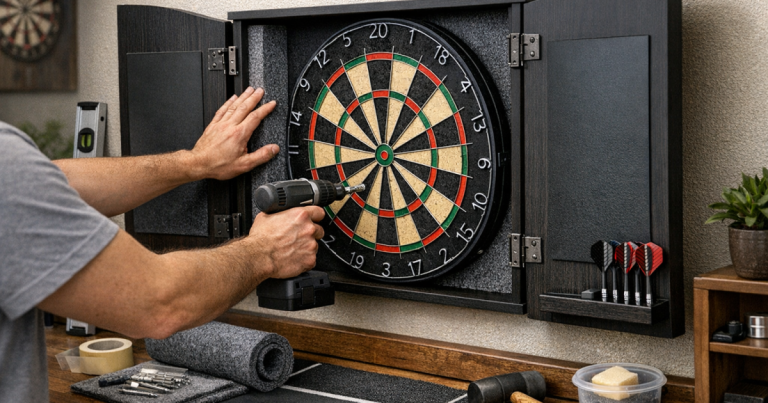
Take extra care if the bracket is mounted inside a cabinet. A cabinet can look level from the outside while the internal mounting point is slightly off. Check the dartboard itself, not only the cabinet frame. Doors, hinges and decorative edges can mislead the eye, especially if the cabinet is on an older wall or near uneven skirting.
If you are setting up or correcting a cabinet, the process is easier when you separate cabinet levelling from dartboard levelling. The detailed steps in fitting a dartboard cabinet without misaligning the board are useful if the board and cabinet seem to be fighting each other.
Step 4: Look for pressure from the surround or cabinet
Sometimes the mount is fine, but something around the board is nudging it out of line. A tight surround, cabinet door stop, uneven backboard or thick wall protector can push one edge of the dartboard forward. From the oche it may look like the board is crooked, even though the centre screw and bracket are straight.
Run your fingers around the edge of the board. The gap between the board and any surround should feel even. If one side is pinched, remove the surround and check the board again. If the board sits correctly without the surround, the surround is the problem rather than the mount.
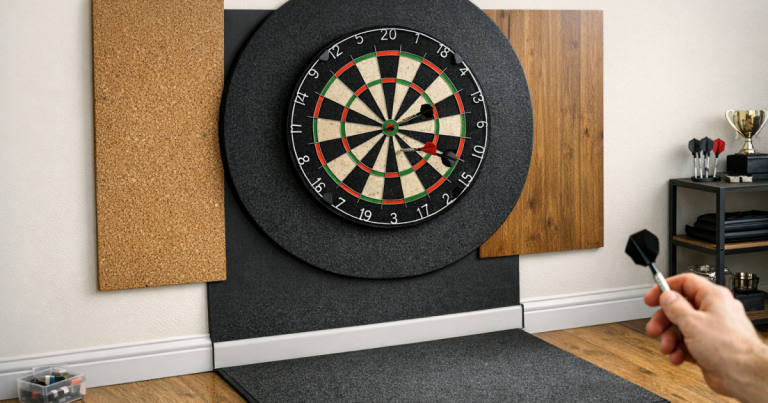
This matters for play as well as appearance. If a surround creeps too far over the board face, it can interfere with the outer doubles, which is more frustrating than a slight visual lean. For a clean fit, see the guide to fitting a dartboard surround without blocking doubles.
Cabinets can cause similar issues if the back panel is not flat or the board is mounted too close to one side. Open both doors, check that nothing touches the number ring, and make sure there is enough room to rotate the board for wear without catching the frame.
Step 5: Correct the board without losing the oche line
Once the board is straight, re-check the relationship between the bull and the oche. A small bracket adjustment can shift the centre point slightly, especially if you have had to move screws or re-seat a cabinet mount.
Measure from the floor to the centre of the bull, then measure the throwing distance from the face of the board, not the wall behind it. If you use a mat with a printed oche, make sure it has not crept forwards or sideways during the work. If you use a raised oche, check it still lines up squarely with the board face.
A simple way to check alignment is to stand at the oche and imagine a straight line from the centre of your stance to the bull. The board can be perfectly level but still feel wrong if the mat, rug or room layout encourages you to stand slightly off-centre.
If you share the setup with family or friends, mark the mat position discreetly once you are happy. Small pieces of low-tack tape under the rear corners can help you put it back in the right place after hoovering or moving furniture.
Step 6: Stop the board rotating again
A board that straightens easily but slips again after a few visits usually needs better rear support. Most bristle boards use small rubber feet or pads on the back to reduce movement and help the board sit flat. If those pads are missing, compressed or uneven, the board can rock on the centre screw.
Check all support points at the back of the board. They should touch the wall, cabinet backboard or mounting surface evenly. If one pad is thicker than the others, the board may tilt. If one is missing, the board may rotate under the impact of darts.
Do not overtighten the centre screw as a cure-all. If it sits too deep, the board may not engage properly with the bracket. If it sticks out too far, the board can wobble. Adjust it gradually and test the fit each time.
Regular board rotation is still worth doing to spread wear, but always finish by returning the 20 segment to the top. A quick visual check after rotating the number ring saves you from playing a full session on a board that is a few degrees out.
Useful checks before you call the job done
- View from the oche: stand where you actually throw, not close to the wall, and check that the 20 segment runs straight through the bull.
- Side-on view: look from the left and right to see whether one edge of the board projects further than the other.
- Bracket security: touch the lower edge of the board gently. It should not rattle, drop or twist easily.
- Cabinet clearance: open and close the doors to confirm they do not brush the board or number ring.
- Surround fit: check that the surround sits around the board rather than squeezing it.
- Oche position: confirm the throwing line after any bracket or cabinet adjustment.
Why a tiny lean feels more noticeable than it looks
Darts is a rhythm game as much as a scoring game. When the 20 bed is not upright, your eye keeps registering that something is off, even if the physical difference is small. That can be distracting on trebles and doubles because your reference points are no longer where your brain expects them to be.
A slight lean can also make practice less useful. If you are drilling doubles, grouping around treble 20, or working on cover shots, a misaligned board gives you inconsistent visual feedback. You may start adjusting your throw to suit the wonky setup rather than improving a repeatable action.
That does not mean you need a showroom-perfect wall. Many UK homes have uneven plaster, older brickwork, chimney breasts, alcoves and floors that are not perfectly level. The aim is not to make the room square; it is to make the board face, bull and oche line consistent for play.
Common questions
Can I just rotate the number ring instead of the whole board?
No, not if the segments themselves are crooked. The number ring only changes where the printed numbers sit. The 20 segment on the board face still needs to be vertical through the bull.
Why does my board look crooked in a cabinet that is level?
The cabinet frame and the board mount are separate references. The cabinet may be level while the internal bracket is slightly off, or the board may not be seated properly on its centre screw.
Should the dartboard be level with the floor or with the wall?
Use the board face and a true vertical reference, not the floor alone. Floors, skirting boards and ceilings can be uneven, particularly in older homes.
Will a crooked dartboard affect scoring?
The scores still count by the segment hit, but it can affect your sight line, rhythm and practice quality. It is worth correcting before you build habits around a poor setup.
How often should I re-check alignment?
Check it whenever you rotate the board, move a mat, adjust a cabinet, or notice the 20 segment drifting. For regular home play, a quick glance before a session is usually enough.
What to remember
Fixing a tilted board is mostly about working in the right order. Check the 20 segment first, then the centre screw, then the bracket, then anything around the board that might be pushing it out of line. Only move wall fixings once you know the board itself is not simply sitting badly.
A straight setup does not need to be complicated. With a spirit level, tape measure and a few careful checks, you can make the board look right, throw from the correct line, and keep your home darts area feeling tidy and consistent.