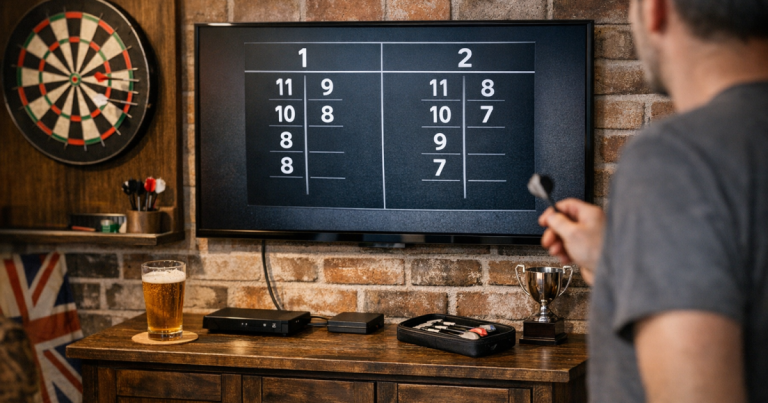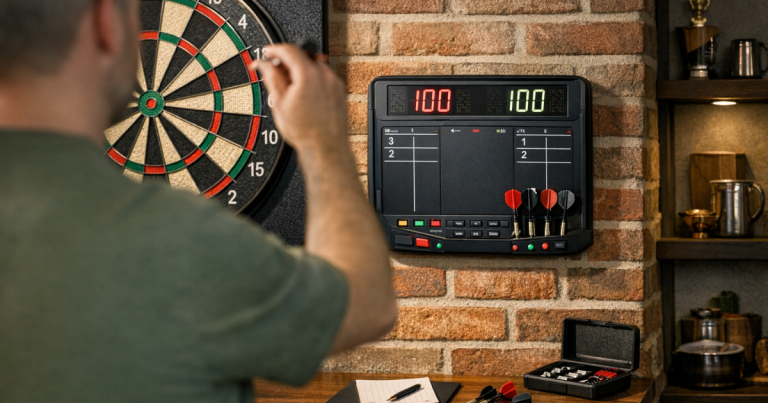
A busy night of darts can get messy quickly if names, legs and fixtures are all being remembered from the sofa. A mini darts tournament keeps the evening organised without needing multiple boards, apps or a dedicated caller. With one clear scoreboard and a simple format, four to eight players can get plenty of darts in and still know exactly where they stand.
The short version
Use the scoreboard for three jobs: the current match, the running standings, and the next fixture. Keep the format small, write names clearly, agree the scoring rules before the first throw, and update the board after every leg rather than after every chat break.
- Best simple format: round robin for four to six players, knockout with a third-place game for seven or eight.
- Best scoreboard layout: current match on the main scoring area, fixtures down one side, standings along the bottom or top.
- Best match length: one leg per match for a quick social night, best of three for a more competitive evening.
- Best way to avoid arguments: write the tie-break rules on the board before play starts.
Step 1: Start with the room and throwing order
The scoreboard can only do its job if everyone knows where to stand, where to wait and who is throwing next. Before you write the first name up, make sure the throwing area is settled and that players are not stepping across the oche while somebody is at the board.
For a home setup, this usually means one player throwing, one player scoring, and everyone else standing behind the oche line. If you are setting up for guests or moving furniture around for the evening, it is worth checking your board height and throw line first. Our guide to marking dartboard height and oche distance accurately is a useful reference if you want the playing area to feel consistent before the tournament starts.
Once the space is sorted, pick a rotation rule. The easiest version is simple: the winner stays near the board for the next match only if the fixture list says they are next; otherwise players rotate in the order shown on the scoreboard. That stops the loudest player from accidentally becoming the organiser.
Step 2: Pick a format that suits the number of players
A mini darts tournament works best when the format fits the group size and the amount of time available. The temptation is to copy a full pub-league structure, but a home session usually needs something leaner.
Four players
Use a round robin. Everyone plays everyone once, giving six matches in total. One leg per match keeps it brisk; best of three makes the result feel fairer. On one scoreboard, write the fixtures as: A v B, C v D, A v C, B v D, A v D, B v C.
Five or six players
A round robin still works, but keep the matches short. For five players, one person sits out each round; for six, you can run three matches per round, one after another. The scoreboard should show the next three fixtures clearly so nobody drifts away when their game is close.
Seven or eight players
Use a knockout if you want a quick winner, or split into two small groups if you have more time. With eight players, a straight quarter-final, semi-final and final gives seven matches. Add a third-place match if people want one more meaningful game.
If you have uneven numbers, avoid overcomplicating it. Give one player a bye in the first round, write it visibly on the board, and make sure they know when they come back in.
Step 3: Divide one scoreboard into clear zones
You do not need a large tournament board. You need a layout that does not get rubbed out by accident. Before the first match, divide the surface mentally into three zones.
- Main scoring zone: Use the centre of the board for the active match. This is where you write the two player names, remaining scores, legs won and any notes needed for the current game.
- Fixture zone: Use one side for the match list. Number each fixture so the running order is obvious.
- Standings or progress zone: Use the top or bottom for wins, legs won, legs lost and points. For a knockout, use this space for the bracket instead.
On a chalkboard or whiteboard, leave more blank space than you think you need. Darts nights tend to include nicknames, corrections and the odd mistaken score. Crowding the board at the start usually leads to messy updates later.
Step 4: Use simple points and tie-breaks
For a small home event, points should be easy to update while people are still enjoying the night. A reliable round-robin system is two points for a win and zero for a loss. If matches are best of three, also track legs won and legs lost, because they make a clean tie-breaker.
Write the tie-break order on the scoreboard before play begins. A good order is:
- Match points
- Leg difference
- Legs won
- Head-to-head result
- One-leg play-off if still level
That order is simple enough for casual players but still rewards consistent scoring. If you are playing one-leg matches, you can use match points first, then head-to-head, then a one-leg play-off. Do not wait until two players are tied before inventing a rule; that is when friendly competition becomes noisy negotiation.
Step 5: Decide who scores each match
One scoreboard means one active scorer at a time. The cleanest approach is for the player who has just finished a match to chalk the next one, unless they are immediately playing again. Another option is to nominate one non-playing person as the scorer for a block of fixtures.
For casual nights, do not over-police it. The important thing is that the scorer says the remaining total clearly, checks big finishes before rubbing out, and confirms the result with both players before updating the standings. If a score is disputed, pause and sort it straight away rather than carrying the mistake into the next visit.
Keep a small section of the board for temporary maths. It is better to work out 87 minus 43 in a side space than to scribble over the player’s remaining score and forget what was there.
Step 6: Keep fixtures moving without rushing people
The difference between a smooth home tournament and a stop-start one is usually the handover between matches. As soon as one leg finishes, the scorer should mark the result, circle or tick the completed fixture, and call the next two players.
A simple rhythm helps:
- Call the current match.
- Write both names in the main scoring zone.
- Confirm who throws first.
- Play the leg or match.
- Record the result immediately.
- Call the next fixture before players wander off.
If people are sharing darts, build in a small pause. If players have their own darts, you can move faster, but still give the next pair time to retrieve drinks, check the board and settle at the oche.
Example: six-player round robin on one scoreboard
For six players, label them A to F while you are writing fixtures, then add names beside the letters. This saves space and makes the board easier to read.
- Round 1: A v B, C v D, E v F
- Round 2: A v C, B v E, D v F
- Round 3: A v D, B v F, C v E
- Round 4: A v E, B v D, C v F
- Round 5: A v F, B v C, D v E
Use one-leg matches if you want a quick session. Use best of three if the group is happy for it to take longer. After each result, update points and leg difference immediately. If two players end level at the top, the head-to-head result usually gives a tidy winner without needing extra games.
Alternative games that work well on one board
You do not have to use 501 for every small event. Some games are easier to manage on a single scoreboard because the scoring is compact and visible. Killer is a good example: each player has a number, lives are marked beside names, and everyone can see who is still alive. If you want a ready-made scoring structure, use our walkthrough on how to score Killer darts on a wall scoreboard.
Other good one-scoreboard formats include around the clock races, doubles-only challenges, and highest score over nine darts. These work nicely between main matches too, especially if knocked-out players want something to do while the final is being played.
Small checks before the first dart
Five minutes of preparation saves a lot of mid-game confusion. Before the tournament starts, run through these checks with everyone in the room.
- Names: Use real names, initials or nicknames, but make sure each one is unique.
- Starting score: Agree whether matches are 501, 301 or another format.
- Finish rule: Decide whether it is double-out, straight-out or a casual house rule.
- Match length: Put “one leg” or “best of three” beside the fixture list.
- Throw order: Decide whether the first player is chosen by bull-up, coin toss or fixture order.
- Tie-breaks: Write the tie-break order where everyone can see it.
- Corrections: Agree that scoring mistakes are fixed before the next player throws where possible.
If the group includes beginners, keep the first event simple. A complicated format can be fun for regular throwers, but it slows down new players and makes the scoreboard harder to follow.
When one scoreboard starts to feel limiting
One board is enough for most home sessions, but it can feel tight when you have a larger group, best-of-five matches, detailed averages or several side games running at once. At that point, you can either simplify the format or move some information away from the main scoring area.
For example, keep the active match on the wall scoreboard and write fixtures on a separate notepad. Or keep standings on the board and use a small side sheet for the knockout bracket. If your group plays often and wants automated totals, it may be worth reading our guide on deciding whether an electronic dart scorer is worth buying, but a neat manual layout is still perfectly capable for most mini events.
Helpful questions
How many players can realistically use one darts scoreboard?
Four to eight players is the sweet spot. More than that can still work, but you will need shorter matches, a simpler fixture list and a stricter rotation so the board does not become crowded.
Is round robin better than knockout for a home tournament?
Round robin is better when everyone wants several games. Knockout is better when time is limited or you want a clear final. For mixed-ability groups, round robin usually feels friendlier because nobody is out after one poor leg.
Should beginners play 501 or 301?
301 is often smoother for beginners because legs finish sooner. If the group is comfortable with scoring and doubles, 501 feels more like standard darts. For a relaxed evening, straight-out 301 can keep things moving.
What should be written on the scoreboard before play starts?
Write the player list, fixture order, match length, starting score, finish rule and tie-break order. Leaving any of those off the board is the usual cause of confusion later.
Can one person play and score at the same time?
Yes, but it slows the match down and increases the chance of mistakes. A non-playing scorer is cleaner, especially for finals or close matches where every visit matters.
The big picture
A good small tournament is not about making the setup complicated. It is about giving the scoreboard a clear job and keeping the information visible: who is playing, what the score is, what happens next, and who is leading overall. Choose a format that suits the group, update results straight away, and keep the rules written down. Do that, and one scoreboard is more than enough for a tidy, competitive and enjoyable darts night at home.