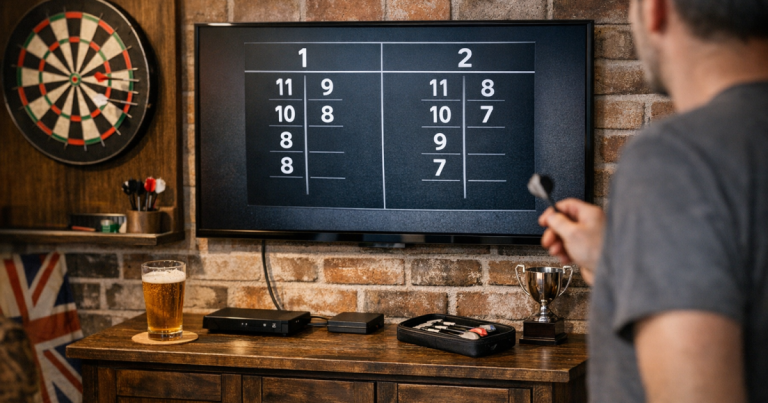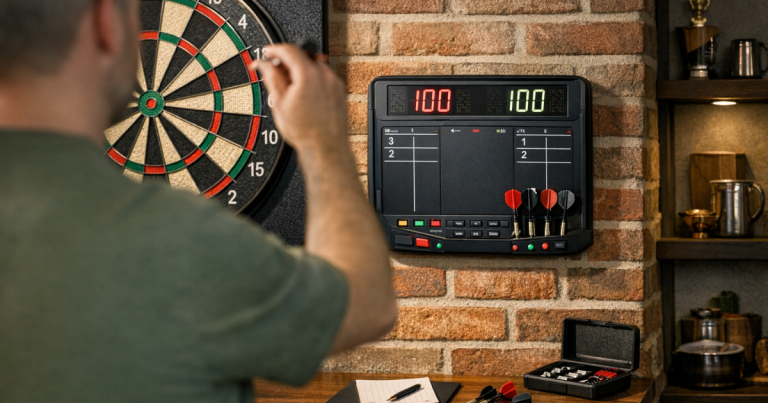
Killer is one of the easiest pub-style games to run at home, but it can get messy if the wall board is not laid out clearly. Killer darts scoring is easiest when every player can see three things at a glance: their assigned number, whether they are active as a killer, and how many lives they have left. A simple chalkboard or dry-wipe scoreboard is enough as long as you keep the marks consistent.
The key is to separate setup information from live match information. Put names and numbers in one place, lives in another, and use one clear symbol to show who has earned killer status.
The short version
- Give each player a unique target number, usually from 1 to 20.
- Write each player’s name, number and lives on the wall scoreboard before the first scoring throw.
- Players must hit their own agreed target, commonly the double, to become a killer.
- Once a player is a killer, they can remove lives from opponents by hitting the opponents’ target area.
- Cross off one life each time a valid hit is made.
- The last player with at least one life remaining wins.
Set up the wall scoreboard before assigning numbers
A neat board layout matters more than fancy scoring. Killer involves several players, changing status and quick life deductions, so a cramped corner of a whiteboard soon becomes confusing.
Use four simple columns:
- Player: first name, nickname or initials.
- Number: the number that belongs to that player.
- Killer: a tick, K or circle once that player is active.
- Lives: three clear marks, such as III, ●●● or 3-2-1.
Leave enough space between rows so a life can be crossed out cleanly. If you are using chalk, make the lives large enough to rub away one at a time without smudging the player’s name or target number. If you are using a dry-wipe board, avoid very small marks because they are harder to read from the oche.
Place the scoreboard where the thrower and the next player can see it without stepping into the throwing line. If you are still planning the board, mat and scoreboard position, it is worth taking a few minutes to test your darts layout before drilling, especially in a spare room, garage or narrow hallway setup.
Step 1: choose the house rules
Killer has plenty of local variations, so agree the rules before anyone throws. The scoreboard only works if everyone is using the same version.
Decide these points first:
- Starting lives: three lives is the usual home-game choice, but larger groups may prefer two to keep the game moving.
- How numbers are assigned: random draw, nearest number by a throw, or one throw each at the board.
- How to become a killer: many players require the double of your own number, but some casual groups use any segment or the treble.
- Whether hitting your own number after becoming a killer costs you a life: this is a common house-rule split, so make it clear.
- Whether bust-style protection exists: most home games do not use it, but agree whether a player can accidentally knock themselves out.
For a home scoreboard, write any unusual rule at the bottom of the board. Something as short as “Double to qualify” or “Own double removes own life” prevents arguments later.
Step 2: assign each player a number
Each player needs one target number. Avoid duplicate numbers; if two players land on the same number during assignment, the second player should throw again or be given a spare number.
A simple assignment method for home play is:
- Write all player names down the left side of the wall scoreboard.
- Each player throws one dart at the board in order.
- The number hit becomes that player’s number.
- If the dart misses the scoring area or lands on an already-used number, throw again.
- Write the number beside the player’s name immediately.
If you are playing with beginners, random assignment can be fairer and quicker. Write numbers 1 to 20 on small slips, draw one per player, then add them to the scoreboard. It avoids repeated rethrows and keeps the start of the game moving.
Step 3: mark starting lives clearly
Give every player the same number of lives unless you are deliberately handicapping the game. Three lives works well because it gives beginners a chance to stay involved without making the game drag.
On the wall scoreboard, choose one life marking system and stick to it:
- Three strokes: III becomes II, then I, then out.
- Three dots: ●●● becomes ●●, then ●, then out.
- Number countdown: 3 changes to 2, then 1, then 0.
For a busy home game, strokes are often easiest because you can cross one out rather than rewriting the row. A countdown number looks tidy, but it can be misread if the board is smudged or someone changes it in a hurry.
Step 4: show who is a killer
Before a player can attack anyone else, they must qualify under your chosen rule. The most common version is to hit the double of your own assigned number. For example, if Jas is number 14, Jas must hit double 14 to become a killer.
When a player qualifies, mark the Killer column immediately. Use one obvious symbol for everyone. A tick is fine, but a large K is clearer from a few metres away.
Do not rely on memory. Killer moves quickly once several players have qualified, and the most common scoring mistake is allowing a non-qualified player to remove someone else’s life. If there is no mark in the Killer column, that player is still only trying to qualify.
Step 5: remove lives when a killer hits
Once a player has killer status, they aim for an opponent’s number. If your agreed rule is doubles only, they must hit that opponent’s double. If your casual rule allows any segment, then a single, double or treble on the target number may count as one life, unless you have agreed otherwise.
For clarity, update the scoreboard after each dart that changes the game, not only at the end of the visit. This matters because a player may knock someone out with the first dart and then choose a different target with the next dart.
Use this routine:
- Call the target before or after the throw, depending on your group’s preference.
- Check the dart is in the agreed scoring segment.
- Cross off one life from the correct opponent.
- If the opponent reaches zero lives, mark them out clearly.
- Leave their row visible so everyone can see why they are no longer throwing.
A simple “OUT” beside the lives column is usually clearer than rubbing the row away. Removing the row can cause confusion later, especially if players are joining in the chat and not watching every throw.
A clean Killer darts scoring example
Here is how a four-player game might look on a wall scoreboard after setup:
- Amir — 8 — Killer: blank — Lives: III
- Beth — 16 — Killer: K — Lives: II
- Callum — 3 — Killer: K — Lives: III
- Riya — 20 — Killer: blank — Lives: I
In this position, Beth and Callum can attack other players because they have qualified. Amir and Riya still need to hit their own qualifying target before they can remove lives.
If Beth hits Riya’s valid target, Riya loses her last life. Change Riya’s row to “Lives: 0” or “OUT”. If Beth then hits Amir’s target with a later dart in the same visit, remove one of Amir’s lives as well. The scoreboard should show the match state after each meaningful dart, not after a delayed mental recap.
Keeping the board readable during a noisy game
Killer is often played socially, so your scoring system should survive people chatting, swapping drinks and asking whose turn it is. The wall scoreboard has to act as the referee when attention drifts.
These habits help:
- Use initials only if everyone can recognise them instantly.
- Keep the active thrower responsible for calling what they hit, but let one scorer update the board.
- Do not use two different symbols for lives in the same game.
- Mark eliminated players as out rather than wiping them away.
- Put a small arrow, dot or underline beside the next player if turn order is being forgotten.
If you like mixing traditional wall scoring with digital tools, a tablet can also sit nearby for other formats, averages or casual match notes. The wall board is still the simplest option for Killer, but a separate screen can be useful on a fuller home setup; here is how to set up a tablet scoring station without making the oche area feel cluttered.
Common mistakes to avoid
Letting players attack before they qualify
This is the quickest way to spoil the game. If the Killer column is blank, that player cannot remove lives. Keep the qualifying mark large and obvious.
Changing rules halfway through
If you start with doubles to qualify and doubles to kill, keep it that way until the next game. Mid-game changes nearly always benefit one player and annoy another.
Overcrowding the scoreboard
Six or more players can fill a small wall board quickly. Use short names, large life marks and a separate note for house rules rather than squeezing everything into one cramped line.
Forgetting turn order
Killer does not usually need complex scoring maths, but it does need order. If people are taking turns casually, write the names in throwing order and move down the list row by row.
Helpful questions
How many lives should each player start with?
Three lives is the easiest default for home games. Use two lives for a larger group or a quick warm-up game, and four or five only if everyone is happy with a longer session.
Do you have to hit a double to become a killer?
That is the common version, but it is not the only one. Beginners may prefer any segment on their own number, while stronger players usually get a better game from doubles only.
Can a killer lose a life by hitting their own number?
Many groups play that hitting your own active target costs you a life, but it is a house rule. Write it on the scoreboard before the game starts so nobody is surprised.
What is the easiest way to score Killer with beginners?
Use random assigned numbers, three lives, and any segment to qualify for the first game. Once everyone understands the flow, move to doubles to qualify or doubles to kill.
Is a wall scoreboard better than paper for Killer?
For most home games, yes. A wall scoreboard is easier for everyone to see, and it reduces repeated questions about numbers, lives and who has already qualified.
Main lessons
A good Killer scoreboard is not complicated: names, numbers, killer status and lives are enough. The important part is consistency. Agree the house rules first, write the layout clearly, update lives as soon as they change, and leave eliminated players visible until the game ends.
Once you have a tidy scoring method, Killer becomes one of the most flexible games for a home darts night. It works for mixed abilities, keeps everyone watching the board, and needs far less arithmetic than 501. If your group also plays other formats, the same wall-board discipline carries across well; for example, the method used to score Cricket darts on a home scoreboard follows the same principle of making the match state obvious at a glance.