A darts area only feels fair when the measurements are right, and dartboard height and oche distance are the two marks that matter most. A few millimetres will not ruin a casual throw, but a sloppy setup can make practice feel inconsistent and matches harder to trust.
The good news is that you do not need specialist equipment. A tape measure, pencil, spirit level, masking tape and a little patience are enough to mark a reliable home setup before you fit anything permanently.
The measurements to use
For a standard steel-tip setup, the centre of the bullseye should be 1.73 m from the floor. The throwing line, or oche, should be 2.37 m from the front face of the dartboard, not from the wall behind it.
- Bullseye centre height: 1.73 m from the finished floor surface.
- Steel-tip oche: 2.37 m from the face of the board to the front edge of the toe line.
- Diagonal check for steel-tip: 2.93 m from the bullseye to the front edge of the oche.
- Soft-tip oche: commonly 2.44 m from the board face, but check the rule set or board guidance you intend to use.
- Diagonal check for common soft-tip layouts: about 2.99 m from bullseye to toe line when using a 2.44 m oche.
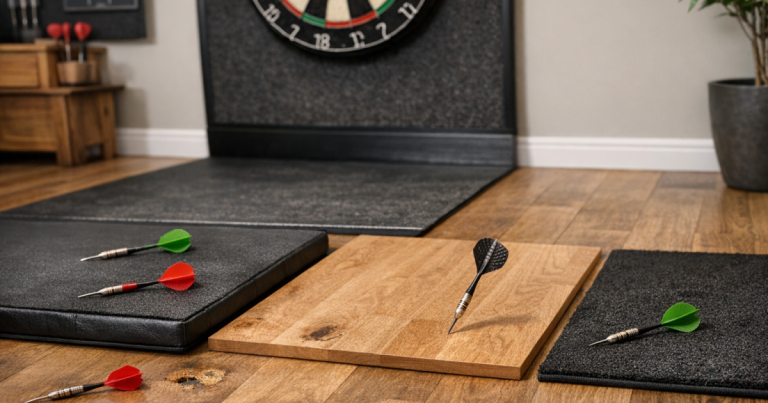
If you are setting up on carpet, laminate, tiles or a darts mat, measure from the actual surface you will stand on. A thick mat placed after measuring can subtly alter the feel of the height and stance area.
Step 1: Choose the exact board position
Pick the final wall position before measuring anything. The board should have enough clear space around it for stray darts, a comfortable arm swing and safe movement behind the thrower. Avoid placing the board where doors, walkways or low furniture interrupt the throwing lane.
Stand in the likely throwing position and check that the line feels natural. If the room is narrow, also check whether right-handed and left-handed throwers have enough elbow room. Before you drill or commit to adhesive pads, it is worth using temporary tape and a cardboard mock-up; the process in testing a darts layout before drilling is a useful next step if the wall, furniture or lighting position is still uncertain.
Step 2: Mark the bullseye height, not the top of the board
The key height mark is the centre of the bullseye. Do not measure to the top of the board, the bracket, the number ring or the cabinet edge. Those parts vary between boards and mounting systems, while the bullseye height stays fixed.
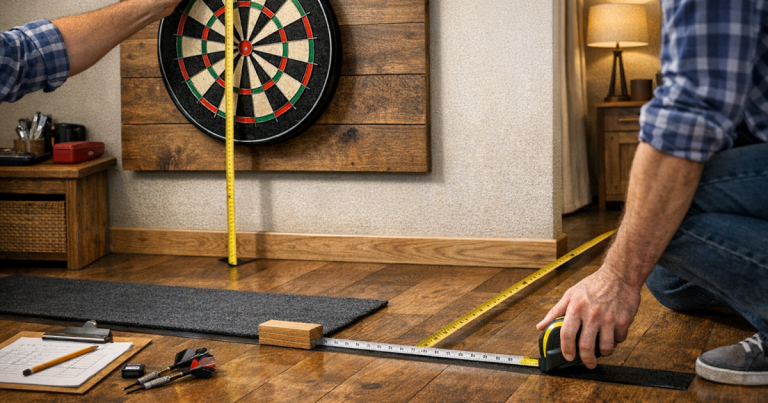
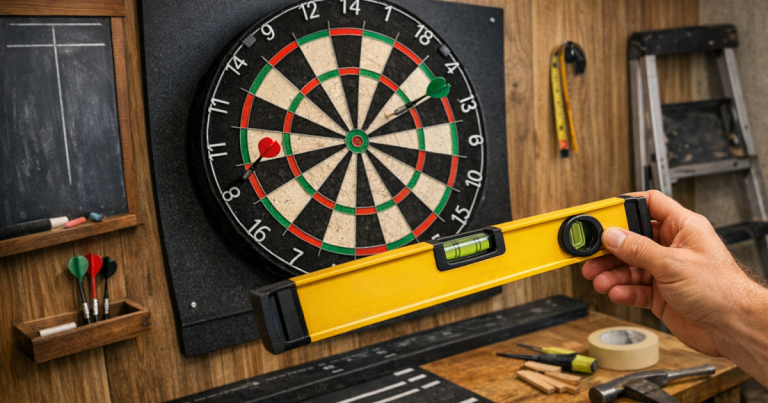
Measure 1.73 m up from the finished floor directly below the intended centre of the board. Make a small pencil mark on the wall. Then use a spirit level to draw a short horizontal reference line through that mark. This gives you a visible target when you offer the board or mounting bracket up to the wall.
If your floor is uneven, measure from the point where the thrower will actually stand rather than from an odd dip near the skirting board. In garages, older houses and converted spaces, a few millimetres of slope can show up quickly when you compare one side of the room with the other.
Step 3: Create a centreline down to the floor
Once the bullseye height is marked, create a vertical centreline. Use a spirit level, plumb line or laser level if you have one. This line should run from the bullseye mark down towards the skirting board and onto the floor position where the oche will be measured.
The centreline helps prevent a common home setup mistake: measuring the oche from a point slightly left or right of the board centre. That can leave the toe line technically the right distance away, but not square to the board. When you throw, it may feel as though you are aiming across the board rather than straight at it.
Step 4: Allow for the board face standing proud of the wall
The oche distance is measured from the front face of the dartboard. Most boards do not sit perfectly flush with the wall because the board itself, bracket, cabinet back panel or surround creates depth.
After the board is mounted temporarily or held in its final position, find the vertical plane of the board face. The simplest method is to hold a straight edge flat against the face of the board and let it extend downwards, then mark where that plane meets the floor centreline. From that floor mark, measure forward to the oche.
If you instead measure 2.37 m from the wall, your oche will usually end up too close. The difference may only be the thickness of the board and mounting, but it is enough to matter if you are trying to build consistent muscle memory.
Step 5: Mark the front edge of the oche
Measure 2.37 m out from the board-face floor mark along the centreline for steel-tip darts. Mark the front edge of the oche with masking tape first. The front edge is the line your foot must not cross, so make the measurement to that edge, not the middle of a strip of tape or the back of a raised oche.
Use a set square, long spirit level or careful measuring from both sides to make the toe line perpendicular to the centreline. If you use a darts mat, line up its centre mark with the board centreline and confirm that the printed oche position matches your measurement. For a more permanent and match-like floor area, the advice on creating a match-ready darts mat and oche area will help you tidy up the stance zone once the measurements are confirmed.
Step 6: Check the diagonal measurement
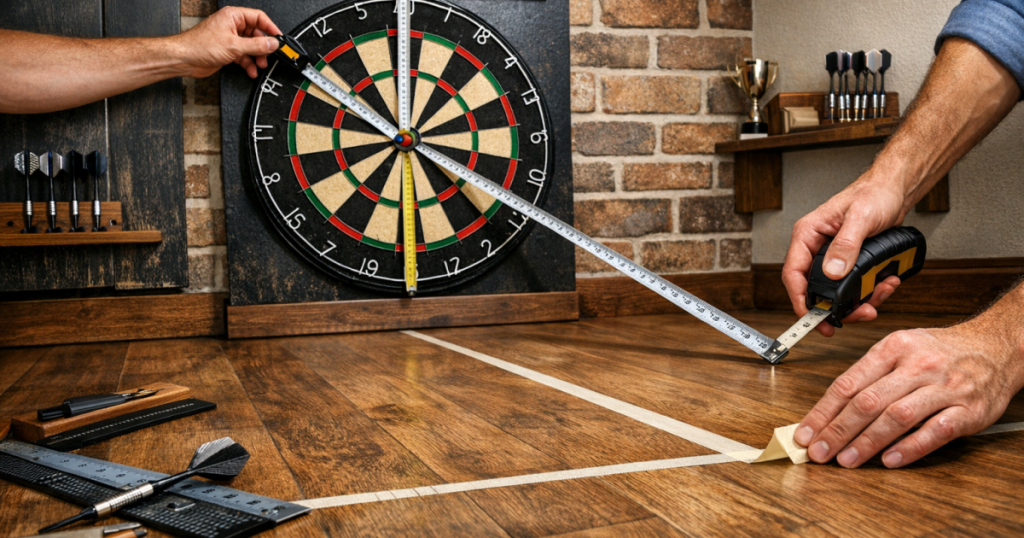
The diagonal check is the easiest way to spot a hidden error. For steel-tip darts, measure from the centre of the bullseye to the front edge of the oche. The tape should read 2.93 m. Keep the tape straight and taut, and make sure the end is genuinely on the bullseye centre rather than hooked over a wire or segment edge.
If the diagonal is wrong, do not automatically move the oche. Check the bullseye height first, then check whether the oche was measured from the wall instead of the board face. Many inaccurate home setups are caused by one of those two mistakes.
For soft-tip layouts, the standard can vary by board, league or game format. If you are using a 2.44 m oche, the diagonal from bullseye to toe line is about 2.99 m. If you play both soft-tip and steel-tip at home, mark the lines clearly so players do not drift between distances without noticing.
Step 7: Make the marks permanent only after a test throw
Once the board height, centreline and oche position are taped, throw a few visits before making anything permanent. You are not testing whether you score well; you are checking whether the stance area feels safe, the board is visible, and the toe line is easy to respect.
Look for practical issues: a heel catching the edge of a rug, glare across the treble 20, a cabinet door blocking the chalkboard, or a raised threshold behind the player. Good lighting matters here because shadows can make the board feel lower or the wires harder to read. If the board looks uneven once you stand at the line, use the guidance on lighting a dartboard properly at home before deciding the measurements are the problem.
Common measuring mistakes to avoid
- Measuring to the top of the board: always use the bullseye centre as the height reference.
- Starting the oche measurement at the wall: measure from the face of the board, allowing for board and bracket depth.
- Using the back edge of the tape line: the official toe line is the front edge nearest the board.
- Ignoring the finished floor surface: measure from the surface people will stand on, including any fitted mat.
- Skipping the diagonal check: it catches errors that look fine when measured separately.
- Marking before checking room flow: make sure doors, furniture and walkways do not interfere with the throwing lane.
FAQ
Is the oche measured from the wall or the dartboard?
Measure from the front face of the dartboard. If you measure from the wall, the throwing line will usually be too close because the board and bracket stand proud of the wall.
What is the correct dartboard height in centimetres?
The centre of the bullseye should be 173 cm from the finished floor surface for a standard steel-tip setup.
Can I use the diagonal measurement instead of measuring the floor distance?
Use both if you can. The floor measurement sets the oche, while the diagonal measurement confirms that height and distance work together correctly.
Should a darts mat change the measurements?
If the mat is thick and you stand on it, measure from the top surface of the mat. If it is thin, the difference is small, but it is still better to measure from the final playing surface.
Do soft-tip boards use the same oche distance?
Not always. A common soft-tip distance is 2.44 m from the board face, but you should check the rules or board guidance for the format you play.
The big picture
A reliable home setup comes down to three reference points: the bullseye at 1.73 m, the oche measured from the board face, and a diagonal check to confirm the whole layout. Mark everything temporarily first, test the stance and visibility, then make the toe line and board fixing permanent once the throw feels square and repeatable.