For a living room, dartboard cabinets can make a home oche feel intentional rather than temporary. The real question is not whether they look smart, but whether they solve the problems your room actually has: wall protection, storage, visual tidiness and everyday usability.
If the board is in a garage or spare room, function usually wins. In a lounge, dining room or open-plan family space, the cabinet has to share the room with furniture, lighting, guests, pets and people who may not be darts fans.
The short version
A cabinet is worth considering when the board stays up permanently, the surrounding wall is visible, and you want the setup to look neat when nobody is playing. It is less convincing if your main concern is maximum wall protection, because a full surround usually covers more of the risky area around the board.
- Worth it: permanent living-room boards, traditional decor, tidy storage, hiding the board between sessions.
- Less useful: very tight rooms, homes where bounce-outs are common, modern minimalist rooms where a boxy unit looks too heavy.
- Often best paired with: a slim surround, good lighting and a properly planned throw line.
- Not a cure-all: it will not make an unsafe wall safe, stop all dart damage, or replace sensible room planning.
What a cabinet actually changes in a living room
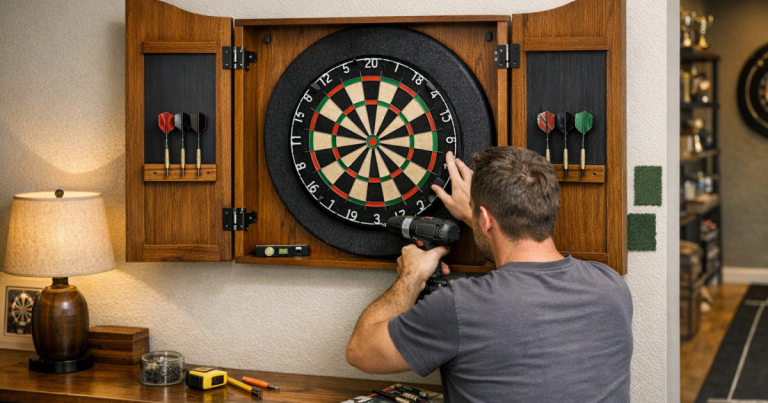
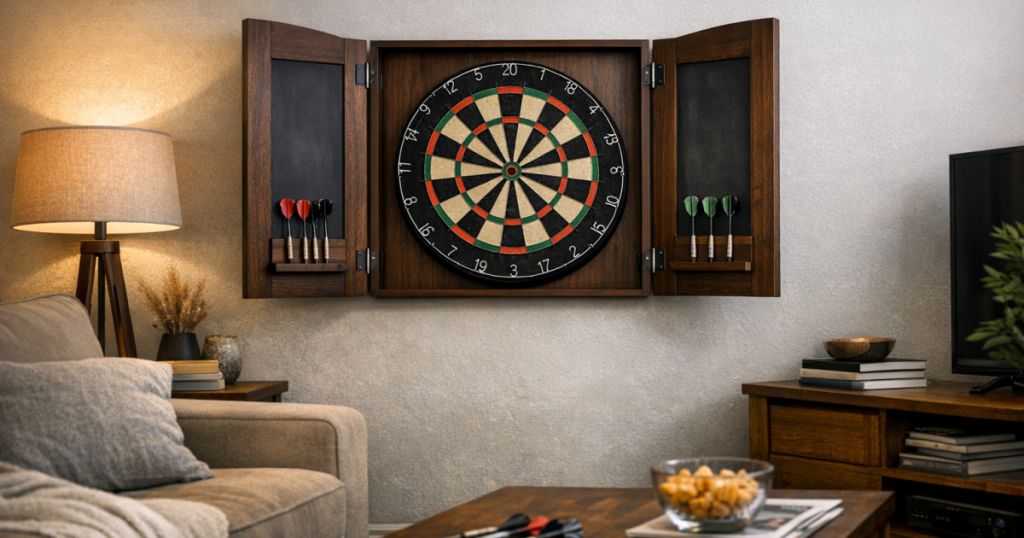
A dartboard cabinet does three visible jobs. It frames the board, gives you doors to close when play is finished, and usually provides a little storage inside for darts, chalk or small accessories. That makes it feel more like furniture than sports kit, which matters in a shared room.
The biggest benefit is visual control. A bristle board, numbers, marks on the wall and hanging darts can make a living room feel unfinished. Close the doors and the setup becomes a more contained feature. In rooms with bookcases, wood furniture or a pub-style corner, that can work particularly well.
The trade-off is depth. A cabinet projects from the wall more than a bare board or a slim surround. In a narrow room, that can make the darts area feel busier, especially if it sits near a walkway or beside a television. Before fitting one, stand where people will normally walk and sit, not just where the thrower stands.
Wall protection: useful, but not complete
The common misunderstanding is that a cabinet fully protects the wall. It does protect the area directly behind the open doors and immediately around the board, but it leaves more exposed wall than many players expect. Missed darts do not always land neatly inside the cabinet outline, especially with beginners, children or casual guests.
For a living room, the wall finish matters. Painted plaster, wallpaper and decorative panelling all show damage differently. Small point marks may barely show on darker paint but stand out on pale walls. Wallpaper can tear rather than dent. Freshly decorated walls are the least forgiving because every mark looks deliberate.
If protection is the main reason you are considering a cabinet, compare it carefully with a surround. A surround sits tight around the board and usually covers the circular miss zone more evenly. The best choice depends on your room and playing level, so the detailed breakdown in cabinet vs surround wall protection is a sensible next step if damage is your biggest concern.
Storage is helpful, but keep expectations realistic
The storage inside a cabinet is convenient rather than generous. It is ideal for keeping a couple of sets of darts out of sight, along with chalk, a cloth, spare flights or a small checkout card. That alone can make a living room feel tidier, because the accessories stop drifting onto shelves, sideboards and coffee tables.
Where cabinets are less effective is bulk storage. Spare stems, multiple cases, point tools, wax, flight protectors and several sets of darts soon become cluttered inside a shallow cabinet. If you play league darts or often take darts out of the house, a proper case is still the better place for your main kit.
Think of the cabinet as living-room storage, not complete darts storage. Keep only what you use at home in it. If the doors are hard to close because darts, flights and score pads are crammed inside, the setup will look messy again even when closed.
Does a cabinet make the room look better?
It can, but only when the style matches the room. A dark wooden cabinet can look natural in a traditional lounge, snug, dining room or home bar area. In a bright modern room, it may feel visually heavy unless the rest of the space already uses darker furniture or framed wall features.
There is also a difference between looking tidy and looking subtle. A closed cabinet still says there is something on the wall. If you want the darts area to disappear completely, a removable board mount or a less prominent setup may suit the room better. If you are happy for the board to be part of the room’s character, a cabinet can make it feel deliberate rather than improvised.
Door clearance is easy to overlook. Open doors need space either side of the board, and they can clash visually with shelves, pictures, curtains or wall lights. Measure the wall with the doors open, not just closed. A cabinet that looks perfect shut but awkward open will annoy you every time you play.
Living-room safety and layout still come first
A cabinet does not make a poor darts location suitable. The board still needs a safe throw line, a clear walking route and enough space behind the thrower. In a living room, that often means thinking about doorways, sofas, fireplaces, dining chairs, pets and where people naturally cross the room.
Soft furnishings can help a room feel more forgiving, but they are not a safety plan. Darts should never be thrown across a route someone may use unexpectedly. If the only available wall means throwing towards a doorway or across the television area, the cabinet is solving the wrong problem.
For open-plan homes, it is worth mapping the darts area as part of the room rather than as a separate hobby zone. The guide to planning a darts area in an open-plan room is useful if your board shares space with a kitchen, dining table or lounge seating.
When a cabinet is worth it
A cabinet tends to earn its place when the board is used regularly and stays on display. If you play a few legs most evenings, practise checkouts, or host friends for casual games, the convenience adds up. You avoid setting up and packing down, and the room still looks orderly afterwards.
It is also a good fit when the living room already has a traditional or pub-inspired feel. Framed prints, wooden shelves, darker furniture and warm lighting can make the cabinet look like part of the room. In that setting, a bare board can look a little unfinished by comparison.
Another strong reason is household compromise. Not everyone wants a dartboard visible all week. Doors give the setup an off mode, which can be enough to make a permanent board acceptable in a shared space.
When it may not be the right answer
A cabinet is less convincing in rooms where space is already tight. If people have to squeeze past the board, or the cabinet doors open into a walkway, it may become a nuisance. A slim surround with separate storage can feel lighter and easier to live with.
It may also be the wrong choice for heavy beginner use. If lots of missed darts are likely, you may want wider protection around the board before worrying about how the setup looks when closed. A cabinet can still be part of the solution, but it should not be the only protection.
Rented homes need extra care. Fixing a cabinet securely usually means wall fixings, and landlords may have rules about drilling, decorated walls or making good at the end of a tenancy. If you rent, read the advice on cabinets and surrounds for rented homes before committing to a permanent-looking installation.
Cabinet, surround or both?
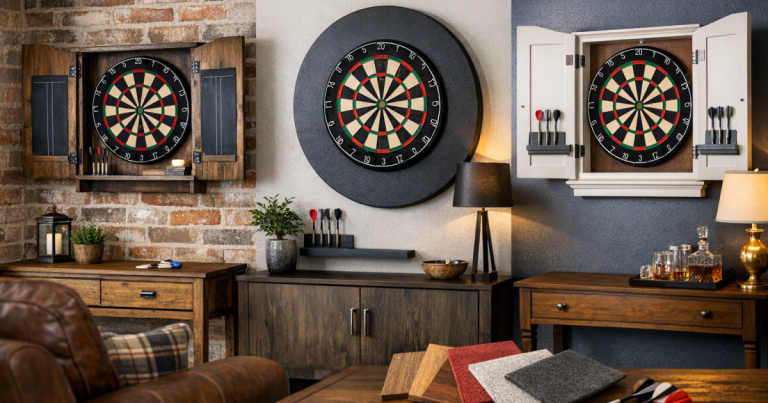
The best living-room setups often use a cabinet for appearance and a surround for practical protection. That may sound like overkill, but the two accessories solve different problems. The cabinet hides and frames the board; the surround catches more stray darts around it.
There are a few ways to approach it:
- Cabinet only: neatest when closed, good for confident players, but limited coverage for wider misses.
- Surround only: better protection and a cleaner modern look, but the board remains visible all the time.
- Cabinet plus surround: strongest all-round solution if the wall has enough space and the combination does not look too bulky.
- Removable setup: useful where darts are occasional, but less convenient for regular practice.
If you are aiming for a lounge-friendly finish, avoid building the whole area around one accessory. Think about the board, cabinet, lighting, floor protection and throw line together. A beautiful cabinet still looks awkward if the mat is skewed, the lighting casts shadows, or the oche cuts across the main seating route.
Small details that make a cabinet work better
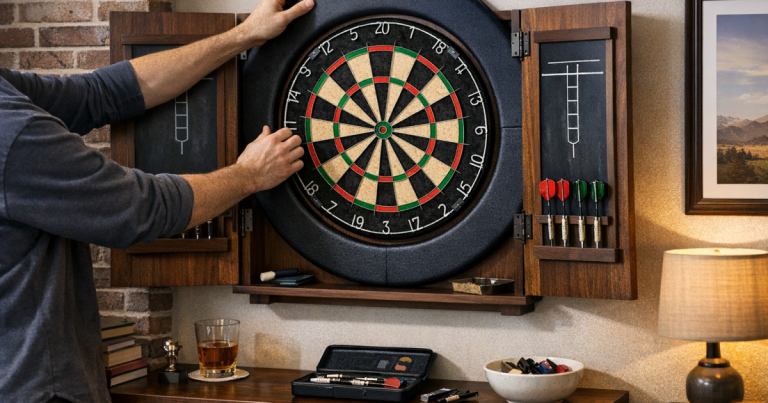
Good results come from careful placement more than from the cabinet alone. Centre the board properly, check the official height from the floor to the bull, and mark the throw distance accurately. Even a smart-looking setup feels wrong if the measurements are casual.
Lighting is another detail that changes the room. A cabinet can create shadows if the main light is behind the thrower or off to one side. Dedicated dartboard lighting may be worth planning if the living room is used in the evening, but the fitting should suit the room rather than making it feel like a club practice lane.
Noise is worth considering too. Darts hitting a bristle board are not usually loud, but the thud can carry through a party wall or into the room above, depending on the wall construction. A cabinet may slightly change the sound because it adds a wooden box around the board. If the wall is shared with a neighbour, avoid late-night sessions and consider whether another wall would be kinder.
Maintenance is simple. Keep the inside dry, remove chalk dust, do not overload the door holders, and make sure the board remains secure. If the doors start to sag or the board mount loosens, deal with it early rather than letting the cabinet become misaligned.
Common questions
Will a dartboard cabinet stop all wall marks?
No. It protects some of the area around the board, but missed darts can still land outside the cabinet. For wider protection, consider a surround or a larger protected backing area.
Can a cabinet look too bulky in a living room?
Yes, particularly in small or minimalist rooms. Check the depth, door swing and visual weight against nearby furniture before fitting one.
Is a cabinet enough for beginners?
Usually not on its own. Beginners tend to miss wider, so a surround or broader wall protection is often more useful than a cabinet alone.
Should I keep darts inside the cabinet?
It is fine for a home set or two, provided they are held securely and the doors close cleanly. Keep larger collections and travel sets in a proper darts case.
Can I fit a cabinet over wallpaper?
You can, but wallpaper is easily marked by missed darts and may show fixing holes if the cabinet is removed. A surround or removable protection can reduce the risk of visible damage.
Final thoughts
A dartboard cabinet is worth it for a living room when it supports the way the room is actually used. It makes a permanent board look neater, keeps small accessories under control and gives the darts area a more finished feel. It is not automatically the best wall protection, and it will not fix a cramped or unsafe layout.
The most successful living-room setups treat the cabinet as one part of a bigger plan. Choose the safest wall, allow for everyday movement through the room, protect the areas most likely to be hit, and make sure the finished setup still feels at home when the darts are packed away.