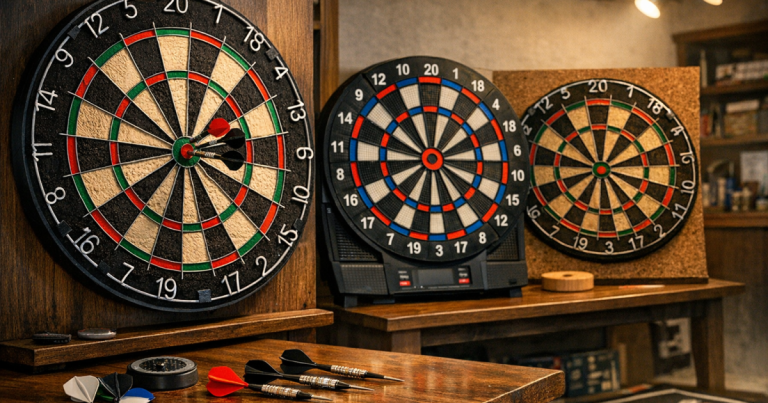
A standard dartboard can look chaotic at first, but the dartboard layout is designed to reward accuracy, punish near misses and keep every leg tactically interesting. Once you understand what each ring, number and centre section does, scoring becomes quicker and practice starts to make far more sense.
The key point is simple: the large numbered wedges give the base score, the outer narrow ring doubles it, the inner narrow ring trebles it, and the bullseye area has its own fixed values. The board is not just a target; it is a scoring map.
The big picture
A traditional steel-tip board has 20 numbered segments arranged around a circular playing area. Each segment runs from the outside edge towards the centre, but it is split by scoring bands. That is why a dart landing in the 20 segment can score 20, 40 or 60 depending on which part of the segment it hits.
The standard number order, clockwise from the top, is 20, 1, 18, 4, 13, 6, 10, 15, 2, 17, 3, 19, 7, 16, 8, 11, 14, 9, 12 and 5. The 20 must sit at the top. If the number ring has been moved during board rotation, reset it carefully so that the sequence is correct before playing.
This arrangement is commonly attributed to Brian Gamlin, although the historical evidence is not as tidy as the story suggests. What matters for players is the effect: high numbers are often next to low numbers. Miss treble 20 by a small amount and you may hit 1 or 5 instead. The board therefore rewards a controlled throw, not just a hard one.
What the numbered segments actually mean
Every numbered wedge has two single-scoring areas. The outer single is between the double ring and the treble ring. The inner single is between the treble ring and the bull area. Both score the face value of the number.
- A dart in the single 20 scores 20.
- A dart in the single 19 scores 19.
- A dart in the single 1 scores 1, whether it lands in the inner or outer single section.
For new players, this is useful because not every dart has to hit a narrow band to count. Much of the board is made up of singles, so early practice should include grouping darts in a chosen segment before worrying too much about trebles.
Doubles: the finishing ring
The double ring is the thin outer scoring band around the edge of the playable board. Hitting it doubles the number of that segment. Double 20 scores 40, double 16 scores 32 and double 1 scores 2.
Doubles matter most in popular 501 and 301 formats because many games require a double to finish. If you have 32 left, for example, double 16 is the usual target. If you miss inside into single 16, you still have 16 left and can aim at double 8 next. That is why some finishing routes are preferred: they leave sensible follow-up doubles when the first dart is slightly off.
On a home board, make sure the outer edge is visible and evenly lit. Shadows or glare around the double ring can make a small target feel much harder than it needs to be. If your lighting is causing shine on the wires or bright patches near the top of the board, the advice in lighting a dartboard without creating glare is a good next step.
Trebles: the power scoring band
The treble ring is the thin inner scoring band roughly halfway between the outer edge and the bull. It triples the segment value. Treble 20 scores 60, treble 19 scores 57 and treble 18 scores 54.
The treble 20 is the most famous target because three darts in it score 180, the highest possible score with three darts in standard steel-tip play. That does not mean treble 20 is always the smartest target. Players often switch to treble 19 if the 20 bed is blocked by a previous dart, or if their natural grouping sits slightly lower on the board.
Trebles are narrow, so they highlight small inconsistencies in stance, release and follow-through. For practice, it can help to aim at a full segment first, then gradually narrow your target to the treble bed once your grouping tightens. Chasing trebles before you can reliably hit the correct wedge often leads to messy scoring and frustration.
Bullseye and outer bull
The centre of the board is split into two scoring areas. The outer bull, often called the single bull, scores 25. The inner bull, usually called the bullseye or double bull, scores 50.
In standard double-out games, the inner bull can be used as a finishing double. For example, if you have 50 remaining, a bullseye can finish the leg. The outer bull is not a double; it simply scores 25 and leaves another finish or setup depending on the score.
The bull is also useful for deciding who throws first in casual games. Players throw nearest the bull, sometimes called “bulling up”. House rules vary on whether an outer bull beats any other dart outside the centre, so agree that before starting if you are playing with guests.
Bristle boards and electronic boards
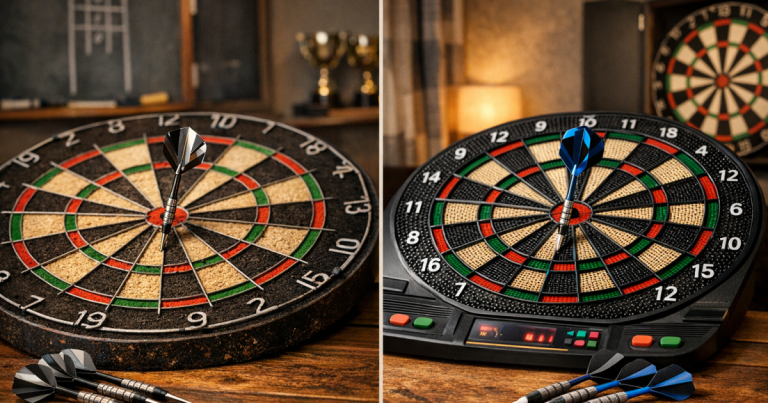
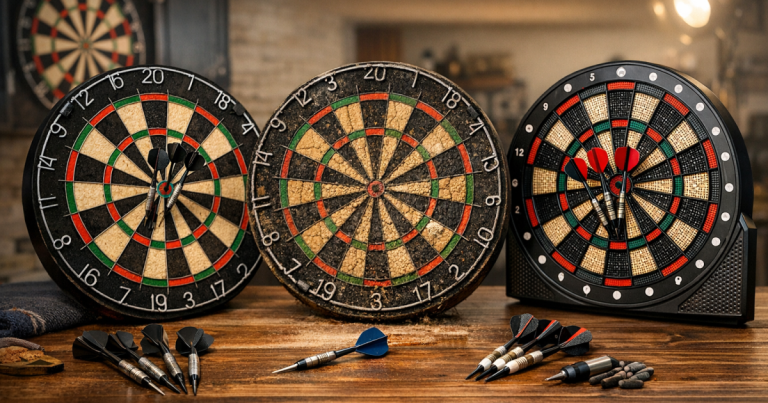
The same general scoring logic applies across most traditional bristle boards and many electronic boards: numbered wedges, singles, doubles, trebles and bull sections. The feel, sound and practical setup can differ, though.
On a bristle board, darts land in sisal fibres and the wire layout separates the scoring beds. You can usually rotate the board to spread wear, then reposition the number ring so 20 returns to the top. That helps stop one heavily used area, especially around treble 20, from wearing out too quickly.
Electronic boards use moulded plastic segments with holes for soft-tip darts. Many follow the familiar numbering pattern, but bullseye settings can vary by game mode. Some soft-tip games treat the full bull area differently from steel-tip scoring, so check the board’s game settings before assuming outer bull and inner bull will score separately. For practical mounting and safe home positioning, see setting up an electronic dartboard safely at home.
Why the number order changes how you play
The board’s number order creates risk and reward. The top of the board is a perfect example. Treble 20 is worth 60, but its neighbours are 1 and 5. A dart that drifts sideways can turn a strong scoring visit into a poor one. Treble 19, by contrast, is worth slightly less but sits beside 3 and 7, so it has its own risk profile.
This is why experienced players do not just aim at the highest number blindly. They think about cover shots, blocked beds and the score they want to leave. If the first dart sits awkwardly in the treble 20 bed, switching to 19s may give a clearer target. If a player is on a finish, the best target is often the one that leaves a manageable double after a miss.
For home practice, this means the board layout should shape your routines. Do not only throw at 20s. Include 19s, 18s, bull, and common doubles such as 16, 8, 20 and 10. You will build a more complete game and avoid becoming comfortable on only one part of the board.
Setting the board so the layout works properly
The scoring map only helps if the board is mounted squarely and consistently. The 20 should be at the top, the face should be flat to the throw line, and the board should not wobble when darts land. A slight tilt or loose fixing can change how the board feels and make bounce-outs more common.
Also check the throw line. In steel-tip darts, the standard throwing distance is 2.37 metres from the face of the board to the oche, with the bullseye centre 1.73 metres from the floor. Soft-tip setups commonly use different distances, so follow the rules for the board and format you are playing. If you need a removable line for a rented home, shared room or garage setup, use a method that will not lift varnish, vinyl or carpet fibres; marking a throw line without damaging flooring covers practical options.
Questions people ask
Is the dartboard layout the same worldwide?
For standard steel-tip darts, yes: the usual 1 to 20 number sequence and scoring rings are consistent. Novelty boards and some soft-tip game modes may differ, so check before playing a serious match.
Why is 20 at the top of a dartboard?
The modern board is designed around that orientation. The high 20 is placed between low-scoring 1 and 5 segments, which makes accuracy more important and stops the top of the board being an easy scoring zone.
Does the bullseye count as a double?
The inner bull scores 50 and counts as a double for finishing in standard double-out games. The outer bull scores 25 and does not count as a double.
What is the difference between a double and a treble?
A double is the narrow outer ring and scores twice the segment number. A treble is the narrow inner ring and scores three times the segment number.
Can I rotate my dartboard without changing the scoring?
You can rotate many bristle boards to spread wear, but you must move the number ring afterwards so that 20 is back at the top and every number is in the correct order.
Key takeaways
The board is easier to understand when you see it as layers. The number gives the base value, singles score that value, the outer ring doubles it, the inner ring trebles it, and the centre scores 25 or 50. The unusual number order is deliberate, because it rewards precision and creates consequences for small misses.
For a better home game, learn the map as well as the mechanics of throwing. Keep the board correctly orientated, practise more than one scoring area, and make sure your lighting and throw line support consistent play. Once the layout feels familiar, tactics such as cover shots, setup scores and finishing routes become much easier to understand.