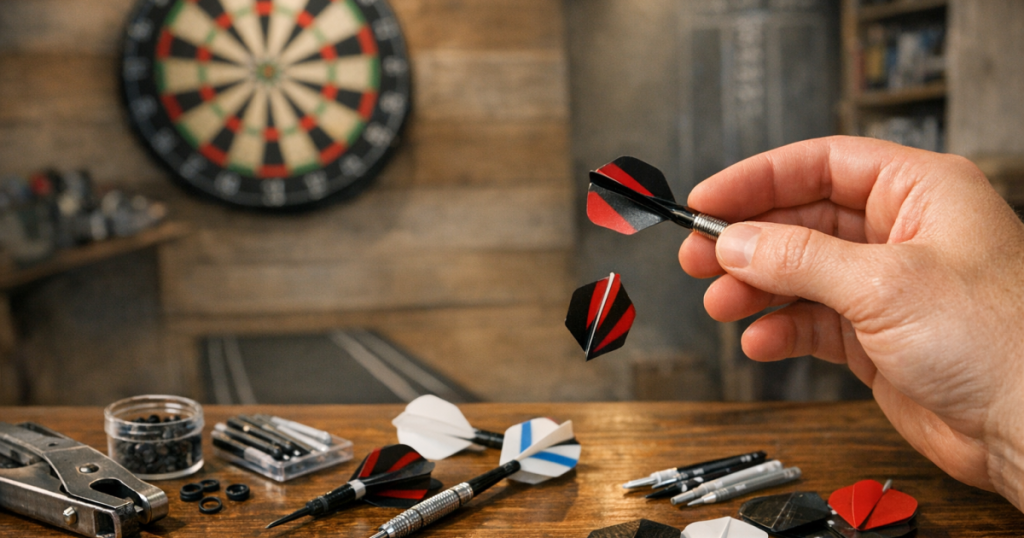
A flight that drops out during a leg breaks rhythm and can make a good visit feel untidy. The good news is that dart flights falling off is usually caused by a small fit issue between the flight, shaft and ring rather than anything complicated. Work through the checks below and you can usually fix it in a few minutes.
For home players, the aim is not to make every part impossibly tight. It is to create a secure, repeatable fit that still lets you replace damaged flights without fighting the dart.
At a glance
- Most loose flights come from worn shaft slots, thin flights, poor ring placement or repeated impacts from tight grouping.
- A new set of shafts often fixes the problem faster than trying to rescue badly spread or cracked prongs.
- Stem rings work best when the flight has been punched correctly, so the ring can sit in the right position.
- Integrated or lock-in style systems can help, but only when the shafts and flights are designed to work together.
- Good storage matters: crushed flights and bent shafts are more likely to come apart during play.
Start by finding when the flight comes loose
Before changing parts, notice the pattern. If the flight comes out after a bounce-out, after another dart hits it, or only when you pull darts from the board, the cause may be different.
- If it happens on impact with another dart, the shaft may be gripping reasonably well but taking heavy contact.
- If it happens every few throws with no obvious collision, the shaft slots are probably too loose or worn.
- If it happens when removing darts from the board, you may be brushing the flight with your hand or twisting the dart awkwardly.
- If only one dart is affected, compare that shaft with the other two rather than changing the whole setup immediately.
This quick diagnosis stops you chasing the wrong fix. A flight that is being knocked out by close grouping needs a different answer from a flight that barely grips the shaft in the first place.
Check the shaft slots for wear or spreading
The shaft holds the flight by pinching it between the split prongs at the rear. Over time, those prongs can spread, chip or lose tension, particularly on softer plastic shafts or shafts that have taken a few direct hits.
Remove the flight and look at the end of the shaft under decent light. The slot should be even, clean and narrow enough to hold the flight without forcing it. If the prongs are visibly flared out, cracked, uneven or white-stressed from bending, replacement is usually the cleanest fix.
You can sometimes pinch a slightly open nylon shaft back together with your fingers. Do it gently and evenly. Avoid crushing the slot closed, as that can split the shaft or make the flight sit crooked. If you use small pliers, use minimal pressure and keep your fingers clear of the dart point.
Players who prefer a grippy conventional setup often use shafts such as Harrows Supergrip Shafts, but the important point is condition rather than brand. Even a good shaft becomes unreliable once the slot is damaged.
Make sure the flight is not the weak link
A flight can also become loose because the flight itself is worn. The base of the flight takes repeated pressure every time it is pushed into the shaft, and small splits can develop at the bottom edge.
Check the lower section of each flight. If it is creased, split, heavily chewed or no longer sits flat, it will not grip consistently. Swapping the flight to a different shaft can confirm the issue: if the same flight works loose on more than one shaft, the flight is likely the problem.
Flight thickness and shape can affect feel too. Some thin flights slide in easily but may not feel as secure in a worn slot. Thicker flights may hold more firmly, but they should still sit squarely and fully down into the shaft. Do not force an unsuitable flight into a slot that is too tight; it can distort the shaft and make the dart fly oddly.
Use stem rings the right way
Stem rings are small metal rings that help the shaft grip the flight. Used well, they are one of the simplest fixes for mid-game flight drop-outs. Used badly, they can sit in the wrong place and add very little.
The most reliable method is to punch a small slot in the flight, push the flight into the shaft, then slide the ring into the punched opening so it compresses the shaft prongs around the flight. This is why many home players keep a flight punch with their darts gear.
If you are using a punch, take a moment to line it up cleanly and keep the hole consistent across all three flights. For broader repair and adjustment habits, it is worth reading how to use a dart repair tool kit safely at home, particularly if you keep pliers, point tools or small spare parts in the same case.
A quick ring check
- Punch all three flights in the same position so the darts feel consistent.
- Seat the flight fully into the shaft before sliding the ring into place.
- Replace bent or opened rings rather than trying to rely on poor tension.
- Keep a few spare rings in your case, as they are easy to lose on carpet or around a dart mat.
Try a matched flight and shaft system if standard parts keep failing
If you regularly group darts tightly, standard push-in flights can still get knocked loose. A matched system can reduce that annoyance because the shaft and flight are designed to connect in a more controlled way.
Examples include L-Style Champagne Flights, which are commonly used with compatible caps and shafts, and Cosmo Fit Flight, which uses its own matching shaft approach. These systems are not automatically better for every thrower, and they do change the rear of the dart, so check compatibility before mixing parts.
The main benefit is consistency. If the flight always sits at the same angle and depth, there is less fiddling between visits. The trade-off is that you need to keep to the compatible parts rather than mixing any random shaft and flight from your spares box.
Look at how your darts are landing
Sometimes the rear setup is not the only issue. If your darts land very tail-up, tail-down or close together, incoming darts may be clipping the flights and shafts hard enough to knock parts loose. That is not necessarily bad throwing; it often happens as grouping improves.
Check the angle of the darts in the board. If the flights are sitting directly in the path of the next dart, try a small change such as a different shaft length or flight shape. Make one change at a time, then throw a few legs before deciding whether it helped. Changing shaft length, flight shape and dart grip all at once makes it difficult to know what solved the problem.
Your surrounding setup also matters. A cramped throw area can make you rush retrieval, brush flights with your hand, or knock darts while stepping in. If your home lane feels tight or improvised, revisit how to set out your darts throwing area and oche so the board, stance and retrieval space all work together.
Do not overlook storage between sessions
Flights that are stored crushed, twisted or half-fitted into a soft case can lose their shape. Shafts can also get knocked around in a loose accessories tin, opening the slots before the next session even starts.
For a simple home setup, keep each assembled dart separated or use a case that holds them without flattening the flights. If you remove flights after play, store them flat rather than folded under heavier accessories. Keep spare rings, shafts and flights in small compartments so they are not rubbing against points or tools.
If darts are kept in a family space, secure storage is about more than tidiness. Sharp points, tiny rings and spare shafts should be kept away from children, pets and casual visitors. The same thinking applies to broader kit organisation, so setting up child-safe storage for darts gear is a sensible next step for a shared home.
A simple mid-game fix routine
When a flight pops out during a match, do not spend the next three legs pushing it back in every visit. Use a quick routine so you either fix it properly or swap the weak part.
- Push the flight fully back into the shaft and check that it sits square.
- If it comes loose again, rotate the flight to a different corner and try once more.
- If the same shaft keeps failing, swap that shaft rather than changing all three darts.
- If the flight base is split, replace the flight immediately.
- If you use punched flights, check the ring is still seated and has not sprung open.
For casual home games, keeping a small spares pouch beside the board saves frustration. Three spare shafts, three spare flights and a few rings are usually enough to rescue a session without turning the game into a maintenance break.
Common mistakes that make the problem worse
- Forcing oversized or unsuitable flights into tight shaft slots, which can split the shaft.
- Using rings without punching the flight, then expecting the same grip as a proper punched setup.
- Mixing old and new shafts across the same set, making one dart behave differently from the others.
- Ignoring cracked prongs because the flight still holds while stationary.
- Leaving flights fitted in a cramped case where they are permanently bent or compressed.
FAQ
Why do my flights come out more when I start grouping better?
Closer grouping means incoming darts are more likely to hit the flight or shaft already in the board. The grip may be fine, but repeated contact can still knock the flight loose. Rings, punched flights or a matched system can help.
Are punched flights worth it for a home darts setup?
Yes, if dart flights falling off is a recurring nuisance. A punch lets the ring sit properly, which usually gives a more secure hold than pushing a ring onto an unpunched flight.
Should I glue dart flights into the shafts?
No. Glue makes routine replacement awkward, can create uneven seating, and may leave residue in the shaft. It is better to fix the fit with fresh shafts, suitable flights and correctly placed rings.
Do metal shafts stop flights coming loose?
Not automatically. Some metal shafts grip well, but the slot design and condition still matter. A damaged or poorly matched metal shaft can still drop flights, while a good nylon setup can be very secure.
How often should I replace shafts and flights?
Replace them when they are damaged, loose or no longer consistent. Home players who throw regularly should keep spares ready, but there is no fixed schedule that suits every player.
Why it matters
A secure flight setup keeps your throw routine calm. You spend less time repairing darts between visits and more time focusing on scoring, finishing and enjoying the game.
Start with the simple checks: inspect the shaft slots, replace damaged flights, use rings properly and store the darts so the rear end stays straight. If the problem continues, move to a matched flight and shaft system or experiment carefully with shaft length and flight shape. Small, controlled changes are usually enough to stop loose flights spoiling a good home session.