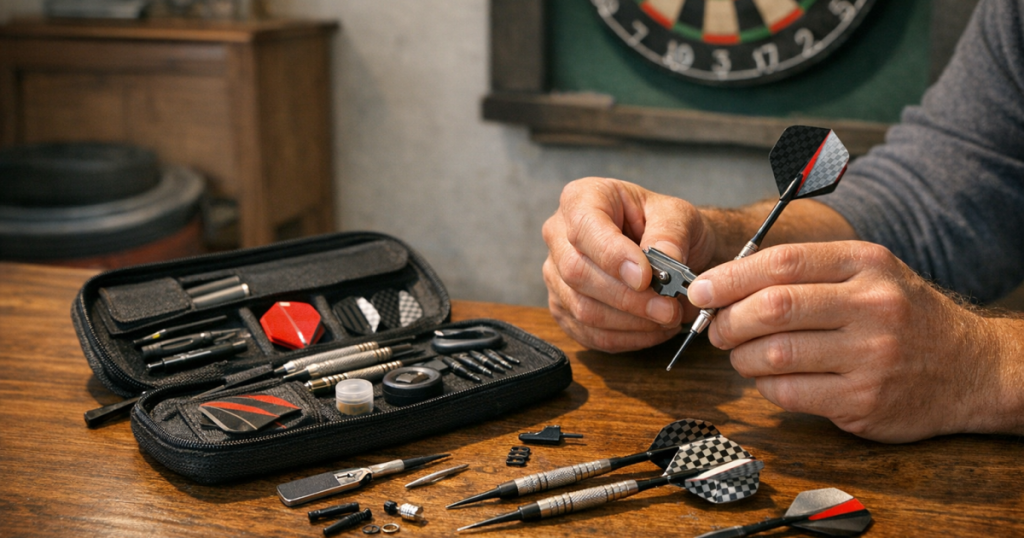
Small maintenance jobs keep home darts feeling consistent, but the sharp points and tiny components deserve a bit of care. A dart repair tool kit is useful for tightening stems, reshaping flights, checking points and sorting spares, provided you use it methodically rather than treating it like a loose box of bits. Set up on a clear table, work slowly, and put everything away before the next throw.
Safe method at a glance
The safest approach is simple: separate the darts from the playing area, inspect one dart at a time, use only the tool needed for the job, and check every part before anyone starts throwing again.
- Work on a flat, well-lit surface rather than on the floor or dart mat.
- Keep points facing away from your hands while handling barrels.
- Remove loose flights and shafts before tightening or cleaning.
- Use gentle pressure; forcing small dart parts usually causes damage.
- Put spare points, rings, shafts and broken pieces into a lidded container straight away.
Set up a calm work area first
Do not repair darts in the middle of a leg, beside the oche, or on a cluttered table with drinks and score markers. Move the darts to a separate workspace such as a kitchen table, desk or garage bench. A plain tea towel, rubber mat or shallow tray helps stop tiny rings and broken shaft pieces from rolling away.
Good lighting matters because many repairs involve small threads, grooves and splinters of plastic or nylon. If your home board is in a dim corner, fix the darts away from the board rather than trying to work in poor light. A small parts tray is also handy if you already keep a grab-and-go darts maintenance kit for home practice nights.
Before you start, remove any darts from the board and make sure nobody is throwing nearby. It sounds obvious, but repairs often happen between legs when players are still standing around the board. Treat the repair table as a no-throw zone until everything has been checked and packed away.
Use your dart repair tool kit in a fixed order
A repeatable order prevents rushed fixes and makes it easier to spot problems before they become annoying mid-game. Lay the three darts side by side, then complete the same check on each one rather than fully repairing one and forgetting the others.
1. Remove flights before applying pressure
Flights are easy to bend, split or crease if you grip the dart too high while tightening the shaft. Pull each flight out gently and place it flat on the work surface. If you use flight protectors, remove and store them with the flight so they do not end up loose underfoot.
Check the flight slots at the top of each shaft. If a slot is flared too wide, cracked or uneven, do not try to squeeze it back aggressively with pliers. A distorted slot can make the flight sit crooked, which affects grouping and may lead to more deflections.
2. Tighten shafts gently
Loose shafts are one of the most common home darts irritations. Use the slot or grip section of your dart tool to tighten the shaft into the barrel with light, controlled pressure. Stop as soon as it feels secure. Over-tightening can damage the thread, make future removal harder, or snap a plastic or nylon shaft flush with the barrel.
If a shaft keeps working loose, check whether the thread is dirty, worn or mismatched rather than simply tightening harder. Small rubber rings can help with some metal-shaft setups, but they should sit neatly and not bunch up around the thread.
3. Deal with broken shafts without rushing
A broken shaft extractor can be very useful, but it needs patience. Hold the barrel firmly on the table, keep the point directed away from your other hand, and turn the extractor slowly into the broken stem section. The aim is to bite into the broken piece enough to turn it out, not to drill hard into the barrel.
If the broken section will not move, stop and reassess. Picking at it with knives, pins or improvised sharp tools is more likely to scratch the barrel or slip into your fingers. A controlled extractor tool is safer than forcing a household item into the thread.
4. Inspect points and tips separately
Steel-tip points should be checked for burrs, hooked ends, heavy rounding or rough patches. A slightly dulled point can often be cleaned up with a dart point stone or sharpener, using small movements and light pressure. The goal is not to create a needle-sharp spike; it is to remove roughness so the point enters the board cleanly and does not drag sisal fibres excessively.
Soft-tip points need a different check. Look for bending, cracking or damaged threads. Replace worn tips rather than trying to straighten them repeatedly. A bent soft tip can bounce out unpredictably and may damage electronic board segments if used when badly misshapen.
5. Replace parts that are past saving
Flights, shafts and points are consumable parts. Keeping a damaged part in play because it is nearly usable often causes more trouble than replacing it. Split flights can alter the dart’s path, cracked shafts can fail during a throw, and rough points can make board wear worse.
If you are regularly changing the feel of your darts during repairs, it is worth reading more on choosing shafts and flights for your throw so replacements are deliberate rather than random. Keep matching spares together, especially if more than one player uses the same home setup.
Safer ways to handle common tools
Most dart tools are small, but they can still pinch, scratch or damage parts if used carelessly. These habits keep the job controlled.
- Multi-tool: Use the correct notch for the part you are tightening. If it slips, stop and reposition rather than adding more force.
- Point sharpener or stone: Rotate the dart lightly and evenly. Avoid filing the point into an excessively sharp needle shape.
- Broken shaft extractor: Keep the barrel supported on the table. Do not hold the point in your palm while twisting.
- Flight punch: Punch flights on a flat surface and keep fingers clear of the cutting slot. Check that the punched hole is clean before fitting rings.
- Small pliers: Use only when there is a genuine grip point. Pliers can crush shafts, mark barrels and make a minor repair worse.
- Cleaning cloth: Wipe barrels away from the point, not towards it. A cloth can catch on a sharp or burred point and pull your hand forward.
Keep small and sharp parts under control
Dart repair creates exactly the sort of bits that disappear into carpets: tiny rings, snapped plastic, old points, damaged tips and slivers from broken shafts. Keep a small lidded tub beside you and treat it as the only place for discarded parts. Do not leave broken stems or old tips loose on a table where they can be brushed onto the floor.
This is especially important in family homes. Darts, spare points and repair tools should be stored separately from general games equipment and well away from children. If your setup is in a shared lounge, garage or spare room, use the same thinking as you would for child-safe darts storage: closed boxes, clear routines and no loose sharp items left near the board.
When the repair is finished, count the darts, count any removed parts, and check the floor around the workspace. A quick scan with a torch helps if you have worked near a rug, mat or garage floor where dark pieces can blend in.
Pre-throw checks before the darts go back on the oche
Once the darts look repaired, give them a final practical check before play restarts. This takes less than a minute and catches most small problems.
- Spin each dart gently in your fingers to feel for loose shafts or wobble.
- Check that all three flights are seated to the same depth.
- Look along each dart from the rear to see whether the flight sits square.
- Feel the point carefully from the side, not the tip, to check for obvious burrs.
- Confirm that no tools, old tips or spare parts are still near the throwing area.
- Throw a few controlled practice darts before returning to a competitive leg.
If something feels wrong, stop and fix it properly. A dart that feels slightly loose in the hand will usually become more annoying once you are focused on scoring.
Common mistakes that make repairs less safe
Most repair problems come from rushing or using too much force. Avoid these habits and your kit will last longer too.
- Repairing while standing at the board: It encourages rushed handling and leaves sharp or broken parts close to the playing area.
- Using household blades: Knives and craft blades are poor substitutes for a proper extractor or trimming tool and can slip easily.
- Over-sharpening points: Very sharp points can stick too aggressively, increase board damage and make handling riskier.
- Mixing spare parts loose in one pocket: Rings, tips, shafts and flight protectors are easier to lose or damage when stored together without compartments.
- Ignoring repeated loosening: If the same part keeps coming loose, inspect the thread or replace the part instead of tightening harder every time.
Things readers ask
Should I sharpen my darts before every session?
No. Check them before each session, but only use a point stone when the tip is noticeably rounded, burred or not entering the board cleanly. Too much sharpening can make points unnecessarily aggressive.
Is it safe to use pliers on dart barrels?
Use pliers sparingly. They can mark the barrel grip or crush softer parts. A dart multi-tool or broken shaft extractor is usually safer for normal maintenance tasks.
What should I do with broken points or tips?
Put them straight into a lidded container, then dispose of them securely. Do not leave them loose in a darts case, pocket, drawer or near a carpeted playing area.
Can children help with dart maintenance?
Children should not handle sharp points, extractors or loose spare points. If they are involved, limit it to non-sharp tasks such as sorting flights under direct adult supervision.
Why do my shafts keep coming loose after I tighten them?
The thread may be worn, dirty or not well matched to the barrel. Clean the thread, try a suitable ring if appropriate, or replace the shaft rather than forcing it tighter.
Key takeaways
Safe dart maintenance is mostly about routine. Work away from the board, handle one dart at a time, use light pressure, and replace damaged parts before they fail during a throw. Keep sharp and broken pieces contained, check the floor afterwards, and return the darts to play only when every flight, shaft and point feels secure.
A tidy repair habit also makes your home setup more enjoyable. Darts feel more consistent, the board area stays safer, and you spend less time hunting for tiny parts when you should be throwing.