Darts gear is easy to underestimate at home: the sharp points are obvious, but loose flights, spare shafts, tools and chalk pens also tend to migrate into drawers, sofas and toy boxes. A good child-safe darts storage setup keeps playing kit reachable for adults while putting every sharp, swallowable or messy item behind a clear barrier.
Safety note: Fixed wall cabinets, shelves and any storage that carries noticeable weight should be installed securely by a qualified tradesperson to suit the wall type and comply with UK safety requirements and the manufacturer’s fixing instructions.
In brief
- Store assembled darts in a locked case, box or cabinet, not left in the board.
- Separate sharp items from small parts such as flights, shafts, springs, rings and flight protectors.
- Use a simple end-of-session routine so nothing is left on the floor, oche mat or nearby furniture.
- Keep score pens, chalk, cleaners and tools in one adult-controlled pouch or kit.
- Do not rely on height alone if children can climb onto chairs, sofas or storage units.
Step 1: Sort your darts gear by risk, not by convenience
Start by emptying the drawer, cabinet, darts case and any nearby side table where accessories have gathered. Put everything into groups before choosing storage. The aim is to avoid one mixed box where a child can reach harmless flights and sharp darts at the same time.
High-risk items
- Steel-tip darts, whether assembled or loose.
- Replacement points, point tools and sharpening stones.
- Broken darts or damaged points waiting to be repaired.
- Any sharp craft-style tools used for flights, stems or grip adjustments.
Small-part items
- Flights, shafts, stem rings, springs and washers.
- Flight protectors and spare soft accessories.
- Chalk, marker caps, erasers and small scoreboard magnets.
Low-risk but messy items
- Microfibre cloths and grip cloths.
- Score sheets, notebooks and checkout cards.
- Packaging, spare tubs and empty cases.
This sorting stage matters because the storage answer is rarely one container. Sharp items need a lock or another reliable barrier. Small parts need lidded compartments so they do not spill. Paperwork and cloths simply need a tidy home so the playing area stays clear.
Step 2: Create a locked zone for assembled darts
Assembled darts should not live in the board between sessions, even if the board is in a spare room. A dart left in the treble bed is still reachable if a child climbs, and it also encourages the habit of walking away before the area is properly reset.
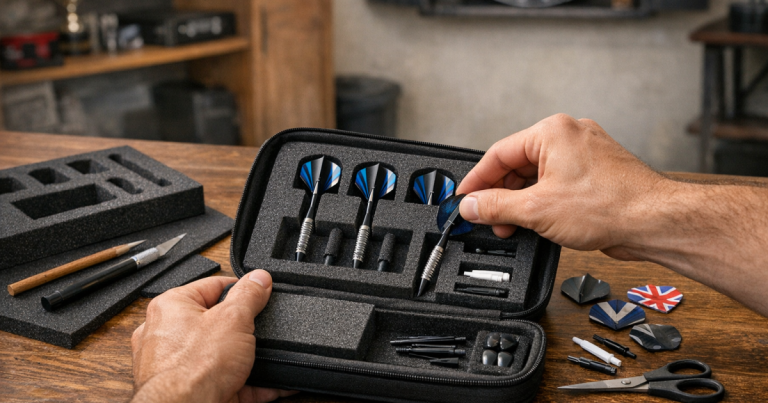
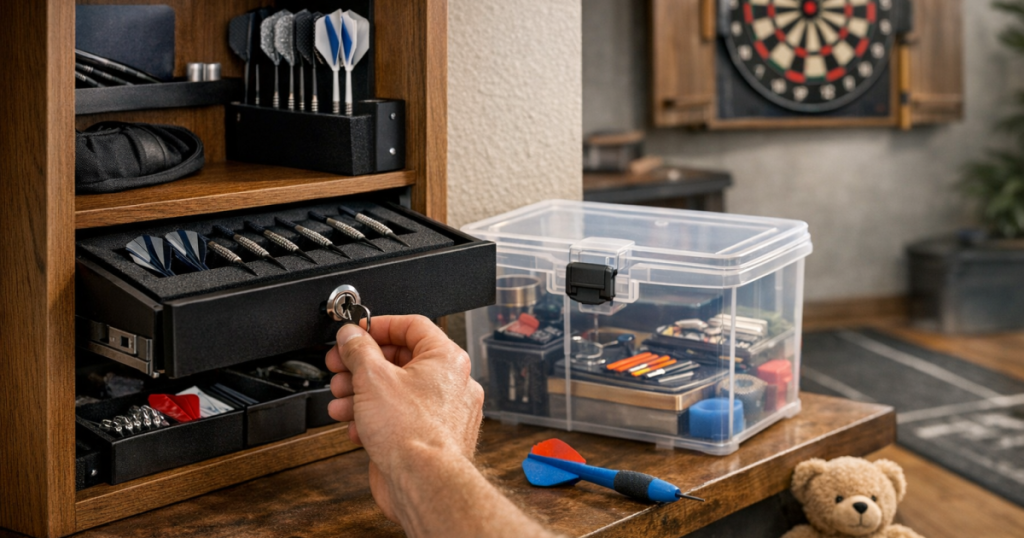
The simplest option is a lockable darts case stored inside a high cupboard. If several people play at home, use one larger locked box with individual cases inside it. That keeps sets together without needing multiple keys or separate hiding places.
A good layout is easy for adults to use in the right order: open the cupboard, unlock the case, take out the darts, play, then return the darts before anything else is put away. If the storage is awkward, it is more likely to be skipped after a late throw or a quick practice session.
Step 3: Keep spare points and tools in a separate adult-only kit
Maintenance items are often more tempting to children than the darts themselves because they are small, shiny and kept in little boxes. Keep point tools, sharpeners, spare points and repair bits away from flights and other colourful accessories.
A compact lidded organiser inside a locked toolbox works well. Label it clearly, but do not make it look like a toy craft kit. If you already keep stems, flights and cloths together, move the genuinely sharp or fiddly parts into a separate compartment that only adults open.
For a tidy routine, it helps to build a small maintenance pouch rather than letting spare bits scatter across the room. The same logic applies when you set up a darts maintenance kit: useful tools are easier to manage when they live in one defined place.
Step 4: Make the dartboard area reset-friendly
Child-safe storage is not only about the cupboard. It is also about what happens in the two minutes after the final leg. Most loose darts and accessories are left out because the reset process is vague, not because anyone meant to be careless.
Set a clear end-of-session order:
- Remove every dart from the board and surrounding area.
- Check the floor, mat and skirting line for bounce-outs or broken tips.
- Put darts into their case before wiping the board or updating scores.
- Return flights, shafts and tools to their compartments.
- Close and lock the storage before leaving the room.
If your board is in a living room, hallway or shared family space, add a visual check from a child’s height. Kneel or crouch and look under nearby furniture, behind the oche mat and around the cabinet. Bounce-outs can travel further than expected, especially on hard flooring.
Step 5: Do not treat wall protection as storage
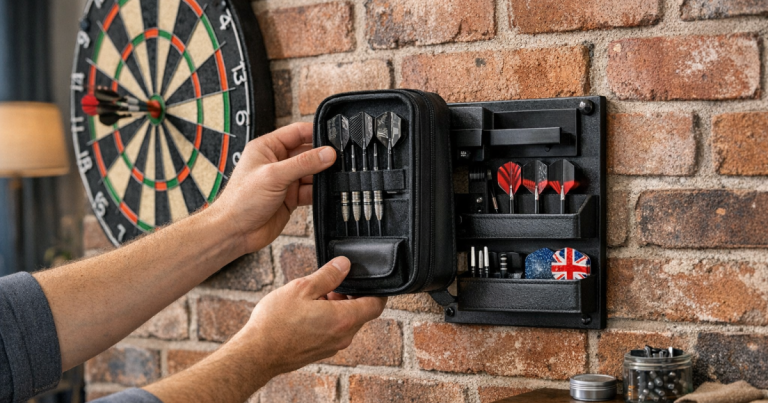
A surround, cabinet or backing board is there to protect surfaces and contain missed darts during play. It should not become a place to park darts, tools or spare flights. Cabinets in particular can feel like storage, but many are designed for scoreboards and light accessories rather than child-resistant locking.
If your setup uses a surround or cabinet, keep the board area visually clean when play ends. No darts in the sisal, no spare set balanced on a shelf, and no point tool tucked beside the scoreboard. For more on stopping missed darts damaging the room itself, see this guide to protecting floors and walls around a dartboard.
Step 6: Choose the right storage position for your room
Height helps, but it is not enough on its own. Children can move stools, climb onto sofas and pull at hanging organisers. The safest arrangement combines position, closure and habit.
Living room setup
Use a high cupboard or a lockable box stored out of sight. Avoid leaving darts in a decorative cabinet if the room is used by children during the day. Keep the oche mat rolled away if it becomes a trip point or a cue that the area is open for play.
Garage or utility setup
Do not store darts beside garden tools, DIY fixings or sharp household items where the whole corner becomes a general hazard. Give darts gear its own labelled container. Garages can also be dusty or damp, so use a closed case rather than an open shelf.
Rented home or temporary setup
If you cannot drill into walls or fit permanent storage, use a lockable portable toolbox or a lidded storage crate kept in an adult bedroom cupboard. For board placement itself, a freestanding option may reduce wall fixing issues; this is worth considering if you need to pick a dartboard stand for a rented home.
Step 7: Give every accessory a home
Loose accessories are the weak point in many home setups. A set of darts may be locked away, but then the spare shafts, flight punch, checkout card and marker pen are scattered across a sideboard. That creates clutter and makes it harder to notice if something is missing.
Use small lidded compartments for:
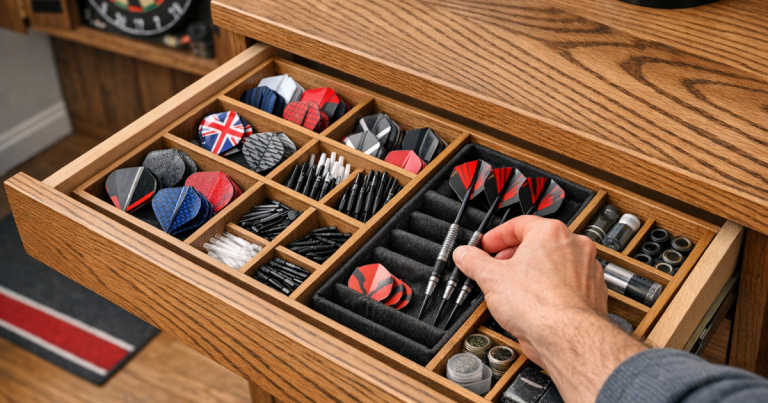
- Flights by shape or player.
- Shafts by length.
- Rings, springs and tiny fitting parts.
- Score pens, chalk and erasers.
- Cloths and grip aids.
Keep the compartments inside a larger adult-controlled box rather than leaving a tempting organiser on display. Transparent lids are useful for adults because you can see what is inside without rummaging, but the box still needs to be stored securely.
Step 8: Build a household rule that is easy to enforce
Rules work best when they are short and consistent. “Darts only come out when an adult sets up the area” is clearer than a long list of exceptions. If older children are learning to play, the same rule can still apply: an adult controls the gear, checks the space and puts the kit away afterwards.
It is also worth separating “watching darts” from “handling darts”. A child can enjoy scoring, calling out totals or retrieving flights from a safe table without being given access to sharp gear. If you use a home scoreboard, keep magnets, chalk and pen caps in the same controlled storage as the rest of the accessories.
Common storage mistakes to avoid
- Leaving darts in the board because the room has a door. Doors get opened, and habits slip.
- Keeping sharp darts and colourful spare flights in the same unlocked case.
- Using a display stand at child height for match darts or practice sets.
- Storing a point sharpener or point tool in a general stationery drawer.
- Forgetting bounce-outs under mats, cabinets or nearby furniture.
- Assuming a standard darts cabinet is child-safe simply because it closes.
Questions people ask
Can I leave darts in a locked room?
A locked room is useful, but it should not be the only control. Put the darts back into a locked case or box as well, because rooms are often opened for cleaning, storage or other household reasons.
Are magnetic darts safer for young children?
Magnetic darts remove the sharp point, but they are still not a reason to leave small parts scattered around. Treat them as a separate family game and keep steel-tip darts stored securely away from them.
Should flights and shafts be locked away too?
Yes, if young children are in the home. Flights are less dangerous than dart points, but shafts, rings and caps are small enough to go missing quickly and should be kept in lidded storage.
Is a dartboard cabinet enough for child-safe storage?
Usually not on its own. Many cabinets are intended to tidy the board area, not to provide a secure barrier. Use a separate locked case or box for the darts themselves.
How often should I check the area after playing?
Check after every session. Look at the board, floor, oche area, nearby shelves and under furniture before the storage is locked and the room is left.
Final thoughts
The best setup is not complicated: lock away the sharp items, contain the small parts, and make the reset routine so simple that it happens every time. Once each accessory has a clear home, the darts area stays tidier, the gear is easier to find, and the space is much safer for family life between games.