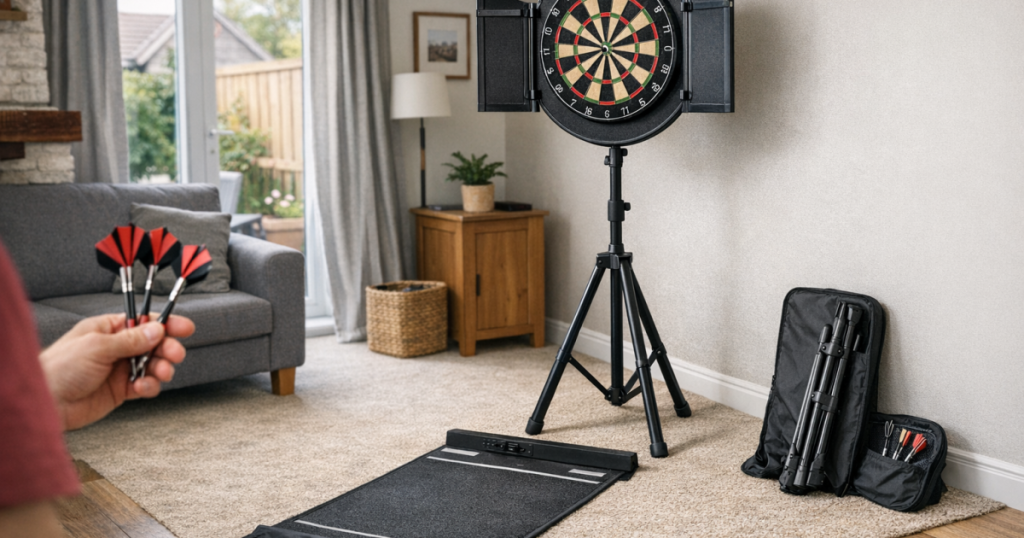
A dartboard stand for rented homes solves a very specific problem: you want a proper steel-tip setup without drilling into walls, risking plaster damage or arguing about fixings when you move out. The right stand should feel stable, place the board at regulation height, fold away sensibly and leave enough room for a comfortable throw.
Do not treat a stand as a shortcut around measuring. It removes the wall-mounting issue, but it still needs floor space, clearance behind the board, and a safe area where missed darts are unlikely to damage anything important.
The short version
Choose a stand that is stable before it is compact. A slightly wider footprint is usually easier to live with than a narrow stand that wobbles every time a dart lands in the board. For most rented homes, the best option is a freestanding or tripod-style stand with adjustable height, rubberised feet, a secure board mounting point and enough room behind it for a surround or protective panel.
- For small flats: prioritise fold-down size, easy storage and a stand that does not need to sit hard against a wall.
- For shared houses: look for stability, quick setup and a layout that keeps darts away from walkways.
- For carpeted rooms: check whether the feet sit firmly and whether the stand rocks on soft flooring.
- For laminate or tiled floors: favour grippy feet and use a darts mat or rug to reduce movement.
- For long-term use: check board compatibility, replacement parts, and whether the stand can support your preferred surround or back protection.
Step 1: Measure the throw space before choosing a stand
The stand is only one part of the setup. You still need the board face at the correct height and the oche at the correct distance. For standard steel-tip darts, the bullseye should be 1.73 m from the floor, and the throwing line should be 2.37 m from the face of the board. If you are checking your room properly, it is worth using a tape measure rather than judging by eye.
A common mistake in rented homes is placing the stand in front of a wall, then realising the tripod legs push the board closer to the thrower than expected. Measure from the board face, not from the wall behind it or the rear feet of the stand. If you want a clear measurement process, use this guide to set the correct oche distance at home before ordering anything.
Also check side clearance. A narrow hallway or box room might technically give you the oche distance, but still feel awkward if your arm, shoulder or follow-through is close to furniture. A good stand cannot fix a poor throwing lane.
Step 2: Decide where the stand will actually live
In a rented home, the best position is rarely the most obvious one. You may want the board in the lounge, but a bedroom corner, spare room or garage-style utility space can be easier to manage if it avoids shared walls, televisions, picture frames and doorways.
Before buying, mark the footprint of a likely stand using masking tape or a couple of books on the floor. Then stand where the oche would be and go through your throwing motion without darts. You are checking whether you can stand squarely, retrieve darts comfortably, and move around without stepping over the stand legs every visit to the board.
If the only available spot already feels tight, solve the room problem first. A stand adds flexibility, but it also introduces legs and depth. For layouts where the board area feels squeezed, the advice in fixing a darts setup that feels too cramped will help you decide whether a stand, wall mount or different room makes more sense.
Step 3: Put stability ahead of the smallest footprint
A dartboard stand needs to cope with repeated impact. Even light darts can make a poorly balanced frame tremble, and that movement becomes annoying quickly. It can also make scoring feel less satisfying because the board does not have the solid feel of a wall-mounted setup.
Look for a stand with a wide, even stance and adjustment points that lock firmly. If you are shopping online, read the product information carefully and check user photos where available. Pay attention to how the board is attached, how the central pole locks, and whether the stand is designed for a full-size bristle dartboard rather than a light novelty board.
For renters, the feet matter as much as the frame. Rubberised or non-marking feet are useful on hard floors, while carpet can sometimes hide a slight wobble until the board is in use. If the floor is uneven, test the position before committing to a permanent setup spot.
Step 4: Check board compatibility and what is included
Not every stand is sold in the same way. Some are supplied as a stand only, while others come as a package with mounting hardware or extra accessories. Before buying, check whether your existing board will fit, whether you need to use a particular bracket, and whether the stand gives enough clearance for a surround.
Real examples you may come across include the Winmau Xtreme 2 Dartboard Stand, Unicorn Dartmate Tri-Stand and Mission RotaPro Travel Stand. Treat these as examples to compare rather than automatic answers: verify the current specification, included parts, folding size and board compatibility with the retailer or manufacturer before ordering.
If you already own a heavier or premium board, do not assume every portable stand will feel equally solid with it. The stand needs to hold the board securely at the right height without sagging, twisting or needing constant readjustment.
Step 5: Plan wall and floor protection as part of the purchase
A stand reduces the need for wall fixings, but it does not magically protect the wall behind the board. Missed darts can still hit plaster, doors, furniture or skirting boards. In a rented property, that is the damage you are usually trying to avoid in the first place.
Leave enough depth behind the stand for a dartboard surround, freestanding backing panel or removable protective board. A surround is often the simplest option because it sits around the dartboard itself and can move with the stand. For a closer look at coverage and limitations, the Winmau dartboard surround review is useful even if you are comparing other surrounds too.
Floor protection matters as well. A darts mat helps define the oche and protects carpet or hard flooring from dropped darts. On smooth flooring, it can also stop the throw line area becoming slippery or inconsistent.
Step 6: Think about storage, not just setup
Portable stands sound convenient, but only if you have somewhere sensible to put them. Check the folded dimensions, how quickly the legs collapse, and whether the stand can be stored with the board attached. Some players prefer to leave the board on the stand and move the whole unit aside; others remove the board and store everything separately.
If you rent a small flat, storage may be the deciding factor. A stand that is brilliant in use but awkward to fold may end up living permanently in the middle of the room. That is fine if you have a dedicated darts corner, but annoying if the same room is used for work, eating or guests.
Also think about your routine. If setup takes too long, you will play less. The best stand for a renter is the one you can put up accurately, throw on comfortably, and pack away without turning every session into a chore.
Step 7: Match the stand to the way you play
A casual player who throws a few legs at the weekend has different needs from someone practising most evenings. If you play regularly, small annoyances become big ones: a wobbling pole, awkward board rotation, fiddly height adjustment or a stand that creeps forward on hard flooring.
For regular practice, favour a sturdier frame, repeatable height setting and a setup that allows quick board rotation. If you use different darts, heavier points or aggressive grip patterns, you may also want a more robust wall-protection plan behind the board.
For occasional play, portability may matter more. A lighter stand that folds neatly can be a sensible choice if it is stable enough when assembled. Just avoid choosing purely on convenience if the playing experience will feel flimsy.
Buying checks before you order
- Height adjustment: confirm the stand can position the bullseye at 1.73 m from your actual floor surface.
- Measured depth: check how far the stand sits out from the wall once the board is fitted.
- Footprint: make sure the legs will not block doors, radiators, cupboards or walking routes.
- Board mounting: verify whether your dartboard will attach directly or needs extra hardware.
- Surround clearance: check whether a surround or backing panel can sit around or behind the board without clashing.
- Floor grip: consider how the feet will behave on carpet, laminate, vinyl or tiles.
- Pack-away routine: decide whether you need it to fold daily, weekly or only when moving house.
- Noise and neighbours: avoid placing the board against a shared wall where the thud of darts may travel.
Things readers ask
Can I use a dartboard stand without putting anything on the wall?
Yes, but you should still protect the area behind the board. The stand holds the board, while a surround or freestanding backing panel helps catch missed darts.
Will a stand feel as solid as a wall-mounted dartboard?
A good stand can feel stable enough for home practice, but a wall-mounted board usually feels firmer. Stability depends on the stand design, floor surface, board weight and how well the adjustment points lock.
Is a dartboard stand suitable for a small rented flat?
It can be, provided you have the full oche distance and enough side clearance. The folded storage size is just as important as the playing footprint.
Do I still need a darts mat?
A mat is strongly worth considering. It marks the oche, protects the floor from dropped darts and can help reduce stand movement on smooth surfaces.
Can I leave the board attached when storing the stand?
Some players do, but it depends on the stand design and your storage space. Check the manufacturer’s instructions and avoid leaning a loaded stand where it could tip or bend.
The big picture
The best dartboard stand for rented homes is the one that gives you a reliable throw without creating new problems for the room. Measure first, prioritise stability, protect the wall and floor, and think honestly about how often you will pack it away.
A stand is a smart no-drill answer for many renters, but it is still part of a complete setup. Get the space, oche, protection and storage right, and you will have a home darts area that is easy to live with as well as enjoyable to play on.