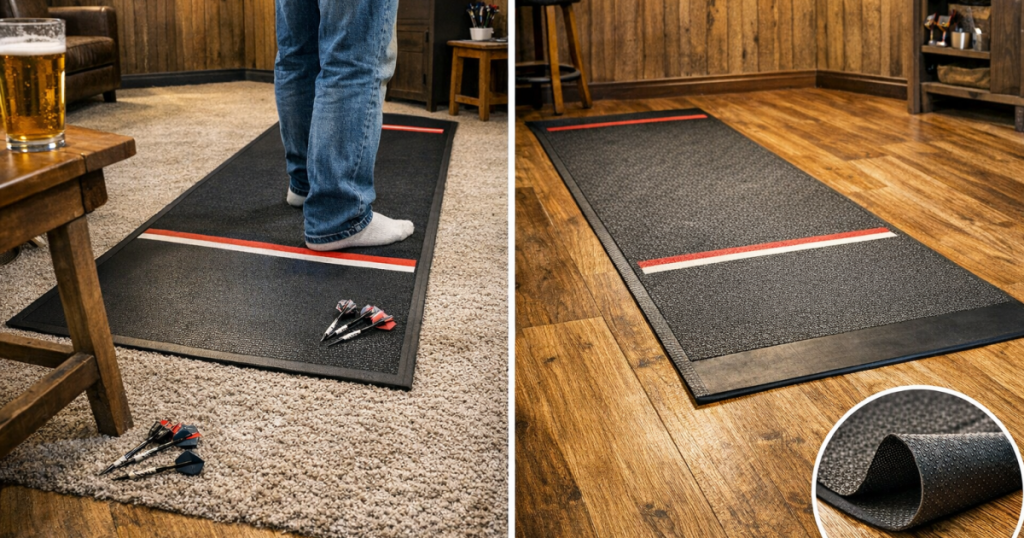
A good dart mat does more than mark the throw line. Choosing a dart mat for carpet is mainly about stability, thickness and how well it sits underfoot, while hard floors need grip and impact protection without creating a trip hazard. Get those basics right and your home setup feels tidier, safer and much easier to use.
The best choice depends on the room, the floor surface, how often you play and whether the mat needs to be moved after every session. A spare bedroom, garage and living room all ask slightly different things from the same piece of kit.
What to know first
For most home players, the right mat is the one that stays flat, clearly marks the oche, protects the landing area and suits the floor it sits on. A thick rubber mat can feel excellent on hard flooring, but it may ruck or feel bulky on deep carpet. A lighter roll-up mat is easy to store, but it may shift more readily unless the underside grips well.
Before looking at brands, check three things: the floor surface, the available length from board to throw line, and whether the mat will live in place or be packed away. If you are still checking room dimensions, use this guide to measure a spare bedroom for a dartboard setup before buying a mat with printed oche markings.
Step 1: Match the mat to your floor type
For carpeted rooms
Carpet makes a darts area feel comfortable, but it is not always the easiest surface for a mat. Deep pile can let thin mats ripple, while some rubber-backed mats can slowly creep as players step on and off them. On carpet, look for a mat with enough weight to stay settled and enough flexibility to lie flat without curling at the ends.
A dart mat for carpet should not be so thick that it rocks under your stance or creates a raised edge where people walk across the room. If the room doubles as a bedroom or office, a mat that rolls up cleanly is often more useful than a heavy semi-permanent option. For very soft carpet, a firmer backing can help the mat feel less spongy at the oche.
For laminate, vinyl, tile and wooden floors
Hard floors change the priorities. You want the underside to grip, the top to feel steady under your shoes, and the front section to reduce damage from bounce-outs. Smooth floors can make cheaper lightweight mats slide forward over time, so anti-slip backing matters more than it does on carpet.
On wood or laminate, avoid anything that traps grit underneath and gets dragged around. Lift and clean the mat occasionally rather than sliding it across the floor. If the floor is easily marked, choose a mat with a soft, stable underside and check the manufacturer’s care notes for your floor type.
Step 2: Decide how permanent the setup is
A mat that lives in a garage darts area can be heavier, wider and less convenient to store. A mat used in a rented flat, spare room or shared living space needs to be easier to roll, carry and tuck away. Neither approach is automatically better; the right one is the one you will actually use every time you throw.
- Permanent setup: choose a heavier mat with clear oche markings and good floor coverage.
- Occasional setup: prioritise roll-up storage, low curl and quick alignment.
- Shared room: look for a low-profile edge and a surface that is easy to wipe clean.
- Garage setup: consider moisture, dust and temperature changes, not just the throw line.
If your board is in a garage, mat choice is only one part of keeping the space practical. It is worth planning storage, lighting, walking routes and floor clearance alongside the mat; this guide to planning a garage darts area that stays usable covers those wider decisions.
Step 3: Check the oche markings carefully
Many dart mats include printed throw lines, but you still need to verify that the markings suit your setup. The standard steel-tip throwing distance is measured from the face of the dartboard to the oche, not from the wall. If your board sits in a cabinet, on a backboard or proud of the wall, that difference matters.
Before trusting a printed line, hang the board correctly, measure from the board face, then align the mat. Some mats have multiple markings for different games or board types, which is useful only if they are easy to read from standing height. Overly busy graphics can look smart online but become annoying if the actual throw line is not obvious.
Raised oches can give a more consistent toe position, but they are not for everyone. In a compact home room, a raised front edge may become a trip point when the mat is left out. A printed oche is simpler, flatter and usually enough for casual and regular home play.
Step 4: Choose the right material and thickness
Most home dart mats fall into a few broad types. Rubber mats tend to feel stable and protective, while fabric-topped mats can be easier to roll and more comfortable in mixed-use rooms. Foam-style mats are light, but they need careful checking for grip, durability and whether they mark easily under shoes.
- Rubber mats: usually strong on grip and floor protection, though heavier to move.
- Carpet-style mats: comfortable underfoot and room-friendly, but may need more care to keep flat.
- Thin roll-up mats: convenient for storage, but check whether the corners curl after rolling.
- Mats with integrated oche blocks: useful for repeatable positioning, but less subtle in shared rooms.
Thickness is a balancing act. Too thin and the mat may not protect the floor well from bounce-outs. Too thick and it can feel intrusive, catch feet or sit awkwardly on carpet. For a normal home setup, choose a mat that gives confidence underfoot without changing your stance.
Step 5: Think about bounce-outs and floor protection
A mat will not catch every stray dart, but it can reduce visible damage in the most common landing zone. Steel-tip darts can still pierce or mark softer materials, so do not treat a mat as a complete shield. Its job is to reduce everyday wear, define the playing area and make dropped darts easier to spot.
If you play on hard flooring, the protection area in front of the board is important. If you play on carpet, the mat may be more about protecting fibres from flattened foot traffic and making the oche consistent. In either case, check the mat length and width against your room rather than assuming all full-length mats will fit neatly.
Noise is another small but real factor in flats, terraces and shared homes. A heavier mat can soften foot movement and dart impacts slightly, but it will not solve noise from the board itself. For that, read the separate guide on how to make a darts setup quieter for shared walls.
Step 6: Compare real-world options without getting distracted
There are plenty of branded mats available in the UK, but the name on the mat matters less than whether it suits your floor and setup. Still, looking at recognised examples can help you understand the main styles before you buy.
- Target World Champions Dart Mat: a familiar style to compare if you want a branded mat with clear oche guidance. Check the current dimensions and floor suitability before ordering.
- Winmau Xtreme Darts Mat: worth considering if you prefer a more substantial mat style. Confirm how it rolls, stores and sits on your specific floor type.
- Unicorn Professional Dart Mat: a recognisable option for players who want a traditional full-length mat. Look closely at the printed markings and whether the backing suits carpet or hard flooring.
Do not choose by graphics alone. A busy design can look good in product photos but make the throw line harder to see. Likewise, a very heavy mat may feel premium in a dedicated room but become irritating if you need to move it every night.
Step 7: Run these checks before buying
Use this quick checklist before committing to a mat. It will prevent most of the common mistakes: buying too long for the room, choosing the wrong underside, or ending up with a mat that looks good but never lies flat.
- Measure from the board face: make sure the printed oche will line up with the correct throwing distance.
- Check total mat length: allow space behind the oche for your stance, not just the distance to the board.
- Look at the underside: carpet and hard floors need different kinds of grip.
- Check storage: if it rolls up, find out whether it is likely to curl when unrolled.
- Consider cleaning: garages and utility rooms need wipeable, hard-wearing surfaces.
- Watch the edges: raised or curled edges are more annoying in shared walkways.
- Match your footwear: a mat can feel different in trainers, socks or flat indoor shoes.
Common mistakes to avoid
The biggest mistake is treating a dart mat as a universal accessory. A mat that works beautifully on a concrete garage floor may be clumsy on thick carpet. A lightweight mat that is fine for occasional practice may move too much during long matches.
Another common issue is placing the mat before checking the dartboard position. If the board height, wall bracket or cabinet depth changes, the throw line may need adjusting. Always set the board first, then align the mat to the board face.
Finally, do not ignore how the room is used outside darts. In a family living room, low-profile and easy storage may matter more than maximum weight. In a dedicated darts corner, a heavier mat with a more obvious oche may be the better long-term choice.
Things readers ask
Can I use the same dart mat on carpet and hard floors?
Sometimes, yes, but it depends on the backing and weight. A mat that grips laminate well may not sit as neatly on deep carpet, so check floor compatibility rather than assuming it will work everywhere.
Do I need a raised oche on a home dart mat?
No. A raised oche can help with consistent foot placement, but a clear printed line is usually enough for home practice. Avoid raised edges if the mat sits in a walkway.
Will a dart mat stop all floor damage?
No mat can guarantee that. It can reduce everyday marks and protect the main landing area, but sharp darts can still pierce soft materials or bounce beyond the mat.
How wide should a dart mat be?
Choose enough width to cover your normal stance and the likely bounce-out area. Wider mats feel more protective, but they must still fit the room without bunching against furniture.
Is a heavy mat always better?
Not always. Heavy mats usually stay put well, but they are harder to move and store. In a shared room, a lighter mat that rolls flat may be more practical.
Final thoughts
The right dart mat is not just the toughest or most expensive one. It is the mat that suits your floor, lines up correctly with the board, stays flat during play and fits the way you use the room. For carpet, prioritise stability and low edges. For hard floors, focus on grip, protection and a backing that will not mark the surface.
Measure first, think about storage, and choose the material around your actual room rather than a product photo. That way your mat becomes part of a reliable home darts setup, not something you have to keep adjusting between throws.