A home darts setup feels much more settled when the throw line is fixed, visible and repeatable. Get the darts oche measurements right and every practice leg feels closer to match play, whether you use a printed mat, a raised oche or a simple taped line on a garage floor.
The key is not just knowing the distance. You also need to measure from the correct point on the board, understand where the toe line actually starts, and make sure the mat or oche stays square to the board over time.
At a glance
- Standard steel-tip throwing distance: 2.37 m from the face of the dartboard to the front of the oche.
- Standard bullseye height: 1.73 m from the floor to the centre of the bull.
- Diagonal check: around 2.93 m from the centre of the bull to the front of the oche.
- The toe line is the front edge of the oche, not the middle of a mat graphic or the back edge of a raised block.
- Measure from the face of the board, not the wall behind it.
The standard steel-tip oche distance
For a normal steel-tip home setup, the throw line should be 2.37 m from the face of the dartboard to the front edge of the oche. That “face of the dartboard” detail matters. If you measure from the wall, cabinet backing or surround, the line can end up slightly too close because the board itself projects forward.
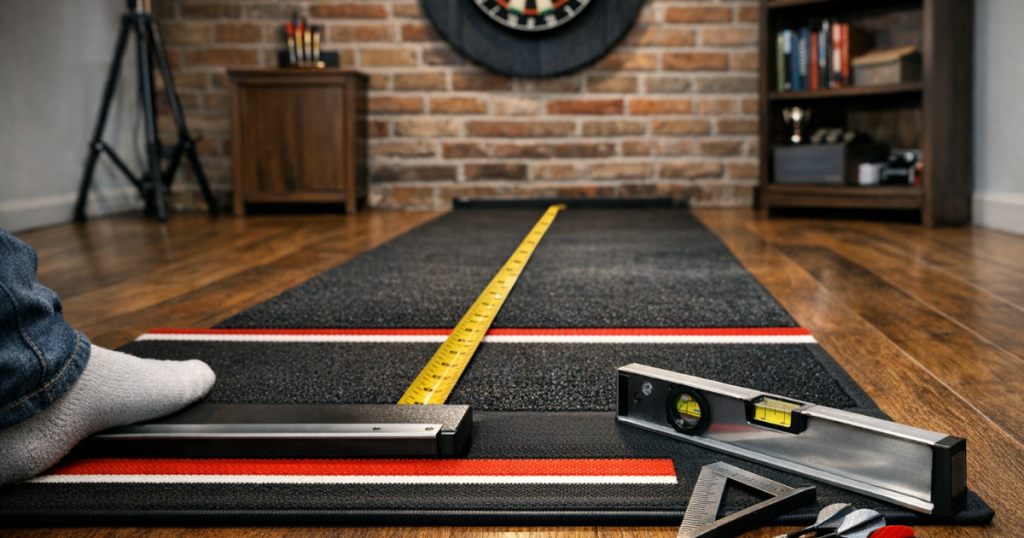
The cleanest method is to hang a plumb line, tape measure or weighted string from the front face of the board, directly below the centre line. Mark the point on the floor beneath the board face, then measure 2.37 m straight out from that mark. That final point is where the front edge of your toe line should sit.
Board height matters too. The centre of the bull should be 1.73 m from the floor. If the board is too high or too low, the oche distance might be correct on paper but the throw will still feel wrong. Once height and distance are both set, use the diagonal measurement as a useful cross-check: from the bullseye to the front of the oche should be about 2.93 m.
What counts as the toe line?
The toe line is the limit the player’s foot must not cross during a throw. In a home setup, it can be shown by a raised oche, a line on a mat, a strip of tape, or the front edge of a fixed timber or rubber oche.
If you use a raised oche, the front face of that raised strip is the line. Your foot can touch it, and you can lean over it, but your foot should not go beyond it before the dart is released. If you use a flat line or printed mat, treat the nearest edge of the line to the board as the boundary unless the mat clearly marks a separate throwing edge.
This is where many home setups become inconsistent. A printed mat might show several distances for different games, or the graphic might not sit exactly where the true measurement lands in your room. Do not assume the boldest line on the mat is automatically right for your board position. Confirm the measurement from the board face and then align the mat to that.
Getting the board centre line straight
A good oche is not only the right distance away; it is also centred on the board. Stand in front of the setup and imagine a straight line running vertically through the 20, bull and 3. Your oche should sit square to that centre line, not drift left or right.
For a practical check, mark the centre point directly below the board, then run a tape measure out to the oche position. The toe line should be at 90 degrees to that centre line. If one side of the mat sits further forward than the other, the player may be throwing from a slight angle without realising it.
In tight UK homes, sheds and garages, the wall, skirting board or floorboards may not be perfectly square. Use the dartboard as your reference rather than the room. A mat that looks parallel to the wall can still be misaligned if the board is mounted slightly off-centre inside a cabinet or surround.
Mat alignment without constant re-measuring
Once the distance is correct, make it easy to keep it that way. A mat that creeps forward during practice gradually shortens the throw, while a mat that twists can put the toe line out of square. This is particularly noticeable on smooth floors, laminate, tiles and garage concrete.
Useful alignment habits include:
- Marking two small reference points on the floor at each end of the toe line.
- Checking the mat edge against those marks before each session.
- Using the board centre line, not the wall, to square the mat.
- Keeping the oche area clear so players do not kick or drag the mat out of place.
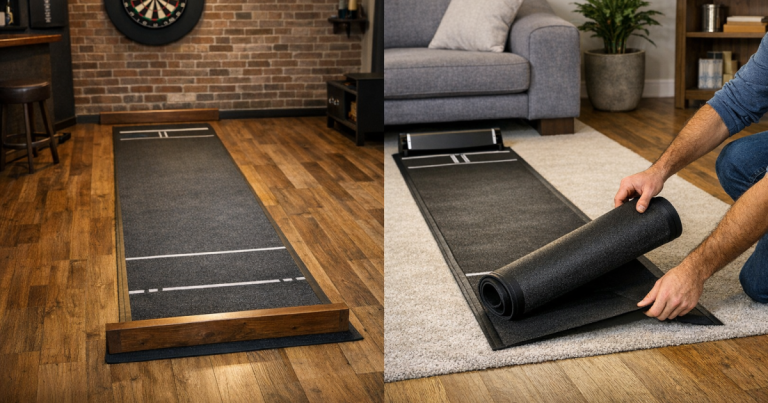
- Rolling, rather than folding, mats that are prone to holding creases.
If the mat has a raised oche attached, check that the raised section has not shifted relative to the printed distance marks. On some home setups, the most accurate solution is to ignore decorative markings and use your own measured toe line as the reference.
Stability is also part of accuracy. A mat that lifts at the corners or moves underfoot can become distracting and unsafe. For more detail on keeping the throwing area secure, see the guide to mat safety and oche stability.
Raised oche, tape line or darts mat?
Each approach can work, but they create a slightly different feel underfoot.
Raised oche
A raised oche gives the clearest physical stop for the front foot. It helps repeat stance position because the player can feel the boundary without looking down. The main check is placement: the front edge of the raised oche must sit at 2.37 m from the board face.
Flat tape line
A tape line is simple and accurate if applied carefully. It is handy for temporary setups, spare rooms and shared spaces where you cannot leave a full mat down. The weakness is that it offers no physical foot stop, so players need to be disciplined about not creeping forward.
Darts mat
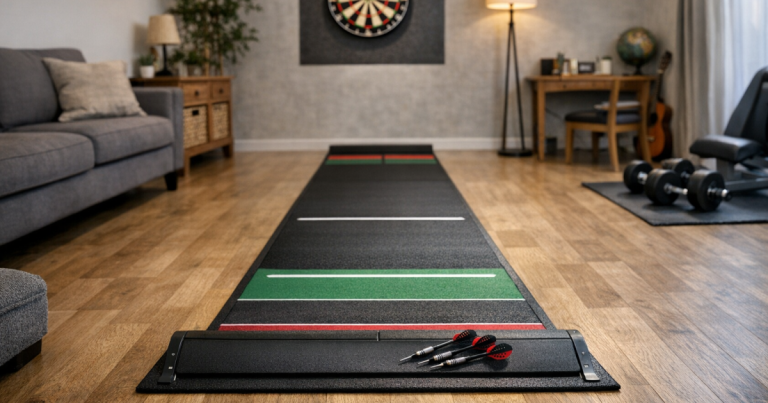
A mat protects the floor, makes the playing area look more complete and usually gives a clear throwing reference. The important detail is to check the mat’s marked oche against your board rather than assuming it is correct in every room. If you want to see how a more serious home mat behaves in practice, the Winmau Xtreme Dart Mat review is a useful next read.
Common setup mistakes
- Measuring from the wall: this ignores the depth of the board and can make the throw shorter than intended.
- Using the wrong edge of the oche: the front edge nearest the board is the important point, not the back edge.
- Skipping the board height check: distance alone will not fix a board mounted too high or too low.
- Trusting a mat graphic blindly: printed lines are only useful when the mat is placed accurately.
- Letting the mat drift: a few centimetres of movement can change the feel of your throw.
- Aligning to a crooked room feature: the board centre line should be the reference point.
A simple measuring routine
Use this sequence when setting up or checking your home oche:
- Set the bullseye height at 1.73 m from the floor.
- Drop a vertical reference from the face of the dartboard to the floor.
- Measure 2.37 m straight out from that floor point.
- Mark the front edge of the oche at that point.
- Check that the toe line is square to the board centre line.
- Use the diagonal bull-to-oche measurement as a final sense check.
- Mark small floor references so the mat can be returned to the same position.
This routine is worth repeating after moving furniture, replacing a mat, fitting a cabinet, or changing the board mount. Even a small change behind the board can alter where the face of the board sits in relation to the floor.
Keeping the oche consistent over time
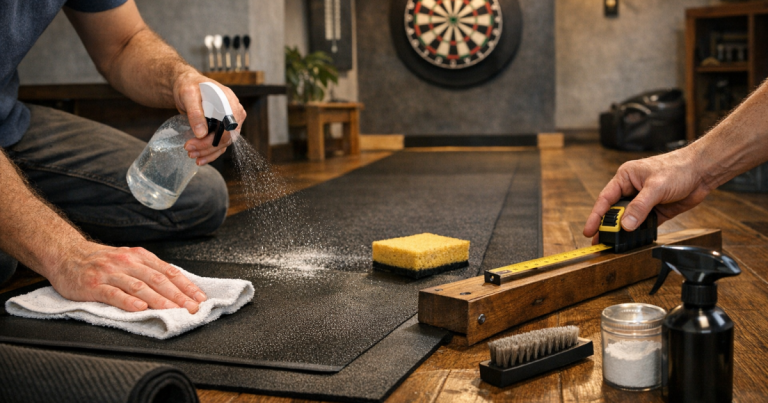
The most accurate setup is the one you can reproduce easily. If your mat is stored between sessions, roll it in the same direction, avoid crushing the raised oche section, and let it settle flat before playing. Dirt, grit and curled edges can all affect how stable the mat feels underfoot.
For regular home players, a quick check before each session is usually enough: line up the mat with the floor marks, press down any lifted edges, and make sure the toe line is still square. The guide to cleaning and storing a darts mat and oche covers the maintenance side in more detail.
Common questions
Is the oche measured from the wall or the dartboard?
Measure from the face of the dartboard. Measuring from the wall can make the throw too short because it does not account for the board’s depth or the way it is mounted.
Can my foot touch the oche?
Yes. Your foot can touch the oche or toe line, but it should not cross beyond the front edge before you release the dart.
What if my mat’s printed line does not match 2.37 m?
Use the measured distance from the board face as the authority. Move the mat until the correct line matches the true oche position, or add your own discreet marker.
Do soft-tip darts use the same oche distance?
Not always. Many soft-tip setups use a different throwing distance, commonly 2.44 m, but you should follow the rules for the board, machine or competition format you are using.
How often should I re-check the oche?
Re-check it whenever the board, cabinet, mat or room layout changes. For loose mats, a quick alignment check before each playing session is sensible.
What stands out
Good darts oche measurements are about repeatability as much as accuracy. Set the bull at the right height, measure the throw from the board face, mark the front edge of the toe line clearly, and keep the mat square to the board centre. Once those basics are fixed, practice feels more consistent and your home setup becomes far easier to trust.