A dartboard cabinet can make a home oche look cleaner, protect part of the wall and keep darts, chalk or accessories in one place. Getting dartboard cabinet dimensions right matters because the cabinet affects more than the look of the setup: it changes door clearance, wall positioning, lighting, scoring space and how comfortable the throw feels.
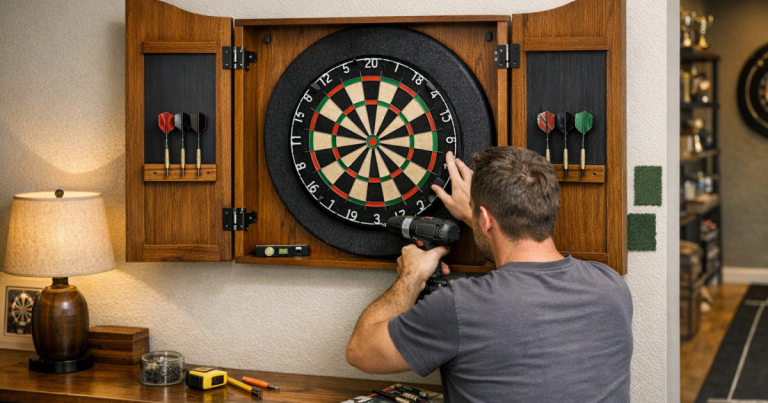
Drilling into walls for cabinet mounting, particularly where concealed electrical cables, pipework or uncertain wall construction may be present, should be handled by a qualified tradesperson to comply with UK safety requirements and appropriate fixing standards.
The short version
- Measure the cabinet both closed and with its doors fully open, not just the front face.
- Set the bullseye at 1.73 m from the floor, measuring to the centre of the bull, not to the top of the cabinet.
- Measure the oche distance from the face of the dartboard, not from the wall behind it.
- Allow space at the sides for open doors, stray darts and a comfortable throwing stance.
- Check the wall type before choosing fixings, especially on plasterboard, masonry or older internal walls.
- Plan lighting before the cabinet goes up, because shadows from doors and cabinet depth can affect visibility.
What you are actually measuring
The useful way to think about dartboard cabinet dimensions is to split them into three separate measurements: the closed cabinet size, the open-door footprint and the playing position of the board inside it. A cabinet that looks compact when shut can take up far more width once both doors are open.
Most home cabinets are designed around a standard bristle dartboard, so the board itself is rarely the difficult part. The bigger issue is what surrounds it: door thickness, hinges, storage slots, scoreboard panels and the depth of the cabinet body. Some cabinets sit quite close to the wall; others hold the board further forward. That forward projection matters because the official throwing distance is taken from the face of the board.
Before choosing the wall position, make a simple note of the space available. Measure the wall width, the distance to nearby furniture, the height from skirting board to ceiling and how much room you have behind the thrower. In many UK homes, the limiting factor is not the wall itself but a radiator, door swing, sofa arm, alcove, light switch or walkway cutting into the oche area.
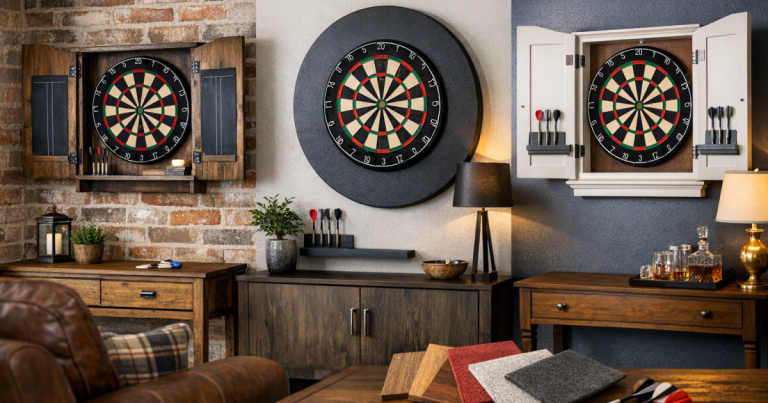
If you are still deciding on style, storage and door layout, the guide to dartboard cabinet types, storage, doors and finishes is a useful companion to this mounting guide.
Clearance around the cabinet
Side clearance with the doors open
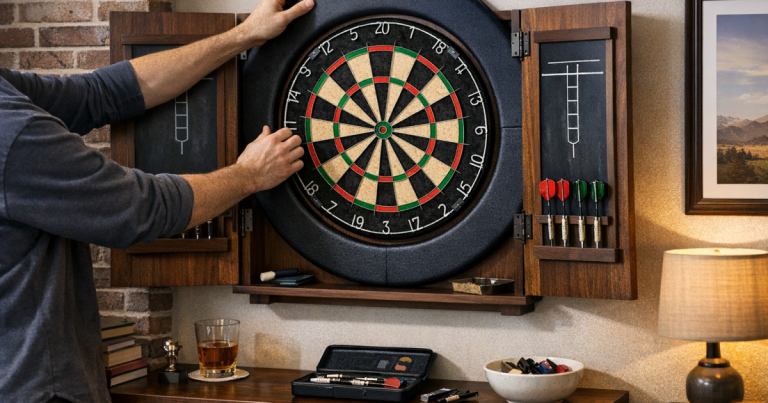
Cabinet width on the box only tells half the story. Open doors need enough space to sit flat or near-flat without hitting a side wall, picture frame, shelf or curtain rail. If a door cannot open properly, it can block sightlines, make scoring awkward or sit in the path of a stray dart.
As a practical home setup rule, allow extra clear wall space on both sides of the cabinet rather than fitting it tightly into an alcove. This is particularly important if the cabinet doors include scoreboards, marker holders or dart storage. You want enough room to write, retrieve darts and close the doors without squeezing between furniture.
Height clearance above and below
The cabinet top does not determine board height. The bullseye does. Once the board is mounted, the centre of the bull should sit 1.73 m above the floor. Because cabinet designs vary, the top edge of one cabinet may sit higher or lower than another even when both boards are mounted correctly.
Below the cabinet, leave enough space so it does not feel visually cramped against a radiator, sideboard or shelf. A cabinet mounted above furniture can look tidy, but it often compromises the oche or makes dart retrieval awkward. If someone has to lean over furniture to collect darts, the setup is not working well.
Forward clearance into the room
Cabinet depth affects the board face position. For standard steel-tip darts, the oche distance is 2.37 m from the face of the dartboard to the toe line. If the cabinet brings the board forward from the wall, the oche also moves forward by the same amount. Measuring from the wall is one of the most common home setup mistakes.
This is where mats and fixed oches deserve attention. A mat can help mark the throw line neatly, but it should line up with the board face rather than the skirting board. If you use a raised oche, make sure it is stable and positioned accurately before you commit to permanent marks on the floor.
Mounting height: start with the bull, not the cabinet
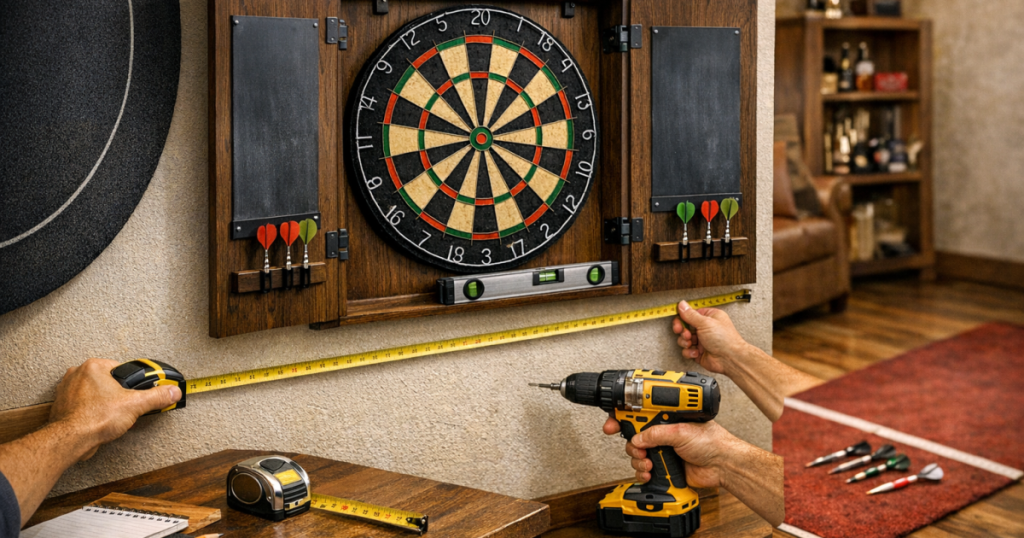
The simplest method is to mark the bullseye height first. Measure 1.73 m from the finished floor level and make a light pencil mark where the centre of the bull will sit. If you are using a darts mat, measure from the floor surface the player stands on. A thick mat can alter the effective standing height slightly, so set up the floor area before final marking where possible.
Next, check how the board mounts inside the cabinet. Some cabinets use a central bracket or screw position, while others rely on the dartboard’s own hanging system. You need to know the distance between the board’s hanging point and the bullseye centre. This lets you place the cabinet so the board ends up at the correct playing height.
Do not assume the pre-drilled cabinet holes automatically put the board at regulation height. They only position the cabinet on the wall. The board height depends on the relationship between those holes, the cabinet back panel, the board bracket and the bullseye.
Getting the oche distance right
Once the cabinet is mounted and the board is in place, measure from the face of the board straight out to the oche. The steel-tip standard is 2.37 m. A diagonal measurement from the bullseye to the oche line is commonly used as a cross-check; for a standard setup this is about 2.93 m.
The key detail is the board face. A cabinet, backboard, spacer or thick mounting arrangement can move the dartboard forward. If you marked the oche from the wall before fitting the cabinet, re-check it after the board is mounted. Even a small shift can make the throw feel wrong if you practise regularly.
Also think about the area behind the oche. A player needs room to stand, step back and avoid clipping furniture. In a narrow room or garage, measure the full throwing lane: board face to oche, plus comfortable standing space behind the line. A neat cabinet cannot compensate for a cramped throw.
Wall type, fixings and cabinet weight
A cabinet, board and darts are not usually enormous on their own, but the load is concentrated on a small area of wall. The right fixing depends on the wall construction. Solid masonry, timber studs and plasterboard all behave differently, and older walls can be less predictable than they look.
For masonry, use suitable wall plugs and screws matched to the wall material. For stud walls, fixing into timber is usually much stronger than relying on the plasterboard alone. For plasterboard without a stud in the right place, specialist fixings may be needed, but they must be rated appropriately for the total load and the way the cabinet hangs.
Check the cabinet instructions before drilling. Some cabinets need two fixing points; others may have more. Use a spirit level before tightening everything fully, because a slightly tilted cabinet is very noticeable once the round board and rectangular doors are in place.
It is also worth considering how the cabinet will be used day to day. Doors are opened and closed, darts are pulled from the board and the back panel can receive vibration from regular play. A secure mounting is not just about holding static weight; it must cope with repeated small movements over time.
Cabinets, surrounds and wall protection
Cabinets and surrounds solve related but slightly different problems. A cabinet adds storage, hides the board when not in use and gives the setup a more furnished look. A surround focuses more directly on catching stray darts around the board. Some players use one or the other; some try to combine them, but compatibility is not guaranteed.
A thick surround can stop cabinet doors closing, push the board forward or cover storage areas. Before mixing both, check the depth inside the cabinet, the door swing and how the surround sits around the board. If the aim is maximum wall protection, a surround may protect a larger impact area than cabinet doors alone. If the aim is a tidy living-room-friendly setup, a cabinet may be the better fit.
For smaller rooms, a cabinet with internal storage can reduce clutter around the oche. Darts, spare flights, stems, chalk and a marker all have a home, which helps keep the playing area tidy. For a deeper look at the details that make a cabinet easier to live with, see the guide to dartboard cabinet features that matter before you buy.
Lighting and sightlines
Cabinet doors can change how light reaches the board. A ceiling light behind the thrower may cast shadows, while a side lamp can create glare on scoreboard panels or make one half of the board easier to see than the other. The deeper the cabinet, the more likely it is to create small shadow pockets around the board edge.
Plan lighting with the doors open, because that is how the cabinet will be used during play. Check whether the top of the cabinet blocks light from above and whether open doors create dark vertical edges. If you are fitting a dedicated dartboard light, confirm that it will work with the cabinet depth and door movement before drilling additional holes.
The guide to darts lighting zones for the board, oche and surrounding room explains how to think about visibility beyond the board itself, which is useful when a cabinet becomes part of the room layout rather than just a wall accessory.
Common measurement mistakes
- Measuring the oche from the wall: always measure from the dartboard face once the board is mounted.
- Using the cabinet top as the height reference: the bullseye centre should be 1.73 m from the floor.
- Forgetting the open-door width: check the cabinet with both doors open before committing to a narrow wall space.
- Ignoring furniture and walkways: the throw line may be correct, but the room can still feel cramped if people have to pass behind the player.
- Mounting before planning lighting: cabinet depth and door position can create shadows that are harder to solve later.
- Choosing weak fixings: match fixings to the wall type and total load, not just to the size of the screws supplied.
FAQ
How much wall space do I need for a dartboard cabinet?
You need enough space for the closed cabinet, both doors fully open and a clear throwing lane. Measure the actual cabinet width with doors open, then check that nearby walls, shelves, curtains and furniture will not interfere.
Should the dartboard be centred in the cabinet or on the wall?
The dartboard should be positioned so the bullseye is at the correct height and the throw line is square to the board. Visual centring on the wall is helpful, but playing accuracy matters more than symmetry.
Can I mount a dartboard cabinet on plasterboard?
It can be possible with the correct fixings, but the wall construction and total load matter. Fixing into timber studs is usually stronger than relying on plasterboard alone, and uncertain walls should be assessed before drilling.
Does a cabinet replace a dartboard surround?
Not completely. A cabinet offers storage and some wall coverage, but a surround usually protects a wider area around the board. Check compatibility carefully if you want to use both together.
Do I set the oche before or after fitting the cabinet?
Set the final oche after the cabinet and board are mounted. The correct distance is measured from the face of the dartboard, so cabinet depth can change the throw line position.
What stands out
A good cabinet setup is not just about finding a box that fits the board. The important measurements are the bullseye height, the open-door footprint, the board face position and the usable throwing lane. Get those right and the cabinet will feel like part of a proper home oche rather than an awkward piece of wall furniture.
Before drilling, mark the bull height, mock up the door clearance and measure the oche from where the board face will actually sit. That small amount of planning prevents most cabinet problems, from cramped scoring to incorrect throwing distance and poorly placed lighting.