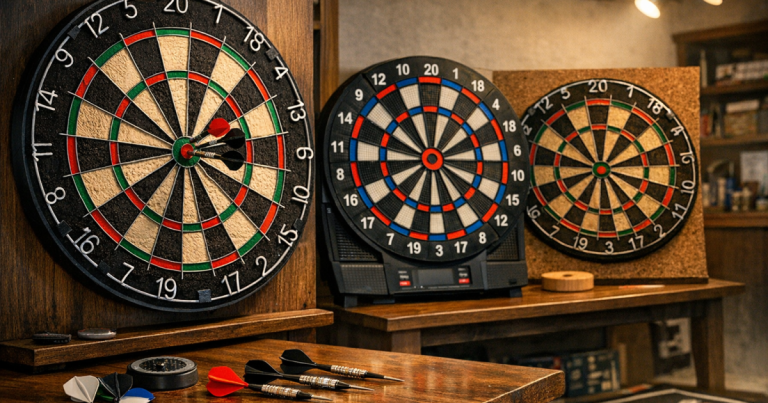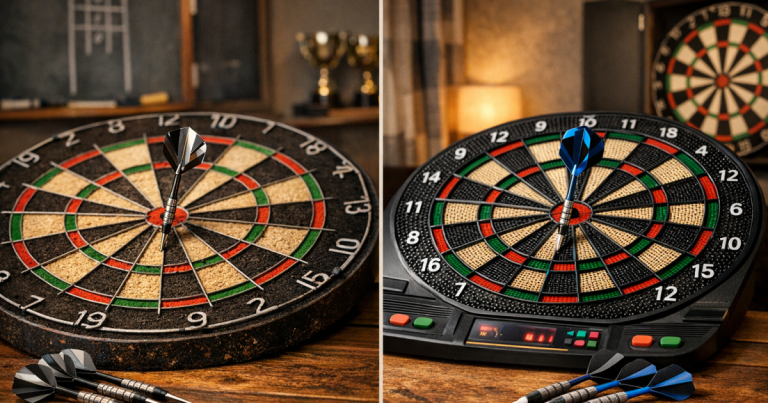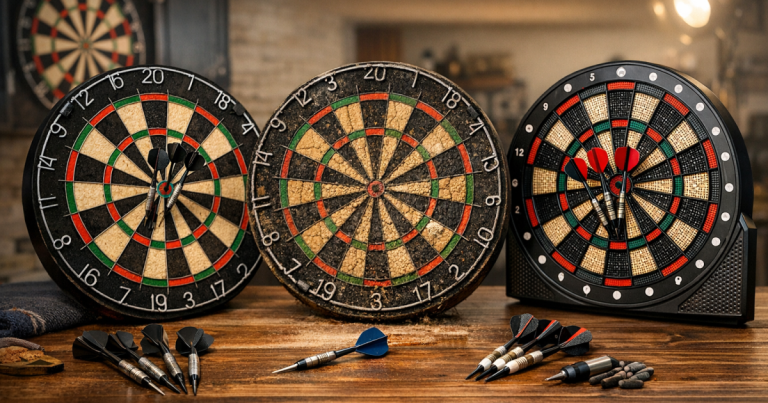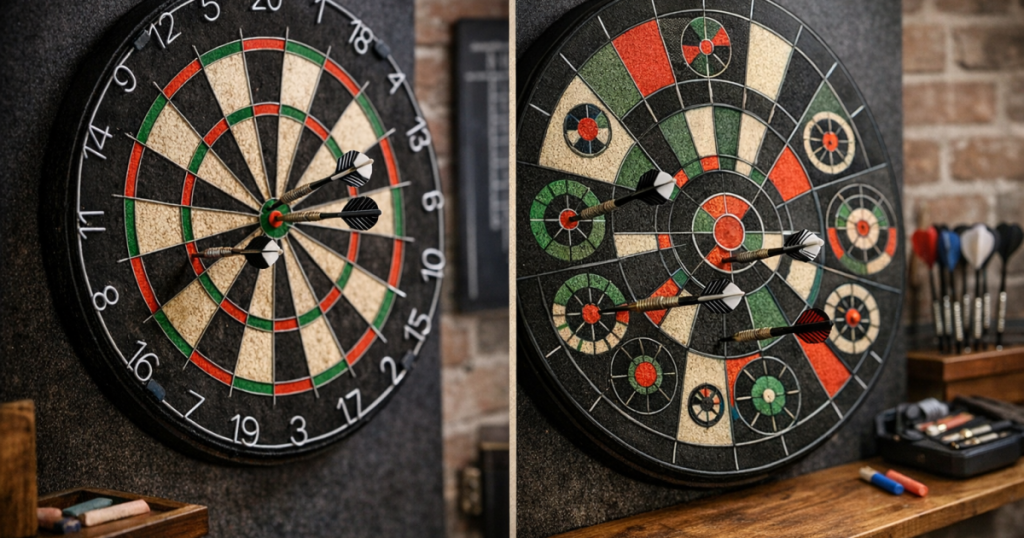
A match-standard board and a training board can look similar once they are on the wall, but the details change how the game feels. For home players, competition dartboards are usually about consistency, regulation layout and clean scoring, while practice boards are about repetition, targeted drills and learning under less pressure.
At a glance
- A match-style board is designed to mirror formal steel-tip play: standard numbering, regulation scoring areas, clear segment separation and a familiar feel under match conditions.
- A practice board may be a normal board used for drills, or a specialist training board with altered scoring areas, smaller targets or visual aids.
- The better choice depends on your aim: match preparation, casual scoring, finishing practice, grouping drills or general confidence at the oche.
- Many home setups use one high-quality bristle board for both match play and practice, then add drills rather than buying a separate training board.
What makes a board feel match-ready?
For most UK home players, a match-ready board means a steel-tip bristle board with a standard clock layout, a regulation bullseye and doubles and trebles in the expected places. The board should be mounted with the bull at 1.73 m from the floor, with the throwing distance measured 2.37 m from the face of the board for standard steel-tip play. If you play in a league, always use the measurements and rules published by that league, because some formats and accessibility categories may differ.
The board surface matters too. Bristle boards are usually made from compressed sisal fibres, which close around dart points after impact and help the surface recover over time. Density, fibre quality, rotation habits and dart point condition all influence how the board wears. For a deeper explanation of why fibre recovery affects bounce-outs and lifespan, read our guide to sisal dartboard density and recovery.
Where competition dartboards differ most
The main distinction is not that a match board is always more expensive or more advanced. It is that it tries to remove distractions from scoring. A good match-style board gives you recognisable proportions, clean target definition, a stable number ring and a surface that behaves predictably across long sessions. When you are practising for a pub league night or a home knockout, that consistency is more useful than novelty.
Regulation layout and familiar sight picture
A competition-style board should look and feel like the board you expect to meet in organised play. The number order is standard, the 20 segment sits at the top, and the doubles, trebles, outer bull and inner bull are positioned conventionally. This sounds obvious, but it matters. If you train regularly on a non-standard board, you may become good at that board rather than the game situation you are preparing for.
Wiring and segment separation
The wiring system affects how clearly the beds are divided and how often a dart glances away from metal rather than entering the sisal. Modern match-style bristle boards often use thinner or blade-style dividers instead of older round wire designs. That does not guarantee perfect scoring, because throws, dart points and board condition still matter, but it can make the board feel cleaner and less cluttered. If you are weighing up this part of the design, our explainer on whether staple-free dartboards are worth it covers the real-world trade-off for regular players.
Surface consistency over long sessions
In a match, you want the board to behave the same in leg one and leg twenty. A board with uneven wear, dead patches or soft areas can turn good practice into guesswork. Rotating the board regularly, keeping the number ring aligned after rotation and using suitable dart points all help preserve consistency. This is one reason many serious home throwers prefer a robust bristle board even if they are not playing formal competitions every week.
What practice dartboards are trying to do
A practice board is less about recreating match night exactly and more about exaggerating the skill you want to improve. That can mean using a normal board for structured routines, or it can mean choosing a training-specific design that makes certain targets smaller, clearer or more repetitive.
Some training boards use reduced-size doubles and trebles to make normal targets feel more comfortable afterwards. Others simplify the face so you can focus on grouping, finishing routes or specific scoring zones without the usual visual noise. Electronic soft-tip boards can also be useful for casual scoring games, family sessions and automatic scorekeeping, although they do not replicate the exact feel of a steel-tip bristle board.
The important point is purpose. A board that is excellent for accuracy drills is not automatically the board you should use for match simulation. Likewise, a regulation board can still be a brilliant practice tool if you use deliberate routines rather than simply throwing at treble 20 until your arm gets tired.
Examples of real home setup choices
A league player with limited wall space will usually get more value from one dependable regulation bristle board than from several specialist boards. Real-world examples people often compare in this space include the Nodor SupaMatch 3 Dartboard and the One80 Gladiator 3+ Dartboard. The exact board you choose is less important than whether it is mounted correctly, rotated regularly and used with a clear practice plan.
A newer player might get more encouragement from a setup that makes scoring straightforward and keeps bounce-outs low enough not to become frustrating. That may still mean a standard bristle board, but the practice routine should be kinder: big-number grouping, single-to-double progressions and short finishing games rather than constant pressure on small segments.
A more experienced home thrower may use a match-style board most of the time and add occasional specialist practice. For example, they might run 20-minute doubles-only sessions, play around-the-board on singles, or use a reduced-target training board for short bursts before returning to regulation scoring. The return to a normal board is the useful part, because it shows whether the drill is improving match-relevant accuracy.
The room setup can blur the difference
A premium board in a poor setup will not feel like a competition environment. Lighting, height, oche stability and surrounding space all affect how naturally you throw. Uneven shadows across the treble bed can make even a good board harder to read, while a loose mat or inconsistent toe line can quietly damage your rhythm.
If your goal is realistic match practice, treat the board and the room as one system. Use consistent lighting across the face, keep the throw line fixed, and make sure the floor area is clear enough for a repeatable stance. Our breakdown of darts lighting zones around the board, oche and room is a useful next step if your scoring feels less consistent at home than it does elsewhere.
When a practice board makes more sense
A dedicated training board earns its place when it solves a specific problem. If your doubles are weak, a board that makes doubles visually prominent or more demanding can give your sessions structure. If you struggle with grouping, a simplified target face can help you see patterns more clearly. If you mainly play casual games with family, an electronic board may make the session easier to run, even though it serves a different purpose from steel-tip match preparation.
The risk is buying a practice board because it feels more serious, then using it without a plan. Smaller targets do not automatically build better mechanics. They can also make practice feel harsh if you are still working on stance, grip and release. In that situation, a normal regulation board plus sensible routines is usually the more productive route.
When a match-style board is enough
For many home players, the best answer is not two boards. It is one well-mounted bristle board used properly. You can practise scoring, doubles, checkouts, pressure legs and grouping on the same face you use for casual matches. That keeps your sight picture consistent and stops your home setup becoming cluttered.
A match-style board is particularly useful if you play away from home, join pub league fixtures, host friends or want your practice to transfer directly into normal scoring. It also helps you notice genuine improvement. If your board, height, distance and lighting stay consistent, changes in performance are more likely to reflect your throw rather than the equipment.
How to decide without overcomplicating it
- Choose a regulation bristle board if your main goal is match preparation, realistic scoring or a simple home oche that feels familiar.
- Use a practice-specific board if you have a clear training weakness and know how that board will support your drills.
- Avoid non-standard layouts for regular match preparation unless they are used briefly and deliberately.
- Prioritise mounting accuracy, lighting and oche consistency before worrying about specialist training features.
- Rotate bristle boards regularly so practice does not become distorted by one worn scoring area.
FAQ
Can one dartboard be used for both competition practice and general training?
Yes. A standard bristle board can handle match simulation, scoring games, doubles routines and grouping drills. For most home players, the routine matters more than owning a separate practice board.
Are practice dartboards allowed in league matches?
Specialist training boards with altered target sizes or non-standard layouts are not normally used for formal steel-tip matches. Use the board type and setup required by your league or competition rules.
Do smaller training targets make you better faster?
They can help experienced players sharpen accuracy, but they are not a shortcut. If your stance, release or aiming routine is inconsistent, smaller targets may simply make practice more frustrating.
Should a home board always be mounted to regulation measurements?
If you are practising for standard steel-tip darts, yes: use 1.73 m to the bull and 2.37 m from the board face to the throw line. Check your league rules for any format-specific variation.
Is an electronic board a practice board?
It can be, particularly for casual play and automatic scoring, but soft-tip electronic boards feel different from steel-tip bristle boards. They are useful for some homes, but not a direct match substitute.
Final thoughts
The useful distinction is purpose rather than label. A match-style board gives you consistency, familiar scoring and realistic conditions. A practice board gives you a way to isolate a weakness, provided you use it deliberately. For a home darts setup, start with the environment you want to replicate, then choose the board that supports that routine with the least distraction.
Quick Buying Links
Competition Dartboards
For home players, competition dartboards are usually about consistency, regulation layout and clean scoring, while practice boards are about repetition, targeted drills and learning under less pressure.At a glanceA match-style board is designed to mirror formal steel-tip play: standard numbering, regulation scoring areas, clear segment separation and a familiar feel under match conditions.A practice board may be a normal board used for drills, or a specialist training board with altered scoring areas, smaller targets or visual aids.The better choice depends on your aim: match preparation, casual scoring, finishing practice, grouping drills or general confidence at the oche.Many home setups use one high-quality bristle board for both match play and practice, then add drills rather than buying a separate training board.What makes a board feel match-ready?For most UK home players, a match-ready board means a steel-tip bristle board with a standard clock layout, a regulation bullseye and doubles and trebles in the expected places.
Practice Dartboards: Main Differences Explained
Worth considering if its strengths better match your needs.