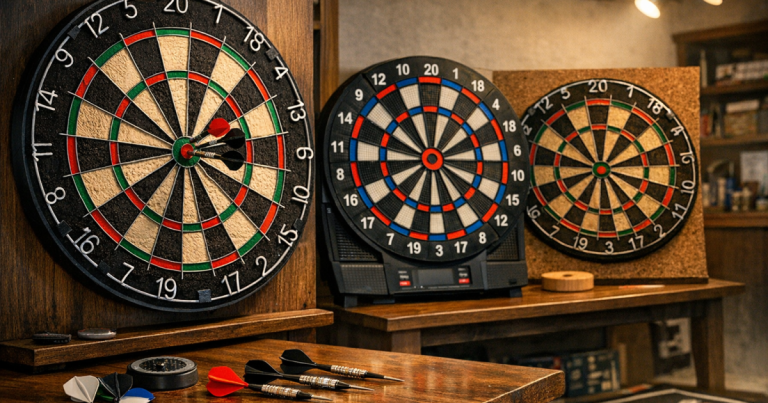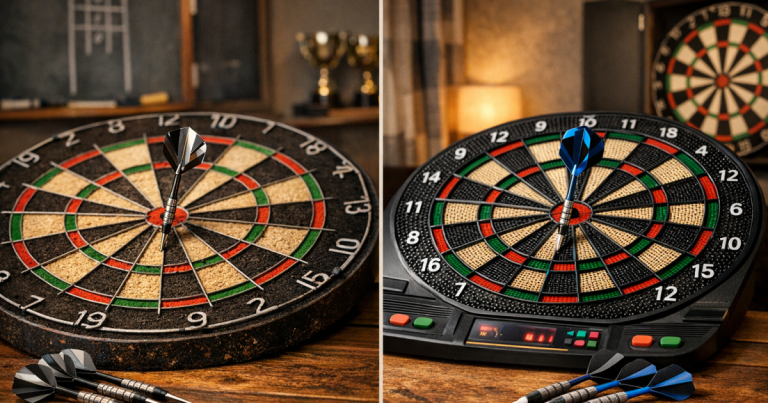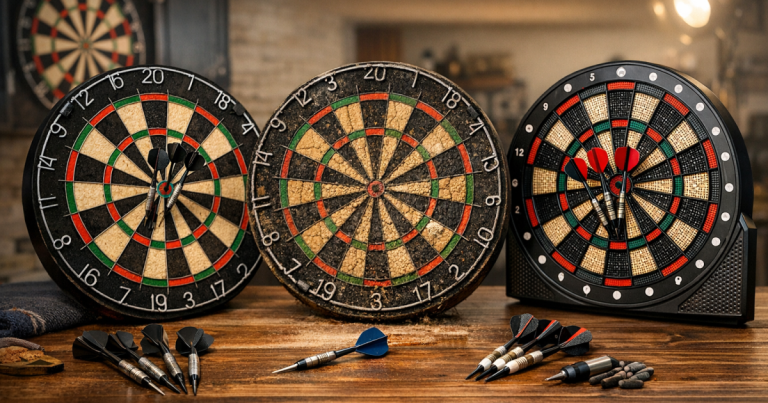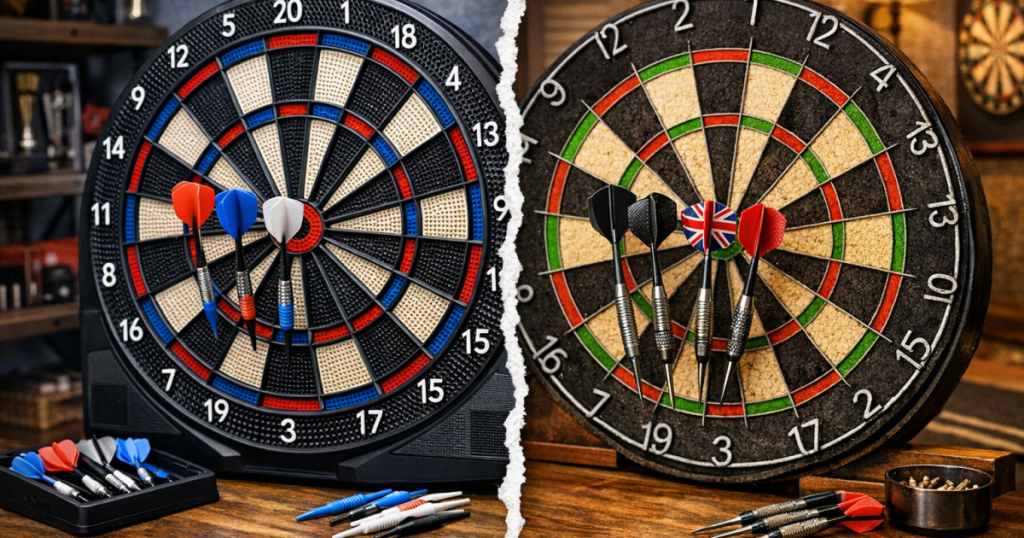
Choosing between soft tip vs steel tip dartboards is really a choice about how you want to play at home: traditional match practice, casual family games, electronic scoring, lower wall damage, or a quieter setup in a shared space. Both formats can work well, but they feel different at the oche and they ask different things of your room.
For most UK home players, a steel tip bristle board is the natural choice if you want the closest feel to pub, league and televised darts. A soft tip board makes more sense if automatic scoring, game variety and less sharp hardware are higher priorities than traditional steel-tip practice.
The short version
- Choose a steel tip board if you want a traditional darts feel, standard UK match practice and a board that works with the same style of darts used in most pub and league play.
- Choose a soft tip board if you want electronic scoring, built-in games, easier casual play and fewer worries about sharp points hitting nearby surfaces.
- Steel tip setups usually need more thought around wall protection, noise and board rotation.
- Soft tip setups still need a proper throw line, safe space and spare tips, but they can be friendlier for mixed-experience households.
- Neither format is automatically quiet. The board, wall, mount and room layout matter as much as the tip type.
What actually changes between the two formats?
A steel tip dartboard is normally a sisal bristle board with metal wiring and numbered segments. Steel-tipped darts pierce the board and stay in the fibres. A good bristle board can be rotated regularly so wear is spread around the scoring areas, which helps keep the treble 20 and other popular targets from breaking down too quickly.
A soft tip dartboard uses plastic-tipped darts. Many home versions are electronic boards with segmented target areas that register the dart on impact and score automatically. Some are compact casual boards, while others are designed to feel closer to an arcade or competition-style soft-tip machine. The important thing is that the playing experience is not just softer steel-tip darts; it is a different format with its own bounce-outs, scoring rhythm and maintenance habits.
For a familiar steel-tip reference point, a board such as the Winmau Blade 6 Triple Core represents the modern bristle-board style many home players recognise: a traditional layout, a sisal playing surface and a focus on clean scoring segments. On the soft-tip side, electronic boards such as DARTSLIVE Home show why some players like the format: scoring support and game modes are part of the appeal, rather than an afterthought. Always check the actual board’s size, mounting method, power requirements and scoring modes before you commit.
Steel tip is better for traditional darts practice
If your aim is to improve for pub darts, local leagues or standard steel-tip match play, a bristle board is the more direct route. The board layout, dart entry, board sound, bounce behaviour and scoring habits all match the format most UK players expect when they talk about darts.
Steel tip also gives you a wider choice of darts in the traditional sense. Barrel weight, grip level, point style, shaft length and flight shape all have a noticeable effect on how the dart lands. If you are building a setup for regular practice, it is worth understanding how dart weight, grip and barrel shape affect your throw before blaming the board for inconsistent grouping.
The trade-off is that steel points are less forgiving around the board. Misses can mark plaster, skirting, doors, furniture and floors. A surround, cabinet or wider protective area is not just decorative; it protects the room and makes practice feel less tense. Steel tip is also more likely to create a deep thud through a wall, especially if the board is fixed directly to masonry, plasterboard or a party wall without any thought to vibration.
Soft tip is easier for casual scoring and mixed households
Soft tip boards are often at their best when the setup is shared by players with different confidence levels. Automatic scoring removes one of the biggest barriers for casual games, especially with cricket-style formats, count-up games or quick party sessions where nobody wants to keep stopping to add totals.
Plastic tips also reduce the chance of sharp-point damage from missed darts. That does not mean the setup can be treated carelessly; darts still travel quickly and can mark surfaces, damage soft furnishings or hit someone walking through the area. But for many homes, soft tip feels less intimidating and more convenient when the board is used socially rather than as a dedicated practice station.
The downsides are real. Soft tips can bend, snap or loosen, so spares are part of normal use. Bounce-outs can feel frustrating because the dart may hit a segment but fail to register cleanly, depending on the board, the throw and the condition of the tips. Electronic scoring is handy, but it also means you should check how the board handles the games you actually play, whether the display is easy to read from the oche and how the board is powered or mounted in your room.
Noise: different sound, not silence
One common assumption is that soft tip equals quiet and steel tip equals loud. It is not that simple. Steel tip usually produces a heavier thud as the dart enters the sisal and transfers energy into the wall. Soft tip often produces more of a plastic click or clack, and some electronic boards can be surprisingly sharp-sounding in a quiet room.
The biggest noise issue in UK homes is often not the board face; it is vibration travelling through a shared or lightweight wall. A bristle board mounted straight onto a party wall can sound much louder next door than it does in the room. A soft-tip board on a hollow door or thin partition can also be irritating, even if the darts are lighter.
If you are planning a setup in a terrace, flat or semi-detached home, deal with mounting before chasing the quietest board. A stable backboard, separation from the wall and sensible room choice can make a bigger difference than changing format. For more detail, see the guide on stopping dartboard noise travelling through a shared wall.
Room layout and throw distance matter more than people think
A steel tip setup is usually based on the familiar measurements: the bullseye at 1.73 m from the floor and the throwing line 2.37 m from the face of the board. Soft tip distances can vary by board type, machine standard or ruleset, with many setups using a longer oche distance, so check the instructions and the format you intend to play.
In a normal spare room, garage, dining room or hallway-adjacent space, the problem is rarely just the straight-line throwing distance. You also need room behind the oche, space to retrieve darts safely and protection for likely miss zones. Doors, windows, radiators, sofas and sideboards can all interfere with the throw or make people reluctant to use the board properly.
A mat can help define the zone, but it needs to sit where people will not trip over it or drag furniture across it every evening. If your board has to share space with everyday furniture, plan the throw line and standing area before drilling holes or ordering accessories. The guide to planning a darts mat zone around everyday furniture is a useful next step for awkward UK home layouts.
Durability and maintenance are different, not one-sided
A well-kept bristle board can last a long time in a home setting, but it needs rotation. The number ring should be moved regularly so the most-used targets do not take all the wear. You should also avoid leaving darts in the board for long periods and keep the board away from damp conditions, strong direct sunlight and uneven storage.
Soft tip boards have a different maintenance pattern. Instead of rotating sisal, you are more likely to think about spare tips, replacement segments, missed registrations and whether the board face still responds consistently. With electronic boards, you should check the manufacturer’s guidance on storage, power and compatible dart weights. Do not assume every soft tip dart or every replacement tip will suit every board.
In practical terms, steel tip wear is visible in the fibres and scoring areas. Soft tip wear often shows up as broken tips, looser segment response or more bounce-outs. Both formats reward tidy habits: keep darts in a case, check tips or points, and store accessories somewhere dry rather than leaving them on a cold garage floor.
Scoring style changes the feel of the game
Steel tip encourages manual scoring, whether that is chalk, a whiteboard, a tablet or a dedicated scoreboard. That can feel slower at first, but it helps players learn checkouts, counting routes and match rhythm. For anyone serious about improving, the mental arithmetic is part of the game rather than an inconvenience.
Soft tip changes the social pace. Automatic scoring keeps games moving and makes it easier for beginners to join in without learning every rule immediately. It can also make cricket and party formats feel smoother because the board handles the state of play. The risk is that players may become less confident with manual scoring if they only ever practise on an electronic board.
If you mainly play 501 and want to improve finishing, steel tip keeps you closer to the traditional format. If your priority is quick games with family or friends, soft tip may get more actual use because it removes friction.
Where each format fits best
Choose steel tip when the setup is for practice
Steel tip is the better fit for players who care about match realism. It suits garages, spare rooms, garden rooms and dedicated corners where you can add proper protection and keep the board mounted permanently. It is also the more natural choice if you already own steel darts or plan to join local pub nights.
Choose soft tip when the setup is for shared fun
Soft tip works well in family spaces, casual games rooms and homes where automatic scoring will encourage more people to play. It can also be a sensible compromise when sharp steel points would make the rest of the household nervous, provided the board is still placed in a safe, controlled throwing area.
Consider both if you use darts in different ways
Some players keep a steel tip board for serious practice and use a soft tip board for social games. That is not necessary for everyone, but it makes sense if you enjoy both traditional 501 and faster electronic formats. Just remember that switching between formats can affect feel, release and scoring habits, so treat them as related skills rather than identical practice.
Why players disagree about the better choice
The disagreement usually comes from different definitions of “better”. A league player may judge a board by match realism, wire quality, sisal recovery and how naturally darts group in the treble bed. A casual household may judge the same decision by whether people can start a game without learning checkout maths.
There is also a space issue. A steel tip board in a well-protected garage can be brilliant. The same board on a shared living-room wall, with no surround and a neighbour on the other side, can become a source of stress. Likewise, a soft tip board may feel ideal for quick scoring, but less satisfying if you are trying to replicate the feel of a pub board.
That is why the right answer is rarely about the tip alone. It is about the board, the room, the players and the kind of darts you will actually play after the first week.
Common questions
Can you use soft tip darts on a steel tip board?
No, not in any useful way. Plastic soft tips are designed for segmented soft-tip boards and will not properly stick in a bristle board. Use the correct dart type for the board.
Are soft tip boards safer for children?
They remove sharp steel points, but they are still throwing games and need supervision, clear space and sensible rules. Do not place any dartboard where people can walk across the throwing line.
Is a steel tip board too loud for a flat?
Not always, but wall choice and mounting are critical. Avoid fixing a board directly to a shared wall without thinking about vibration, backing and when you practise.
Do soft tip boards feel like pub dartboards?
They feel different. The dart weight, tip flex, board surface and impact sound all change the experience. They are fun and useful, but not a direct substitute for steel-tip match practice.
Which format is better for cricket darts?
Soft tip boards can make cricket easier for casual play because scoring is often handled automatically. Steel tip is still perfectly suitable if you are happy to score manually on a board or tablet.
What stands out
For a UK home darts setup, steel tip remains the strongest choice for traditional practice and long-term improvement in the format most players recognise. It rewards a proper setup: a good bristle board, sensible lighting, wall protection, a clear oche and a room where repeated impact noise will not cause problems.
Soft tip is the friendlier option for casual games, automatic scoring and households where convenience matters more than match realism. It can help more people get involved and can make short sessions easier to start, especially when scoring would otherwise slow everything down.
The simplest decision is to start with the way you will play most often. If you picture regular 501 practice and checkout work, go steel tip. If you picture quick games with family, guests or mixed-experience players, go soft tip. The better board is the one that fits your room well enough to be used regularly.
Quick Buying Links
Soft Tip
Choosing between soft tip vs steel tip dartboards is really a choice about how you want to play at home: traditional match practice, casual family games, electronic scoring, lower wall damage, or a quieter setup in a shared space.
Steel Tip Dartboards: Which Should You Choose?
Worth considering if its strengths better match your needs.