A neat darts area should protect the wall without turning the room into a permanent games room. That is where removable dartboard surrounds earn their keep: they slip around the board, soften the impact of stray darts, and can be lifted off when you want the wall to look less busy.
The short version
A removable surround is usually a foam or similar protective ring that sits tightly around a bristle dartboard. It does not normally need screws, adhesive or a cabinet, so it is useful in spare rooms, rented homes, garages and shared family spaces where you want protection without a fixed build.
- Fit matters most: the inner opening should grip the board evenly, not sag, twist or leave a gap.
- Grip affects safety and feel: a loose surround can rotate or drop slightly during play, while an overly tight one can be awkward to remove.
- Wall coverage is limited: it protects the most common miss area around the board, but it will not cover every wild dart.
- Room planning still counts: the board height, oche position and nearby furniture all affect how useful the surround feels in practice.
How a removable surround actually protects the wall
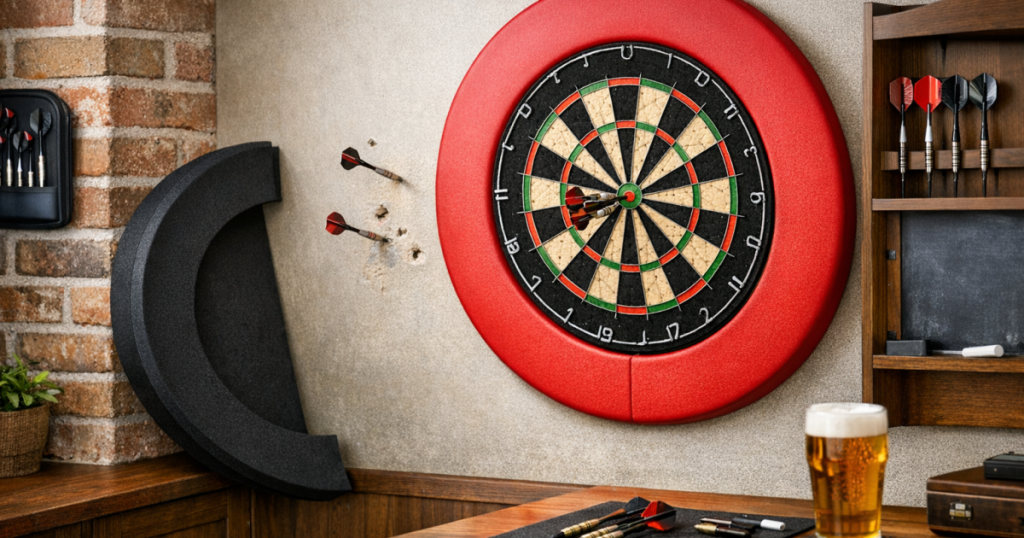
The main job is simple: create a forgiving border around the dartboard. When a dart misses the scoring area by a small amount, the point lands in the surround rather than painted plaster, wallpaper, timber panelling or a cabinet door. For home players, that is usually enough to prevent the most obvious crescent of dart marks around the board.
It is important to be realistic, though. A surround is not a full wall panel. It will not protect the skirting, ceiling, side walls or the wider wall area if the thrower is a beginner, a child, or someone throwing from an awkward angle. If you are building a more permanent setup, the surround can be one part of the protection plan rather than the whole answer.
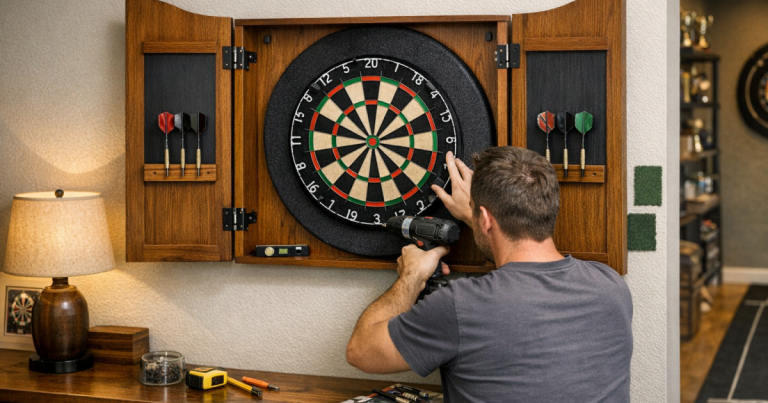
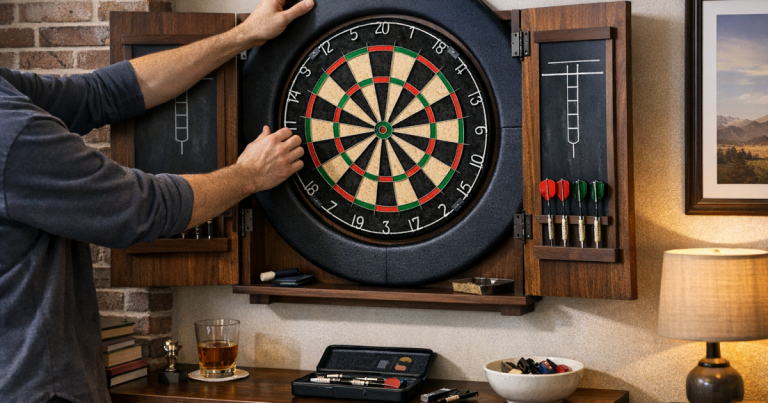
For a step-by-step look at the fitting process, including how the surround should sit around the board, see our guide on fitting a dartboard surround for better wall protection.
Fit: the details that stop it looking untidy
Most slip-on surrounds are designed for full-size bristle dartboards, but “fits a standard board” should not be treated as the only check. Boards vary slightly in outer profile, depth, wire design and how they sit on the wall bracket. A surround that looks fine in the packaging can behave differently once it is pressed around a board that stands proud of the wall.
Start by checking the board is mounted flat and stable. If the board itself rocks, the surround will never feel properly seated. Then look at the inside edge of the surround. It should touch the board all the way round, with no obvious daylight between the board and the foam. Small cosmetic compression marks are normal over time, but the surround should not bulge so much that it pushes against the scoring surface.
Depth is another practical detail. A deeper board or a board mounted on a thick backplate can leave the surround sitting forward, which may make it easier to knock when retrieving darts. A shallow setup can leave the surround closer to the wall, which often looks neater. Neither is automatically wrong, but the surround should feel stable when you gently press the top, sides and bottom.
Grip: snug is good, forced is not
Good grip comes from even pressure around the dartboard. The surround should be snug enough to stay put during normal play, but not so tight that you have to wrestle it on and off. If you need excessive force, you risk distorting the surround, scraping the edge of the board, or nudging the board out of level.
A simple test is to fit the surround, rotate the board as you normally would for wear, then refit the surround. If it only fits neatly in one orientation, there may be a slight mismatch between the board and surround. That does not always make it unusable, but it can become irritating if you rotate your board regularly.
Check the bottom edge as well. Loose surrounds often reveal themselves by sagging at the six o’clock position. This can look minor at first, but a small drop may expose a strip of wall above the board or create an uneven border that catches the eye every time you stand at the oche.
Wall protection depends on the miss pattern
The useful question is not “does it protect the wall?” but “does it protect the wall where your darts actually miss?” For a reasonably controlled adult thrower, most misses tend to land close to the outer doubles, so a surround can make a big difference. For a new player still developing a repeatable throw, the miss pattern may be wider and less predictable.
Look at your wall before you fit anything. Existing marks often tell you more than product photos. If the marks are clustered tightly around the board, a surround is likely to cover the danger zone. If they are spread well beyond the board, you may need a larger backing panel, a cabinet arrangement, or a different setup location.
Soft wall finishes also change the outcome. Painted plaster may show small punctures clearly, especially in bright rooms. Wallpaper can tear around dart holes. Exposed brick may not show marks as much, but bounce-outs and damaged dart points can become the bigger annoyance. The right protection depends on both the wall finish and the people using the board.
Where removable dartboard surrounds work especially well
Removable dartboard surrounds are particularly useful when the darts area shares a room with another purpose. In a dining room, spare bedroom or home office, the board might stay up while the protective ring comes down between sessions. That gives you some wall defence during play without committing to a cabinet or a large permanent backboard.
They also suit players who are still experimenting with the room layout. Before you decide on shelves, cabinets, lighting or a more built-in look, a removable ring lets you protect the wall while you test the sight line, oche position and available throwing space. If you are not yet sure whether the board belongs on one wall or another, avoid making the protection more permanent than the setup itself.
For tight UK homes, the biggest limitation is often space rather than the surround. Door swings, radiators, bookcases and narrow walkways can all affect whether the throw feels comfortable. Before upgrading the wall area, it is worth checking how to measure oche space before setting up a dartboard, especially if the setup is going into a multi-use room.
When a surround is not enough
A surround is not the same as a cabinet, full backboard or protective wall panel. It gives a clean border around the dartboard, but it offers no storage for flights, shafts, chalk, markers or spare darts. If your setup is always cluttered, a cabinet or small wall-mounted shelf may solve more problems than a bigger ring of foam.
It may also fall short in households with lots of casual players. Parties, family games and first-time throwers usually create more unpredictable misses than solo practice. In that situation, wider wall protection is often more sensible than relying on the surround alone. The same applies if the board is near a corner, a window reveal, a television, glass-fronted furniture or a narrow walkway.
Some players consider slimline wall protectors or sound-dampening panels instead. These can help where noise, wall marks or appearance are the main concerns, but every format has limits. Our Winmau Wispa review and alternatives guide explains why wall protection should be judged by the whole setup, not just the product sitting behind or around the board.
Checks before and after fitting
A removable surround is easy to live with when you treat it as part of the board setup, not an afterthought. These quick checks help keep it neat and effective:
- Confirm the board is secure: the board should sit flat on its bracket before the surround goes on.
- Check the inner edge: it should contact the board evenly without covering the scoring area.
- Look from the oche: stand at throw distance and check whether the surround appears level and centred.
- Test dart retrieval: pulling darts from the board should not drag the surround forward.
- Watch the lower edge: sagging at the bottom usually means the fit is not firm enough.
- Inspect the wall after a few sessions: new marks beyond the surround show whether you need wider protection.
- Remove it occasionally: dust, compression marks and hidden wall scuffs are easier to deal with early.
Care, storage and day-to-day use
Foam surrounds are low-maintenance, but they are not indestructible. Repeated dart impacts in the same area can leave visible punctures, and rough removal can stretch or tear the inner edge. Lift it off evenly rather than yanking from one side, and avoid storing it squashed behind furniture where it can deform.
If the surround is used in a garage, shed or utility space, keep an eye on damp and temperature changes. A board setup in an unheated space can feel very different through the year, and accessories may pick up dust, moisture or slight warping. The surround should still sit flat and grip properly each time it goes back on.
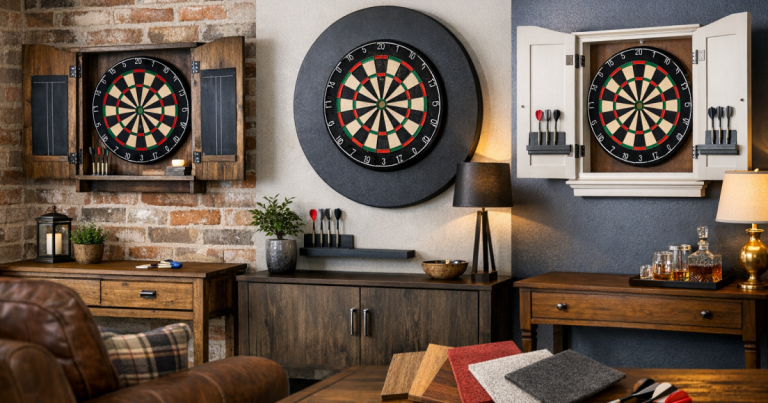
For shared rooms, appearance matters too. Dark surrounds can frame the board neatly and hide small marks, while brighter or coloured versions make the darts area more obvious. Neither choice improves your scoring, but it does affect whether the setup blends into the room or announces itself as a dedicated play area.
Common questions
Will a removable surround fit any dartboard?
Not always. It should fit most full-size bristle dartboards, but the exact board diameter, depth and wall bracket position can affect how snugly it sits. Check the fit before assuming it will work cleanly.
Can I use one with a dartboard cabinet?
Sometimes, but it depends on the cabinet opening, door clearance and how far the board sits forward. Many cabinets are designed to frame the board closely, so a separate surround may not have enough space.
Do surrounds stop bounce-outs?
No. They protect the area around the board, but bounce-outs are usually linked to dart angle, board condition, wire profile, point contact or throw consistency. A surround may catch a missed dart, but it does not fix the cause of a bounce-out.
Will it damage paint when removed?
A well-fitting slip-on surround should not need adhesive, so it is less likely to mark paint than stuck-on protection. The risk is higher if the wall is already flaky, damp or scuffed by the board moving.
Is a thicker surround always better?
Not automatically. Thickness can help absorb dart impact, but fit and coverage matter just as much. A thick surround that sags, twists or leaves gaps will be less useful than a slimmer one that sits properly.
In brief
A removable surround is one of the simplest ways to tidy up a home darts area and reduce wall damage around the board. The best results come from a snug, even fit, enough grip to stay in place, and realistic expectations about the protection zone.
If your misses are mostly close to the board, removable dartboard surrounds can be an effective, tidy solution. If marks are appearing much further out, think bigger: wider wall protection, a cabinet, a backing panel or a rethink of the throwing space may give a better long-term result.