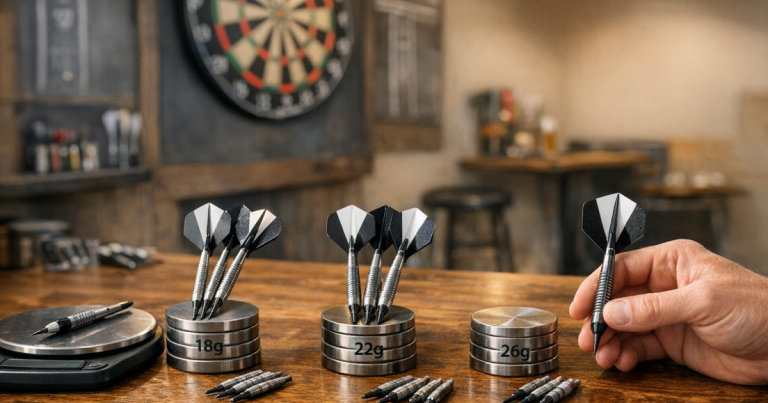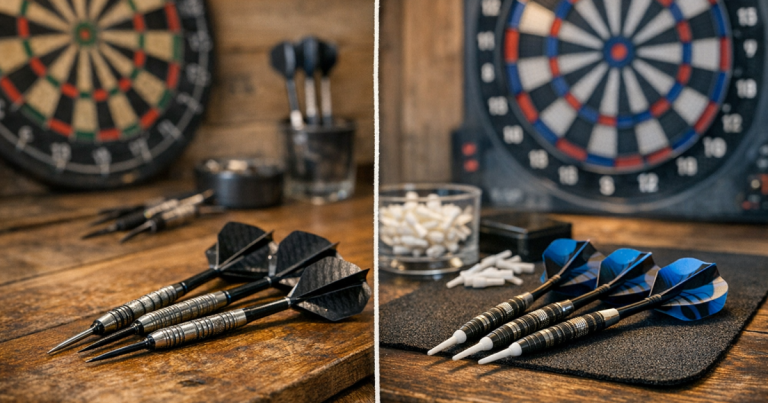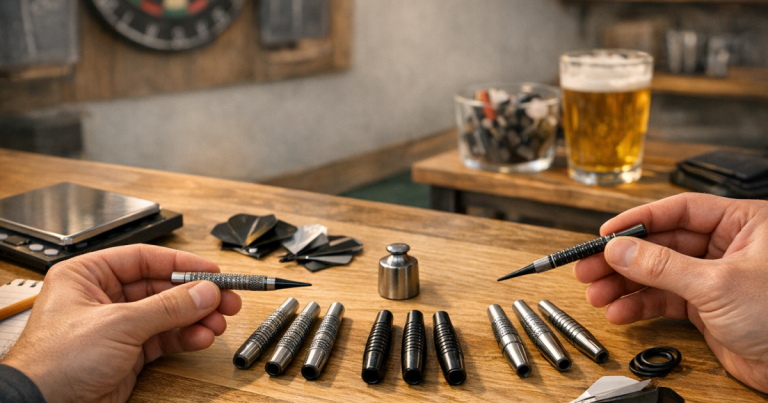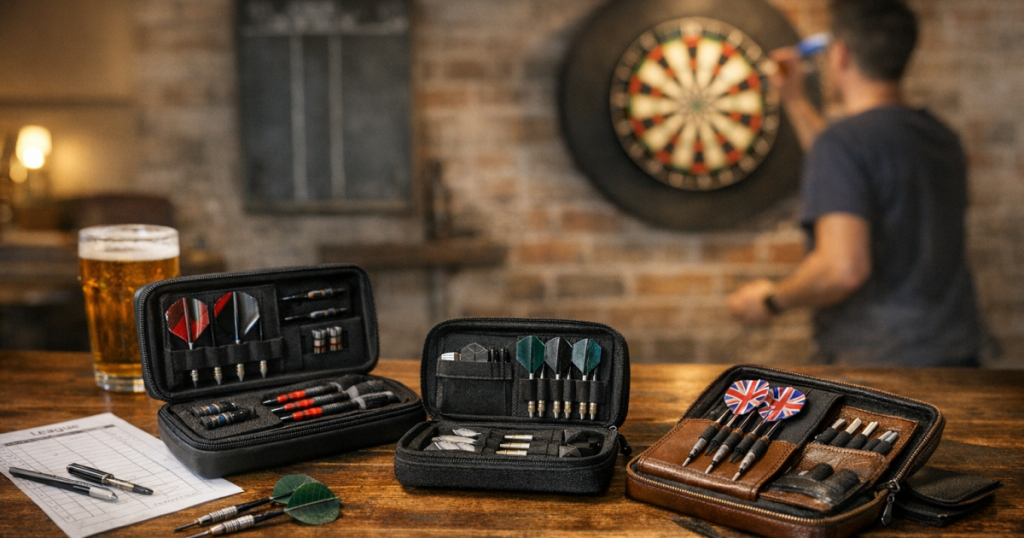
A league night case has to do more than look tidy. Choosing a dart case for league nights is about getting to the board with your darts protected, spares organised and nothing rattling around in a packed pub bag.
The right choice depends on how many assembled darts you carry, whether you swap stems and flights during matches, and how much kit you realistically need between your front door and the away venue.
At a glance
- For one set of darts: choose a compact rigid case that keeps the darts fully assembled and stops flights being crushed.
- For match spares: look for separate space for spare stems, flights, points, a small tool and a chalk or pen.
- For doubles, Super League or long evenings: a larger wallet-style case can be easier than cramming everything into pockets.
- For soft tip and steel tip players: check that the case layout suits both point styles and the accessories you actually carry.
- For travel by bus, train or walking between venues: prioritise a rigid outer shell, secure zip or closure, and a shape that slips into a rucksack without opening.
Start with how you actually play league nights
Before looking at brands, list what you take to a typical match. A casual home case can get away with holding one set of darts and a couple of flights. A league case usually needs to cope with waiting around, warm-up throws, team matches, sudden stem breakages and borrowed accessories.
Think through your routine. Do you travel straight from work? Do you keep darts in a coat pocket? Do you play on boards where bounce-outs are common? Do you lend flights to team-mates? The more moving parts your evening has, the more useful a properly organised case becomes.
A good league setup normally includes your match darts, spare flights, spare stems, a point protector or internal dart holder, a checkout card if you use one, and a small tool for tightening or adjusting parts. If your current case leaves you tipping everything onto a pub table before the pairs, it is probably too basic for the way you play.
Choose the right case style first
Compact hard cases
Compact hard cases are ideal if you want a neat, protective option for one fully assembled set. They are usually the easiest style to slip into a jacket pocket or the front section of a bag, and they reduce the chance of flights being flattened on the way to the venue.
The trade-off is storage. Some compact cases have accessory slots, but they can become tight once you add several stem lengths, multiple flight shapes and tools. If you only ever use one setup, that is fine. If you experiment mid-season, you may outgrow the space quickly.
Wallet-style cases
Wallet-style cases suit players who carry more than one setup or like everything laid out clearly. They can be especially handy on league nights because you can open the case on a table and see what you have, rather than digging through a small compartment.
Look closely at how the darts are held. Some wallets require you to remove flights, while others let you store darts assembled. Neither is automatically better; it depends on whether you prefer maximum protection for flights or quick access when called to the board.
Large team-night cases
A larger case makes sense if you carry two sets of darts, soft tip accessories, spare points, lots of flight shapes or extras for team-mates. It can also be useful if you play different formats through the week and do not want to repack every time.
The downside is bulk. A big case that feels excellent at home may become annoying when the away venue has small tables, crowded seating and nowhere safe to leave your bag. For most league players, the sweet spot is enough capacity for essentials without feeling like a tool roll.
Protection matters more than looks
Match darts get knocked about more than home darts. They sit in bags, on benches, in car footwells and on busy tables. The case should stop points from rubbing against other gear, prevent barrels from clattering together, and protect your flights from bending before you have even thrown a warm-up visit.
Check three things in particular:
- Outer structure: a case should resist light pressure from other items in a bag. Soft fabric alone may not be enough if you travel with shoes, bottles or tools.
- Internal grip: darts should stay in place when the case is turned sideways or carried upright.
- Flight space: if you store darts assembled, the case needs enough room around the flights so they are not permanently squeezed.
If you already own a case with poor internal support, custom foam can make it more usable. For a low-cost upgrade, see our guide on making foam inserts for your dart case.
Work out the capacity you really need
Capacity is not just about the number of darts. It is about keeping the right spares accessible without carrying clutter. Too little space causes frustration; too much space invites you to bring accessories you never use.
For most steel-tip league players, a sensible case should hold:
- one main set of three darts, preferably assembled if that is how you like to arrive;
- at least one spare set of flights in your usual shape;
- one or two spare sets of stems in your preferred length;
- a small dart tool or point-tightening accessory;
- a checkout card, note, or scoring pen if you rely on one;
- a small compartment for broken parts so they do not end up loose in your pocket.
If you regularly switch between slim flights, standard flights and different stem lengths, choose a layout with wider accessory sections rather than a case that only has decorative slots. If you never change setup mid-match, a smaller case may be faster and less distracting.
Check how it handles assembled darts
Many players prefer carrying darts fully assembled because it saves time and protects the setup they practised with. If that sounds like you, inspect the case shape carefully. Some cases claim to hold darts assembled, but the practical question is whether your exact barrel length, stem length and flight shape fit without bending.
Bring one dart with your normal setup when shopping in person, or check retailer photos and user images if buying online. Pay attention to tall moulded flights, wider standard flights and longer stems, as these can be the first parts to catch or compress. Do not assume a case will suit your darts just because it suits someone else’s setup.
If you use a premium or unusual setup, such as scalloped barrels, specialist stems or very grippy points, avoid loose compartments where parts can rub together. A case that separates the darts cleanly will help keep the finish and accessories in better condition over a season.
Look for league-friendly organisation
A good league case should let you find spares quickly while someone is calling your name for the next leg. Organisation is where many cheap cases fall down: they may have space, but not useful space.
Useful features to check include:
- Separate flight slots: so flights stay flat and are easy to compare.
- Stem loops or pockets: useful if you carry more than one length or material.
- A small zipped section: good for rings, springs, spare points or a compact tool.
- Clear access: you should be able to remove one item without emptying the case.
- Secure closure: a zip, clasp or wrap should stay shut when the case is dropped into a bag.
Loose points, stems and flights are easy to lose during a busy match night. If your points start moving in the barrel, sort the issue before it becomes a problem at the oche; our walkthrough on how to fix loose dart points without replacing your darts explains the checks to make.
Examples of cases worth comparing
Specific cases change over time, and small design revisions can affect storage layout, so treat named examples as starting points rather than guaranteed answers. The useful move is to compare the style, capacity and internal arrangement against your own darts.
- Target Takoma XL Darts Wallet is the sort of larger rigid wallet to consider if you want space for an assembled setup and accessories in one place. Check the internal layout against your stem and flight combination.
- Winmau Urban-Pro Darts Case is worth comparing if you prefer a familiar darts brand and want a match-night case rather than a basic sleeve. Verify how many darts and spares the version you are viewing is designed to hold.
- Harrows Blaze Pro 6 Darts Case is an example of a larger case style for players who carry more than one set or plenty of spares. Check the footprint before buying if your league venues are cramped.
Do not buy on brand name alone. A well-made case that does not fit your setup will still annoy you every week. Equally, a simple case can be perfect if it protects your darts, opens cleanly and holds the few spares you actually use.
Think about the venue, not just the case
League darts often happens in less-than-perfect conditions: small tables, busy bars, uneven seating and bags stacked under chairs. Your case should work in that environment.
If tables are tight, a case that opens flat across a large area may be awkward. If you stand while waiting, a compact case that stays in your pocket can be easier. If you travel with a team bag or rucksack, make sure the case shape does not press flights against other items.
Also consider visibility. Dark cases can disappear on dark pub seating, while bright trim or a distinctive shape makes it less likely you leave it behind after the last game. That sounds minor until you are rushing out after an away fixture.
Match your case to your scoring and match routine
The case is part of your wider match-night workflow. If you mark games, keep a pen or chalk in the same place every time. If you captain a side, leave space for notes or a small fixture card. If you play pairs regularly, keep your essentials tidy so you are not delaying your partner between turns.
For home practice before league nights, it is worth keeping your board area and match bag aligned. If you practise doubles and then play pairs, clear scoring habits help you arrive more settled. Our guide to scoring doubles matches clearly on a darts scoreboard is a useful companion if your team rotates markers.
Durability checks before you buy
Pictures can make almost any case look smart. The details that matter are the parts that get used every week. If you are buying in a shop, handle the case properly. If you are buying online, look for close-up images and recent reviews that mention the zip, stitching, clasp or internal holders.
- Zip movement: it should run smoothly around corners without catching.
- Stitching and seams: check stress points around handles, loops and fold lines.
- Internal elastic: it should hold darts firmly without feeling flimsy or overstretched.
- Hinge or fold area: wallet cases should open repeatedly without twisting.
- Odour and lining: cheap linings can feel rough or mark accessories, so inspect the finish if possible.
Durability is not only about surviving years of use. A case that feels dependable makes your routine calmer. You can pack once, zip it shut and know your match kit is ready.
Set a sensible budget
You do not need the most expensive case in the cabinet for league darts. Spend where it improves protection, layout and reliability. Decorative finishes, player branding and oversized storage can be nice, but they are secondary to whether the case protects your darts and makes match night easier.
If you are choosing between a cheaper case with poor organisation and a slightly dearer case with a stronger shell and better accessory layout, the better-designed option is usually the smarter buy. Broken stems, crushed flights and lost tools become irritating over a season, even when each individual part is inexpensive.
Questions people ask
Should I carry one set of darts or two for league nights?
Most players only need one trusted match set plus spares. Carry a second set if you genuinely use it for a different format or as a reliable backup, not just because the case has room.
Is a hard case better than a soft wallet?
A hard case usually gives better crush protection, while a wallet can offer easier organisation. Choose based on how you travel and how many accessories you need to access during the evening.
Can I leave my flights on in the case?
Yes, if the case is designed for assembled darts and your flight shape fits without bending. If the flights are squeezed, remove them or choose a deeper case.
What should I keep in the small accessory pocket?
Use it for the parts you might need mid-match: spare stem rings, a compact tool, spare points if you use them, and a few small accessories. Avoid filling it with old broken bits.
Do I need a large case for pub league darts?
Not always. A compact case is enough for many players. Go larger only if you carry two sets, several stem and flight options, or team-night extras you use regularly.
What stands out
The best league case is the one that protects your darts, fits your match routine and stays easy to use in a busy venue. Start with your actual kit list, decide whether you need assembled-dart storage, then compare case styles by layout rather than looks alone.
If you can open the case, pick out the right spare quickly, close it securely and drop it into your bag without worrying about crushed flights, you have probably found the right option for league nights.