When stray darts are chipping paint around the board, choosing between Harrows and Red Dragon surrounds is really about fit, coverage and how confidently the foam catches a miss. Both brands make familiar home-darts accessories, and either can protect a typical wall far better than leaving bare plaster, wallpaper or painted plasterboard exposed.
The short answer: neither brand wins purely because of the name on the surround. The better wall protector is the one that sits tightly around your board, covers the miss zone your throw actually creates, and uses foam firm enough to grip points without tearing too easily. For many home players, a standard full surround from either brand is enough. If your misses are wide, low or frequent, the surround alone may not be the whole solution.
The short answer for wall protection
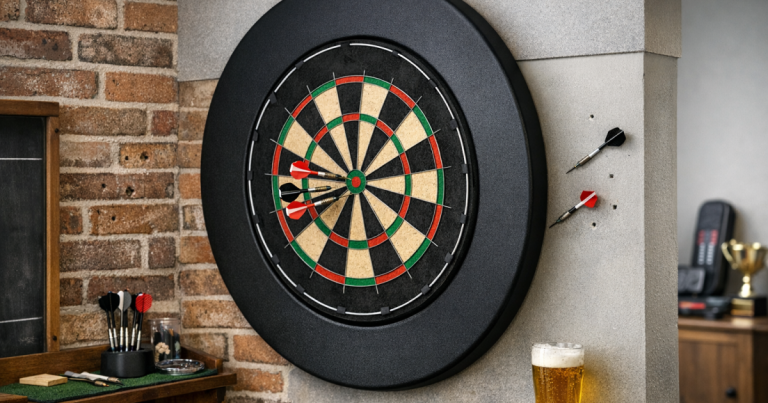
A dartboard surround protects the wall immediately around the outside of the board. It is most useful for near misses: darts that clip past the double ring, land just outside the board, or drift into the wall during practice. In that job, a well-fitted Harrows or Red Dragon surround should do broadly the same thing: absorb the dart point before it reaches the wall.
The difference comes down to the individual surround currently being sold, not just the badge. Check three things before deciding: how wide the protective ring is, how snugly it fits your dartboard, and whether the foam feels dense enough to take repeated impacts. If two surrounds are similar on those points, wall protection will also be similar.
Where one can beat the other is in practical fit. A surround that gaps around the board, slips when darts are removed, or leaves a visible strip of wall near the outer edge is less protective, even if the material itself is decent. If you already have a cabinet, light ring, scoreboard position or tight alcove, physical clearance can matter as much as the surround brand.
How dartboard surrounds actually protect the wall
A surround is a sacrificial protective ring. Instead of the dart point hitting paint, plaster or wallpaper, it hits foam. The foam slows and holds the dart, reducing visible chips and pin marks around the board. It also gives the setup a cleaner, more finished look, which is useful in a living room, spare room or shared home office where the board is not hidden away.
Surrounds are not magic shields. They do not protect the whole throwing lane, skirting boards, floor, nearby furniture or a wall far outside the ring. They also will not correct a badly positioned board or an oche that is too close. If your setup is still being planned, it is worth checking the wider advice on protecting floors and walls around a dartboard before relying on a surround alone.
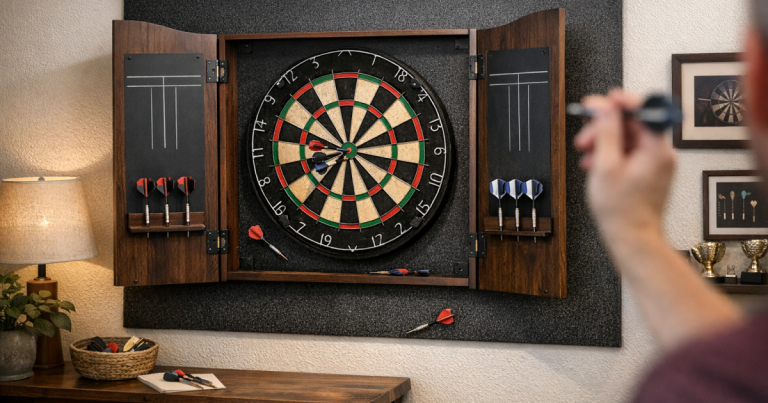
For most home throwers, the main miss area is a halo around the doubles. That is exactly where a surround helps. For beginners, children under close supervision, or anyone practising new grip and release changes, misses can land wider. In those cases, consider a larger backing panel behind the board, with the surround fitted over the top for a neater central finish.
Harrows surrounds: where they tend to make sense
A Harrows Dartboard Surround is a straightforward option if you want a familiar darts brand and a clean, traditional surround around a bristle dartboard. Harrows has long been associated with darts gear, so many players naturally look at its accessories when finishing a home setup.
The main reason to choose a Harrows surround is not that it is automatically stronger than every alternative. It is that, if the current version fits your board neatly and gives enough coverage for your room, it does the job without adding complexity. It can work well in compact setups where you want a simple ring rather than a full cabinet or large backboard.
Before settling on one, verify the current listing rather than assuming all versions are identical. Look at the stated compatibility, colour, depth, whether it is one-piece or sectional, and how it is designed to sit around the board. If you use a light ring or cabinet doors, check that the surround will not push anything out of alignment or stop doors closing properly.
Red Dragon surrounds: where they tend to make sense
A Red Dragon Dartboard Surround is another common choice for home boards, particularly for players who already use Red Dragon darts or boards and like keeping the setup visually consistent. As with Harrows, the protective performance depends on the specific surround in front of you: coverage, foam quality and fit matter most.
Red Dragon can be a strong choice where the current surround option matches your space neatly and gives the look you want around the board. In a multipurpose room, colour and finish are not just cosmetic. A surround that blends with the wall, board and lighting is more likely to stay up permanently rather than being treated as a temporary practice accessory.
As with any surround, check that it grips the board edge securely and sits flat to the wall once the board is in place. A surround that bows out, rotates too easily or needs constant adjustment can become annoying during regular play. Protection is partly about consistency: it needs to be exactly where the missed dart lands every time.
What decides which one protects better?
If you are choosing between the two, use the same checks you would use for any protective surround. These are more reliable than assuming one brand has better wall protection across every model or colour.
1. Coverage around the doubles
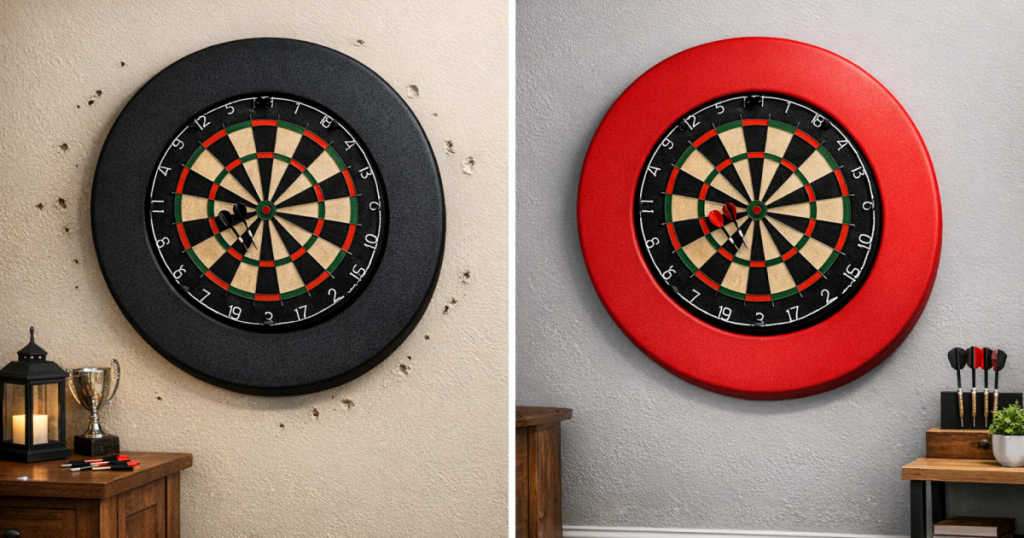
The surround should cover the area just outside the dartboard where most near misses land. Stand at your oche and look at your typical miss pattern. If most darts land within a hand’s width of the board, a normal surround is likely to help. If you see marks much further out, you need a larger backing area rather than simply a different brand of surround.
2. Fit around your exact board
A snug fit matters because gaps expose the wall. Most home players use a standard bristle board, but you should still check the surround’s compatibility and how it seats around the outer edge. If the board sits proud of the wall, is in a cabinet, or uses a particular mounting system, confirm there is enough clearance before assuming the surround will sit properly.
3. Foam density and recovery
Good surround foam needs to be soft enough for dart points to enter, but firm enough not to crumble quickly. It should hold the dart without the point punching straight through to the wall. Because listings do not always describe foam feel in a way that is easy to compare, look for close-up photos, current owner comments and signs that the surface recovers cleanly after use.
4. Depth against the wall
Depth is easy to overlook. A thin surround may still stop light misses, but a deeper, denser foam profile can feel more reassuring with steel-tip darts. Do not assume deeper always means better, though: the surround still has to sit neatly with your board, light and any cabinet or scoreboard nearby.
5. Room layout and player level
A surround fitted in a garage practice space has a different job from one in a rented flat living room. In a rougher practice area, appearance may matter less and wider backing may matter more. In a decorated room, the surround needs to protect the wall while looking tidy enough to leave in place.
Home setup examples
For a steady player in a spare room, either brand can be enough if the misses are usually close to the wire. A plain foam surround, fitted tightly around a standard board, will catch the small drifts that would otherwise leave a crescent of marks around the doubles.
For a newer player in a rented flat, the question is less Harrows versus Red Dragon and more whether a surround alone gives enough peace of mind. If the wall is painted plasterboard and deposits are at stake, a larger removable backing panel behind the board can reduce risk. The surround can then tidy up the centre and catch the most common misses.
For a family setup, think about where the widest misses land. A surround is helpful, but it is not a substitute for sensible storage, supervision and a clear throwing area. If younger players are learning, a larger protected zone and a consistent oche line will usually matter more than small differences between branded foam rings.
For terraced houses, flats and shared walls, protection is only one part of the setup. Darts hitting a board and wall can still transmit sound, so it is worth reading the advice on choosing a quieter dartboard for shared walls if noise is part of the problem you are trying to solve.
Simple checks before fitting either surround
- Check your miss marks first: if the marks are just outside the board, a surround is a sensible fix; if they spread widely, add a larger backing board.
- Measure the available wall space: allow room around the board for the surround, lighting and any scoreboard or cabinet.
- Confirm board compatibility: do not rely on brand matching alone; check the current surround description against your board type.
- Look at the mounting area: the board should sit securely and the surround should not be used to hide a loose or uneven board setup.
- Test lighting angles: a surround can cast a slight edge shadow if lighting is tight or badly placed, so check visibility from the oche.
- Remove darts carefully: twist and pull gently rather than yanking, which can tear foam and shorten the surround’s useful life.
If you want a useful benchmark from another familiar accessory, the Target Pro Tour Dartboard Surround review shows the sort of practical details worth checking on any surround: fit, finish, coverage and how it behaves in a real home setup.
Which should you choose?
Choose Harrows if the current Harrows option fits your board and room neatly, gives the colour or finish you prefer, and offers the coverage your miss pattern needs. It is a sensible route for a clean, simple home setup where the surround is there to stop normal near misses rather than cover a large practice wall.
Choose Red Dragon on the same logic: if the current Red Dragon surround fits well, looks right in your room and gives adequate coverage, it should protect the wall effectively. Brand loyalty is fine, especially if your board and accessories already match, but it should not outrank fit and coverage.
If your priority is maximum wall protection, neither surround should be judged in isolation. A standard foam ring is best treated as the first layer. For wider misses, add a backing panel, cabinet or larger protected surface behind it. That combination will usually protect a home wall better than switching between two similar foam surrounds.
Things readers ask
Will a dartboard surround stop all wall marks?
No. It protects the area immediately around the board, which is where many near misses land. Wide misses, low darts and bounce-outs can still mark the wall, floor or nearby furniture.
Do Harrows and Red Dragon surrounds fit every dartboard?
Do not assume that. Many surrounds are intended for standard bristle boards, but you should check the current product details, your board type and any cabinet or lighting clearance.
Is a surround enough for a rented home?
It may be enough for accurate players with close misses, but rented homes often benefit from a larger removable backing board as well. That gives more protection without relying on the foam ring alone.
Can I use a surround with a dartboard cabinet?
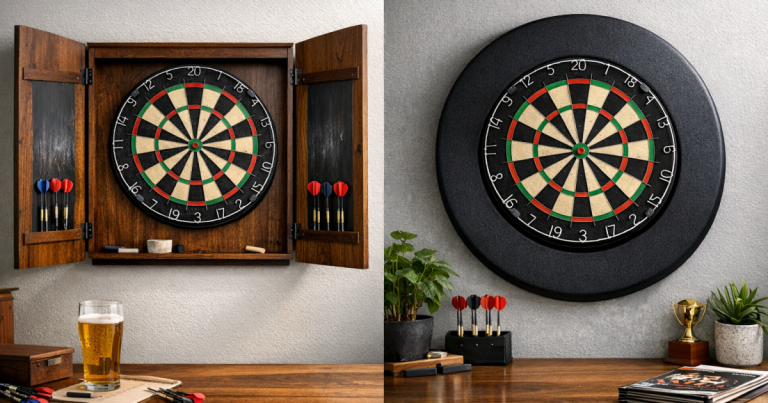
Sometimes, but clearance is the issue. Check whether the cabinet doors can still open and close, and whether the board sits far enough forward for the surround to fit flat.
Which is better for beginners?
For beginners, the better choice is the setup with the larger protected area. Harrows and Red Dragon surrounds can both help, but a backing panel behind the board is often the more important upgrade.
Final thoughts
Harrows and Red Dragon surrounds are both credible choices for protecting the wall around a home dartboard. The better option is the one that fits tightly, covers your real miss zone and works with the rest of your setup. If your darts usually miss close to the board, either brand can be a tidy, effective upgrade. If your wall already has marks well beyond the surround area, think bigger than the brand and protect more of the wall.