Shared walls make every heavy thud feel louder than it really is, especially in flats, terraces and semi-detached homes. The best quieter dartboard choice is usually a good-quality bristle board paired with an isolated mount or backing, not a thin budget board screwed straight to plasterboard. Think of noise control as a small system: the board, what sits behind it, how it is fixed, where it is placed, and the darts you throw all affect how much sound travels next door.
What to know first
If you want to reduce dartboard noise on a shared wall, prioritise three things: a dense sisal bristle board, a mount that does not transfer every impact straight into the wall, and a location that avoids hollow or lightweight surfaces. The board matters, but the wall and fixing method often matter just as much.
A cheap board can sound sharp and papery, while a firmer bristle board usually gives a more muted impact. However, even a premium board can still thump through a party wall if it is fixed tightly to a resonant surface. For most home players, the biggest improvement comes from avoiding direct wall transmission rather than chasing a board that is advertised as silent.
- Best starting point: choose a quality bristle board rather than a paper-wound, magnetic or very lightweight board.
- Best wall fix: use a solid backer or isolation layer between the board and wall, fitted securely and level.
- Best alternative: use a freestanding dartboard stand if the shared wall is thin, hollow or unsuitable for drilling.
- Best expectation: aim for noticeably reduced impact noise, not complete soundproofing.
Where dartboard noise actually comes from
Dartboard noise is not just the sound of a dart hitting sisal. There are usually four separate noises happening at once. First, there is the direct impact of the point entering the board. Second, there is vibration through the board and its mounting bracket. Third, there is resonance in the wall behind it. Fourth, there is general room noise from foot movement, bounce-outs, scoring and conversation.
Shared walls make the mounting noise more noticeable because the structure carries low, dull impact sounds. A board on a plasterboard wall with an empty cavity behind it can seem far louder next door than the same board on a solid internal wall. That is why buying a different board can help, but only if the rest of the set-up is not working against you.
Misses also add noise. A dart hitting bare plaster, skirting, a door frame or laminate flooring can be sharper and more annoying than a normal board hit. If your current area is noisy because of stray darts, the solution may be wall and floor protection rather than a different board. The guide to how to protect floors and walls around a dartboard is a useful next step if bounce-outs and missed doubles are part of the problem.
Choose the right board type
For steel-tip darts at home, a traditional sisal bristle dartboard is usually the best route. It is designed to accept metal points cleanly, self-heal reasonably well, and handle regular practice. Very cheap paper or coiled boards can be louder in a thin, sharp way and may wear quickly. Magnetic boards are quieter in one sense, but they are not a realistic substitute for proper steel-tip practice.
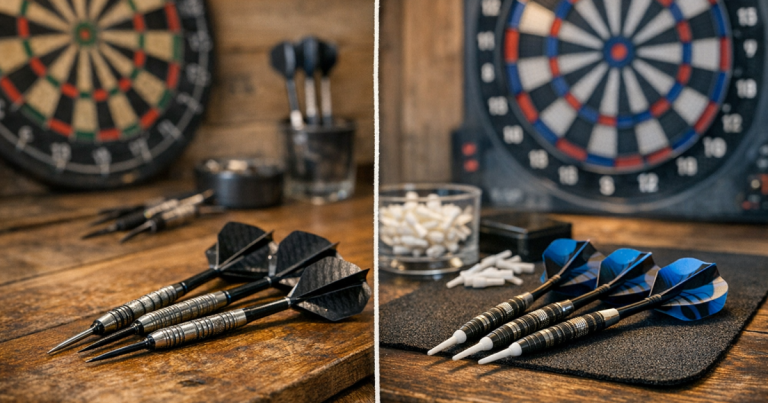
Electronic soft-tip boards are sometimes assumed to be neighbour-friendly, but they can produce a plastic clicking sound and may still be irritating in a quiet flat. They also change the feel of practice. If your aim is proper home darts with steel tips, focus on a good bristle board and improve the mounting.
When comparing real boards, look for reputable bristle models and pay attention to owner comments about feel, firmness and how the board behaves after regular use. Examples worth comparing include Winmau Blade 6 Triple Core, Target Aspar Dartboard and Unicorn Eclipse Ultra Dartboard. Treat those as comparison points rather than guaranteed quiet options, because the wall and backer can change the result dramatically.
Mounting makes the biggest difference
A dartboard fitted directly to a shared wall can act like a small drum. Every dart impact travels from the board, into the bracket, into the screw points, and then into the wall. If the wall is lightweight, the sound can travel further than expected.
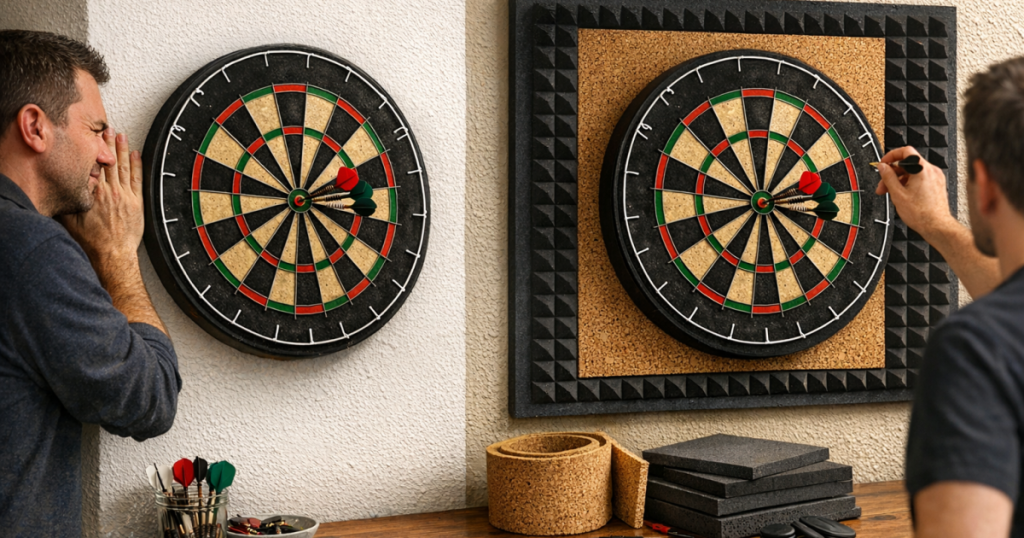
A better approach is to create a more stable, damped layer behind the board. A timber backboard, dartboard cabinet, acoustic-style backing panel or dense protective board can help spread the impact over a larger area. The key is to avoid a flimsy panel that rattles. Anything loose will add noise rather than reduce it.
Do not assume softer always means quieter. A thin foam tile behind a board may compress unevenly, make the board wobble, or allow the bracket to move. The board still needs to sit flat and secure, with the correct height and oche distance. If the backing changes the board depth, re-check your throw line after fitting it.
Simple mounting checks before you buy
- Tap the wall: a hollow sound usually means more resonance than a dense wall.
- Check the fixing points: loose screws, rattly cabinets and flexible panels all create extra noise.
- Look for wobble: a board that moves when darts land will sound worse and feel worse.
- Keep it level: a stable board rotates more predictably and is easier to maintain.
- Think about reversibility: renters should avoid solutions that leave obvious wall damage or breach tenancy terms.
When a stand is the better answer
If the board has to go on a thin party wall, a stand may be the simplest way to keep practice civil. A freestanding stand moves the impact path away from the shared wall, so the thud is less likely to travel directly into your neighbour’s room. It is not silent, and it still needs enough floor space, but it can solve a problem that a better wall bracket cannot.
Stands are especially useful in rented flats, garages, spare rooms and multi-use spaces where permanent fixings are awkward. They also let you test different positions before committing to a wall-mounted set-up. The trade-off is that you need a stable stand, a safe throw area and enough clearance around the board. For rental-friendly planning, see the guide to choosing a dartboard stand for rented homes.
Add a surround or cabinet for missed darts
A surround will not make the board itself silent, but it can reduce the sharper sounds caused by missed darts hitting the wall. It also protects plaster, wallpaper and paintwork, which matters if the board is in a living room, hallway or shared spare room.
Most players choose between a foam surround and a cabinet. A foam surround is simple, light and easy to remove. A cabinet looks tidier and gives you somewhere to keep chalk, flights or a scoreboard, but doors and hinges can rattle if they are not well fitted. If your main concern is neighbour noise, avoid anything that buzzes, flexes or knocks when the dart lands.
Fit matters. A loose surround can shift around the board and make the whole area feel unfinished. A snug surround that sits flat against the wall or backing panel is usually a better bet. For a closer look at coverage and wall protection, the Winmau dartboard surround review explains what to check before buying one.
Room placement checks for UK homes
Before replacing your current board, test whether a different position would help. In many UK homes, the best darts wall is not the most convenient wall. A board on a wall adjoining a hallway, cupboard, garage or external wall may cause fewer complaints than one fixed directly to a neighbour’s bedroom or lounge wall.
Use a few trial taps and a short throwing session at normal practice times. Stand in the next room if you can, or ask someone else to throw while you listen. You are checking for thud, vibration and rattles, not just volume. A dull knock through the structure is often more annoying than the small impact sound you hear in the room.
Also check what is underfoot. Hard floors can make dropped darts, bounce-outs and footsteps sound louder. A dart mat or rug will not soundproof the wall, but it can soften the general noise of practice and help define the oche area.
Practical buying checklist
Use this checklist when choosing a board and accessories for a shared-wall set-up:
- Board material: choose a proper sisal bristle board for steel-tip practice.
- Build feel: avoid very lightweight boards that flex, rattle or feel papery.
- Mounting plan: budget for a backer, cabinet, surround or stand rather than spending everything on the board alone.
- Wall type: treat hollow plasterboard and party walls as higher-risk for transmitted sound.
- Miss protection: add a surround if stray darts are hitting the wall.
- Rental limits: check your tenancy agreement before drilling, and favour removable options where needed.
- Practice timing: even a well-damped set-up can be intrusive late at night in a flat.
- Dart condition: damaged points can hit harder, bounce out more and mark the board unnecessarily.
Common questions
Is a more expensive dartboard always quieter?
No. A better bristle board can feel more solid and less harsh than a very cheap board, but the mounting surface often has a bigger effect on neighbour noise than the board price.
Can I soundproof a dartboard on a shared wall?
You can reduce impact noise, but full soundproofing is unrealistic with a simple home darts set-up. Focus on isolation, a stable backing panel, fewer missed-dart impacts and sensible practice times.
Are dartboard cabinets good for noise?
They can help with wall protection and tidy storage, but a loose or thin cabinet may rattle. Choose one that sits firmly and check that doors, hinges and fixings do not vibrate during play.
Should I use lighter darts to reduce noise?
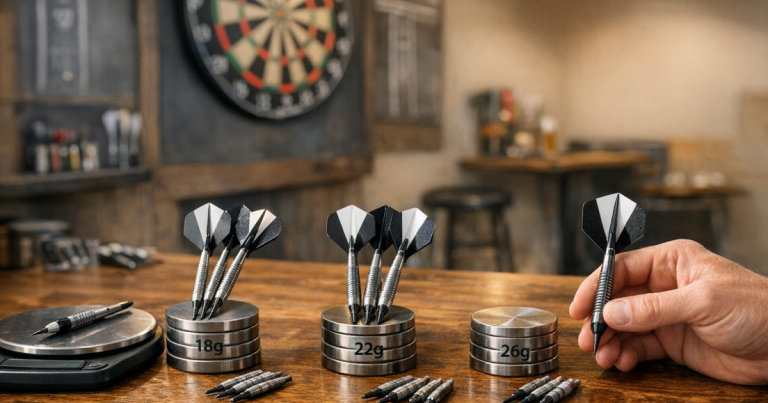
Lighter darts may slightly change the impact feel, but they are not a complete fix. Use darts that suit your throw, keep points in good condition, and solve noise mainly through board choice and mounting.
What is the best option for a rented flat?
A freestanding stand or a carefully planned removable set-up is usually safer than drilling into a shared wall. Check stability, floor protection and your available throwing space before buying.
Main lessons
The quietest home set-ups are built as a complete system. Start with a good bristle board, avoid direct fixing into a resonant shared wall, add a firm backing or stand where needed, and control the noise from missed darts. A quieter dartboard helps, but a well-planned set-up helps more.
If you are upgrading one part at a time, begin with the noisiest link. For some players that will be a flimsy board. For others it will be a hollow wall, rattly cabinet, bare floor or poor location. Fix that first and your home practice area will feel better for you and more considerate for everyone nearby.