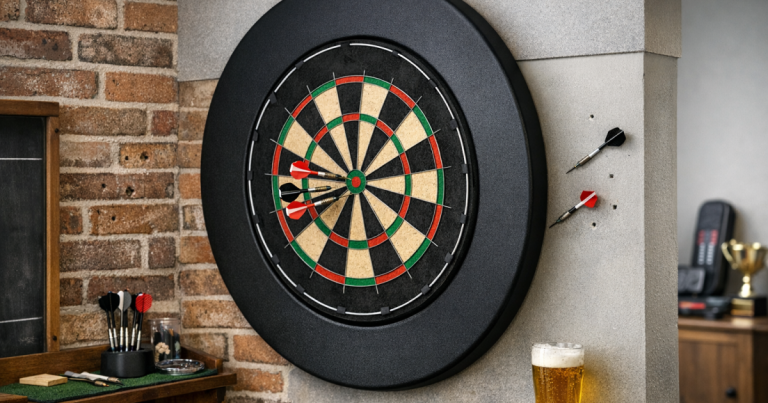
For anyone mounting a home board on plasterboard, this Winmau Pro-Line Dartboard Surround review asks the only question that really matters: will it protect the wall well enough when darts miss?
Short answer: it is a smart, tidy and useful first layer of protection around a standard bristle dartboard, but it is not a complete plasterboard defence system. If your misses tend to land close to the board, it can make a big difference. If the wall is soft, newly skimmed, rented, or used by beginners with a wide spread, you should think beyond the surround alone.
Drilling, fixing or reinforcing a dartboard position on plasterboard where concealed wiring, pipework or wall integrity may be affected should be carried out by a qualified professional to meet UK safety requirements and relevant building standards.
The big picture
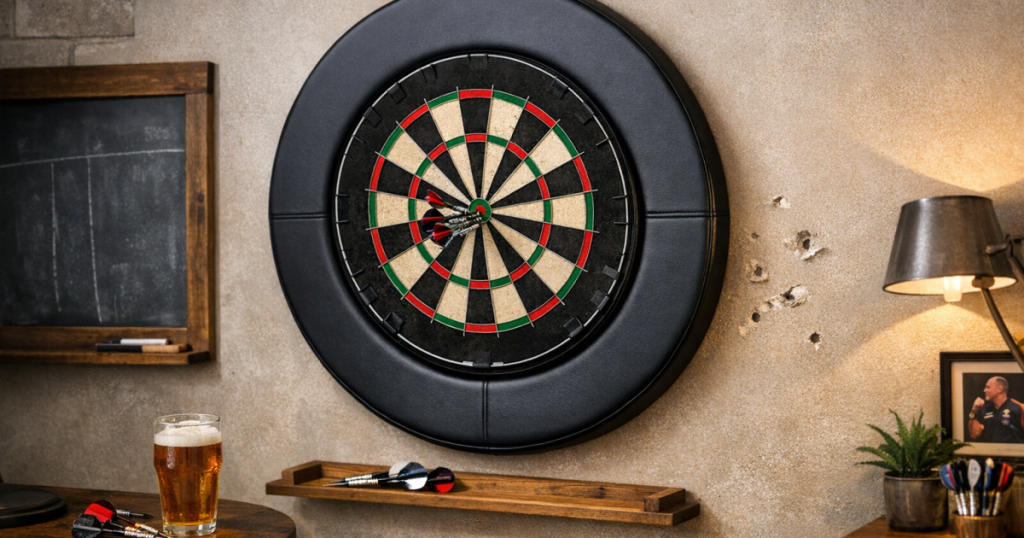
The Winmau Pro-Line Dartboard Surround is aimed at a common home darts problem: the wall damage that happens just outside the scoring area. On painted plasterboard, even a few stray steel-tip darts can leave obvious pinholes, chips and grey marks. A surround gives you a protective ring around the board without making the setup look like a workshop wall.
Its biggest strength is convenience. A typical foam-style surround fits around the dartboard rather than replacing the board mount, so it is far less involved than building a large backing panel. That makes it appealing for spare rooms, garages, home offices and living spaces where the darts area needs to look presentable between sessions.
The limitation is just as important: a surround only protects the area it covers. Plasterboard does not forgive wild misses, and darts that land above, below or well to the side can still mark the wall. Before thinking about wall protection, it is also worth checking whether the throw area itself is sensible; our guide to checking throwing clearance before installing a dartboard is a useful first step if you are setting up a new position.
What the Winmau Pro-Line does well
The main appeal is that it gives the dartboard a clean, finished edge while absorbing the sort of near-miss darts most home players throw from time to time. Around the outer doubles, the wire edge and the top of the board, a surround can prevent the little marks that quickly make a fresh wall look tired.
It also avoids one of the common downsides of bulkier wall protection: visual clutter. A large plywood or MDF backing panel can be very effective, but it changes the feel of the room. The Pro-Line approach is more compact and tends to suit domestic spaces better, particularly if your board is in a multi-use room rather than a dedicated darts area.
Another benefit is flexibility. If you rotate or replace your dartboard, the surround can normally stay part of the same setup, provided the board size and fit remain compatible. For example, players using a tournament-style bristle board such as the Winmau Blade 6 Triple Core should still check fit carefully, but this type of pairing is exactly the sort of home setup a neat surround is designed to complement.
Where plasterboard changes the judgement
Plasterboard walls are not all the same. Some are skimmed and painted, some sit on timber studs, some are dot-and-dabbed over masonry, and some are part of a rented flat where even small marks can become a deposit conversation. That matters because a surround protects the surface from dart impacts, but it does not solve every wall-related issue.
There are three separate jobs to think about:
- Impact protection: stopping stray darts from puncturing or chipping the visible wall surface.
- Board support: making sure the dartboard mount is fixed securely and does not loosen with use.
- Room protection: covering the wider miss zone, floor edge and nearby furniture if the thrower spread is wider than the surround.
The Winmau surround helps mainly with the first job. It does not turn a weak fixing into a secure one, and it does not protect the whole wall. If your board is mounted directly to plasterboard with inadequate fixings, the more urgent issue is the board mount rather than the ring around it.
Fit, feel and day-to-day use
A good surround should feel like part of the dartboard rather than a separate piece that gets in the way. The Pro-Line’s appeal is that it is designed for a clean board-framing look, so the setup feels more deliberate than sticking random foam tiles around the wall.
When fitting any surround, check three things before judging it:
- How firmly it grips the board: it should sit snugly without sagging or needing awkward adjustment during play.
- Whether the board remains level: a surround should not pull the dartboard off-centre or interfere with rotation.
- Whether it covers your real miss pattern: watch where darts actually land over several sessions, not where you hope they land.
The last point is often overlooked. Experienced players may only need protection close to the scoring area. Newer players, children under supervision, or guests at a social setup may miss much wider. In that situation, the Pro-Line still helps, but it may not be the only protection you need.
How it compares with cabinets and larger backing panels
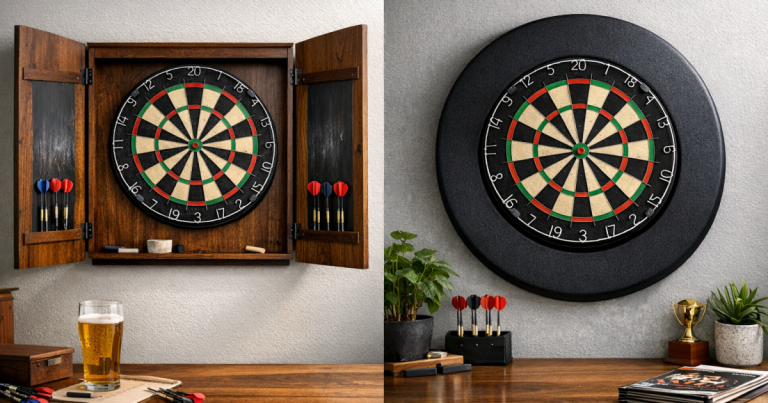
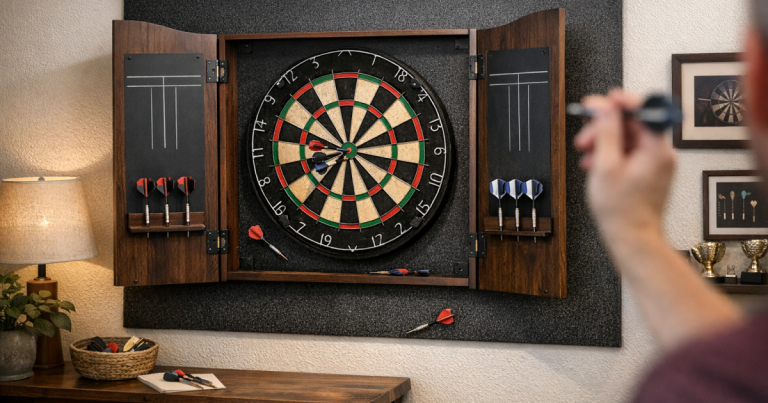
A dartboard cabinet gives a different type of protection. It covers the wall behind the board and adds doors that can hide the board when not in use, but it does not always protect as much side area during play as a large backing solution. A surround is simpler and more open, but it provides no storage for chalk, flights, shafts or a marker.
If your priority is a tidy living-room look, the choice often comes down to whether you want the board visible. A surround frames the board and keeps the setup ready to play. A cabinet makes the area look more like furniture when closed. For a deeper breakdown of storage, style and protection trade-offs, see our guide to dartboard cabinets vs surrounds.
Larger backing panels are the practical heavyweight option. A full panel behind the board can protect a much wider area than any ring-style surround, which is useful on plasterboard walls in family homes or shared spaces. The trade-off is appearance, fixing method and the extra planning needed to make it look intentional rather than temporary.
Best use cases
The Winmau Pro-Line makes most sense when the dartboard position is already sensible and the main problem is occasional near-miss damage. It is particularly well suited to players who want a cleaner-looking home setup without turning the whole wall into a padded practice bay.
It suits:
- Home players using a standard bristle dartboard who want neat, close-range wall protection.
- Setups where most missed darts land just outside the doubles.
- Rooms where appearance matters, such as a home office, games room or spare room.
- Players who want a simple upgrade without building a custom backing board.
It is less suitable on its own for:
- Beginners with a wide miss pattern around the board.
- Rented rooms where any wall damage could be an issue.
- Very soft, fragile or freshly finished plasterboard walls.
- Hallways or narrow spaces where people, doors or furniture sit near the throw line.
That last point is not just about wall marks. A darts setup needs a safe throwing lane and enough room around the player. If your only available wall is in a narrow route through the home, read our advice on deciding whether a hallway is safe for darts before relying on wall protection alone.
What to check before using it on plasterboard
Before fitting the surround, look at the whole setup rather than the product in isolation. Plasterboard protection works best when the board, wall and playing area are treated as one system.
- Check the dartboard fixing: the board must be securely mounted before the surround is added. The surround should not be compensating for a loose or poorly supported board.
- Inspect the wall finish: matt paint, fresh plaster and thin skim coats can show marks quickly, even outside the protected area.
- Map your miss zone: after a few sessions, note whether darts land mainly around the board or across a wider section of wall.
- Think about the floor edge: darts that fall or bounce out can mark skirting, laminate or carpet thresholds, so wall protection is only part of the room plan.
- Check board rotation access: a good setup should still let you rotate the bristle board as part of routine care.
If the wall is particularly vulnerable, a surround plus a wider backing board can be a stronger answer than either one alone. The surround keeps the board area looking polished, while the backing material catches the darts that miss by a larger margin.
Pros and drawbacks
The strengths are straightforward: it is neat, purpose-made, relatively unobtrusive and useful against common near misses. It is a cleaner solution than improvised offcuts, and it can make a home board look more finished almost immediately.
The drawbacks are mainly about coverage. A ring surround cannot protect the wider wall, the board fixing, the floor or nearby furniture. It also offers no built-in storage, scoring surface or door cover. If you want those things, a cabinet or a more complete wall panel setup may make more sense.
There is also a behavioural point: wall protection can make players more relaxed, but it should not make the setup careless. Darts are still steel-tip objects, and a protected wall does not make a cramped room safe.
Alternatives worth considering
If the Pro-Line is not enough for your wall, the alternatives are not complicated, but they each solve a slightly different problem.
- Dartboard cabinet: better for hiding the board and storing small accessories, but side protection varies by design.
- Large backing board: stronger coverage for plasterboard, especially for beginners or family use, but more visible and more involved to fit well.
- Rubber or foam wall tiles: useful for wider protection zones, though they can look more utilitarian unless carefully arranged.
- Freestanding stand: avoids fixing the board to the wall, but still needs safe space behind and around the target area.
For a permanent-looking home setup, many players end up combining methods: a secure board mount, a neat surround and a wider decorative backing area where the room demands it. That layered approach is often the most sensible answer for plasterboard.
Winmau Pro-Line Dartboard Surround review verdict
The Winmau Pro-Line is a strong choice if your main concern is protecting the wall immediately around the dartboard while keeping the setup smart. It is not a miracle shield for plasterboard, but it is one of the most straightforward ways to reduce visible damage from ordinary near misses.
For competent throwers, it may be enough on its own, assuming the board is securely fixed and the surrounding room is safe. For beginners, rented homes or delicate plasterboard finishes, treat it as the first layer rather than the whole answer. Add wider protection if your real miss pattern proves you need it.
Best for plasterboard walls? Yes, with conditions. It is best when the wall is already suitable for a darts setup, the board is properly mounted, and the likely misses are close to the target. If you need protection beyond that ring, go wider rather than expecting any surround to do a job it was not designed to do.
Helpful questions
Will the Winmau Pro-Line stop all dart holes in plasterboard?
No. It protects the area it covers around the dartboard. Darts that miss outside the surround can still puncture or mark plasterboard.
Can I use it instead of a backing board?
Yes, if your missed darts usually land close to the board. If beginners or guests are playing, a wider backing board gives more forgiving coverage.
Does a surround help with bounce-outs?
Not directly. A surround catches some missed or deflected darts, but bounce-outs are more closely linked to board condition, dart angle and wire impact.
Is it suitable for a rented flat?
It can reduce visible damage, but it does not remove the risk. In rented accommodation, wider wall protection and a secure, approved mounting approach are safer choices.
Should I still rotate my dartboard with a surround fitted?
Yes. Board rotation is still important for bristle wear. Make sure the surround can be removed or adjusted easily enough to keep rotation practical.