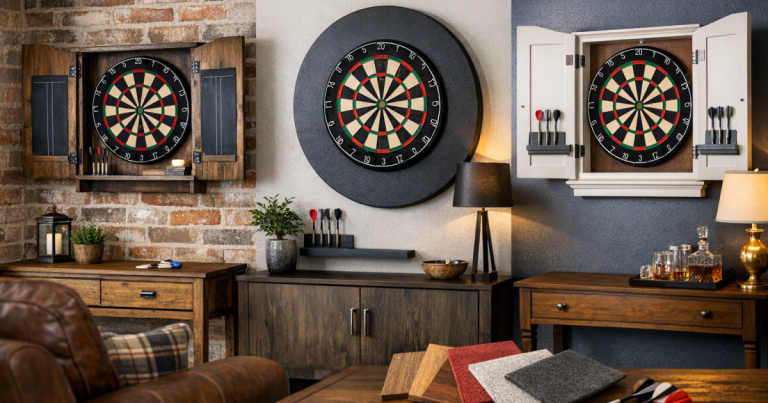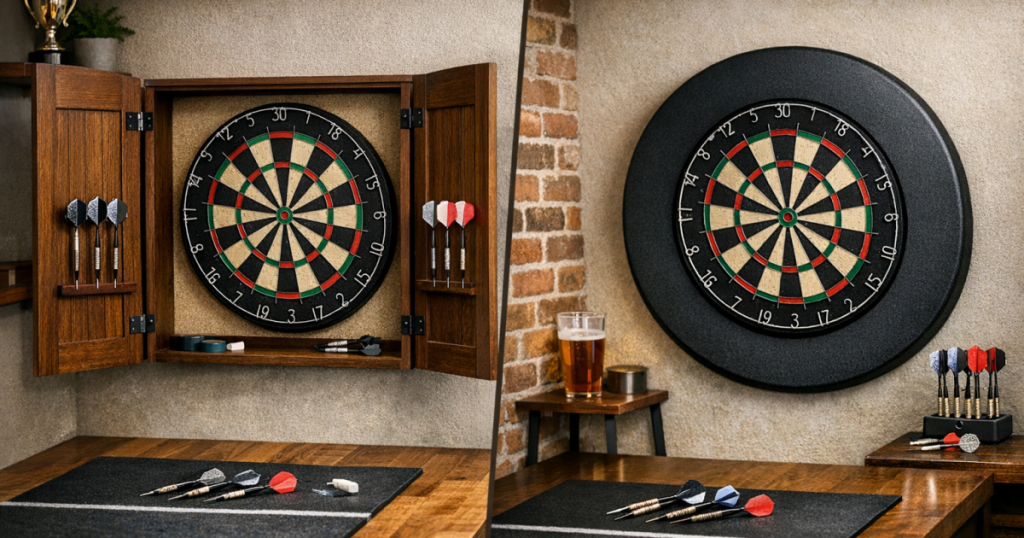
A neat darts area has to do two jobs: protect the wall and still look right in the room. Choosing between dartboard cabinets vs surrounds is really a choice about wall protection, room style, storage and how much space you can give the board when it is not in use. Both can work in UK homes, but they solve slightly different problems.
Main points
- Wooden cabinets make the board feel more like a fixed feature, with doors that can hide the board and often provide useful storage or score panels.
- Foam surrounds are simpler, softer and usually easier to live with in compact rooms, especially when the main concern is catching stray darts.
- Protection is not identical. A surround protects the area immediately around the board; a cabinet protects a rectangular zone and may leave the outer corners exposed depending on its size.
- Room style matters. Cabinets can look smarter in a lounge, dining room or games room, while surrounds tend to feel more casual and practical.
- The right answer depends on your misses. Newer players, juniors and casual throwers often benefit from wider soft protection; tidier, more experienced throwers may prefer the finish of a cabinet.
What a wooden cabinet actually changes
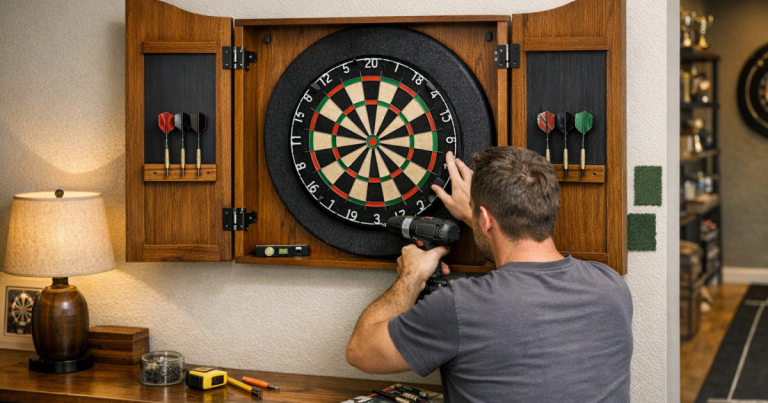
A wooden dartboard cabinet frames the board and gives the setup a more furniture-like feel. Instead of the dartboard sitting directly on a plain wall, it sits inside a box with doors that open for play and close when the board is not being used. In a shared room, that makes a noticeable difference: the board can be hidden away, darts can be stored neatly, and the whole area looks more intentional.
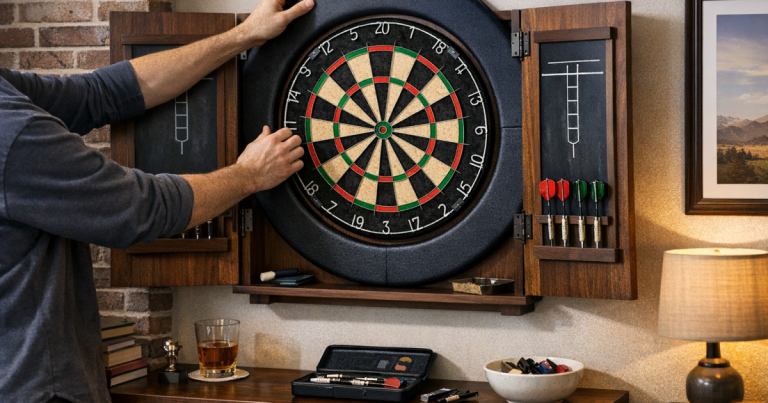
The storage side is one of the strongest arguments for a cabinet. Many designs include clips or slots for darts, plus space on the inside of the doors for chalkboards, whiteboards or printed scoring areas. That is handy if you do not want darts, chalk, flights and spare stems scattered across a shelf or sideboard.
The trade-off is bulk. A cabinet needs enough wall width for the doors to open, and it projects further from the wall than a bare board or foam ring. In narrow hallways, alcoves or multipurpose rooms, this can make the setup feel more intrusive. Before committing, measure the wall space with the cabinet doors fully open, not just the closed width.
For a deeper look at how cabinets and surrounds fit into a complete home setup, see the cabinet and surround setup guide.
What a foam surround does better
A foam surround is much more direct: it sits around the dartboard and protects the nearby wall from stray darts. There are no doors, hinges or storage sections, so it keeps the setup visually light and easy to use. For many home players, that simplicity is the main appeal.
Foam surrounds are especially useful when the dartboard is in a smaller room or a casual family space. If somebody misses the doubles by a few centimetres, the dart is more likely to land in the foam rather than the plaster, wallpaper or painted wall. That does not make the surrounding area indestructible, but it gives a softer landing zone where most near-misses happen.
They are also easy to remove when needed. If your board is mounted in a spare room that sometimes becomes a guest room, office or exercise space, being able to lift the surround away can be useful. There is less of a permanent furniture feel, and the wall area usually looks less busy.
The limitation is that a foam surround does not tidy the space by itself. It will not hide the board, store darts or provide scoring panels. If you like a clean, closed-off look when you are not playing, foam alone may feel unfinished unless you pair it with nearby storage.
Wall protection: different shapes, different coverage
The biggest practical difference is the shape of the protected area. A foam surround usually protects in a circular or segmented ring around the dartboard. That suits the way most missed darts happen: close to the board, just outside the doubles, or slightly high and low around the scoring segments.
A wooden cabinet protects more like a rectangle. The backboard and doors can help shield the wall directly beside the board when open, but the amount of protection depends on the cabinet design and how wide it sits around the board. Some cabinets look substantial but still do not provide as much soft catching area as a large foam ring.
This is where honesty about playing level helps. If most misses are only just outside the scoring bed, either option can be fine. If darts regularly land well outside the board area, neither a standard cabinet nor a neat surround will solve everything. You may need a larger protective panel, a wider surround arrangement or a rethink of the throw area.
Fit is also important. A surround that is too loose can shift, while one that does not suit your board may sit awkwardly. The surround size and fit guide explains the practical checks around diameter, material and how the surround sits around a bristle board.
Room style and everyday living
In a dedicated games room, garage conversion or garden room, the visual difference may not matter much. In a lounge, dining room or home office, it often does. A wooden cabinet can make the board look deliberate rather than temporary. Closed doors soften the look, which is useful if the room is shared with people who are less enthusiastic about having a dartboard permanently on show.
Foam surrounds look more like sporting equipment. That is not a bad thing; many home players prefer the straightforward pub-practice look. But in a decorated living space, a foam ring around the board is harder to disguise. Darker surrounds can blend into some rooms, while brighter or heavily branded designs draw more attention.
There is also the question of noise and feel. A cabinet can add a firmer, boxed-in presence behind the board, depending on how it is mounted and what the wall is made from. A foam surround does not change the board feel much, but it can slightly soften the visual and physical edge of the setup.
Storage, scoring and match-night convenience
Cabinets win clearly on built-in organisation. If you like keeping match darts, spare sets, chalk and a cloth near the board, having everything inside the doors is genuinely useful. It makes impromptu games easier and stops the area becoming messy after a few evenings of play.
Scoring is another point in favour of cabinets. Internal scoreboards are convenient for casual 501, round-the-board games or family matches. You do not need to set up a separate board or rely on a phone placed nearby. That said, the quality and layout of scoring surfaces varies, so it is worth checking whether the inside panels suit how you actually play.
Foam surrounds do not compete on storage, but that can be an advantage if you already have a tidy shelf, a darts case or a dedicated scoring area. They keep the board area uncluttered and leave you free to choose your own scoring method.
Small rooms: where the decision gets sharper
In small UK bedrooms, box rooms and narrow spare rooms, every centimetre matters. A cabinet can look excellent when closed, but the open doors may interfere with nearby furniture, shelving, radiators or the natural flow of the room. If the throwing lane already feels tight, adding door swing and visual bulk can make the space feel even smaller.
A foam surround is usually easier to accommodate because it stays close to the circular outline of the board. It also keeps the player’s focus on the board rather than the furniture around it. For compact setups, that simplicity can be more valuable than storage.
Before choosing either, check the full playing area rather than just the wall. You need enough clear space for stance, throw, retrieval and people moving around behind the player. If the room is tight, the advice on choosing a dartboard for a small room is a useful next step.
When a cabinet makes more sense
- The board is in a shared living space. Doors help hide the board and make the setup look less exposed when not in use.
- You want built-in storage. A cabinet keeps darts and small accessories close without needing extra shelves.
- You prefer a traditional look. Wood suits classic pub-style setups and rooms where a plain foam ring feels too casual.
- Your misses are reasonably controlled. If stray darts tend to land close to the board, the cabinet’s protection may be enough.
- You like manual scoring. Internal scoreboards are convenient for casual games without adding extra wall accessories.
When foam is the more practical answer
- Wall protection is the priority. A foam ring gives soft coverage around the area where most near-misses occur.
- The room is compact. There are no doors to open and less visual weight around the board.
- You want a simple setup. It is easy to remove, clean around and replace if it becomes worn.
- Several people use the board. Casual players and improving throwers often benefit from broader soft protection.
- You already have storage sorted. If darts live in a case or drawer, a cabinet’s organisation features may not matter.
Can you use both?
Sometimes, yes, but it depends on the cabinet, surround thickness and how the board is mounted. A foam surround inside or around a cabinet can look cramped if the fit is not right, and the doors may not close properly. Some players use a cabinet for storage and add extra wall protection outside it, but that tends to work better in a games room than a tidy lounge.
For most home setups, it is cleaner to decide which problem matters most. If the problem is appearance and organisation, start with the cabinet. If the problem is protecting the wall from everyday missed darts, start with foam. Trying to solve both with a mismatched combination can leave the setup looking bulky without giving much extra benefit.
Key takeaways
Wooden dartboard cabinets and foam surrounds are not just two versions of the same accessory. A cabinet is about presentation, storage and making the dartboard feel like a permanent feature. A foam surround is about straightforward protection and practical everyday play.
If your darts area is in a visible room and you want it to look tidy between sessions, a wooden cabinet has a strong case. If the board is in a smaller space, used by mixed-ability players, or mounted on a wall you want to protect from near-misses, a foam surround is often the easier and more forgiving choice.
The smartest setup is the one that matches the room as much as the player. Measure the space, think about how often the board will be on show, and be honest about where missed darts usually land. That will tell you far more than appearance alone.
Quick Buying Links
Wooden Dartboard Cabinets
Trying to solve both with a mismatched combination can leave the setup looking bulky without giving much extra benefit.Key takeawaysWooden dartboard cabinets and foam surrounds are not just two versions of the same accessory.
Foam Surrounds: Practical Differences
Worth considering if its strengths better match your needs.