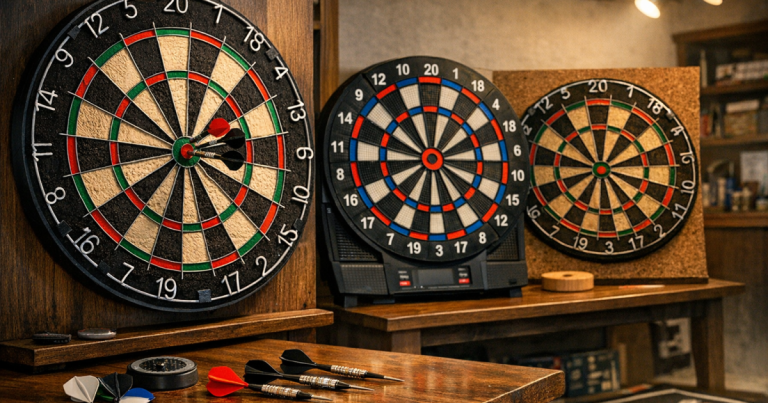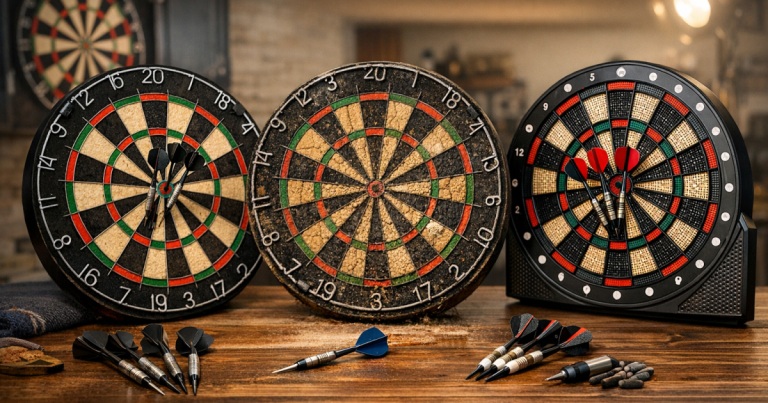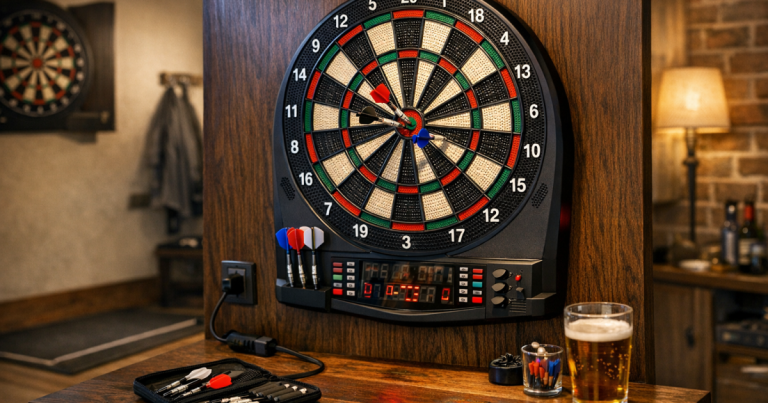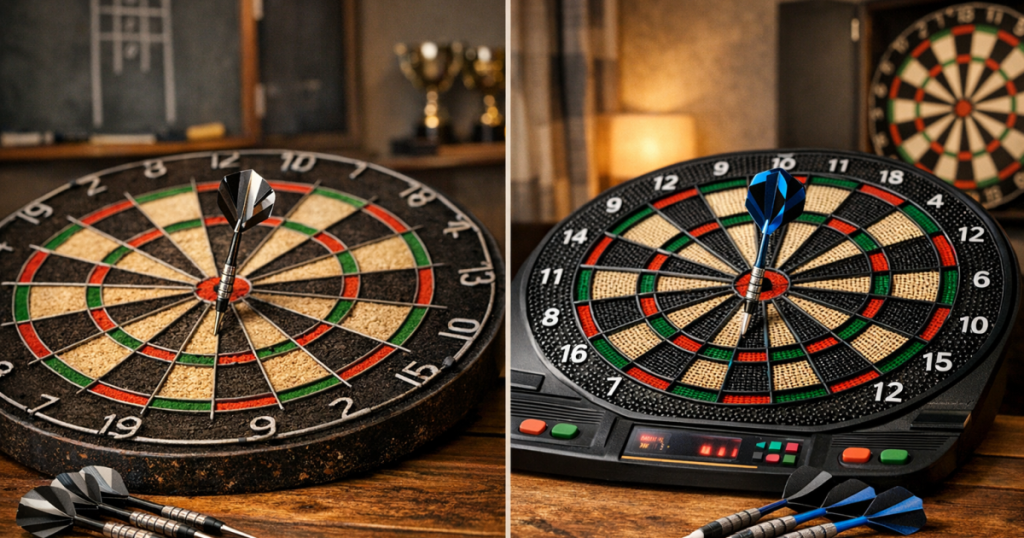
A good home darts area starts with the board, but the right choice depends on more than what you throw in the pub. That is why steel tip vs soft tip dartboards is less about one being better and more about how you play, who uses the room, and what your walls, neighbours and routine can handle.
Steel-tip boards give the closest feel to traditional darts, while soft-tip boards can make casual scoring easier and reduce the risk of sharp points around family spaces. Both can work brilliantly at home, provided the board type matches the room rather than forcing the room to fit the board.
At a glance
- Choose a steel-tip board if you want the classic bristle-board feel, standard steel-tip darts, a pub-style setup and a more traditional practice routine.
- Choose a soft-tip board if you want electronic scoring, lighter plastic-tipped darts and a setup that feels more casual or family-friendly.
- Steel-tip setups need more wall protection because missed darts can mark plaster, doors, skirting and surrounding furniture.
- Soft-tip boards are not silent; they can still create impact noise through walls, although the sound is different from steel tips entering sisal.
- Room planning matters for both: oche distance, safe walkways, lighting and storage affect the experience as much as the board itself.
What actually changes between the two board types?
A steel-tip dartboard is usually a bristle board made from compressed sisal fibres. Steel points grip into the board, and the fibres close up around the hole when the dart is removed. This is the familiar setup used in most traditional pub and home darts environments.
A soft-tip dartboard is usually an electronic board with plastic segments and holes designed for soft plastic points. Many models track scores automatically, which can be handy for casual games, parties and players who do not want to keep writing totals on a scoreboard. Some boards are simple and self-contained; others include more advanced scoring features, so it is worth checking exactly what each board supports rather than assuming every electronic board behaves the same.
The key difference is feel. Steel tips land with a firm, natural bite, and scoring depends entirely on your throw and the board’s condition. Soft tips have a lighter, springier contact with the surface, and bounce-outs can feel different because the dart has to enter a pre-formed hole or segment area. Neither is wrong, but switching between them can take a few sessions to feel natural.
Why steel tip still suits serious home practice
If you practise for league nights, pub matches or traditional darts, steel tip is normally the more relevant home format. The throw, board response and manual scoring habits carry over neatly to standard match play. A decent bristle board also lets you rotate the number ring, spread wear across the scoring segments and keep the treble 20 area from taking all the punishment too quickly.
Steel-tip boards are also simple. There are no electronic scoring menus to learn and no reliance on a particular scoring system. You can play 501, cricket, round the clock, doubles practice or finishing drills with a wall scoreboard, app, notebook or mental arithmetic. If you like the rhythm of retrieving darts, marking scores and resetting for the next visit, a bristle board keeps that ritual intact.
The trade-off is protection. Steel points can damage nearby walls and furniture, especially when newer players are involved. A cabinet or surround becomes more than decoration; it is part of keeping the setup presentable. For a deeper look at how board quality affects play over time, the guide to how dartboard quality affects scoring, wear and practice is a useful next read.
Recognisable bristle boards range from entry-level practice boards to tournament-style options. A model such as the Viper Shot King is an example of the kind of traditional sisal board people may come across when looking at home setups, although you should always verify the board construction, staple arrangement, mounting hardware and number-ring design before deciding whether it fits your expectations.
Where soft tip makes more sense
Soft tip is often the better fit when the board will be used socially, by mixed ages or in a space where easy scoring matters more than match-style authenticity. Electronic scoring removes a common barrier for newer players: nobody has to calculate checkouts, remember cricket marks or argue about what is left after a missed treble.
Soft-tip darts also remove exposed steel points, which can feel more comfortable in a family games room. That does not make the setup risk-free, as darts are still thrown objects and the surrounding area still needs to be managed sensibly. It simply changes the nature of the risk and reduces the likelihood of sharp-point damage from missed darts.
The downsides are worth knowing. Plastic tips can bend or snap, electronic segments can wear, and some players find the board face less satisfying than sisal. Scoring can also depend on the board registering the dart cleanly, so segment condition and correct dart weight guidance matter. Always check the manufacturer’s instructions for compatible darts and setup requirements.
For a real-world example of a casual electronic home board, the Winmau Sabre electronic dartboard review gives a more focused look at what this type of board can offer. You may also see connected soft-tip boards such as the Gran Board 3s; before choosing any electronic model, check its scoring modes, power setup, mounting needs and current support rather than relying on brand reputation alone.
Room size, throw line and layout
Both board types need a proper throwing space. For steel-tip darts, the common home reference is a bullseye height of 1.73 m from the floor and a throwing distance of 2.37 m from the board face to the oche. Soft-tip setups may use a different throwing distance, commonly around 2.44 m depending on the board, ruleset or league format, so check the instructions for your specific board.
The throw line is only part of the layout. You also need space to stand, retrieve darts and let other people pass safely behind or around the player. In a spare room this is usually easy; in a lounge, hallway, garage or garden room it needs more thought. Avoid placing the board where people naturally walk across the throw path, even if the measurements technically fit.
If your space is tight, a removable darts mat can mark the oche without permanently changing the room. A fixed oche can feel more consistent, but it only makes sense if the room is dedicated enough to keep the layout clear. Good lighting also matters, because shadows across the treble bed can make both bristle and electronic boards harder to read.
Noise through walls and floors
Steel-tip boards create a distinct thud as the dart enters the sisal and transfers energy into the wall. On a solid external wall this may be barely noticeable; on a shared plasterboard wall it can travel more than expected. A cabinet, backing board, isolation layer or freestanding stand may help, but the best solution depends on wall type and room layout.
Soft-tip boards are not automatically quiet. The impact is often sharper or more plasticky, and electronic boards may add button beeps or scoring sounds unless these can be adjusted. If you live in a terraced house, flat or semi-detached property, think carefully before mounting any board directly to a party wall.
Noise is one of the most overlooked reasons people regret their first setup. Before drilling permanent fixings, do a temporary test at the time you are most likely to play. If sound transfer is a concern, the guide on how to reduce dartboard noise through a shared wall covers practical ways to make the setup more neighbour-friendly.
Scoring style and practice habits
Manual scoring is part of the appeal of steel-tip darts. It sharpens arithmetic, helps you learn finishes and keeps your attention on visit-by-visit decision-making. If you are trying to improve your 501 game, that mental rhythm is useful. A wall scoreboard also makes cricket and practice games easy once you are used to the notation.
Electronic scoring suits a different kind of session. It keeps games moving when friends are round, helps beginners enjoy darts without pausing for calculations, and can make quick evening games feel lighter. It is particularly useful when several people rotate in and out, because the board handles the bookkeeping.
For many homes, the steel tip vs soft tip dartboards choice comes down to whether you want your setup to train match habits or remove friction from casual play. If you regularly play in pubs or leagues, steel tip better mirrors that environment. If darts is mostly a shared household game, soft tip can make the board more inviting.
Wall protection, maintenance and running costs
Steel-tip boards need surrounding protection. A missed dart can leave a visible mark, and beginners often miss wider than they expect. A foam surround is simple and effective around the board, while a cabinet adds doors, a more furnished look and sometimes space for scoreboards or accessories. The right choice depends on room style, not just protection.
Bristle-board maintenance is straightforward: rotate the board regularly, remove darts carefully and avoid leaving it in damp conditions such as an uninsulated shed. Over time, high-use scoring areas will wear. That is normal, but better rotation habits can slow the process.
Soft-tip boards need a different kind of upkeep. Keep spare soft tips handy, remove broken tips properly, and check that the segments still register accurately. If the board uses sound, power options or accessories, check those details before setting it up in a shared room. Replacement tips are inexpensive in general, but availability and compatibility vary, so confirm the thread and style your darts require.
Which board should you choose?
Choose steel tip if your priority is authentic feel, traditional scoring and practice that transfers to pub or league darts. It is the stronger option for players who care about finishing routes, grouping, board rotation and developing consistency on a standard bristle surface.
Choose soft tip if your priority is simple scoring, relaxed household use and a less intimidating setup for casual players. It is often the easier format for family games rooms, shared spaces and evenings where the aim is quick play rather than serious practice.
If you are still unsure, look at your most common session. A solo player throwing three or four nights a week will usually benefit from steel tip. A household where different people play short games at weekends may get more use from soft tip. The better board is the one that will actually be played, maintained and enjoyed in the room you have.
Things readers ask
Can you use steel-tip darts on a soft-tip board?
No. Steel tips are not designed for electronic soft-tip boards and can damage the segments. Use darts and tips that match the board manufacturer’s guidance.
Can soft-tip darts be used on a bristle board?
Soft plastic tips generally will not grip a bristle board properly. Some darts can be converted with the right points or barrels, but you need compatible parts rather than forcing the setup.
Is a soft-tip dartboard safer for children?
It reduces the sharp-point issue, but it still needs supervision, a clear throw area and sensible storage. Darts should never be thrown when someone is near the board or walking through the throw line.
Which is quieter in a flat or terraced house?
Neither is guaranteed to be quiet. Steel-tip boards thud into the wall, while soft-tip boards can create a sharper plastic impact and scoring sounds. Wall type and mounting method make a big difference.
Do I need different oche distances?
Often, yes. Steel-tip setups commonly use 2.37 m from the board face, while soft-tip rules may differ. Check the board instructions or the ruleset you plan to follow.
What stands out
Steel tip feels more traditional, rewards serious practice and suits players who want their home setup to mirror pub or league darts. Soft tip is more accessible, easier for casual scoring and often better for shared household play. The smartest choice is not the most advanced board; it is the board type that fits your room, your players and the way you genuinely want to use your home darts setup.
Quick Buying Links
Steel Tip
That is why steel tip vs soft tip dartboards is less about one being better and more about how you play, who uses the room, and what your walls, neighbours and routine can handle.Steel-tip boards give the closest feel to traditional darts, while soft-tip boards can make casual scoring easier and reduce the risk of sharp points around family spaces.
Soft Tip Dartboards: Which Should You Choose?
Worth considering if its strengths better match your needs.