Bounce-outs are part of home darts, but the damage they leave behind is not something you have to accept. Good floor protection for dartboards is about covering the likely landing zone, stopping darts from skidding into awkward gaps, and keeping the setup easy to live with between sessions.
The right approach depends on your floor, your room layout and whether the darts area is permanent or packed away after play. A thick mat, a sensible oche position and a few small checks around furniture can make a big difference.
At a glance
- Protect the strip directly below the board and along the throw line first; this is where most bounce-outs and dropped darts land.
- Use a mat or removable floor covering that lies flat, grips well and does not create a trip point at the oche.
- Hard floors need impact protection; carpeted rooms mainly need snag and puncture control.
- In shared rooms, choose a roll-away setup that is quick to remove and does not leave tape marks or compressed patches.
- Check your setup after the first few sessions and extend the covered area if darts are landing wider than expected.
Work out where darts actually land
Before choosing anything, spend a few minutes observing the space. Bounce-outs do not always drop straight down. A dart can hit a wire, glance off the board, strike the cabinet door, or fall from a loose grouping and land short of the board. The result is usually a damage pattern rather than a single point.
Start with three zones. The first is the floor immediately below the board, where dropped darts and soft rebounds tend to fall. The second is the lane between the board and the oche, where darts can bounce out with more energy and slide along laminate, vinyl or tiles. The third is the area just in front of your feet, where darts are most often dropped when loading, retrieving or changing sets.
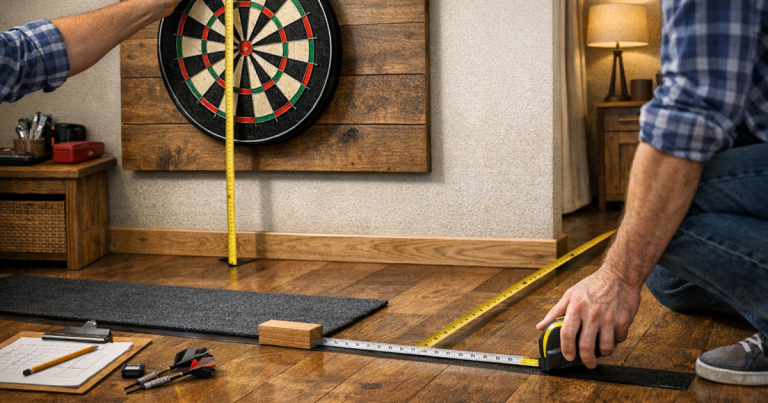
For a typical home steel-tip setup, the centre of the bull is normally mounted around 1.73 m from the floor, and the throw distance is commonly 2.37 m from the face of the board to the oche. Those measurements help you estimate the strip of floor that needs regular protection, but always measure from your actual board face rather than the wall if your cabinet or mounting changes the depth.
Choose protection that suits the floor
Different flooring reacts differently to darts. The aim is not just to stop visible marks; it is to avoid dents, splinters, pulled fibres and annoying little chips that become obvious in daylight.
Laminate, engineered wood and solid wood
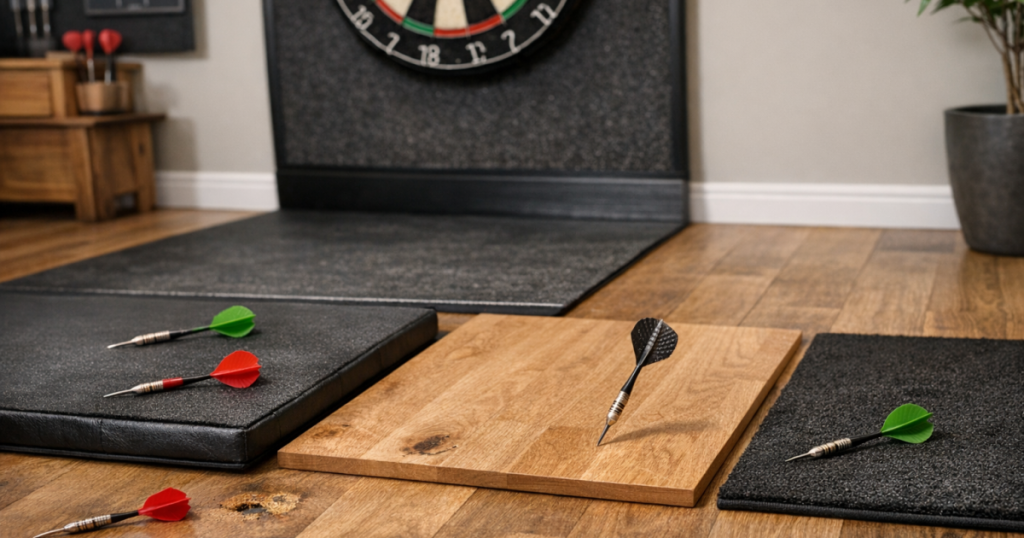
Hard timber-style floors are the most vulnerable to bounce-outs. A steel tip can leave a pin mark, and a dart that lands point-first can chip the surface. Use a dense mat with enough thickness to absorb impact, ideally with a non-slip underside so it does not creep forwards during play.
Avoid relying on a thin decorative rug on its own. It may look tidy, but darts can still punch through to the floor underneath, especially where the rug is loosely woven. If you like the look of a rug, place it over a denser protective layer and make sure the combined surface remains flat.
Vinyl and lino
Vinyl and lino can mark less dramatically than wood, but they can still puncture or dent. A smooth-backed mat can sometimes trap grit underneath, which then scratches the surface when the mat shifts. Clean the floor before putting protection down and lift the mat occasionally rather than leaving debris under it.
Carpet
Carpet hides small marks better, but darts can snag loops, leave tiny punctures in underlay, or disappear point-down in thicker pile. A firmer runner or darts mat gives you a more predictable surface and makes dropped darts easier to spot. On deep carpet, check that the mat does not rock underfoot at the oche.
Tiles and concrete floors
Tiles protect the property but can be harsh on darts. Bounce-outs may blunt tips, mark points or send darts skidding into skirting boards. Concrete garage floors have the same issue. A rubber-backed mat or interlocking floor tile section can soften the impact and reduce the distance a dart travels after it lands.
Set the mat up so it protects the right area
A dart mat is most useful when it covers the board-to-oche lane rather than sitting like a small doormat beneath the board. If your room allows it, run the mat from the wall or cabinet area towards the throw line, with the oche clearly marked or built into the edge.
Width matters as much as length. A narrow strip may protect the centre line but miss angled bounce-outs. If your throws sometimes drift into the 1 and 5 segments, or if several people play with different stances, give yourself extra width. In a family or shared home, generous coverage is usually more forgiving than a neat but minimal strip.
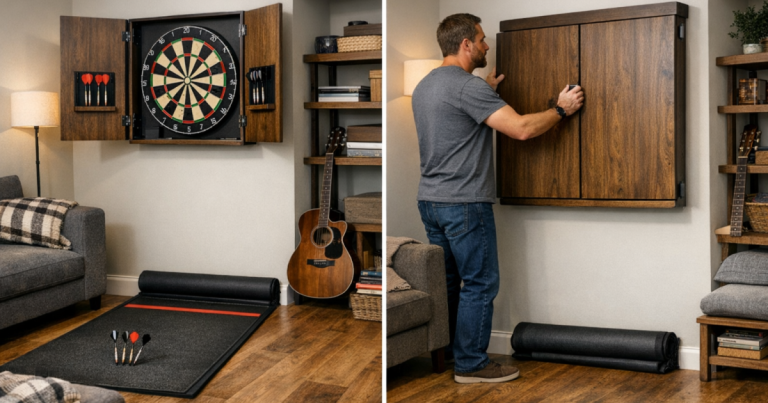
If you need the area to convert back into a normal living space, a removable mat is usually easier than permanent flooring. The key is consistency: roll it out to the same position each time, keep the front edge flat, and store it so it does not curl. For multipurpose rooms, the ideas in this guide to a portable darts mat and oche setup are especially useful because the oche and protection need to work together.
Stop bounce-outs reaching awkward gaps
Floor damage is only half the problem. Bounce-outs often roll under sofas, radiators, cabinets and sideboards, which makes retrieval irritating and increases the chance of stepping on a dart later.
Look around the board area from floor level. If there is a gap beneath furniture within a few metres of the board, consider moving the item slightly, placing a removable draught-excluder style barrier along the gap during play, or using a wider mat that slows the dart before it reaches the edge. Keep the solution simple; anything fiddly will be skipped after a few sessions.
Skirting boards also take more punishment than many people expect. A dart that lands on a hard floor can slide point-first into the skirting or bounce against it. If your board is near a corner, protect the return wall side as well as the front-facing area. Where possible, leave a little clear space either side of the board rather than crowding it with furniture.
Match the setup to the room
Shared living room
In a shared living room, the best setup is usually one that protects well but disappears quickly. A roll-out mat, removable oche marker and a storage spot for darts keep the room from feeling permanently taken over. Avoid strong adhesives on flooring, and be careful with any tape that could lift finish from laminate or leave residue on vinyl.
It also helps to think about foot traffic. If people will walk through the room while the darts area is not in use, roll the mat away rather than leaving a raised edge across a route. For layout compromises around sofas, doorways and viewing angles, see the guide to planning a darts setup in a shared living room.
Garage, shed or garden room
Utility spaces usually give you more freedom, but floors can be harder and colder. Rubber floor tiles, dense matting or a dedicated darts lane can work well, provided the surface remains level. Watch for moisture and grit, especially near doors, because both can make mats slip or wear faster.
If the floor is uneven, do not create a throwing position where one foot sits higher than the other. It will feel minor at first, but it can affect your stance and make the oche less consistent. Prioritise a flat standing area even if the protection near the board needs to be made up from separate sections.
Rented homes
For rented flats and houses, removable protection is the safest approach. Use non-marking solutions, lift mats periodically to check the floor, and avoid anything that bonds permanently to the surface. Take photos of the area before setting up if you are worried about existing marks being blamed on darts later.
Reduce bounce-outs at the source
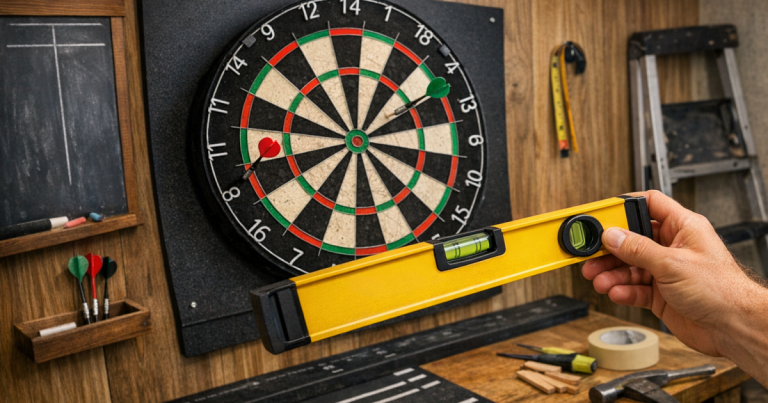
Floor protection deals with the landing, but fewer bounce-outs means less damage overall. Check that the board is securely mounted, flat against its fixing and not wobbling when darts land. A loose board can throw darts back unpredictably.
Rotate a sisal dartboard regularly if one segment is taking heavy use. Worn treble areas can increase rejections, particularly around popular practice targets. Keep steel tips in sensible condition too: a badly burred point can catch wires or damage sisal, while a completely blunt one may not hold cleanly.
Cabinets and surrounds can also change the way darts fall. A surround helps protect the wall, but if it sits proud, loose or uneven, it may deflect darts downwards or sideways. If wall protection is part of the same project, the notes on choosing an oversized dartboard surround can help you think about coverage beyond the board face.
Small checks before each session
- Make sure the mat is flat, with no curled corners near the oche or walking route.
- Check that the oche has not shifted since the last session.
- Remove grit or small stones from underneath removable mats on hard floors.
- Keep shoes, bags and cables away from the landing zone so darts do not hide underneath them.
- Check lighting and shadows so you can see dropped darts before anyone steps forward.
- Inspect the most-used floor area every few weeks and adjust coverage if marks are appearing outside the mat.
Common mistakes to avoid
The biggest mistake is protecting only the wall and forgetting the floor. A cabinet or surround looks like the main defence, but bounce-outs often cause their damage after they have already missed the board area. Treat the floor as part of the same setup, not an afterthought.
Another common issue is choosing a mat that is too light. If it slides every time someone steps into position, it will end up crooked and leave the floor exposed. A mat that grips properly is more useful than one that looks perfect for the first five minutes.
Finally, do not ignore the edges. A thick mat with a raised lip can become a trip point, especially in a living room or narrow spare room. If the mat edge catches your foot as you step to the oche, choose a flatter design or reposition the protection so the edge sits outside the walking line.
FAQ
How far should floor protection extend from the dartboard?
For most home setups, cover the full lane from beneath the board towards the oche, not just the small area directly below the board. If darts land beyond the mat during your first sessions, extend the protected area rather than hoping the pattern changes.
Will a normal rug stop dart damage?
A normal rug can help with light scuffs, but it may not stop a steel-tip dart from reaching the floor underneath. Use a denser protective layer if you have wood, laminate, vinyl or tiled flooring.
Can I use gym flooring under a dartboard?
Yes, dense rubber gym flooring can work well in garages, sheds and dedicated rooms. Make sure it lies flat, does not smell strongly in an enclosed room, and gives you a level stance at the oche.
What should I do if darts keep bouncing out?
Check the board mounting, board wear, wire condition and dart points. Floor protection for dartboards is still worth having, but repeated bounce-outs usually mean something in the board, darts or setup needs attention.
Is floor protection still needed with soft-tip darts?
Soft-tip darts are less likely to chip hard flooring, but they can still bounce, slide and vanish under furniture. A mat is useful for retrieval, stance consistency and general room protection.
What to remember
The most effective floor protection is practical rather than complicated: cover the real landing zone, keep the oche consistent, and make the setup easy enough that you use it every time. Start with the strip from board to throw line, widen it if darts are landing off-centre, and keep nearby gaps clear so bounce-outs do not become a hunt around the room.
Once the floor is protected, the whole darts area feels calmer. You can practise properly, invite others to play and stop worrying about every missed treble turning into a mark on the floor.