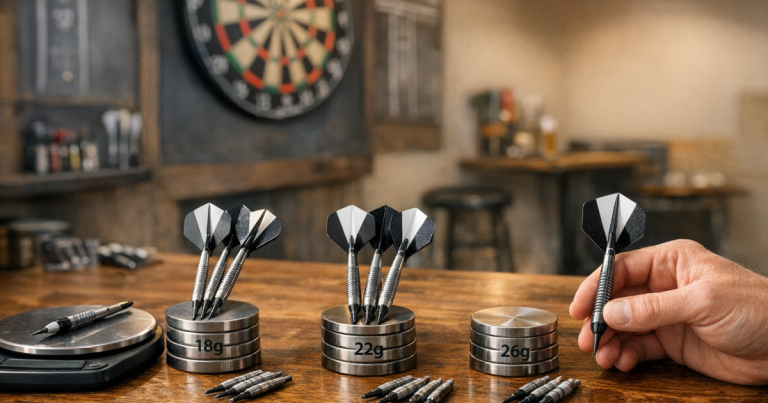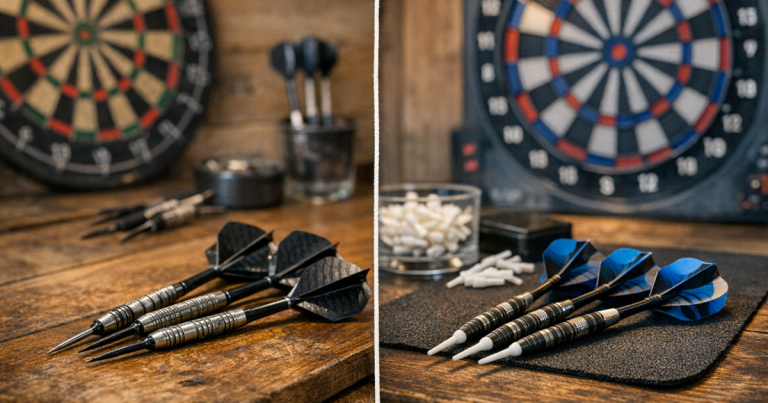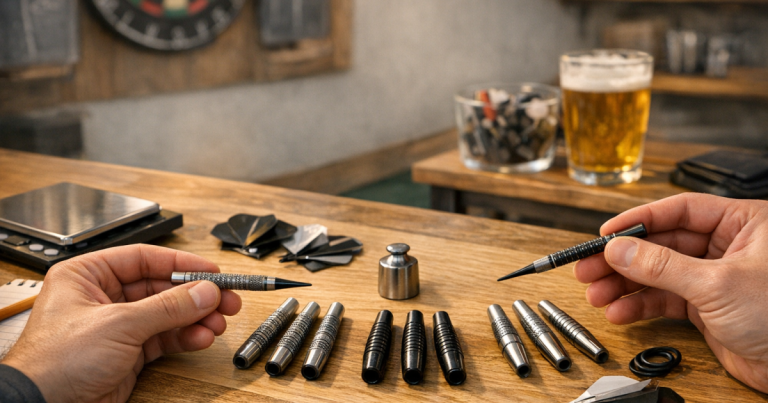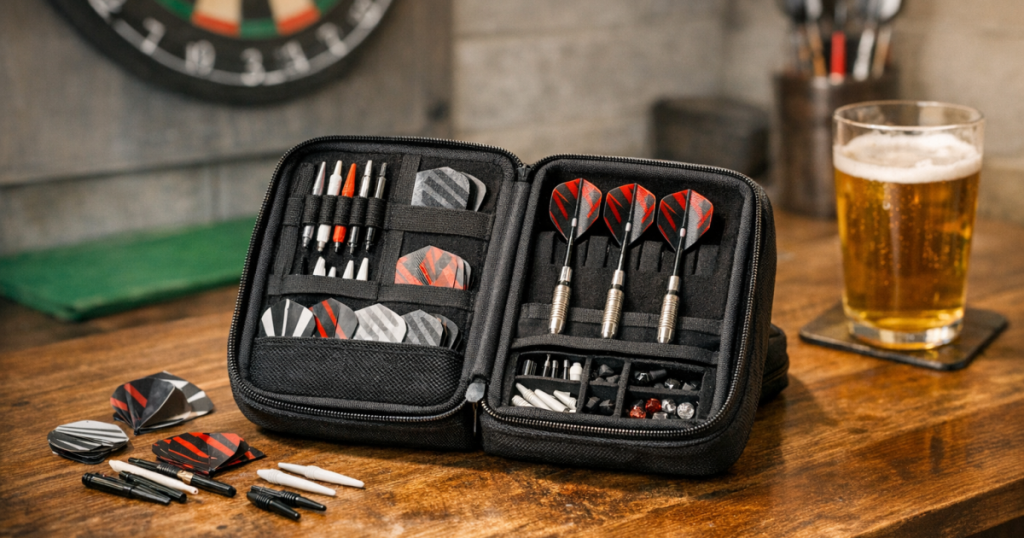
Spare flights, shafts, points, stems, washers and tools are only useful if you can find them quickly. A dart case for spares is worth buying when it keeps small parts separated, protects delicate pieces from being crushed, and fits naturally into the way you play at home. The best choice is not always the biggest case; it is the one that makes your match-night routine simpler.
For home throwers, the decision usually comes down to layout, protection and portability. A tidy case can save time between legs, stop mixed-up accessories becoming a nuisance, and make it easier to keep one complete spare setup ready for visitors or practice sessions.
The short version
A spares case earns its place when it does three jobs well: it stores the parts you actually use, keeps fragile items flat or secure, and opens in a way that lets you grab what you need without emptying everything onto a table.
- For casual home play: choose a compact organiser with room for flights, shafts and a small tool.
- For regular practice: look for separated sections, spare dart storage and space for several flight and shaft sets.
- For league-style home nights: consider a larger wallet or case that can hold multiple complete sets, point tools and guest spares.
- For shared rooms: prioritise a case that closes securely and can be stored away with the rest of the setup.
What counts as a useful spares case?
A normal darts wallet is designed mainly to carry one or more dart sets. A spares-focused case has to do a little more. It should stop tiny parts from migrating between pockets, protect flights from bending, and make it obvious when you are running low on a favourite shaft length or flight shape.
The key is to think about your real playing habits. If you always use the same flight and shaft combination, you may only need a slim case with two or three spare sets. If you experiment with stems, points and flight shapes, a more structured case becomes more valuable because it prevents the collection from turning into a loose pile of accessories.
It also helps to separate “home storage” from “carry storage”. A drawer organiser can hold bulk accessories, but a darts case should contain the spares you would actually want within arm’s reach during a session. That might mean fewer items, better chosen.
Start with the spares you genuinely use
Before buying anything, lay out the accessories you want the case to hold. Do not start with the case and hope everything fits. Count the items you reach for most often during practice or games.
- Flights: keep a few sets in your preferred shape and thickness rather than a random stack of old designs.
- Shafts or stems: store full matching sets, not odd singles, unless you deliberately keep emergency replacements.
- O-rings and washers: tiny parts need a secure mini compartment or resealable pouch inside the case.
- Spare points: keep them protected so they do not scratch flights, cases or other accessories.
- Dart tool: check that the case can hold your tool without pressing into flights or barrels.
- Chalk, marker or small score aid: useful for some home setups, but only include it if it fits cleanly.
If your spares are mainly for home use, you can be stricter. There is little benefit in carrying every spare you own from room to room. Keep bulk stock elsewhere and use the case as a ready-to-play kit.
Layout matters more than raw capacity
A large case can still be frustrating if everything sits in one open pocket. For spares, a good layout should reduce rummaging. Look for separate areas for flights, shafts and small metal parts, with enough structure that accessories stay where you put them when the case is zipped or folded shut.
Flight storage deserves particular attention. Flights are easy to crease when they are pushed under barrels or loose tools. If you use moulded or integrated flight systems, check the case depth and compartment shape carefully before buying. Some cases that work well for folded flights may be less convenient for bulkier flight-and-shaft systems.
For shafts, elastic loops can be tidy, but small lidded sections can be better if you carry several lengths or materials. If you regularly switch between short, intermediate and medium setups, clear separation saves time and avoids mixing similar-looking parts.
Protection: what should the case prevent?
The point of a spares case is not just neatness. It should prevent the little problems that make accessories fail early or disappear. The most useful cases protect against crushing, abrasion, rattling and accidental opening.
- Crushed flights: avoid cases where flights must be bent or forced into tight corners.
- Scratched accessories: keep points and tools away from softer plastic flights and shafts.
- Loose parts escaping: check zips, press studs, lids and internal pockets for secure closure.
- Moisture and dust: a fully closing case is better than an open tray if it is stored in a garage, shed or busy shared room.
- Overpacking: a bulging case puts pressure on flights and can make zips fail sooner.
Durability is worth assessing in person where possible. Open and close the case, check whether the seams feel tidy, and look at how the hinges, zip pulls or fold points are likely to cope with repeated use.
Size choices for different home setups
The right size depends on how your darts area is arranged. In a dedicated darts room, a larger wallet can live near the board. In a living room, spare bedroom or garage setup, a compact case that packs away neatly may be more practical.
- Slim wallet: best for one dart set, a few flights, a few shafts and a tool. Good if you dislike clutter.
- Medium case: a sensible middle ground for regular throwers who want spare parts without carrying a full accessory collection.
- Large darts case: useful for multiple dart sets, family players, guests or anyone who likes testing setups.
- Hard shell case: worth considering when the case travels in a sports bag or gets stored with heavier kit.
If your throw line, mat and accessories are all stored together, it is worth thinking about the complete routine. A case that fits neatly alongside your darts mat and oche setup is more likely to be used properly than one that has to be kept somewhere else.
Examples of cases and what to check
Named cases can be useful reference points, but always check the current retailer listing and product photos before buying. Capacity, internal layout and included accessories can vary by version or bundle.
- Target Takoma XL Wallet: a larger wallet-style option to compare if you want room for more than a bare match set. Check how its internal sections suit your flight type and spare shaft storage.
- Winmau Urban Pro Dart Case: worth comparing if you prefer a structured case from a familiar darts brand. Look closely at how many complete sets and loose accessories it can realistically hold.
- Harrows Blaze Pro 6 Dart Case: a useful example of a multi-set case style. Verify whether the layout suits spares, not just assembled darts.
Do not buy purely because a case looks premium in photos. For spares, the most important question is whether it keeps small accessories visible and separated. A smart exterior is a bonus; a practical interior is the reason to buy.
Match-night checks before you buy
A good way to judge a case is to imagine a broken shaft or damaged flight halfway through a leg. You should be able to open the case, find a matching replacement and get back to the board quickly.
- Can you identify matching sets at a glance? Clear organisation matters more than storing lots of near-duplicates.
- Can you remove one item without disturbing everything else? Tight pockets become annoying during play.
- Does it close cleanly when full? If it needs squeezing shut, it is too small or badly laid out for your kit.
- Will it stay put near the board? A case used at home should sit safely on a shelf, side table or storage unit.
- Can guests use it without explanation? For shared home matches, simple organisation is a real advantage.
If you run casual 501 nights at home, your case can sit alongside the scoring setup. When phones or tablets are part of the routine, the same principle applies: keep the darts accessories separate from cables and devices. For the scoring side, see the guide to setting up a dart scoring app for home matches.
Small details that make a case better
Several small features can make a case easier to live with. None are essential for every player, but they are worth checking because they affect day-to-day use.
- Contrasting interior colour: small black O-rings and points are easier to spot against a lighter lining.
- Removable pouches: useful if you want to take only a few spares to another room or venue.
- Firm flight sections: helpful for keeping flights flat and easy to pair up.
- Label-friendly pockets: useful if several players in the house use different shaft lengths or flight shapes.
- Easy-clean lining: handy when the case picks up dust from a garage or multi-use space.
For a tidy home board area, think beyond the case itself. If chargers, scoreboards or light leads sit near your darts kit, keeping those separate avoids tangles and accidental damage. The guide to tidying scorer cables around a dartboard is a useful next step for neater setups.
When a bigger case is not worth it
Bigger cases are tempting, but they can encourage clutter. If you keep broken flights, mismatched shafts and accessories you never use, the case becomes storage rather than a playing aid. That makes it harder to find the part you actually need.
A smaller, well-edited case is often better for home players. Keep one or two spare sets of your main flights, at least one matching shaft set, a simple tool and any small parts your darts require. Review it every so often and remove damaged or unwanted items.
There is also a cost point. A more expensive case only makes sense if the build, layout and capacity solve a real problem for you. If your spares are minimal, spend the difference on better flights, shafts or board-area organisation instead.
A simple buying checklist
Use this checklist before adding a case to your basket:
- List the exact spares you want to store.
- Check whether the case suits loose flights, moulded flights or both.
- Look for separate spaces for shafts, points, tools and tiny parts.
- Make sure the case closes without crushing anything.
- Choose a size that fits your actual home storage routine.
- Check product photos carefully, not just the headline capacity.
- Read buyer feedback for comments about zips, stitching and pocket usefulness.
- Avoid overbuying if you only need a compact match-night kit.
Common questions
Should spare darts be stored assembled or broken down?
If space allows, keeping a spare set assembled is convenient for quick swaps. For flights and shafts kept purely as replacements, separate storage usually protects them better and makes matching easier.
Is a hard case better than a soft darts wallet?
A hard case offers better crush protection, which helps if the case travels in a bag or drawer with heavier items. A soft wallet can be perfectly fine for a shelf or cupboard in a home darts area.
How many spare flights should I keep in the case?
For most home players, two or three matching sets are enough. Keep extra bulk packs elsewhere so the case stays tidy and quick to use.
Do I need separate storage for points and tools?
Yes, if you carry them. Points and metal tools can mark flights or scratch softer accessories, so they should sit in a secure pocket or small compartment.
What is the biggest mistake when choosing a spares case?
Buying for headline capacity instead of layout. A case that holds lots of parts badly is less useful than a smaller one that keeps your most-used spares visible and protected.
In brief
A case is worth buying when it makes your spares easier to use, not merely easier to own. Prioritise sensible compartments, flight protection, secure closure and a size that suits your room. If it helps you replace a damaged part in seconds and keeps your board area tidier between sessions, it has done its job.