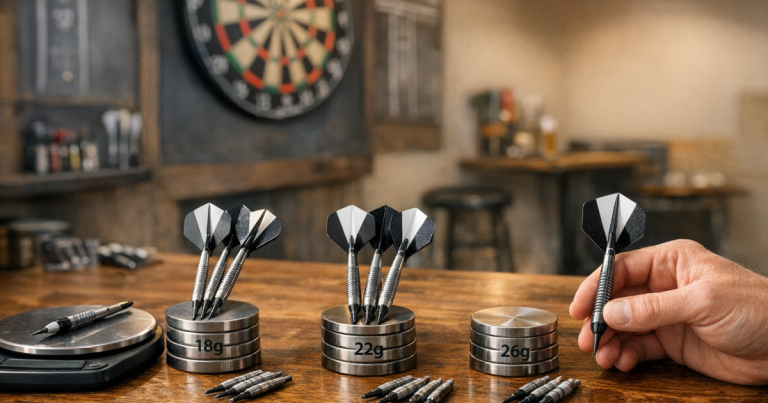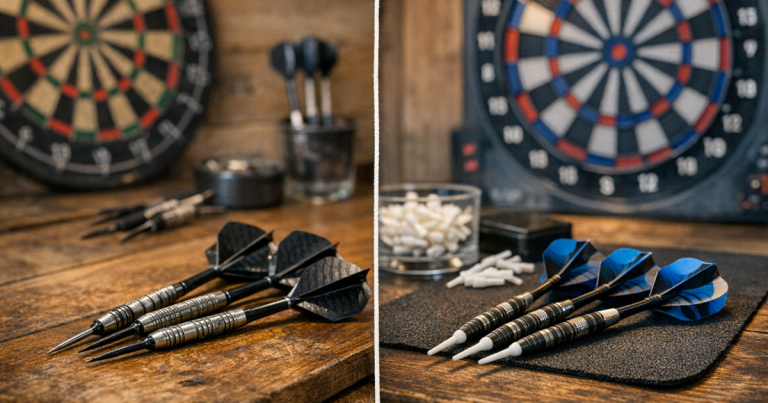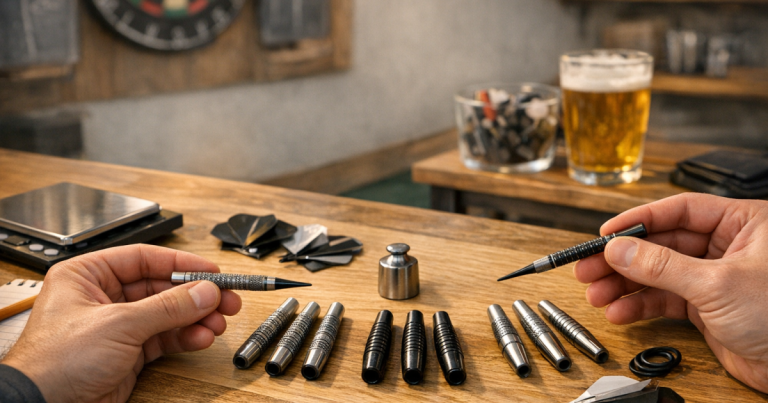
A worn, bent or badly matched dart point can make a good set of barrels feel awkward surprisingly quickly. Before buying replacement steel tip points, check the barrel fit, point length, grip style, fitting method and how the new tips will treat your dartboard.
The right choice is not always the sharpest or most aggressive option. For a home setup, you want points that enter cleanly, stay secure, suit your throw and do not chew through your board faster than necessary.
The short version
Most buying mistakes happen because players focus on grip pattern first and compatibility second. A grippy point is useful only if it fits the barrel properly, suits your release and can be installed without damaging the dart.
- Check barrel compatibility first: standard press-fit points are common, but tolerances and proprietary systems vary.
- Choose length with your board angle in mind: longer points can change how the dart sits in the board and how much clearance you get around tight trebles.
- Match grip to your throw: finger-grip points help some players, while board-grip points can reduce fall-outs but increase sisal wear.
- Confirm the fitting method: some points need a repointing tool, while some proprietary systems use a dedicated mechanism.
- Think about storage and maintenance: new points will last longer if they are not rattling loose in a drawer or case.
Start with the barrel, not the point
The first check is whether the point will physically fit your dart barrels. Many steel-tip darts use press-fit points, where the plain section of the point is held inside the nose of the barrel by friction. That sounds simple, but the fit still depends on the barrel, the point, the manufacturing tolerance and whether the dart has been repointed before.
A point that is too loose can creep out over time. A point that is too tight can be difficult to fit and may mark or damage the barrel if forced. If your darts use a proprietary point system, standard press-fit points are unlikely to be the right choice. Target Swiss Point darts, for example, need compatible Swiss Point replacements rather than ordinary press-fit tips. Products such as Target Swiss Storm Nano Points are examples to look at only if your barrels are made for that system.
Once those basics are clear, buying replacement steel tip points becomes a much easier decision. Check the dart maker’s guidance where available, look for the stated point type, and be cautious with mixed-brand combinations unless other players have confirmed the fit with the same barrels.
Check the length before you chase more grip
Point length affects more than appearance. A longer exposed point can make the dart sit slightly differently in the board, create more room between the barrel and the sisal, and change how close later darts can group around the treble. A shorter point can feel more compact but may bring the barrel closer to the board face.
For home players, the safest approach is to measure the exposed point length you already like before changing anything. Use millimetres, measure from the nose of the barrel to the tip, and note whether you are happy with the way the dart stands in the board. If you are only replacing damaged points, staying close to the original length keeps the feel familiar.
If you are changing length deliberately, make one adjustment at a time. A longer point combined with a new grip pattern and different shafts can make the dart feel like a completely different setup. If balance and entry angle are part of the problem, it may also be worth reviewing how you choose dart shafts that suit your throw, because points and shafts both influence the finished feel of the dart.
Understand the different grip styles
Steel tip points are not all smooth needles. Some are plain, some have rings or grooves, some use rougher coatings, and some are shaped to reduce the step between the barrel nose and the point. The right style depends on why you want a change.
Smooth points
Smooth points are the simplest option and are often a sensible replacement when your current tips are bent, blunt or rusty. They tend to be kinder to the board than heavily textured points, and they suit players who do not use the point as a finger reference during the throw.
Finger-grip points
Some players rest a finger on the point or the nose of the dart. In that case, a lightly ringed or textured point can provide a more consistent reference. The key word is lightly. A very aggressive texture can catch on the fingers during release, which may send the dart off line rather than improving control.
Board-grip points
Points with pronounced grooves, ripple cuts or rough coatings are designed to hold the board more securely. They can help if your darts are falling out of a firm board, but they can also pull more sisal when removed. Mission Sniper Ripple Points are a recognisable example of a gripped point style, but the principle matters more than the brand: more hold usually means more board contact.
Think about your dartboard, not just your darts
Replacement points should suit the board you actually use at home. A fresh, quality sisal board may not need aggressive tips at all. If darts are dropping out, check whether the board is overly dry, worn, swollen, loosely mounted or being hit at a poor angle before assuming the points are the only issue.
Aggressive points can be useful, but they are not a cure for a tired board. They may hide the problem for a while, then accelerate wear in busy scoring areas. If your setup is in a spare room, garage or shared space, also make sure the area around the board is suitable for steel-tip play. A good points upgrade is still only one part of a safer setup; it sits alongside having enough clearance, a reliable oche and sensible wall protection. For layout checks, use this guide to plan a safe throwing area around your dartboard.
Check the shoulder shape and nose transition
The shoulder is the area where the point meets the barrel. A sharp step at the nose can sometimes catch flights from following darts or make grouping feel less clean. Some points are shaped to create a smoother transition from point to barrel, which can help the dart slide past flights and stems more easily.
That does not mean every player needs specialist nose-cone-style points. If your current darts group neatly and you rarely suffer deflections from the nose area, a standard profile may be fine. But if your barrels have a blunt nose and you see lots of flight damage near the front of the dart, the transition shape is worth checking before you buy.
Products such as Harrows Apex Points show how replacement tips can vary in shape and finish. Before choosing any shaped point, verify the fitting type, exposed length and whether the design suits your barrel nose rather than judging it only on looks.
Make sure you can fit them properly
Standard press-fit points usually need a dart repointing tool. The tool grips the barrel and pushes the old point out before pressing the new one into place. A proper tool reduces the chance of bending the new point, marking the barrel or leaving the tip seated unevenly.
A dedicated tool such as the Designa Dart Repointing Tool is the sort of item home players often consider if they expect to repoint more than one set. Before buying a tool, check that it is suitable for steel-tip darts, that it can hold your barrel shape securely, and that you are comfortable using it patiently rather than forcing the mechanism.
If you only need one set repointed, a local darts shop or experienced player may be able to do it for you. That can be a better route than buying tools you will rarely use, particularly if your darts are expensive, unusual or sentimental.
Do not ignore point finish and corrosion
Point finish affects feel, board hold and long-term condition. Black, silver and coated finishes can all work well, but they may feel different in the fingers and may wear differently with use. Some coatings become smoother after a bedding-in period; others can leave visible marks on the board at first.
If you play in a garage, shed or cooler room, corrosion matters more. Steel points can suffer if they are stored damp or left in a case with moisture. After play, wipe the points dry and avoid leaving darts in a cold space where condensation is common. Good storage also protects the tips from knocks, which is why it is worth reading how to store steel tip darts without blunting points once you have fitted new ones.
Match the point to how you actually throw
Your grip and release should decide the final choice. If your front finger sits on the point, texture may help. If you grip only the barrel, point texture is mainly about board hold. If your darts already enter firmly, extra grip may add wear without solving a real problem.
Watch how your darts land before buying. Do they droop heavily? Stand too upright? Fall out from certain areas? Bounce off wires? Cluster too tightly against the barrel nose? Each issue points to a different check. A point change can help with some of these, but it will not fix poor alignment, a worn board, loose mounting or an inconsistent release.
Pre-purchase checklist
Before adding any points to your basket, run through these practical checks:
- Barrel type: confirm whether your darts use standard press-fit points or a proprietary system.
- Point length: measure your current exposed point in millimetres and decide whether you want the same feel or a deliberate change.
- Grip purpose: choose finger grip, board grip or a smooth finish based on the problem you are solving.
- Board condition: avoid using very aggressive points to compensate for a worn-out board.
- Fitting method: make sure you have the correct tool or access to someone who can repoint them cleanly.
- Finish and environment: consider corrosion risk if your darts are stored in a garage, shed or other cool space.
- Rules and venues: if you play league darts, check whether your points are acceptable at the venues you use.
- Future maintenance: think about whether the point will be easy to clean, inspect and replace later.
Questions people ask
Can I put any steel tip point into any steel tip dart?
No. Many darts use standard press-fit points, but that does not make every point a guaranteed fit. Proprietary systems and small tolerance differences mean you should always check compatibility before buying.
Are longer dart points better?
Not automatically. Longer points can improve clearance around the barrel and change the board angle, but they can also make the dart feel unfamiliar. Stay close to your current length unless you have a clear reason to change.
Do grippy points damage dartboards?
They can increase wear, especially if the grip is aggressive and the board is already tired. Remove darts by pulling straight out with a gentle twist rather than levering them sideways.
Do I need a repointing tool?
For standard press-fit points, yes, a proper repointing tool is normally the cleanest option. Proprietary systems may use their own fitting method, so check the point and barrel system first.
When should I replace steel tip points?
Replace them when they are bent, badly blunted, rusty, loose, uneven, or no longer entering the board consistently. If only the very tip is slightly dull, careful maintenance may be enough.
The big picture
The best replacement points are the ones that fit securely, suit your throw and work with your home board rather than against it. Start with compatibility, then decide on length, grip and fitting method. A smooth, correctly fitted point is usually better than an aggressive point bought to solve the wrong problem.
For most home players, the sensible route is simple: measure what you already like, make one change at a time, and treat the board as part of the decision. That keeps your darts predictable, your setup kinder to the wall and board, and your practice sessions focused on throwing rather than constantly troubleshooting equipment.