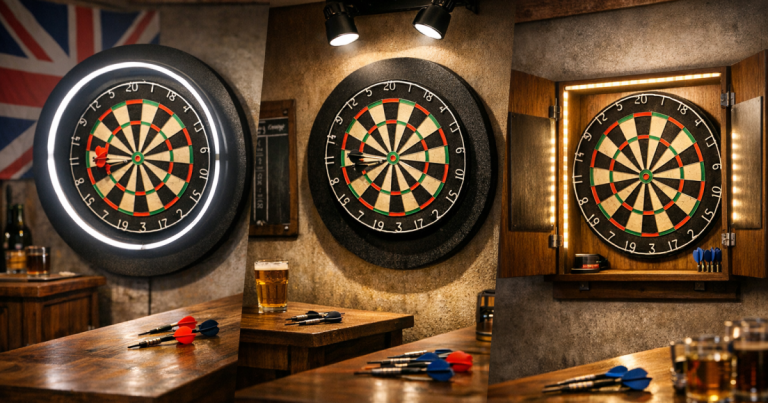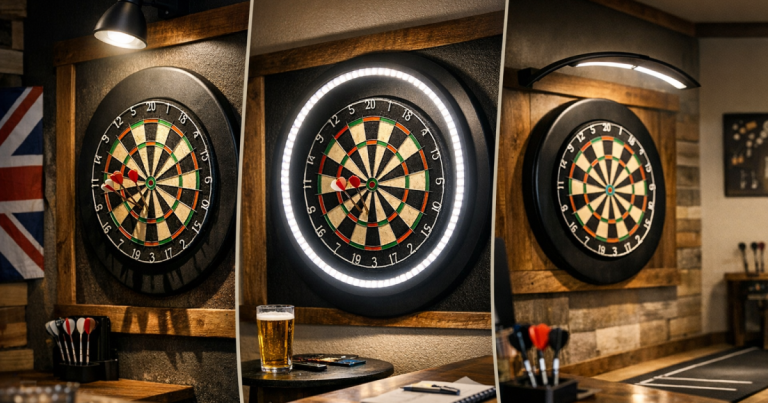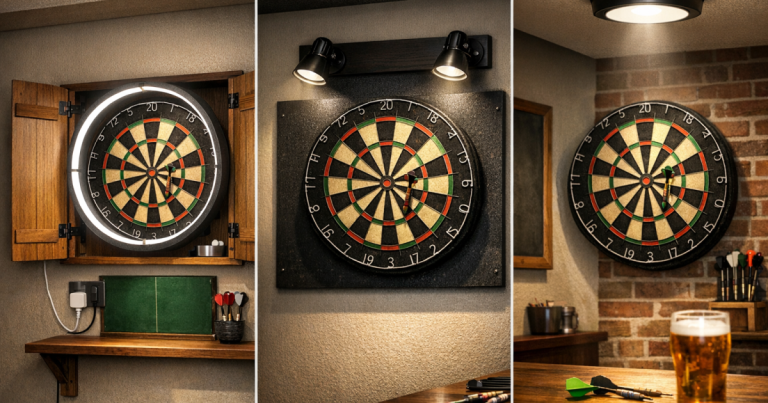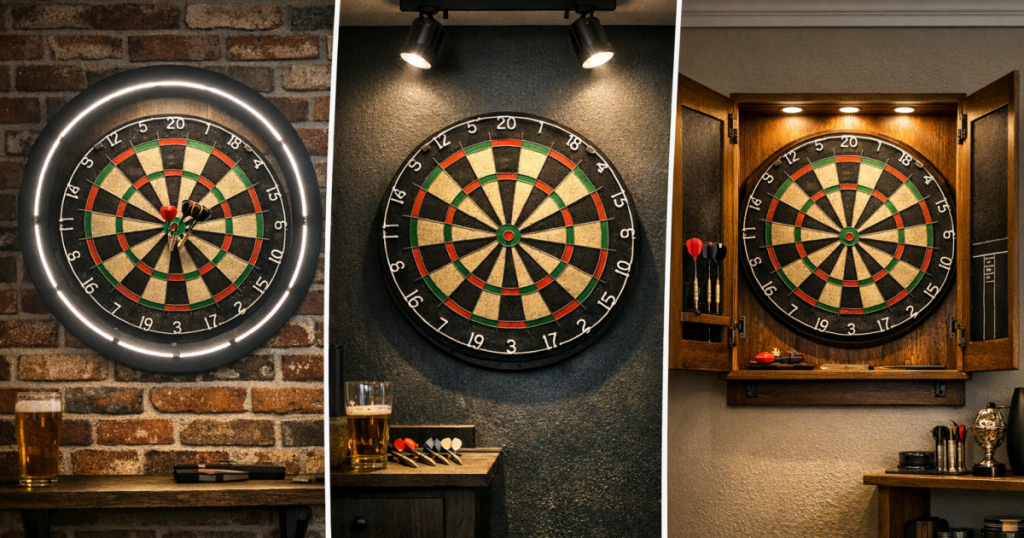
Good lighting makes a home board feel sharper, fairer and more enjoyable. The right dartboard lighting options reduce shadows across the treble bed, make scoring easier, and stop the room light from becoming part of the challenge. In a UK spare room, garage, dining room or converted office, the best setup is usually the one that gives even illumination without getting in the way of the throw, the surround, the cabinet doors or the people walking past.
Mains electrical work for permanent lighting, fused spurs, new sockets or ceiling fittings should be carried out by a qualified electrician to meet UK electrical safety requirements and the relevant BS 7671 wiring standards.
The short version
Most home players are trying to solve one of three problems: the board is too dim, the darts cast awkward shadows, or the setup looks untidy in a shared room. Ring lights usually give the most even coverage around a bristle board. Spotlights can work well in a larger room, but they need careful placement to avoid shadows and glare. Cabinet lighting is neat and traditional, but it is rarely as even as a purpose-made ring system.
- Choose a ring-style light if you want the simplest route to even board coverage.
- Use spotlights where the room layout supports them and you can aim the beam accurately.
- Consider cabinet lighting when appearance and storage matter as much as visibility.
- Check clearance around the board before adding any light, surround or cabinet.
- Avoid relying on a single ceiling pendant behind the thrower; it often creates the worst shadows.
Why darts lighting is different from ordinary room lighting
A dartboard is a small target with fine divisions. The bull, treble segments and doubles need enough contrast to read quickly, but the light should not be so harsh that it reflects off the wires or makes the white segments glare. The issue is not just brightness; it is where the light comes from.
A typical UK room might have a central ceiling light, downlights, wall lamps or a pendant over a dining table. These are designed for general use, not for illuminating a circular target at eye level. If the main light is behind the player, the throwing arm and darts can cast shadows across the face of the board. If the light is directly above the board, the upper half may look fine while the lower numbers sit in shadow.
The aim is even, front-facing illumination. A good setup lights the full board face, keeps the outer doubles visible, and does not dazzle the player at the oche. For a deeper step-by-step look at placement, beam direction and avoiding dark patches, the full dartboard lighting setup guide is a useful next read.
Ring lights: the most even solution for many home boards
Ring lights sit around the dartboard or around the board and surround, depending on the design. Their main strength is symmetry. Because the light comes from multiple points around the board, shadows are reduced from almost every throwing angle. That is why ring systems have become so common in serious home setups.
A ring light suits a bristle dartboard on a flat wall, especially where you have a surround already fitted. It can also be helpful in rooms with awkward ceiling lighting, because it reduces your dependence on the main room light. Examples of real systems in this category include the Target Corona Vision Dartboard Lighting System and the Mission Torus 270 Dartboard Light. Do not assume every ring light fits every board arrangement, though; check how it attaches, whether it needs a surround, and whether it leaves enough room for your cabinet, wall protection or scoreboard.
Where ring lighting works well
- Spare bedrooms and box rooms where ceiling lighting is not in the right place.
- Garage boards where the main light is too far away or too cold in tone.
- Serious practice setups where consistent visibility matters more than a furniture-style look.
- Shared rooms where you want the board to be playable without turning every room light on.
What to watch with ring systems
The main issue is clearance. Some ring lights project forward or sit close to the board edge, so you need to think about bounce-outs, wall protection and cabinet doors. If your surround is particularly thick or your board is already mounted inside a cabinet, measure the available space before assuming a ring will sit neatly around it.
Cable routing also matters. A dangling lead down the wall spoils an otherwise tidy setup and can be irritating in a living space. Many players use cable clips, trunking or a nearby socket arrangement to keep things neat, but avoid making permanent electrical changes yourself. For plug-in systems, keep the cable away from foot traffic and out of the throwing lane.
Spotlights: flexible, but less forgiving
Spotlights can look smart and can be very effective when placed correctly. They are common in garages, garden rooms, modern kitchens and multi-use spaces where the board shares the room with other activities. A pair of adjustable LED spotlights, aimed from in front of the board rather than directly above or behind the thrower, can create a clean playing area.
The trade-off is precision. One badly positioned spotlight can create a strong dart shadow over the scoring area. A narrow beam may make the bull bright while the doubles fade. A very bright beam can also cause glare on the wires, particularly if the room itself is otherwise dark.
Good spotlight habits
- Use more than one light source where possible, so shadows are softened rather than sharpened.
- Aim the light at the board face, not straight into the player’s eyes.
- Keep the beam broad enough to cover the full board and surrounding scoring area.
- Test from the actual throw line, not just from beside the board.
- Look at the board with darts already in it, because the darts themselves reveal shadow problems.
Spotlights make most sense when the room already has adjustable fittings or when you are planning a wider room upgrade. They are less convenient if you simply want a quick, board-specific improvement without changing the room.
Cabinet lighting: neat, traditional and room-friendly
A cabinet setup can make a dartboard feel more at home in a lounge, dining room or office. The doors hide the board when it is not in use, and many cabinets include scoreboards or storage for darts. Lighting can be added above, inside or near the cabinet to improve visibility without turning the wall into a dedicated practice bay.
The limitation is coverage. A small light mounted at the top of a cabinet can brighten the upper half of the board but leave the lower segments less clear. Side-mounted or under-shelf lights can help, but they still need testing for shadows. Cabinet doors can also interfere with wider ring lights, depending on how far they open and how much clearance there is around the board.
If you are working out whether a cabinet, surround or combined arrangement makes sense for your room, the guide to dartboard cabinets and surrounds covers the practical fit and room-planning side in more detail.
When cabinet lighting makes sense
- The dartboard is in a room where appearance matters between games.
- You want built-in storage for darts, flights, chalk or a marker.
- The wall needs protection but you prefer a furniture-style finish.
- The board is used casually and does not need a full practice-lighting setup.
For more regular practice, cabinet lighting can still be improved by adding a secondary light source. A neat wall-mounted picture light, an adjustable LED fitting or a discreet plug-in lamp can make the board more usable, provided it does not create glare or cast a heavy shadow over the lower numbers.
How the surround affects your lighting choice
A surround is not just wall protection. It changes the physical space around the board, which can affect how a light fits. Some ring systems grip, clip or sit around the edge of the surround. Others sit closer to the board itself. If the surround is oversized, unusually shaped or very soft, the light may not sit securely.
Colour also has an effect. A black surround can make the board face stand out clearly, while a very bright surround may reflect more light back into the player’s view. In most rooms this is a small issue, but it becomes more noticeable with strong direct lighting.
Before buying or fitting lighting, check the board diameter, surround depth, cabinet clearance and wall space as one combined setup. The dartboard surround size and fit guide is especially useful if you are balancing lighting with wall protection in a tight room.
Colour temperature and brightness without overcomplicating it
You do not need studio-grade lighting knowledge to set up a dartboard well. A neutral white LED is usually a safe choice because it gives good contrast without making the board look overly yellow or harshly blue. Very warm lighting can make the colours look muted, while very cool lighting can feel clinical in a home room.
Brightness is similar: enough to see every segment clearly, not so much that the board becomes uncomfortable to look at. If the light has different brightness levels, start in the middle and adjust after throwing for a few legs. The right setting is the one that lets you score quickly without noticing the light.
Try to avoid a huge contrast between the board and the rest of the room. A brightly lit board in an otherwise dark garage may look dramatic, but it can be tiring over a longer session. A small amount of background room light usually makes the setup feel more natural.
Room examples that change the answer
Small spare room
A ring light is often the neatest answer because it solves the main shadow problem without needing ceiling changes. Keep an eye on door swings, wardrobes and the distance between the oche and the wall. In a compact room, anything that projects too far forward can feel intrusive.
Garage or outbuilding
Garages often have a single batten light, which may be behind or above the thrower. A ring light gives reliable board coverage, while adjustable spotlights can work well if the room is being set up as a more permanent darts area. Consider moisture, dust and cable routing, and use equipment suited to the environment.
Living room or dining room
Appearance matters more here. A cabinet with discreet lighting can be a good compromise, especially for casual play. If you want stronger performance lighting, look for a setup that can be removed or visually softened when the board is not in use.
Dedicated darts corner
If the board stays up all the time, prioritise consistency. A ring light or well-planned multi-spot arrangement will usually beat a decorative single lamp. This is where even coverage, cable management and wall protection should be considered together rather than as separate afterthoughts.
Common lighting mistakes to avoid
- Mounting the board first and only thinking about lighting after the surround or cabinet is already in the way.
- Using one strong overhead light that throws dart shadows across the lower board.
- Choosing a light that blocks cabinet doors from opening properly.
- Letting cables hang near the oche or along a route people walk through.
- Making the board much brighter than the room, which can become tiring during longer practice.
- Ignoring how the setup looks when the board is not being used in a shared family space.
Key takeaways
For most UK home players, a ring light is the most straightforward way to get clear, even dartboard visibility. Spotlights are more flexible and can look built-in, but they need careful positioning. Cabinet lighting is tidy and room-friendly, though it usually needs extra help if you want practice-level illumination.
The best result comes from planning the board, surround, cabinet, oche and light as one setup. Check clearances, test for shadows from the throw line, and keep the wiring tidy and safe. When the lighting is right, the board is easier to read, the room feels better to play in, and you spend less time fighting shadows and more time focusing on the throw.